San Biagio Montepulciano: Visitor Guide to the Renaissance Church
Plan a visit to San Biagio below Montepulciano's walls: Sangallo's Renaissance plan, its unfinished tower, and what to see inside and out.
On this page
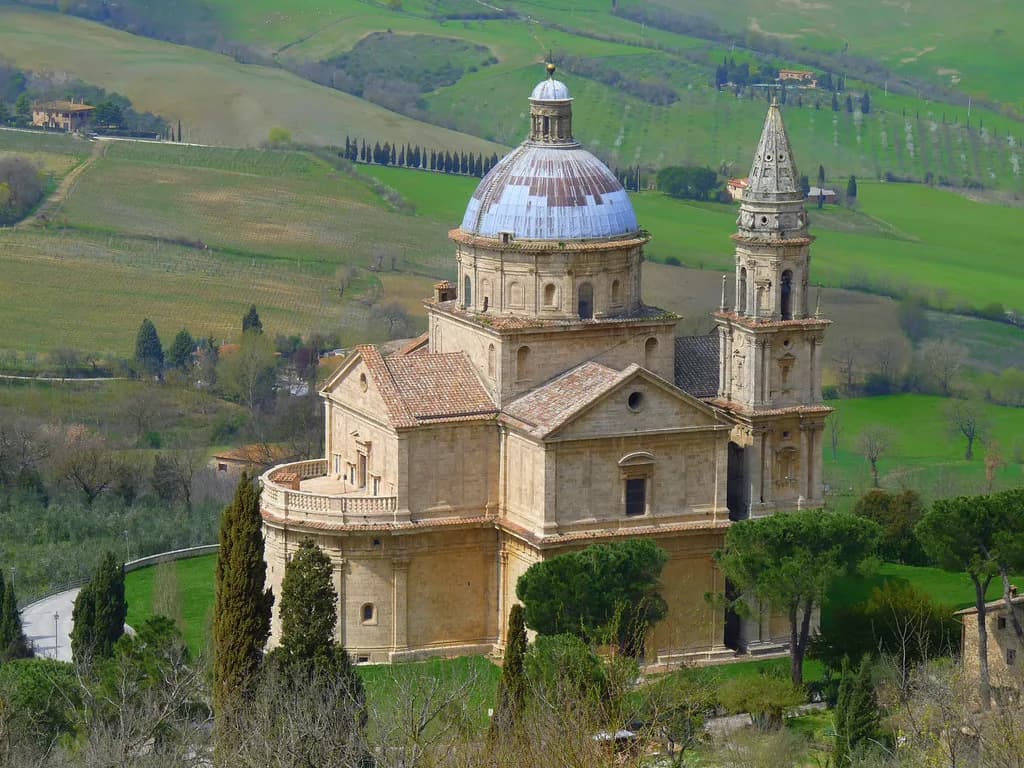
The Church of the Madonna di San Biagio stands just outside the walls of Montepulciano, below the ridge on which the town climbs. Its geometry is the first thing to notice: the whole complex, apart from the rounded apse, fits into a square that can be subdivided into smaller squares, which is the Renaissance idea of perfection made buildable.
This guide concentrates on the church itself rather than the town: how to read the exterior and interior, what was left unfinished, and how to pace a visit. Entry terms and hours are something to confirm before you go, since no reliable published statement of them was available for this guide. Further visitor details appear in Comune di Montepulciano - Sito istituzionale del Comune di Montepulciano.
Why San Biagio Matters in Renaissance Architecture
The church was begun in 1518 by Antonio da Sangallo the Elder and is counted among the first great examples of Cinquecento architecture. That date is history, not a current schedule: what you see today is a building that took roughly a century to complete and was never finished according to plan.
The driving idea was the centrally planned church, a form that preoccupied High Renaissance architects from Bramante to Michelangelo. A plan built from a square and a circle was thought to express perfection, because the human figure was understood to fit inside both shapes. San Biagio pursues that ideal more closely than most real churches, which usually compromised to accommodate a nave and a processional route.
That tension between theory and construction is the most interesting thing to hold in mind as you walk around. The building is not a museum piece frozen at a drawing stage; it is a working church where the ambition of the plan and the realities of funding and execution sit side by side.
Getting Your Bearings Below the Town Walls
Montepulciano occupies a narrow limestone ridge at about 605 metres above sea level, between the Valdichiana and the Val d'Orcia. The town is ringed by walls and fortifications designed by Antonio da Sangallo the Elder in 1511 for Cosimo I, and San Biagio lies outside that enclosure rather than within the historic centre.
Treat the approach as a descent from the town and a climb back up. No source consulted gives a verified walking distance or time, so plan by feel and add margin if you are carrying bags or travelling with children. The direction is simple: leave the centre, head downhill toward the open ground where the church stands, and keep the dome and towers in view as your reference.
Because the church sits apart from the streets of palazzi, it works well as either the first or the last stop of a day. Arriving early means quieter surroundings before the town fills; leaving it to the end means the climb back is the last effort before dinner rather than a preamble to a long walk.
Reading the Exterior: Three Facades and a Missing Tower
Walk around the building rather than stopping at the first elevation you meet. The central core is articulated by three flat facades that appear nearly identical, while the rounded apse occupies the lower part of the fourth side. That repetition is deliberate, part of the attempt to make a compact centralised volume read coherently from every direction.
Approach from the side with the rounded apse and then continue to the right to find what would have been the main facade. Two identical towers were planned here; one was completed, and the other stands as an incomplete structure. The asymmetry is not a quirk of restoration but a visible record of a project that ran short of the resources or will to finish.
The towers were meant to create a sense of directional axis pointing toward the apse. Standing between the finished tower and its unfinished partner, you can read the intention and the interruption in the same glance, which is arguably the single best architectural moment on the site.
Inside: Travertine, Vaults and Moving Light
The interior is a single open space and, at certain times of day, dramatic directional light falls through it. The symmetry is clearest when you notice the equal vaults on three sides, which reinforce the centralised plan rather than pulling you toward one end.
The whole interior is finished in travertine. Engaged columns and Doric or Tuscan pilasters divide and repeat the wall surfaces, while the arches carry strongly projecting rosettes. Look for those rosettes specifically: they are small details that reveal how carefully the classical vocabulary was applied to a building that never quite followed the textbook.
The architectural language refers back to ancient Rome, and the Basilica Aemilia in the Roman Forum has been cited as a model. You do not need the reference to enjoy the space, but knowing it explains why the detailing feels archaeological rather than merely decorative.
What Was Never Finished
Completion took about a hundred years and still fell short of the original design. The abandoned second tower is the most obvious evidence, but the plan as a whole was never realised in full, which changes the facade you actually see.
Rather than treating this as a disappointment, use it as a way of reading Renaissance building practice. Large church projects depended on patrons, money and time, and many stalled or changed course. San Biagio is unusual because the interruption is written into its most prominent feature.
A Short Glossary for the Visit
A few terms make the building much easier to read. A Greek cross plan has four arms of equal length; a centrally planned church organises its space around a middle point rather than a long nave; and a pilaster is a flattened column attached to a wall that orders the surface without carrying a freestanding load.
With those three ideas, the rest of the vocabulary follows. Engaged columns project partly from the wall, vaults are the arched ceilings you see repeated overhead, and travertine is the pale stone that gives the interior its unified tone. Using the terms as you walk will help you compare one facade to the next rather than admiring them in isolation.
Pairing San Biagio With the Town Centre
The town rewards a slow circuit after or before the church. The main square, Piazza Grande, is surrounded by major buildings including the Palazzo Pubblico and the cathedral, whose unfinished facade was begun in 1594 to a design by Ippolito Scalza. Several palazzi are attributed to Vignola, Sangallo and Peruzzi, so the centre reads as a compact Renaissance ensemble.
The cathedral, Santa Maria Assunta, deserves its own stop. It stands on the edge of Piazza Grande, keeps its medieval bell tower from the earlier church on the site, and contains works including a triptych of the Assumption painted in 1401 on the high altar.
If you want more church interiors after San Biagio, the town has several. Santa Maria dei Servi is one of the oldest, dating to the fourteenth century, and holds works by Sienese artists including Ugolino di Nerio; Sant'Agostino, founded in 1285, preserves a polychrome wooden crucifix attributed to Sangallo the Elder.
How Long to Allow, as a Suggestion
Nothing official sets a visit length, so treat any figure as a personal suggestion. A reasonable approach is to give the church itself a focused block of time for the exterior circuit and the interior, then add the downhill walk and the climb back separately, since the gradient is the variable most likely to surprise you.
If architecture is your main interest, allow more time outside than inside: the walk around the three facades and the unfinished tower is where the story is told. If you are visiting several churches in one day, keep San Biagio first, while your attention is fresh and the light is still changing.
Practical Planning: What to Confirm Before You Go
Entry terms, opening hours and any closure days are not published in a form this guide can verify, so check before making the church the fixed point of your day. The Comune's site carries current notices for Montepulciano and is a sensible starting point; the town's central telephone line is a fallback if you cannot find what you need online.
Do not assume that a paid interior elsewhere in Tuscany implies a ticket here, or the reverse. San Biagio is a pilgrimage church outside the walls, and its arrangements are best confirmed on site or by asking the parish directly rather than by analogy.
Practical access details such as the state of the path, step counts and parking are likewise unverified here. If mobility is a concern, ask before you set out or plan to view the exterior from the level ground near the church instead of committing to a full circuit.
Wine Country Context: Vino Nobile and the Val d'Orcia
Montepulciano is chiefly known for Vino Nobile, a red wine made primarily from Sangiovese, known locally as Prugnolo gentile, with at least 70 percent required and Canaiolo Nero making up 10 to 20 percent. It must age for two years, at least one of them in oak, or three years for a riserva, and it received DOCG status in 1980.
Note the naming trap: Vino Nobile di Montepulciano is not the Montepulciano grape used for Montepulciano d'Abruzzo. The wine zone sits between the Val d'Orcia and the Val di Chiana, running from Abbadia through Cervognano and Acquaviva toward Sant'Albino, which makes a cellar visit a natural afternoon extension of a church morning.
Plan Your Visit
San Biagio rewards a visitor who arrives knowing what to look for: the square-based plan, the three near-identical facades, the single completed tower, and the travertine interior with its equal vaults. Give it a deliberate circuit rather than a quick photograph, and the unfinished parts become the most memorable feature.
Build the rest of the day around the town: Piazza Grande, the cathedral, and a slow walk through the Renaissance streets. For wider context on what else is worth seeing in and around Montepulciano, browse the Montepulciano Attractions hub, and confirm entry terms with the Comune before you go.
Frequently Asked Questions
Where is the Church of San Biagio in Montepulciano?
It stands just outside the town walls, below the ridge on which Montepulciano is built. The walled centre, with Piazza Grande and the cathedral, sits above it, so visiting means walking down from the town and back up again.
Why is San Biagio considered a notable Renaissance church?
It was begun in 1518 by Antonio da Sangallo the Elder and pursues the centrally planned church ideal, with the complex fitting into a square apart from the rounded apse. It is counted among the first great examples of Cinquecento architecture, even though it was never completed to plan.
Is San Biagio free to enter?
Entry terms are not published in a form that can be confirmed here, so do not assume the church is free or ticketed. Check with the parish or the Comune before you travel, and treat any admission figure you see elsewhere as unverified.
How long does a visit to San Biagio take?
No official duration exists. As a suggestion, allow a focused block for the exterior circuit and interior, then add separate time for the downhill walk and the climb back to the centre, since the gradient is the main variable.
What should I look for inside San Biagio?
Look for the equal vaults on three sides, which reinforce the centralised plan, and the travertine surfaces throughout. Engaged columns and Doric or Tuscan pilasters divide the walls, and the arches carry strongly projecting rosettes worth seeking out.
Why does San Biagio have only one finished tower?
Two identical towers were planned on what would have been the main facade, but only one was completed. The other remains an incomplete structure, a visible record of a project that took about a century and still fell short of its design.
Can I combine San Biagio with Montepulciano's town centre?
Yes, and it is the usual approach. Pair the church with Piazza Grande, the cathedral of Santa Maria Assunta and the surrounding Renaissance streets, and if you want more churches, Santa Maria dei Servi and Sant'Agostino are both in the centre.
When is the best time to see the interior light?
The interior is illuminated by dramatic directional light at certain times of day, but no verified schedule describes when. Plan around the changing light during your visit rather than relying on a published window.
Sources
Continue exploring
More guides you'll find useful