Sant'Agostino Church, Montepulciano: Visitor Guide
A practical guide to Sant'Agostino in Montepulciano: the facade, the artworks worth slowing down for, and where the church fits in an uphill walk through town.
On this page
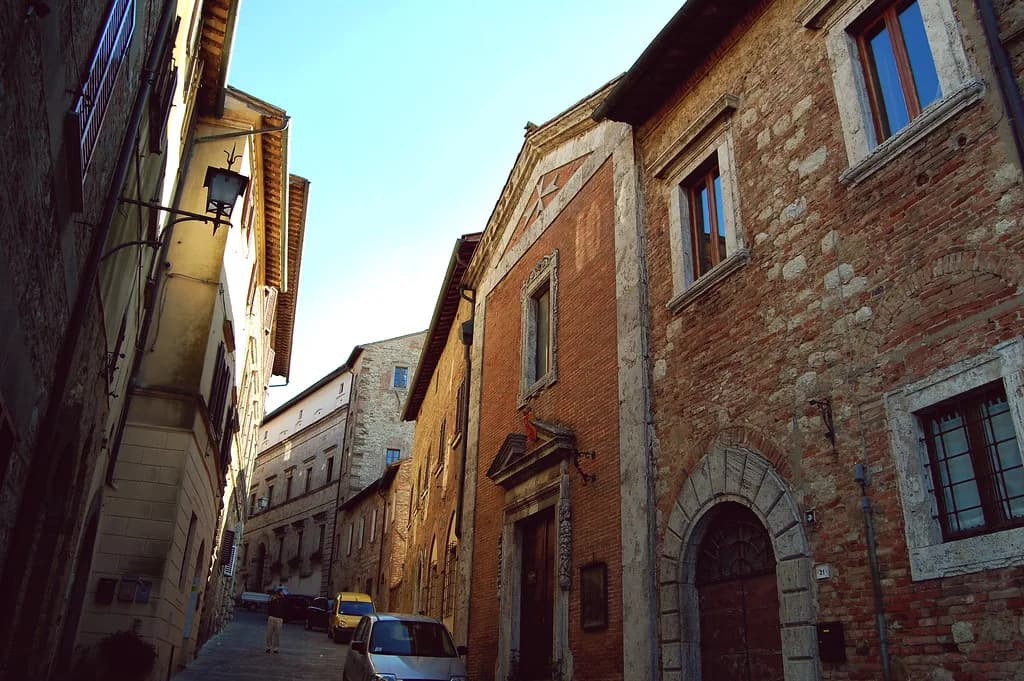
Most people arrive in Montepulciano through Porta al Prato and start climbing. Within the first stretch of the Corso, the street opens enough for a substantial church facade to register, and that building is Sant'Agostino. It is worth treating as more than scenery on the way to Piazza Grande.
The church sits on the lower main street, between the town gate and the main square, which makes it the natural first stop on an uphill walk. The organisation here is deliberately practical: what to look at, how long to allow, and what to compare it with farther up. For the wider set of sights, see the Montepulciano Attractions hub.
Where Sant'Agostino Sits on the Corso
Montepulciano's old town runs along one long ridge, and the main street changes name several times as it climbs from Porta al Prato to Piazza Grande. Sant'Agostino is on this lower stretch, which means you reach it early, before the steepest climbing and before the crowds around the main square. Its position makes it an easy add-on to any walk through town.
The old town is a restricted traffic zone, so the church is reached on foot rather than by car; one travel blog describes fines for driving past the zone signs even to turn around. If you are driving, park outside the walls and walk in. A self-guided walking route through Montepulciano is the most efficient way to link Sant'Agostino with the sights above it.
The Facade: Trecento Origins and a Renaissance Face
Sant'Agostino was founded in 1285, and the building you see today is a layered document rather than a single design. A Borgo Tre Rose church overview records the foundation date, while a Full Suitcase guide describes the exterior's travertine face as mixing Gothic and Renaissance elements and mentions Michelozzo in connection with the church. Treat the attribution as reported rather than settled.
Stand back across the street to read the proportions; the building's scale is easier to judge from a few metres away than from directly beneath the door. The same Borgo Tre Rose overview notes that the church was restored during the eighteenth century, completely modifying its original structure while leaving the artworks in place. Knowing this helps you separate the medieval foundation from the Renaissance face and the later restyling.
This is also the point where Montepulciano's street layout becomes clear: the town is one sustained incline, and Sant'Agostino is one of the first major buildings that rewards a pause. If you want the broader context of the town's historic centre, the Piazza Grande and Palazzo Comunale in Montepulciano visitor guide covers the upper half of the climb.
Cross the Street: the Pulcinella Bell Tower
Directly across from Sant'Agostino stands a bell tower topped by a mechanical wooden figure of Pulcinella, the character from Italian comic theatre. On the hour, he strikes the bell with a stick, and the small spectacle draws both visitors and locals. The figure's origin in Montepulciano is not fully explained; one theory links it to a seventeenth-century priest with Neapolitan connections, but the source presents this as uncertain.
Timing your pass for the hour is worth the small detour, and the best photograph is taken from farther up the hill looking back. The tower is a useful landmark if you are meeting someone on the lower Corso. It also pairs naturally with a stop at Sant'Agostino, since the two sit within sight of each other.
What to Look for Inside Sant'Agostino
The interior holds several specific works rather than a single headline piece. Above the entrance door is a terracotta relief depicting the Madonna with Saints John the Baptist and Augustine, and inside the church is a polychrome wooden crucifix attributed to Antonio da Sangallo the Elder. These are the two details most worth seeking out if you have only a few minutes.
The same overview notes a reliquary kept in the church, and the eighteenth-century restoration left the artworks in place while changing the interior's overall look. Look for the contrast between the older sculptural pieces and the later decorative scheme. If a work is covered or roped off, treat that as a conservation decision rather than a permanent state; ask locally if something you expected to see is missing.
The Eighteenth-Century Restyling and What It Changed
The church's history is one of adaptation: a medieval foundation, a Renaissance facade, and an eighteenth-century interior renovation. That sequence is why Sant'Agostino can feel like two buildings in one, with a Gothic-tinged exterior and a later interior. The restoration did not strip the church of its art, which is why the crucifix and the terracotta relief survive in the spaces you see today.
This layering is common in Tuscan churches, and comparing Sant'Agostino with Montepulciano's other churches helps you read the town's architectural history. For more on the churches that reward a detour, the hidden gems in Montepulciano guide covers quieter corners and less obvious stops. It is a useful companion if you want to build a church-focused walk rather than a single-street sprint.
Sequencing the Nearby Churches
Sant'Agostino is the first in a loose sequence of religious buildings along the climb. Farther up is the Chiesa del Gesù, a seventeenth-century church with paintings and stuccos by Sienese artists, and Santa Maria dei Servi, which holds works by Sienese painters including Ugolino di Nerio. Santa Lucia, a small Baroque church, is tucked away on its own street.
At the top of the town, the Duomo di Montepulciano (Cattedrale di Santa Maria Assunta) has a plain, unfinished brick facade and a notable triptych by Taddeo di Bartolo inside. Outside the walls and downhill, San Biagio is a separate excursion with its own character. For that church's practical details, see the San Biagio church Montepulciano visitor guide.
How Long to Allow and How to Slot It Into the Climb
A stop at Sant'Agostino takes a short amount of time if you are focused: the exterior, the terracotta relief over the door, and the crucifix inside can be seen in a brief visit. If you want to sit with the building and read the facade properly, allow a little longer. As a suggested framework, several travel blogs give the town as a whole around half a day, and the church fits naturally into that as the first stop; these are editorial suggestions, not official timings.
The single best piece of advice for Montepulciano is to wear proper shoes: several guides note the streets are cobbled and the route is uphill almost the entire way. If the climb is a concern, local shuttle services work the main street, and you can ride up and walk down. For a fuller sequence of stops, the self-guided walking route gives a structured order to the town.
Morning is generally the calmer time to start the climb, and late afternoon light is better for the upper viewpoints. The comune publishes current notices about events, road changes, and public works on its institutional site, which is worth checking before a visit if you are driving into town. Further visitor details appear in Comune di Montepulciano - Sito istituzionale del Comune di Montepulciano.
Free Churches Versus Ticketed Sites
There is an important distinction in Montepulciano between free-to-enter churches and sites with a separate charge. A Full Suitcase guide reports that the Palazzo Comunale charges a small fee for the terrace or the climb, and that San Biagio's admission includes an audio guide; those are separate from the churches along the Corso. Check current ticketing at each site rather than assuming one ticket covers a complex.
For Sant'Agostino specifically, admission and opening hours are not established in the sources reviewed here, so do not assume the church will be open at a particular time. Church hours in Italy often change with the season and around services, and a locked door is not unusual outside published times. Check locally or with the tourist information office in Piazza Grande rather than planning around a guessed schedule.
Suggested Half-Day Route Starting at Sant'Agostino
Enter through Porta al Prato, pause at Sant'Agostino, and cross the street to see the Pulcinella tower. Continue uphill along the Corso, stopping at the Chiesa del Gesù and Santa Maria dei Servi if they are open. Finish at Piazza Grande, where the cathedral, the well, and the Palazzo Comunale sit together.
If time allows, climb the Palazzo Comunale tower for the view and then walk down to San Biagio as a separate leg. That version turns a short visit into a fuller half-day. The full Montepulciano Attractions hub lists the sights in one place if you want to prioritise.
Beyond the town, the Val d'Orcia is the surrounding landscape that gives Montepulciano its setting, and it rewards a slower afternoon once the town walk is done. The hidden gems in Montepulciano guide is useful for choosing where to go next.
Plan Your Visit
Sant'Agostino earns its place on the walk not because it is the town's grandest church but because it is the first one you meet and the one that explains the town's layered building history. A short stop, properly timed with the Pulcinella bell, sets up the rest of the climb.
Confirm opening and any event closures locally before you go, wear shoes that handle cobbles, and treat the church as the opening move in a day that ends at Piazza Grande. For a route that ties the stops together, the self-guided walking route through Montepulciano is the practical companion.
Frequently Asked Questions
Is Sant'Agostino church in Montepulciano free to visit?
Admission is not confirmed in the available sources, so it is safer to treat the church as one whose entry conditions should be checked locally. Many churches in Montepulciano are entered without a ticket, but Sant'Agostino's current arrangements are not established. Ask at the tourist information office in Piazza Grande before you plan around it.
Where is Sant'Agostino located in Montepulciano?
It sits on the lower main street, the Corso, between Porta al Prato and Piazza Grande. You reach it early in the climb, before the route gets steepest. The Pulcinella bell tower stands across the street, which makes the church easy to spot.
What is there to see inside Sant'Agostino church?
The interior holds a polychrome wooden crucifix attributed to Antonio da Sangallo the Elder and a terracotta relief above the entrance showing the Madonna with Saints John the Baptist and Augustine. The building was restored in the eighteenth century, so the interior reads differently from the medieval exterior. These are the details worth seeking out if your time is short.
What is the Pulcinella statue and where is it?
Pulcinella is a character from Italian comic theatre, and a mechanical wooden figure of him tops a bell tower across from Sant'Agostino. On the hour he strikes the bell with a stick. The reason a Neapolitan character appears in a Tuscan town is not definitively explained; a seventeenth-century priest with Neapolitan ties is one theory.
How long does a visit to Sant'Agostino take?
A focused visit takes only a short time, especially if you look at the facade, the relief above the door, and the crucifix inside. Allow a little longer if you want to read the building carefully. The church works best as the first stop on a suggested half-day walk, rather than a destination on its own; the timing is editorial advice, not an official figure.
Should I stop at Sant'Agostino on the way up to Piazza Grande?
Yes, because it is directly on the route and costs little time. Stopping also gives you the chance to see the Pulcinella bell tower across the street at the hour. From there you can continue uphill to the Chiesa del Gesù, Santa Maria dei Servi, and Piazza Grande.
Sources
Continue exploring
More guides you'll find useful