Montepulciano Historic Centre: A Walking Orientation Guide
Orient yourself in Montepulciano's historic centre: how Il Corso climbs to Piazza Grande, where to start, steep gradients, parking and a half-day plan.
On this page
Montepulciano is built on a ridge, and that single fact decides how you should plan a visit. Almost everything in the walled centre sits along one climbing spine, so the route you choose at the bottom determines how much uphill walking you do. Understanding that shape before you arrive saves you from backtracking on cobbles.
The main street is the key to orientation. It starts near Piazza Savonarola and changes name several times as it climbs — Via di Gracciano, Via di Voltaia, Via dell'Opio and Via di Poliziano — before ending at Piazza Grande. Visitors who think they have left Il Corso have usually just crossed into the next name.
The Shape of the Town: One Street, One Hill
Montepulciano's centre follows the eastern ridge, with the Corso running from the lower end up to the summit square. The street is lined with tall, shuttered mansions, and it passes Palazzo Bucelli at number 73, whose facade is set with Etruscan urns and pots. That detail is easy to miss if you are watching your feet on the climb. The town's free public art and architecture can be absorbed on foot, while specific interiors and collections have their own entry conditions.
Because the town developed freely rather than to a single plan, it has an asymmetry that sharper Renaissance towns lack. Practically, this means the Corso is not a straight processional axis: it bends, narrows and shifts name as it gains height. Treat the walk as one continuous route rather than four separate streets.
Where to Start: Lower Gates or Higher Parking
There are two sensible starting strategies. The first is to begin at the bottom, at Piazza Savonarola near Porta al Prato, and walk up through the whole Corso so the town unfolds in order. The second is to park higher, see Piazza Grande first, and walk downhill — kinder on the legs but harder on the narrative, since you meet the summit before the approach.
Piazza Savonarola is guarded by a Marzocco lion, the Florentine symbol that marks how far Florentine influence reached. Beginning here puts the Etruscan, medieval and Renaissance layers in sequence as you climb. If you only have a short window, starting at the bottom and stopping wherever energy runs out is a reasonable compromise.
Walking the Corso: The Name Changes Explained
The street's changing names trip up plenty of first-time visitors. From Piazza Savonarola it runs as Via di Gracciano nel Corso, becomes Via di Voltaia nel Corso, then Via dell'Opio and Via di Poliziano before reaching Piazza Grande. Each stretch has its own character, but the direction is always uphill.
Landmarks arrive in a loose sequence. Sant'Agostino, with a Renaissance facade attributed to Michelozzo, sits along the main street and makes an easy pause. Further up, Caffè Poliziano occupies a restored Art Nouveau interior with a balcony view over the Valdichiana — a natural break before the final climb to the square.
As you walk, keep an eye out for the small workshops and wine shops that line the route. This is also where the wine-ordering confusion matters: Vino Nobile di Montepulciano takes its name from the town and is made mainly from Sangiovese, locally called Prugnolo Gentile, while Montepulciano d'Abruzzo is a different wine from a different region.
Gradients and Pacing: Cobbles, Steep Sections and the Shuttle
The old town is compact and walkable, but it is very steep from the bottom. Cobbles, narrow pavements and short flights of steps between levels make sturdy shoes worthwhile. If you have limited mobility or are travelling with someone who struggles on inclines, plan a shorter section rather than attempting the full climb.
A tourist shuttle, sometimes called the City Tour Bus or Bus Navetta, is described as running from the lower town to the top, though its schedule is seasonal. Confirm current operation, frequency and fares locally or through the town's own channels rather than assuming a timetable. The official town site is the place to check notices and any changes to services.
Piazza Grande as the Summit
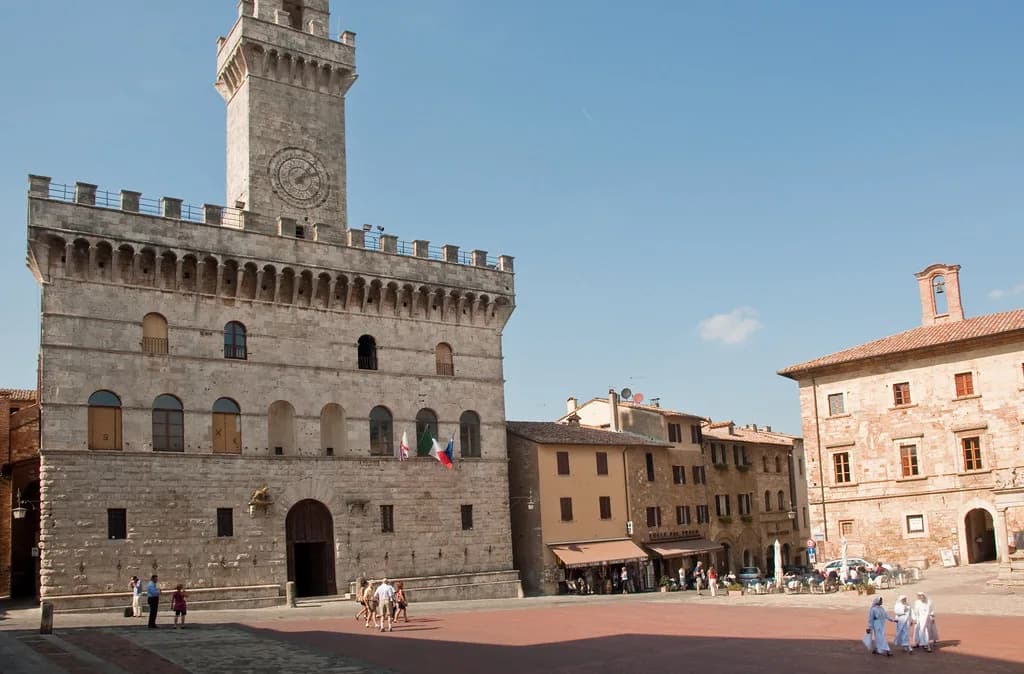
Piazza Grande gathers the town's main civic and religious buildings into one space at the highest point. Palazzo Comunale, a fifteenth-century town hall with a Florentine facade over Sienese crenellations, anchors one side; Palazzo Contucci, the sixteenth-century Sangallo mansion, faces it. The Duomo sits between them, its plain exterior hiding an altarpiece by Taddeo di Bartolo.
The square is also a working stage: it hosts summer festivals, open-air concerts and occasional film sets, and it stood in for Volterra in the Twilight films. If you want the tower views from Palazzo Comunale, check access and any charges on site or through the town's pages before building your day around them.
Beyond the Walls: Tempio di San Biagio
San Biagio sits just below the walls at the end of a cypress-lined avenue, and it is easy to slot in wrongly. Begun in 1518 to a design by Antonio da Sangallo, the domed travertine church is one of the most accomplished Renaissance buildings in Tuscany. Many visitors treat it as either the first or last stop of the day, since it lies outside the climb.
Parking near San Biagio puts you below the historic centre, from where the walk into town is short but steep. Deciding whether San Biagio opens or closes your route depends on where you leave the car. If you park there, start with the church and climb; if not, save it for a downhill finish.
ZTL and Parking: Where Cars Stop
Montepulciano operates a ZTL, a restricted traffic zone, and traffic is essentially banned inside the walls. Plan to leave the car outside and walk in, allowing extra time for the final stretch on foot. Signs mark the boundary, so read them before you commit to a street.
Car parks sit at the eastern end of town near Porta al Prato, and there are options around the wider centre. Conditions, charges and seasonal rules change, so check signage or the town's own services pages on the day rather than relying on older advice about which square is free.
Half-Day Versus Full-Day Structure
A suggested half-day, with lunch or dinner, is enough for the Corso, Piazza Grande and one cellar tasting. Allow roughly six hours if you want landmarks, a wine stop and a relaxed pace — this is a suggestion, not an official timetable. Visitors with less time often cover the main street and the square only.
A full day allows San Biagio outside the walls, a longer look at the churches along the street, and a proper tasting. Adding Pienza, roughly a short drive away, works well as a second half-day rather than being crammed into the same morning. Pairing the two is one of the most common ways to use a day in southern Tuscany. For wider planning, see One Day in Montepulciano.
Cellars, Tastings and the Pace of the Walk
Many of Montepulciano's wine cellars sit beneath Renaissance palazzi, so a tasting is also a piece of architecture. Contucci, on the main square, combines a historic palace with cellar tours, while Ercolani and De' Ricci are known for underground spaces. A tasting adds time, and often a booking, so decide before you start how many stops you want.
Some cellars accept walk-ins while others prefer reservations, particularly for guided tours. Since policies vary by producer, contact the winery directly or ask at the shop rather than assuming a fixed rule. Build in slack if a tasting matters to you, and keep the morning lighter when a cellar visit is planned.
Footwear, Water and Timing the Climb
Comfortable shoes matter more here than in flatter Tuscan towns, and water is worth carrying on warm days. The climb is short in distance but steady in gradient, and the sun hits the exposed upper street. Early mornings and late afternoons are gentler for walking, while summer middays are hot and busy.
Check current opening hours for churches, museums and the tower before you go, since these vary by season and are not fixed year-round. The town's official site publishes events and service notices, which is the most reliable place to confirm anything time-sensitive.
Plan Your Visit
Treat orientation as a route decision: climb from Porta al Prato for the full sequence, or park higher and descend if knees or time are short. Leave the car outside the ZTL, wear shoes that handle cobbles, and confirm shuttle operation, opening hours and any charges before you arrive.
With the shape of the town clear, the walk becomes simple: follow the Corso through its name changes, pause where something catches your eye, and let Piazza Grande be the summit. San Biagio, the cellars and Pienza then slot in around that spine rather than competing with it.
Frequently Asked Questions
How steep is the walk through Montepulciano's historic centre?
The old town is compact but very steep from the bottom, with cobbles and short flights of steps between levels. The main street climbs continuously to Piazza Grande. Sturdy shoes help, and a seasonal shuttle is described as running from the lower town to the top if you would rather skip the climb; confirm its current operation locally.
Where should I start a walk through Montepulciano old town?
Start at Piazza Savonarola near Porta al Prato to follow the Corso uphill in sequence, or park above and begin at Piazza Grande if you prefer to walk downhill. The second option is easier on the legs but means you meet the summit before the approach.
How long do you need to see Montepulciano's historic centre?
A suggested half-day with a meal covers the Corso, Piazza Grande and one tasting; allow around six hours for a relaxed version with landmarks and a wine stop. This is a suggestion, not an official itinerary. Add time for San Biagio outside the walls or a Pienza side trip.
Can you drive into Montepulciano's historic centre?
No. A ZTL restricts traffic inside the walls, so plan to park outside and walk in. Car parks sit near Porta al Prato and around the wider centre. Charges, seasonal rules and conditions change, so check signage or the town's own pages on the day.
Does the main street in Montepulciano change name?
Yes. The Corso runs as Via di Gracciano, Via di Voltaia, Via dell'Opio and Via di Poliziano before reaching Piazza Grande. Each stretch is part of the same climbing route, so you have not left the main street when the name changes.
Is Montepulciano worth visiting as a half-day stop?
Yes, if you focus on the historic centre. The compact Corso, Piazza Grande and one cellar tasting fit a half-day with a meal. Adding San Biagio or Pienza justifies a longer stay, but the core sights do not require a full day.
Sources
Continue exploring
More guides you'll find useful