Palazzo Comunale San Gimignano: Museo Civico & Torre Grossa Guide
Plan a visit to San Gimignano's Palazzo Comunale: the Sala di Dante, Lippo Memmi's Maestà, the Pinacoteca, and how the civic ticket connects to Torre Grossa.
On this page
The Palazzo Comunale is not a town hall you tour around the business of local government; it is the historic seat of San Gimignano's civic museums, standing on Piazza del Duomo at the centre of the towered town. Its most quoted room is the first-floor council hall, known as the Sala di Dante in memory of the poet's 1299 visit to San Gimignano as an ambassador of the Guelph league. That detail alone tells you what kind of visit this is: rooms where civic power and civic art were deliberately displayed together.
Budget for a slow hour or more inside the palace, longer if you intend to climb the Torre Grossa and linger over the tower view. The fresco rooms are small and reward reading before looking, so the practical advice is to start on the first floor and work upward rather than rushing to the tower first.
Where the Palazzo Comunale Sits
The palace faces Piazza del Duomo, the upper square lined with the town's tallest tower-houses, and Piazza della Cisterna is a short walk away. San Gimignano has appeared on the UNESCO World Heritage list since 1990 as an outstanding example of medieval town planning, and the two squares are the clearest place to see why. Approaching from the Via Francigena axis, which runs through town from Porta San Matteo to Porta San Giovanni, you arrive at the civic heart rather than a suburban edge.
Treat the palace as one stop in a compact walking loop rather than a separate excursion. The Collegiata di Santa Maria Assunta rises on the same square, and Sant'Agostino and the Rocca di Montestaffoli are each a short stroll beyond it. That density is the argument for giving the civic museum a full slot instead of squeezing it between churches.
The Building: A Palace of Civic Power
Construction of the Palazzo Comunale is dated to 1288, and the destination site notes it became the seat of the comune in 1337. The facade carries lowered-arch windows in squared stone and a balcony on old corbels where the podestà addressed the crowd below. Look up at that balcony before you go in: it explains why the interior rooms are arranged as a stage for governance.
The building is also called Palazzo del Popolo or Palazzo Nuovo del Podestà, and it rises on two main floors above the square. That compressed plan matters for visitors, because the collections, the frescoed council rooms and the route toward the tower all follow one upward sequence rather than branching into separate wings.
First Floor: The Sala di Dante and Lippo Memmi's Maestà
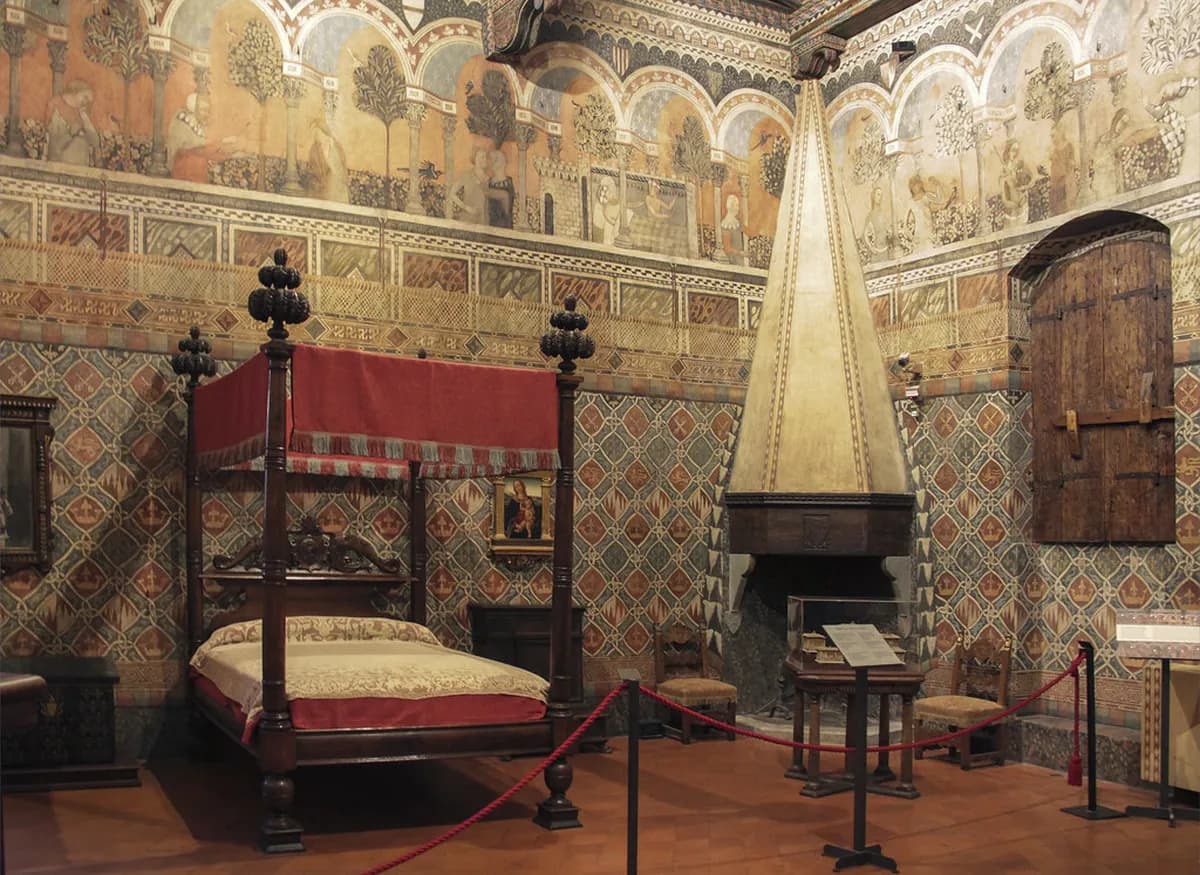
The first-floor council room is the Sala di Dante, named for the Florentine poet's 1299 embassy on behalf of the Guelph league. Around the walls runs a fresco cycle painted by Azzo di Masetto around 1290, with hunting scenes and a tournament dedicated to Charles of Anjou. The coats of arms of French families who fought at Campaldino under Charles II of Anjou fill the rest of the room, so the decoration is a record of alliances as much as an image gallery.
The room's focal work is Lippo Memmi's Maestà of 1317, showing the Virgin as protector of the city and as the inspiration for good government, commissioned by the Sienese captain Nello di Mino de' Tolomei. It follows the model Simone Martini had painted in Siena's Palazzo Pubblico two years earlier, which is why the painting reads as a political statement repeated in a smaller town. The adjoining Sala delle Adunanze segrete, used by the city government, still holds its old inlaid wooden benches. Further visitor details appear in Palazzo Comunale - San Gimignano.
Second Floor: Memmo di Filippuccio's Warning Frescoes
The Camera del Podestà on the second floor holds frescoes by Memmo di Filippuccio painted between 1303 and 1310, depicting the positive and negative outcomes of a young man's amorous initiation. The scenes include Aristotle infatuated with the courtesan Phyllis, a deliberately humiliating image of a philosopher undone by desire. They were placed in the podestà's own chamber as a warning that he should not be distracted from his institutional duties.
Knowing this changes how you look at them. These are not decorative idylls but a moral briefing for the man running the town, which is why it is worth pausing in this room after the ceremonial grandeur of the Sala di Dante. The two floors together form a sequence about good and bad government, not a random anthology of frescoes.
The Pinacoteca: Siena to Florence in One Gallery
The picture gallery on the same upper level traces the town's artistic commissions from the late 1200s onward, with Florentine works by Coppo di Marcovaldo and Sienese pieces by Rinaldo. The fourteenth century is represented by Taddeo di Bartolo, Lorenzo di Niccolò and the so-called Master of 1419, before Florentine painters take over. Benozzo Gozzoli, Filippino Lippi and Sebastiano Mainardi carry the collection into the Renaissance. Further visitor details appear in Civic Museum and Town Hall - Fondazione Musei Senesi.
The sequence ends with Pinturicchio's great altarpiece of 1511, an Assumption of the Virgin with Saints Gregory the Great and Benedict, showing a young Madonna above a delicate landscape. Reading the gallery as a shift from Sienese to Florentine patronage gives the rooms a narrative that individual labels can obscure. If your time is short, prioritise the Sala di Dante and this final altarpiece, then let the middle rooms fill whatever remains.
The Torre Grossa Connection
Access to the Torre Grossa runs from the Pinacoteca, so the climb is not a separate attraction you enter from the street. The tower was erected between 1300 and 1311 and stands 52 metres high beside the Palazzo del Podestà; its name means the fat tower, and it remains the symbol of the city's medieval might. From the top, the panorama covers the rooftops and the Valdelsa countryside out toward the Pistoia mountains and the Apuan Alps.
Decide about the climb before you start the gallery, because it changes your pace and how much you linger downstairs. Older listings mention a higher rate for a reserved tower access time, but those figures are undated, so confirm the current arrangement when you buy rather than relying on a remembered surcharge. Narrow historic stairways also mean the climb suits anyone comfortable with enclosed steps and heights.
Tickets: Civic Museums Versus the Collegiata
The civic circuit covers the Palazzo Comunale with the Pinacoteca and Torre Grossa, the Santa Chiara complex, and the church of San Lorenzo in Ponte. The Collegiata complex, with the Duomo and its Museum of Sacred Art, is a separate ticket scope even where a combined pass exists. Do not assume one purchase opens every church and collection in town; check which sites each ticket names before paying.
Older listings quote a full price of ten euros for the civic museums and eight euros reduced, with eleven euros for reserved Torre Grossa access, plus a fifteen-euro all-inclusive pass and a twelve-euro reduced version valid three days. Those figures appear in undated material and should not be treated as today's prices. The reliable move is to check the official museum site or ask at the ticket office before you commit, especially for the reduced categories.
The San Gimignano Pass, Honestly Explained
The San Gimignano Pass bundles the civic museums with the Collegiata complex, and the official museum site lists a full rate of fifteen euros, a junior rate of twelve euros for ages 6 to 17, and a one-euro advance-sale fee, with three-day validity. The same site states that the pass will not be purchasable between 11 January and 28 February 2027, a reminder that pass conditions change with the calendar. Treat any validity period as something to reconfirm for your own dates rather than a permanent guarantee.
The pass is worth calculating only if you genuinely plan to visit both the civic circuit and the Collegiata, since buying twice may suit a shorter stay. Free and reduced categories depend on documents presented at the local ticket offices, so bring proof if you expect a concession. Museum opening hours shift seasonally on the Senesi listing, and closures around Christmas are noted there, so verify the day you plan to visit.
Practical Tips for the Visit
Go early in the day if you want the fresco rooms before the tower queue builds, and save the climb for last so you are not rushed through the gallery. The tower route involves historic stairways, and the museum does not publish detailed accessibility guidance for them, so ask at the ticket desk if stairs or enclosed spaces are a concern. Carry water in warm months, since the upper floors and tower are not a place to linger on a hot afternoon.
Booking is handled through the museum contact channels listed on the official sites, but the sources do not establish that advance booking is required for individual visitors. If your group is large or you need a specific time slot, contact the booking line rather than assuming walk-in availability. Read the room panels before looking up: the frescoes make far more sense once you know which podestà or council they were meant to instruct.
Nearby Pairings on a Short Loop
After the palace, cross Piazza del Duomo to the Collegiata, then walk down to Piazza della Cisterna for the well and the surrounding tower-houses. Continue to Sant'Agostino and finish at the Rocca di Montestaffoli, whose terrace gives an open view back over the towers without a climb. That loop covers the civic core, the main church and the town walls in a single unhurried half-day.
The town's compactness is both its pleasure and its trap: it is easy to over-schedule churches and arrive at the Palazzo Comunale tired. If you only have one day, put the civic museums first and treat the rest as a walk between squares. The official town site publishes current notices on access and local restrictions, which is worth a glance if your visit falls near a public holiday or civic event.
Plan Your Visit
The Palazzo Comunale works best when you treat it as a sequence: the council hall and its Maestà, the podestà's warning frescoes, the gallery's Siena-to-Florence arc, and finally the tower if you want the view. Check current prices, seasonal hours and pass conditions on the official museum channels before you travel, because the undated listings you find elsewhere may mislead.
Build the rest of your day around the two squares rather than across town, and leave room for the Collegiata if you intend to buy the combined pass. The slow version of San Gimignano is a short walk with long pauses, and this palace is the place to take the longest one.
Frequently Asked Questions
What can you see inside the Palazzo Comunale in San Gimignano?
The palace houses the civic museums across its main floors. On the first floor is the Sala di Dante with Azzo di Masetto's hunt and tournament frescoes and Lippo Memmi's Maestà of 1317. The second floor holds Memmo di Filippuccio's Camera del Podestà frescoes and the Pinacoteca, whose collection runs from thirteenth-century Sienese and Florentine works to Pinturicchio's 1511 altarpiece. The Torre Grossa climb is reached from the gallery.
Is the Torre Grossa included with the Museo Civico ticket?
Access to the tower runs through the Pinacoteca, so it sits inside the same civic museum route rather than being a separate street entrance. Older listings mention a higher rate for a reserved tower access time, but those figures are undated. Confirm the current ticket structure and any time-slot arrangements at the official museum site or ticket office before you buy.
What is the Sala di Dante and why is it named after Dante?
It is the ancient council room on the first floor of the Palazzo Comunale. It is called Sala di Dante in memory of the poet's visit to San Gimignano in 1299 as an ambassador of the Guelph league. The room's decoration, including Lippo Memmi's Maestà of 1317, was designed to express civic pride and good government.
Does the San Gimignano Pass cover the Palazzo Comunale and the Collegiata?
The pass is designed to bundle the civic museums with the Collegiata complex, which is why it can be better value than two separate purchases for a full day. The official museum site also notes a future period when the pass will not be sold, so check its availability and validity for your dates. Do not assume a single pass covers every church and collection in town.
How long should you spend at the Palazzo Comunale?
Allow at least an hour for the fresco rooms and the Pinacoteca, and more if you intend to climb the Torre Grossa and spend time on the view. The fresco sequence is best read slowly, so a rushed twenty minutes undersells the visit. The tower climb adds time and energy, so decide before you start the gallery whether you will go up.
Do you need to book the Torre Grossa climb in advance?
The sources consulted do not establish that advance booking is required for individual visitors. Booking enquiries go through the museum contact channels, which is the right place to ask if you need a specific time or are travelling as a large group. Check the official museum site close to your visit rather than relying on older listings.
Sources
Continue exploring
More guides you'll find useful