San Gimignano Collegiata: Frescoes, Tickets and Timing
Plan a visit to San Gimignano's Collegiata: the frescoes worth your time, how its ticket differs from the Civic Museums pass, and how long to allow.
On this page
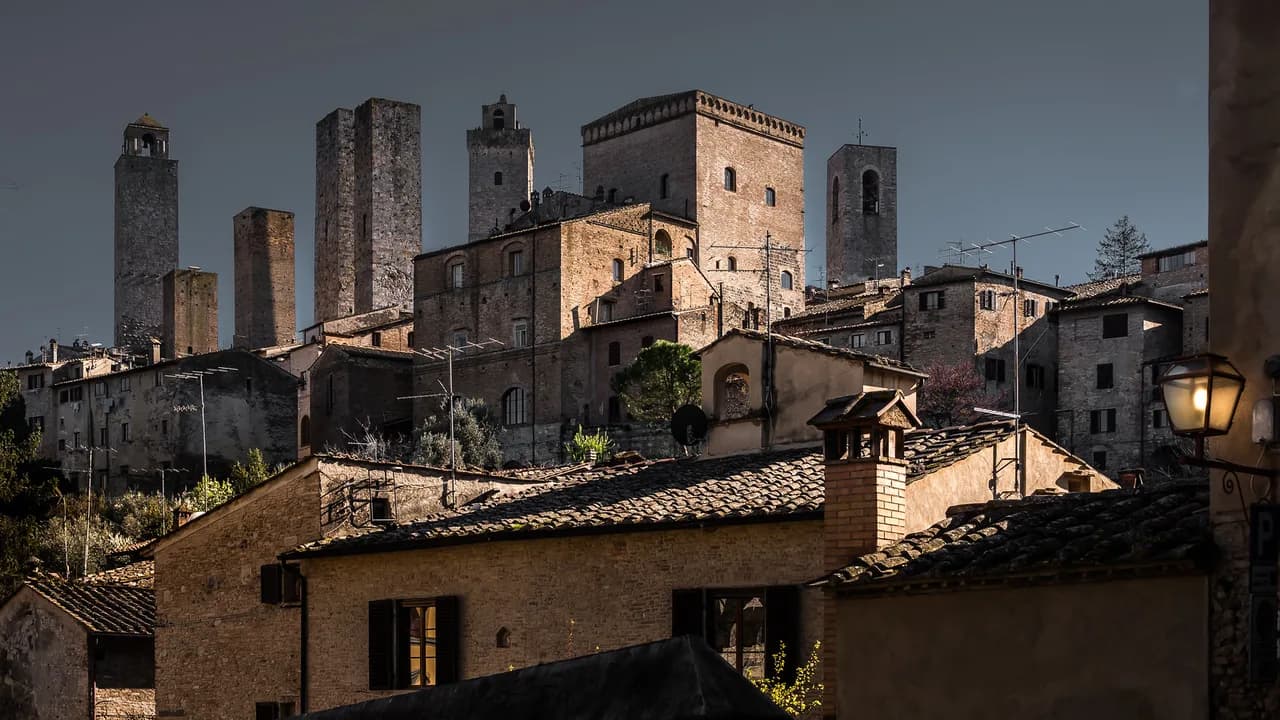
The Collegiata di Santa Maria Assunta sits at the top of Piazza del Duomo in San Gimignano, its bare stone facade giving little away. Inside, however, walls and vaults are almost entirely covered with fresco cycles, making it one of Tuscany's most consistently painted interiors. It is commonly called the Duomo, a lofty name for what remains a collegiate parish church.
What makes the Collegiata especially interesting is that it holds two distinct painting traditions: the Sienese narrative cycles on the nave walls and Ghirlandaio's Florence-inflected chapel nearby. You can see both in a single room, which is rare enough to justify building a visit around it. The church also carries a layered history, from its 1148 consecration to wartime damage and later restoration.
This guide explains where to look first, why the building's facade is plain, and how its ticket sits apart from the Civic Museums pass. It also covers the operator's seasonal opening periods and a suggested, clearly non-official visit duration.
What the Collegiata Is
The Collegiata is a Roman Catholic collegiate church and minor basilica dedicated to Santa Maria Assunta. A pope raised it to minor basilica status in 1932, and it belongs to the archdiocese of Siena-Colle di Val d'Elsa-Montalcino rather than functioning as a cathedral. It stands at the top of a wide staircase on the western side of Piazza del Duomo.
The building's history is one of accretion rather than a single design. It was perhaps erected in 1056 and certainly consecrated on 21 November 1148 in the presence of Eugene III and fourteen prelates, a detail recorded on a plaque in the facade. It was restructured in 1239 and then substantially enlarged from 1460 by Giuliano da Maiano, who lengthened the crossing and presbytery and added two chapels. Further visitor details appear in Discover Collegiata di Santa Maria Assunta - Goparoo.
That long building campaign matters for visitors because the interior is not a single uniform space. The bare stone front, the vaulted naves, and the Renaissance east end all belong to different phases, and knowing this makes the frescoes easier to read as part of the architecture rather than decoration applied to it.
Orientation and the Bare Facade
The most striking thing about the exterior is how plain it is compared with the interior. The facade was never given a finished architectural front, and the two side doors and circular windows were added later. Its austerity is partly a choice: in a wealthy town, the money clearly went inside.
There is also a structural reason. Between 1192 and 1231, during the tenure of the proposto Lamberto, the church's orientation was rotated so that its main entrance faced the square carrying the via Francigena. The new facade was built where the old apse had stood, which means the wide staircase was built to meet a street and a market rather than to compose a grand front. Further visitor details appear in Discover Collegiata di Santa Maria Assunta - Goparoo.
When you arrive, pause at the top of the steps and look back across the square before entering. The relationship between the facade and the street is the key to understanding why the church looks the way it does. Entry is via the side stairs and through a loggia that originally served as a baptistry, according to Lonely Planet's attraction entry.
Tickets and What They Cover
The Collegiata and the Museo d'Arte Sacra are ticketed as part of a complex separate from the Civic Museums, which include Palazzo Comunale, the Pinacoteca and the Torre Grossa. The operator's site lists a combined San Gimignano Pass that includes both the Civic Museums and the Collegiata complex, with a notice that the pass will not be purchasable from 11 January to 28 February 2027. Check current prices and pass availability directly with the operator before you travel, because this notice reflects the page at the time of writing.
The Collegiata and the Museo d'Arte Sacra share a separate ticket from the Civic Museums, so buying a Civic Museums ticket will not get you into the church. A joint ticket covering the Collegiata and Museo d'Arte Sacra appears in older third-party listings, but treat any figure from those pages as historical rather than current.
Do not rely on older guidebook prices. Admissions and pass structures change, and a third-party page may quote figures that no longer apply. The operator's booking and info point pages are the place to verify the current entry arrangements.
The Nave Frescoes: Two Cycles, Two Walls
Once inside, face the altar and look left. On the south wall are scenes from Genesis and the Old Testament by Bartolo di Fredi, painted around 1367, running in tiers from the creation through Noah, Joseph and Moses to the story of Job. On the opposite north wall are New Testament scenes by the workshop of Simone Martini, probably led by Lippo Memmi, completed in 1336, beginning with the Annunciation and moving through the life of Christ. Further visitor details appear in Collegiata di Santa Maria Assunta | San Gimignano, Italy | Attractions - Lonely Planet.
Reading the two walls side by side lets you compare styles within a single room: the Sienese narrative mode on both sides, but by different hands and two generations. Start with the upper tiers, which usually suffer least from glare and crowds, and work downward.
Some of these scenes were damaged in the Second World War and have been restored, so what you see is conserved and reintegrated rather than untouched medieval surface. That is part of the building's story, not a reason to skip it.
The Counter-Facade: Last Judgement and Gozzoli
The inside wall of the front facade carries Taddeo di Bartolo's Last Judgement, with Heaven depicted on the upper left and Hell on the upper right. Beneath it is Benozzo Gozzoli's Martyrdom of Saint Sebastian, dated 1465, framed by painted saints and a Crucifixion group. Further visitor details appear in Collegiata di Santa Maria Assunta (San Gimignano), interno.
On the same wall, on either side, stand the wooden figures of the Annunciation by Jacopo della Quercia, carved in 1421 and painted later in the 1420s. These sculptures are easy to miss if you focus only on the frescoes, so look down and to the sides after taking in the Last Judgement. Further visitor details appear in Collegiata di Santa Maria Assunta (San Gimignano), interno.
The Chapel of Santa Fina: Ghirlandaio's Florentine Contrast
The Chapel of Santa Fina is the most architecturally self-conscious space in the church, and it holds the frescoes by Domenico Ghirlandaio depicting the life of one of the town's patron saints. Its Florentine, architectural character contrasts sharply with the Sienese narrative painting in the nave, which is why the chapel rewards a slower look. Further visitor details appear in Discover Collegiata di Santa Maria Assunta - Goparoo.
Because the chapel was part of Giuliano da Maiano's Renaissance extension from 1460, you are seeing two schools and two generations almost side by side. Spend a few minutes comparing the chapel's clarity and perspective with the more crowded medieval cycles in the nave.
The chapel's frescoes appeared in Franco Zeffirelli's 1999 film Tea with Mussolini, a curious footnote that sometimes draws visitors who would not otherwise seek out the church. It is a reminder that the interior has had a life beyond its religious function. Further visitor details appear in Collegiata di Santa Maria Assunta | San Gimignano, Italy | Attractions - Lonely Planet.
Reading the Building's History
The church began as a pieve, possibly outside the walls, and was moved inside as the town grew in importance. The rebuilt church was consecrated in 1148, restructured in 1239, and given vaults over the naves in the 14th century, which provided the overhead surfaces the painters later covered.
The reversal of the church's axis in the 13th century is the single most interesting decision in its fabric. Demolishing the liturgical east end and rebuilding the entrance there was done for civic and commercial reasons, because the pilgrim road and market were on that side. It explains both the plain facade and the wide staircase.
Damage in the Second World War and repeated restoration campaigns have left a surface that reads as continuous medieval painting but is partly conserved and reintegrated. Appreciating that layering is part of visiting the building well.
Practical Pacing and Opening Periods
The operator publishes seasonal opening periods for the Duomo and Museo d'Arte Sacra, with last entry half an hour before closing. Closures are listed for 15–31 January, 12 March, 15–30 November, 25 December and 1 January. Because the operator warns that hours can change for services, confirm on the day if timing matters, as the official site states seasonal times. Further visitor details appear in Duomo di San Gimignano - cattedrale collegiata museo arte sacra san gimignano.
As an editorial suggestion, allow about 45 to 60 minutes for the church alone, and longer if you also visit the Museo d'Arte Sacra. This is not official guidance, but a practical allowance for reading the nave cycles, the counter-facade and the chapel without rushing.
Sequence your day by ticket scope rather than by queue order. If you hold a combined pass, plan the Collegiata and the Civic Museums as two separate blocks, and leave the tower climb for when you are fresh rather than squeezing it between frescoes.
Access Notes and What to Verify
Because entry is via side stairs and a former baptistry loggia, the main door is not always the way in. The sources consulted here do not confirm step-free access or specific provisions for visitors with reduced mobility, so check with the operator before travelling if stairs are a concern. Further visitor details appear in Collegiata di Santa Maria Assunta | San Gimignano, Italy | Attractions - Lonely Planet.
The operator's pages reviewed here do not state whether an audio guide comes with every admission. Treat claims to the contrary with caution and ask at the info point or by phone when you book.
For current civic notices, including any temporary closures or traffic changes in San Gimignano, the town council's site carries official announcements. For wider planning, see Piazza del Duomo, San Gimignano.
A Slower Second Half: Nearby Squares and Churches
After the Collegiata, walk down to Piazza della Cisterna, the triangular square whose central well was built in 1273 and enlarged in 1346. It was once the town's market and tournament ground, and today it is a natural place to pause over a coffee or a glass of Vernaccia.
From there, the church of Sant'Agostino at the northern end of town holds frescoes behind the main altar depicting the life of St Augustine, and it tends to be a quieter stop than the Collegiata. The town walls offer another way to see the towers from a different angle without another ticket.
If you have time for one more interior, the Chiesa di San Francesco is a short walk away and makes a gentle contrast to the density of the Collegiata. For wider planning, see Hidden Gems in San Gimignano.
Fitting the Collegiata into a Wider Plan
San Gimignano rewards a slower pace than a quick day-trip stop. The historic centre has been a UNESCO World Heritage Site since 1990, and its towers, squares and churches are close enough to see on foot without rushing. The Collegiata is the natural anchor for an art-focused morning. For wider planning, see Hidden Gems in San Gimignano.
If you are planning around specific interests, the wider attraction guides cover the Palazzo Comunale, the towers and the squares, so you can decide which interiors deserve your time and which you can save for a return visit. For wider planning, see San Gimignano Attractions: Visitor Guides to 7 Sights.
Plan Your Visit
The Collegiata di Santa Maria Assunta is the kind of church that rewards preparation: knowing that the facade was rotated toward the pilgrim road, that the nave holds two Sienese cycles, and that Ghirlandaio's chapel sits apart in style makes a short visit far richer. Check the operator's seasonal opening periods and current ticket structure before you go, since those details change. Further visitor details appear in Duomo di San Gimignano - cattedrale collegiata museo arte sacra san gimignano.
Build the day around ticket scope rather than queue order, and leave time for Piazza della Cisterna and a slower walk afterward. The result is a visit that feels less like ticking off a monument and more like reading a layered building.
Frequently Asked Questions
Is the Collegiata di Santa Maria Assunta a cathedral?
No. It is commonly called the Duomo of San Gimignano, but it is a collegiate parish church and minor basilica in the archdiocese of Siena-Colle di Val d'Elsa-Montalcino. It was raised to minor basilica status in 1932.
Is the Collegiata included in the Civic Museums ticket?
No. The Collegiata and the Museo d'Arte Sacra are ticketed separately from the Civic Museums. A combined San Gimignano Pass covers both, but check its current scope and availability with the operator, since the pass is not always on sale.
How long should I allow for a visit?
As an editorial suggestion, allow 45 to 60 minutes for the church alone. Add more time if you also visit the Museo d'Arte Sacra. This is not official guidance, and crowds or services can affect how long you need.
Who painted the frescoes?
The nave cycles are principally by Bartolo di Fredi on the Old Testament side and the workshop of Simone Martini, probably led by Lippo Memmi, on the New Testament side. The Chapel of Santa Fina was frescoed by Domenico Ghirlandaio, and the counter-facade carries Taddeo di Bartolo's Last Judgement and Benozzo Gozzoli's Saint Sebastian.
Why is the facade so plain?
The church was reoriented in the 13th century so that its entrance faced the via Francigena and the market. The new facade was built where the old apse had stood and was never given a finished architectural front, so the money went on the interior instead.
Can opening hours change at short notice?
Yes. The operator warns that hours can change for services, and it publishes seasonal periods with last entry before closing. Confirm current hours and any closures on the official site or by phone on the day you plan to visit.
Sources
- Discover Collegiata di Santa Maria Assunta - Goparoo
- Collegiata di Santa Maria Assunta | San Gimignano, Italy | Attractions - Lonely Planet
- Collegiata di Santa Maria Assunta (San Gimignano), interno
- Home - Musei San Gimignano
- Duomo di San Gimignano - cattedrale collegiata museo arte sacra san gimignano
- Piazza della Cisterna - San Gimignano
Continue exploring
More guides you'll find useful