Porta San Giacomo Bergamo Guide: Città Alta's Marble Gate
A practical guide to Porta San Giacomo, Bergamo's white marble Venetian gate: what to look for, the terrace view, nearby walks and honest access notes.
On this page
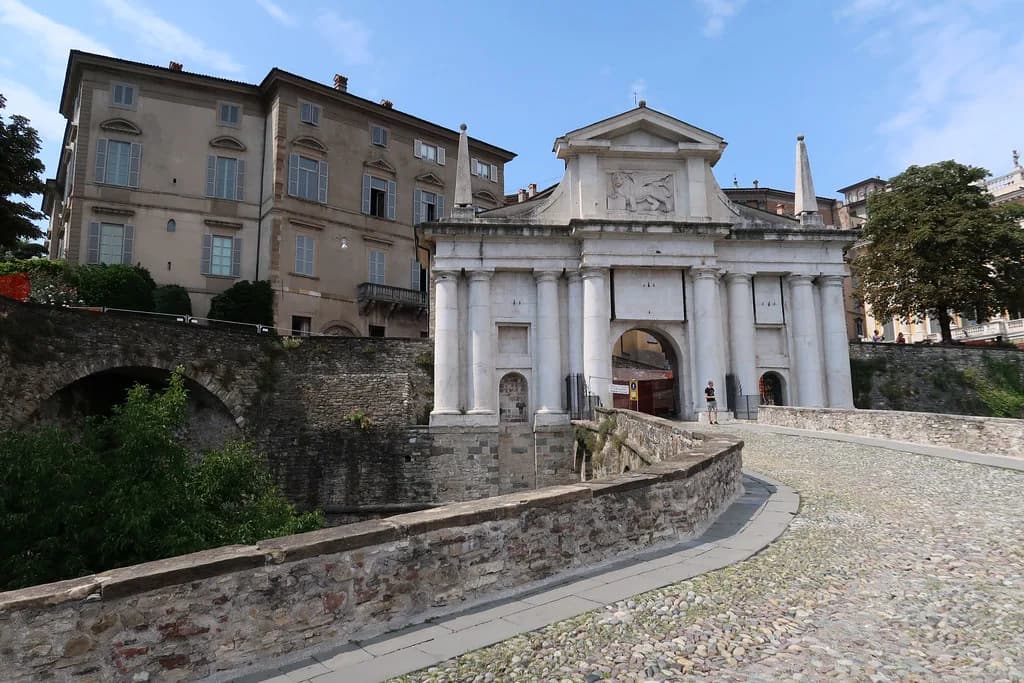
Porta San Giacomo is the southern doorway into Bergamo's walled upper town, and it reads differently from the other entrances the moment you see it from the lower city. Visit Bergamo describes it as the only opening in the walls clearly visible from Bergamo Bassa, the only one built in polished white marble, and the only one approached by a stone viaduct facing the plain. Those three distinctions are the reason this gate deserves a stop of its own rather than a glance on the way up.
The visit itself is short and open-air: you walk the viaduct, pass beneath the classical facade, and step to the balustrade for the view back over the lower town. Allow roughly twenty to thirty minutes if you are simply looking, reading and photographing, and longer if you continue along the walls afterwards; that duration is a suggestion for planning, not an official figure. Because the gate is a public monument in the street rather than an attraction with a ticket desk, it slots easily into a half-day in Città Alta. Related guide: Mura Venete Bergamo: A Visitor Guide to the Venetian Walls.
What Porta San Giacomo Is and Where It Sits
The gate stands on the southern edge of the upper city, at the point where the historic route up from the lower town meets the Venetian defensive circuit. Visit Bergamo gives its location as 24129 Bergamo and places it at the end of a viaduct that looks out over the plain. That position is why the gate appears so clearly on the main axis running through the lower town, viale Vittorio Emanuele, both because of where it sits and because its colour stands out.
For orientation, think of the gate as the hinge between two halves of the city: below it the streets of Città Bassa, above it the lanes of the upper town. Visitors coming up on foot usually reach the gate before they reach Piazza Mercato delle Scarpe, an easy landmark to look for on a map. If you are new to the city and want to place this gate among the other sights, the Bergamo Attractions hub is a sensible starting point for planning which stops to combine.
One planning caveat matters here. Visit Bergamo publishes a tourism information site, not a live status page for every monument, and the comune's site carries city notices, events and administrative news rather than gate opening details. Check both before travelling if you are making a special trip, and treat the gate as an outdoor public passage you pass through rather than a site you enter at a set time.
Why the Gate Is White: Zandobbio Marble
The whiteness is not a restoration choice. Visit Bergamo explains that the marble was quarried at Zandobbio, in the nearby Val Cavallina, and that this is what makes the gate stand out against the grey stone of the defensive walls. The same material appears elsewhere in the city, including Palazzo Nuovo, now home to the Angelo Mai library, and the Contarini fountain in Piazza Vecchia.
Knowing this changes how you look at the gate. Instead of a decorative front, you are seeing a deliberate contrast between a pale ceremonial entrance and a long grey curtain of fortification behind and beside it. Look at the balustrade and the facing surfaces in side light, and compare them with the rougher wall stone as you walk away along the walls; the difference in texture is the point.
A separate visitor guide also notes the white-pink Zandobbio marble and places the gate's construction in 1592, describing it as the most architecturally impressive of Bergamo's four gates. Treat that date as background rather than a schedule, and read any older page for context only, since such guides are updated irregularly and are not official sources for current conditions.
The Venetian Story: Lion, Fronton and Columns
Above the arch, Visit Bergamo describes a triangular fronton supported by semi-columns in the classical style, with the Lion of Saint Mark carved prominently as the symbol of Venetian rule. The lion is the quickest way to read the gate's politics: this was the Republic of Venice announcing itself at the entrance to one of its western strongholds. Look up before you walk through, because the carving is easy to miss when you are following the road.
The gate belongs to the same fortified system as Bergamo's other entrances, and that shared context is worth holding in mind. It was the southern face of a defensive circuit, not a standalone monument, and the architecture was meant to be seen from a distance as well as crossed. Visit Bergamo notes that the pale marble has also served as a backdrop for coloured lighting during special events, which tells you how strongly the facade reads from the lower town after dark.
If you want the wider picture of the city beyond its headline sights, the hidden gems in Bergamo guide covers quieter corners and smaller stops that pair well with a walk along the walls. It is useful for building a route that does not begin and end at the gate.
The Historic Entry from Milan
This was once the way into the upper city for travellers arriving from Milan, according to Visit Bergamo, and its south-facing position made it the main approach from the plains below. Standing on the viaduct and looking outward, you can picture why: the gate faces the open country rather than the interior of the city. The view and the route were designed together.
The gate's defensive role is also documented in a visitor account that describes it as part of the fortification system protecting the city from outside threats, with its southern aspect connecting it to the plains and to Milan. That framing helps explain the solidity of the structure beneath the elegant surface. Read it as historical context rather than current visitor information.
For practical arrivals today, the tourism board's main site is the place to confirm how to get around and what else is open while you are in town, since transport and site arrangements can change. Do not rely on older route descriptions for current services.
The Viaduct and the Former Drawbridge
The approach you walk today is not the original one. Visit Bergamo records that the old wooden drawbridge, which closed the entrance in times of danger, was demolished at the end of the eighteenth century on the orders of the Venetian governor Alvise Contarini, and that a masonry road was built in its place. The romantic viaduct you cross is therefore a later piece of engineering, even though it now looks inseparable from the gate.
This detail is useful when you are standing on the bridge: the flat, solid surface underfoot replaced something that could be raised. It also explains the shape of the approach, which climbs toward the facade before passing through it. Take the crossing slowly, because the viaduct itself frames the first proper view back over the lower city.
A word on the gate's old evening routine. Visit Bergamo notes that, like the other gates in the walls, Porta San Giacomo was once shut at 22.00 each night for the city's security. That is history, not a current closing time, so do not build an evening plan around it. Check official sources if you need to know about access at a specific hour.
The Terrace Panorama over Città Bassa
Lean on the balustrade and the reward is two views in one. Visit Bergamo describes a panorama of the lower town and the plain extending toward the Apennines from one side, and a view of the Venetian fortifications from the other. Clear days give the longest sightline, so if the view matters to you, watch the forecast rather than the clock.
Another guide recommends strolling along Viale delle Mura for panoramic views of Città Bassa from above, and notes that the gate is an easy stop for photographs. That advice holds up because the terrace and the wall walk give you different angles on the same city: one frontal, one along the ramparts.
For photography, plan around light rather than a precise hour. The pale marble reflects strongly in bright conditions, so early or late in the day usually gives more detail in the stone, while the view outward is clearest when haze is low. Bring a little patience for the balustrade, since it is the natural stopping point for everyone crossing the viaduct.
A Free Open-Air Monument, Not a Ticketed Site
Porta San Giacomo is a public gate in the street, so there is no ticket desk, no interior collection and no combined admission with the museums of Città Alta. Treat it as an open-air monument you pass through and look at, and budget separately for any paid attraction you add to the same day. The tourism board's events and experiences listings are the place to see what is currently bookable in the city.
The distinction matters when you are planning a day in the upper town. A pass or ticket for a museum or gallery does not cover this gate, because there is nothing here to admit you to. If a tour you are considering includes the walls, read the description for what is actually guided and what is simply a walk past a public monument.
The city council's site is useful for a different kind of check: temporary notices, road and civic information, and seasonal city initiatives that can affect a visit. It is not a gate listing, so use it alongside the tourism board rather than instead of it.
Walking On: Viale delle Mura and Via Sant'Alessandro
The gate is best treated as the start of a walk rather than the whole outing. From the balustrade, follow Viale delle Mura along the line of the fortifications for changing views over the lower city and the walls themselves. The path is the point: short stops at openings and corners give you more than one perspective on the same defensive circuit.
On the inner side, Via Sant'Alessandro leads from the gate area into the upper town. A visitor guide notes that this street passes the site associated with Bergamo's patron saint, Alessandro, martyred in 298, commemorated by a Roman column outside the church of Sant'Alessandro in Colonna. That gives the walk a historical thread beyond the gate itself.
A simple sequence works well: cross the viaduct, pause at the balustrade, walk a stretch of the wall promenade, then enter the upper town by way of Via Sant'Alessandro and continue to Piazza Mercato delle Scarpe. If you want to extend the day with lower-key stops, the same hidden gems route helps you avoid zigzagging across the city.
Practical Notes: Access, Timing and Verification
Visit Bergamo's listing records motor accessibility as not available and directs visitors to make contact for visual, auditory and cognitive information. Take that as the tourism board's published note rather than a full verdict on every route into and through the gate, and ask directly if you have specific needs. The approach includes a climb and a historic surface, so plan accordingly.
The tourism board does not publish opening hours, ticket prices or booking requirements for the gate, and neither does the comune's site. If you see such details elsewhere, verify them against an official source before you rely on them. For anything time-sensitive, contact the tourist information service rather than planning around a number from an old page.
Finally, keep the visit flexible. Weather, crowds and any works on the walls can change the experience from one week to the next, and no official page in the sources reviewed here gives a live status for the viaduct or terrace. Build the gate into a wider Città Alta day and it will rarely disappoint.
Plan Your Visit
Porta San Giacomo rewards a deliberate stop of twenty to thirty minutes: cross the viaduct, look up at the lion and the fronton, then take the balustrade view before walking on along the walls. It is free to approach as a public street monument, and the surrounding lanes make the rest of the upper town easy to fold into the same outing.
Before you travel, confirm anything that could change, from access notes to city notices, on the tourism board and comune sites rather than relying on older guides. Then keep the plan simple: the gate first, the walls second, and the upper town after that.
Frequently Asked Questions
Is Porta San Giacomo free to visit?
Yes. The gate is a public monument in the street rather than a ticketed attraction, so there is no admission charge to cross the viaduct or stand at the balustrade. Any museum, gallery or guided tour you add elsewhere in Città Alta is separate, so check what each one includes before booking.
What makes Porta San Giacomo different from Bergamo's other gates?
Visit Bergamo identifies it as the only opening in the walls clearly visible from the lower town, the only one built in polished white marble, and the only one approached by a stone viaduct facing the plain. The marble came from Zandobbio in Val Cavallina, which is why the gate reads so differently from the grey defensive stone around it.
What can you see from the balustrade at Porta San Giacomo?
On one side the view opens over Città Bassa and the plain as far as the Apennines on clear days; on the other you look along the Venetian fortifications. Light and haze change the panorama considerably, so early or late in the day usually gives the most detail in the stone and the longest sightlines.
How do you reach Porta San Giacomo from Città Bassa?
The gate sits at the top of the main axis running through the lower town, viale Vittorio Emanuele, and is reached by walking up the approach to the viaduct. From the upper town side, Via Sant'Alessandro leads to the gate area near Piazza Mercato delle Scarpe. Check current transport and route information with the tourism board rather than relying on older guides.
Was the gate ever closed at night?
Yes, historically. Visit Bergamo notes that, like the other gates in the walls, Porta San Giacomo was shut at 22.00 each evening for the city's security. That is a historical detail, not a current closing time, so do not plan an evening visit around it.
Is Porta San Giacomo accessible for visitors with limited mobility?
Visit Bergamo's listing records motor accessibility as not available and asks visitors to make contact for visual, auditory and cognitive information. The approach includes a climb and historic surfaces. If you have specific requirements, ask the tourist information service directly before travelling rather than assuming step-free access.
How much time should I allow at Porta San Giacomo?
For looking, reading and photographing, about twenty to thirty minutes is a reasonable suggestion, though that is a planning estimate rather than an official figure. Add time if you continue along Viale delle Mura or walk into the upper town by way of Via Sant'Alessandro, since both extend the visit well beyond the gate itself.
Sources
Continue exploring
More guides you'll find useful