
Mura Venete Bergamo: A Visitor Guide to the Venetian Walls
Plan a walk on Bergamo's Mura Venete: the roughly six-kilometre UNESCO circuit, its four monumental gates, and how the walls fit into a Città Alta visit.
On this page
Bergamo's Mura Venete are the long defensive ramparts that wrap around Città Alta, the hilltop medieval core of the city. They stretch for roughly six kilometres and were recognised by UNESCO in 2017, so the walk is as much a lesson in Venetian engineering as a scenic stroll.
The walls were begun in 1561 on the orders of the Republic of Venice, which needed to protect its western frontier. Walking them today is free and open to anyone, while the towers, palaces and museums inside the upper town are separate, ticketed attractions.
What the Mura Venete Are
The Mura Venete are a continuous circuit of bastions, curtains and gates encircling Bergamo's upper town rather than a single monument. Italia.it describes them as impressive structures and bastions surrounding Città Alta, restored between 1976 and 1984 before their UNESCO inscription.
Construction was a vast undertaking: the source notes that more than 250 buildings, including eight religious buildings, were demolished to make room for the fortifications. Architects from Venice and Bergamo directed the works, which is one reason the walls read as a coordinated military system rather than a patchwork.
Why the Walls Matter: A Transnational UNESCO Site
The 2017 listing is not a local award. The walls form part of a transnational UNESCO series covering Venetian defence works between the 16th and 17th centuries, which also includes fortifications in Veneto, Friuli Venezia Giulia, Croatia and Montenegro.
That context changes how you look at them. The bastions of Città Alta were one link in a much wider Venetian network, and the same engineering logic appears in fortresses far beyond Lombardy, which makes the Bergamo circuit a useful introduction to Renaissance military architecture.
Getting Oriented: Città Alta Versus Città Bassa
Bergamo works as two towns in one. Città Bassa is the lower, modern city spread across the plain, while Città Alta is the walled hilltop core, and the Mura Venete mark the boundary between them, so the walls double as your orientation tool.
The Wom Travel notes that the historic heart encircled by the Mura Venete has been a UNESCO World Heritage site since 2017 and remains remarkably preserved. It also points out that travellers can reach the upper town by the ancient stone stairways winding up the hillside or by the historic funicular.
A sensible plan is to start in Città Bassa, climb to the upper town, and then use the walls as a loop that returns you to the point where you entered. Visit Bergamo's events and experiences listings are a good place to check what else is running during your stay.
The Four Monumental Gates
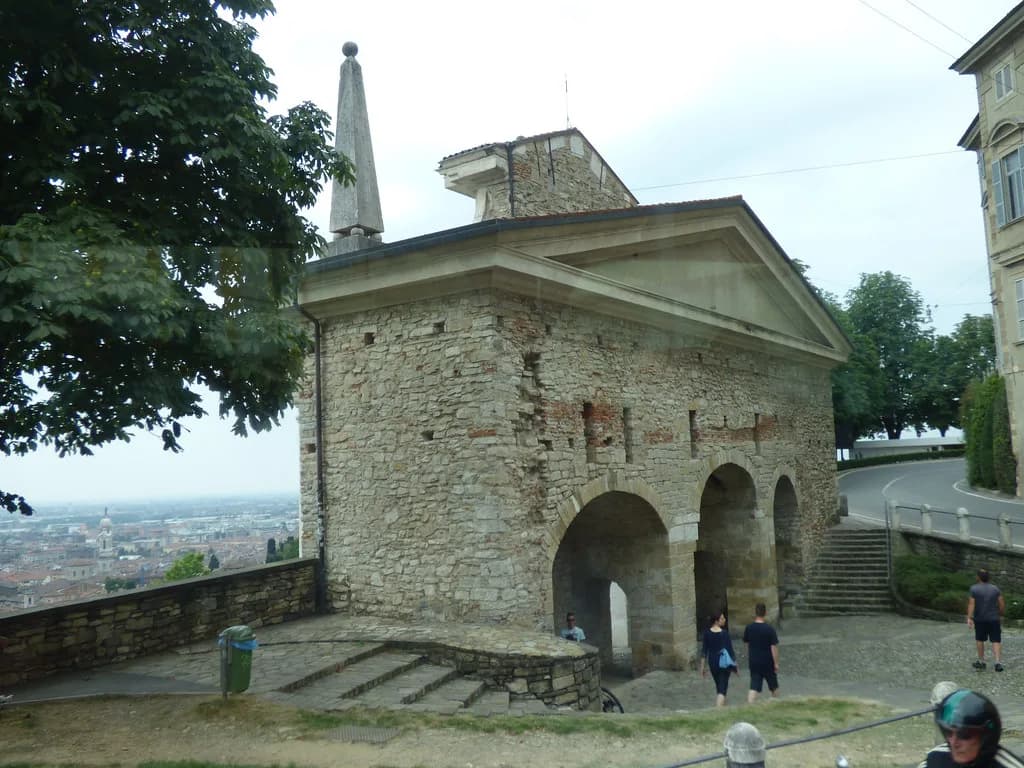
Four monumental gates punctuate the circuit, and Italia.it names them by direction: Sant'Agostino to the east, San Giacomo to the south, Sant'Alessandro to the west and San Lorenzo to the north. Treat them as navigation landmarks rather than decoration, since each one points you toward a different approach to the upper town.
Porta San Giacomo is the gate most visitors meet first when arriving from the lower city, while Porta Sant'Alessandro and Porta Sant'Agostino sit on the flanks of the hill. Choosing your start gate by the direction you arrive from saves backtracking and gives the walk a natural shape.
Walking the Circuit
The published length of the circuit is about six kilometres, which is the most reliable figure available. Italia.it gives that distance, but no source publishes an official walking time, so plan your pace around your own stops rather than a fixed schedule.
Expect a mix of grassy ramparts, stone parapets and open views down over Città Bassa and the plain. Because the walls follow the original defensive line, the route bends and rises rather than running straight, and the sequence of bastions is what makes the circuit interesting.
You do not have to complete the full ring. Walking one side, crossing through a gate and returning through the town centre is a perfectly good half-day plan, and it leaves time for the towers and churches inside Città Alta.
Weekends on the Walls
Weekends change the feel of the upper town. According to Italia.it, the inner perimeter becomes a large pedestrian island in Città Alta at weekends, which makes the circuit more relaxed to walk and easier to combine with time in the streets below the ramparts.
If you want the walls as a quiet walking experience rather than a busy one, this weekend arrangement is worth knowing before you choose your day. The city of Bergamo's events calendar is a useful check for anything that might draw crowds to the upper town on your dates.
Pairing the Walls With Città Alta
The wall walk is free, but the attractions inside Città Alta are separate and ticketed, so budget for them individually. The Wom Travel lists Piazza Vecchia, the Basilica di Santa Maria Maggiore, the Campanone tower, the Rocca and the Duomo as the upper town highlights to build into your day.
Piazza Vecchia is the natural centre of gravity, framed by the Palazzo della Ragione, the Palazzo del Podestà and the Palazzo Nuovo, with the Fontana Contarini at its middle. From there the basilica, the Cappella Colleoni and the cathedral sit close together around Piazza del Duomo.
For elevation, the Campanone tower offers a city view after a climb of 230 steps, and the Rocca di Bergamo on Sant'Eufemia hill gives a wider sweep that can reach Milan's skyline on clear days. Neither is included in wall access, so check current admission where you buy tickets.
Practical Planning Without Guesswork
No official source sets opening hours or closing times for the wall path, so treat it as public ground and build your day around daylight and weather rather than a published timetable. If you are unsure about access at a specific gate, ask at a tourist information point in the city.
Bring water and sun protection, because the ramparts are exposed and the circuit is long enough that heat matters. Wear shoes suited to stone paving and grass, and keep a light layer for the wind that often picks up along the higher stretches.
Late afternoon tends to give the best light on the bastions and the plain below, though nothing in the sources guarantees a specific closing time. Pair an evening wall walk with dinner in Città Alta or back down in Città Bassa depending on where you are staying.
Beyond the Walls
Once the walls are done, Bergamo is a good base for wider Lombardy. The Wom Travel names Lake Iseo, Lovere, Clusone, the Parco delle Orobie and the UNESCO village of Crespi d'Adda among the surrounding places worth adding to a longer stay.
For a slower second day, the hidden gems in Bergamo angle rewards wandering back through Città Alta's smaller lanes and quieter corners after the main sights. That pairs naturally with a partial wall circuit rather than a full repeat of the six-kilometre ring.
Plan Your Wall Walk
The Mura Venete reward a simple approach: pick a gate that matches the direction you arrive from, walk as much of the roughly six-kilometre circuit as your day allows, and leave time for Città Alta's ticketed sights. The walls themselves cost nothing to walk, which makes them one of the best-value hours in Bergamo.
Before you go, confirm current details for the museums and towers you plan to visit, since wall access does not cover them. Use the Bergamo Attractions hub to compare the Campanone, the Rocca and other upper-town stops in one place. For related planning, see Free Things to Do in Bergamo: Città Alta, Walls and Views.
Frequently Asked Questions
Are Bergamo's Mura Venete free to visit?
Walking the wall circuit itself is free public strolling, and no source describes a charge for the ramparts. Towers, palaces and museums inside Città Alta are separate attractions, and you should check current admission at each one rather than assuming it is included with wall access.
How long is the walk around Bergamo's Venetian Walls?
The published figure is roughly six kilometres for the full circuit, according to Italia.it. No official source gives a walking time, so plan around your own pace, your stops and the weather rather than a fixed duration.
When were Bergamo's Venetian Walls built and why?
Construction began in 1561 under the Republic of Venice to defend its western frontier. Italia.it notes that more than 250 buildings were demolished to make way for the works, which were directed by architects from Venice and Bergamo.
What are the four gates of the Mura Venete?
The four monumental gates are Sant'Agostino to the east, San Giacomo to the south, Sant'Alessandro to the west and San Lorenzo to the north, as listed by Italia.it. They work well as orientation points when choosing where to start or end your walk.
Can you walk the walls on weekends?
Yes. Italia.it states that at weekends the inner perimeter of Città Alta becomes a large pedestrian island, which makes the circuit easier and more relaxed to walk. Check the city's events calendar if you want to avoid dates with large crowds.
Is the wall walk worth it if you only have one day in Bergamo?
Yes, especially if you walk one side of the circuit rather than the full ring. Combine a stretch of the ramparts with Piazza Vecchia, the basilica and one tower or the Rocca, and you get both the defensive history and the upper-town highlights in a single day.
Sources
Continue exploring
More guides you'll find useful





