Piazza Vecchia Bergamo Guide: What to See Around Città Alta's Main Square
Plan a visit to Piazza Vecchia in Bergamo Alta: the palaces, fountain and bell tower around it, the sights next door, and sensible walking routes onward.
On this page
Piazza Vecchia is the natural starting point for any walk through Città Alta, the walled upper town that sits on its hill above the modern lower city. Read the square once and the rest of the old town becomes easy: a medieval palace, a later library building, a central fountain and a tall bell tower establish your bearings, and almost everything else is minutes away on foot. This guide treats the square as orientation first and sightseeing second, which is how most short visits actually work out.
A useful planning anchor is the walk along the Venetian Walls, which one local operator describes as taking roughly one and a half to two hours for the full circuit, with shorter sections enough to grasp their scale. That estimate is a suggestion, not an official timing, but it shows how much of a day the fortifications alone can absorb. It also reminds you to decide early whether the square is a quick orientation stop or the hub of a longer itinerary.
Where Piazza Vecchia Sits in the Two Bergamos
Bergamo splits into a lower city on the plain and the old upper town on the hill, separated by the Venetian Walls and their gates. Piazza Vecchia belongs firmly to the upper half, so any plan starts with getting up the slope rather than across the city. Two funicular lines help: one connects the lower town with Città Alta, and a second runs from Colle Aperto up to the San Vigilio hill.
Treat the funiculars as connections rather than as attractions in themselves, and check fares and running times with the operator, since published figures change. Walking up is possible and popular, but the climb is real and shapes how much energy you have left for the square. If your legs are tired or the weather is poor, riding up and walking down is a sensible compromise.
Reading the Four Landmarks Around the Square
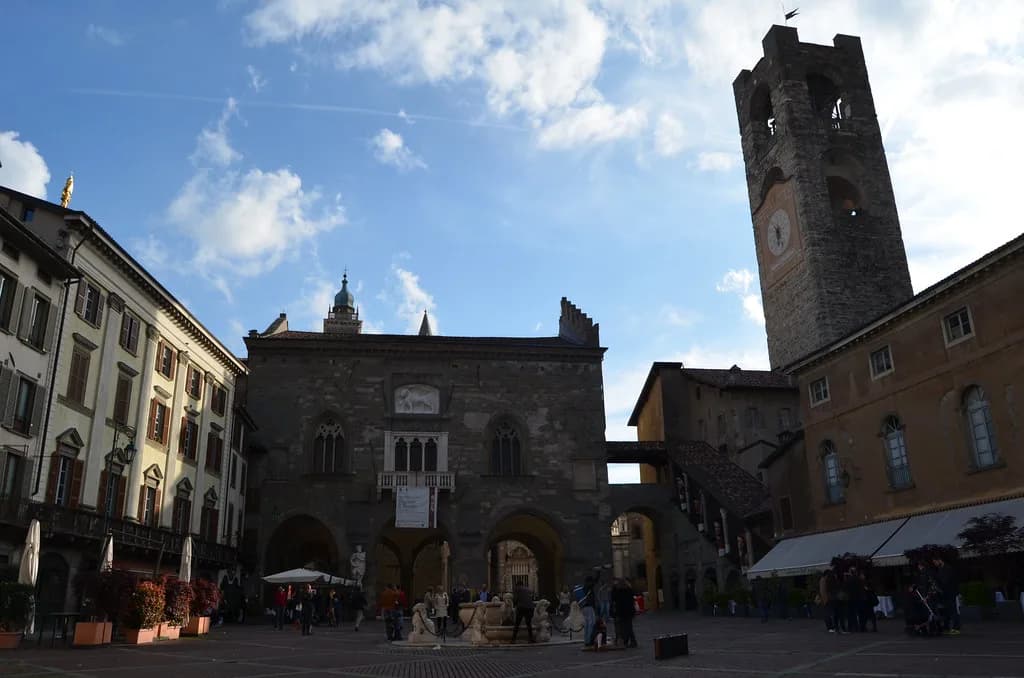
Piazza Vecchia is framed by a handful of buildings that do most of the visual work. The Palazzo della Ragione, medieval in origin, carries a Gothic loggia and arcades at ground level; behind it stands the Palazzo Nuovo, which houses the Angelo Mai library. At the centre sits the Contarini Fountain, added in 1780 as a gift from the Venetian podestà, and the Campanone tower closes the square on its northern side at 52 metres.
None of this requires a ticket to look at. The square functions as public open space you simply walk into, and the facades, fountain and tower are visible from the pavement. What you pay for, if you choose to, are interiors and climbs elsewhere in the cluster, which is why it helps to separate the free experience of the square from the ticketed sights around it.
As a navigation aid, use the tower as north and the fountain as centre. From there, Via Colleoni runs off toward Colle Aperto, the cathedral square opens just beside the Palazzo della Ragione, and the Rocca sits a short uphill walk away. Once those directions are fixed in your head, you can wander the alleys without a map and still recover your position.
Free to Walk, Paid to Go Inside
The most common budgeting mistake in Città Alta is assuming one ticket covers everything. It does not. The same operator guide lists the basilica of Santa Maria Maggiore, the Colleoni Chapel, the Venetian Walls, the Remembrance Park and the Rocca gardens as free to visit, while the funiculars require a ticket and museum collections are separate.
Paid interiors, tower ascents and museum entries should be checked directly with each site before you commit, because prices and conditions are not stable enough to print here. The practical habit is to decide in advance which single paid sight matters most to you, then treat the rest as free wandering. That approach keeps a short break flexible and avoids queueing for things you only half want to see.
For the Campanone specifically, the climb, any lift and the current admission arrangements all need confirming at the tower itself or through the city's tourism pages. Do not rely on older blog posts for that detail. If the climb is closed or busy, the view from the walls and from San Vigilio gives you a comparable sense of the city's shape without the stairs.
Next Door: Piazza Duomo and Its Churches
Walk under the arches of the Palazzo della Ragione and you arrive in the small, asymmetric Piazza Duomo, which packs the cathedral, the basilica and the Colleoni Chapel into a few steps. The basilica of Santa Maria Maggiore began construction in 1137 and layers Romanesque, Gothic, Baroque and Renaissance work inside, with Flemish tapestries and wooden choir inlays among the details worth seeking out. The chapel beside it, built between 1470 and 1476 by Giovanni Antonio Amadeo as Bartolomeo Colleoni's mausoleum, is free to enter, and the same source suggests around twenty to thirty minutes for it.
Bergamo Cathedral, dedicated to Saint Alexander, is described as the quieter of the group and takes only around fifteen to twenty minutes to look around, with a Tiepolo altarpiece and a crypt holding the patron's relics. Because these three buildings sit within metres of each other, this is the densest concentration of art on any short Bergamo visit. Plan the church cluster as one block rather than three separate stops.
Dress and behaviour inside working churches follow the usual Italian conventions, and modest covering is wise in warm months. If a service is under way, step out and return later rather than treating the interior as a museum. The square outside, with the fountain, is a good place to wait.
A Half-Day Route from Funicular to Walls
For a half day of three to four hours, ride the funicular up to Città Alta and walk straight to Piazza Vecchia. The same operator's suggested short itinerary covers the Palazzo della Ragione, Santa Maria Maggiore and the Colleoni Chapel, then a stretch of the Venetian Walls. This is the richest core of the upper town and it all sits within a few minutes on foot, so you are not losing time to transfers.
End the loop at Porta San Giacomo, the white marble gate overlooking the plain, which the source calls the most scenic of the gates. From there you can descend on foot or return through the centre. Keep the half day deliberately short: the temptation to add the Rocca or San Vigilio usually turns a relaxed morning into a rushed one, and those deserve their own outing.
Extending to a Full Day: Rocca, Walls and San Vigilio
With a full day, add the Rocca and its Remembrance Park, then take the second funicular from Colle Aperto up to San Vigilio for the broadest view over the upper town, the plain and, on clear days, the Alps. The castle gardens there are open to the public, and the source suggests thirty to forty-five minutes is enough to enjoy the panorama. Walkers can also reach the hill on foot via the steep Via della Ripa, in roughly twenty to twenty-five minutes from Colle Aperto.
If you want a quieter counterweight to the busy squares, the Sentiero dei Vasi and the Astino Valley offer green walking within the Parco dei Colli, and the restored Benedictine monastery at Astino now hosts cultural events and a botanical garden. The source presents the valley as a peaceful walk away from the tourist crowds. These are good additions for anyone with an extra hour and a preference for landscape over interiors.
The city's official tourism portal lists guided walks, themed tours and seasonal experiences across the province, which is useful if you would rather join an organised group than assemble the route yourself. Check listings close to your dates rather than planning around any single recurring tour.
For corners beyond the headline sights, including the smaller churches, courtyards and hill paths that reward a slower pace, it is worth reading around before you fix a plan. Our guide to the hidden gems in Bergamo pairs well with this square, since it picks up where the main landmarks stop.
Via Colleoni as the Spine of the Upper Town
Via Colleoni leaves Piazza Vecchia and runs as the main axis of Città Alta, lined with shops, workshops and historic venues all the way to Colle Aperto. Use it as your onward route rather than backtracking through the square. It also links the cathedral cluster to the gates and the second funicular, which makes it the most efficient corridor in the old town.
The street shifts character through the day, and the change is part of the appeal. If you want fewer people in your photographs, go early in the morning; if you want the cafes and shops in full swing, go later. Neither is official advice, just a choice about what kind of visit you want.
Timing Your Visit Without Chasing Crowds
The upper town is small and popular, so the square is busiest in the middle of the day and quieter at the edges of it. The operator source notes that the streets of Città Alta are almost deserted in the early morning and that this is the better window for photographs, while afternoons bring a livelier mix of visitors and residents. Treat these as tendencies rather than rules, and expect weekends and holidays to run busier than weekdays.
The city publishes an events calendar that includes concerts, exhibitions and guided visits, some of them in the squares and museums of the upper town. Checking it before you go can turn an ordinary wander into something more specific, but it can also mean a square given over to a stage or a crowd.
Common Planning Mistakes
The first mistake is treating Bergamo as an airport with a city attached. The upper town holds a compact, high-quality set of medieval and Renaissance sights, and it deserves more than a transfer-stop hour. The second is underestimating the hill: the difference between lower and upper town is a genuine climb, and gates and walls sit between them, so a plan that ignores elevation will run out of time.
The third mistake is assuming a single ticket covers the square, the churches, the tower and the museums. They are separate, with different rules and different queues. Decide what you will pay for, and let the free public spaces do the rest of the work. If you only have a few hours, that decision alone will save you from spending them in the wrong queue.
Finally, do not schedule the whole visit around one fixed opening time you read somewhere months ago. Verify current hours and closures with the individual site or the city's tourism information before travelling.
Plan Your Visit
Piazza Vecchia works best as a fixed point you return to rather than a single sight to tick off. Learn the four landmarks, decide which paid interiors you actually want, and let the free squares, churches and walls carry the rest of the day. That structure keeps a short break calm and gives a longer one room to breathe.
Before you go, confirm current opening arrangements and ticket details for any interior or tower you plan to enter, and check the city's event listings for anything that might change the shape of your day. Then set aside the time to simply stand in the square, because that costs nothing and is the reason most people remember Città Alta.
Frequently Asked Questions
What can you see around Piazza Vecchia?
The Palazzo della Ragione with its Gothic loggia, the Palazzo Nuovo housing the Angelo Mai library, the Contarini Fountain at the centre and the Campanone bell tower closing the square to the north. Piazza Duomo, Santa Maria Maggiore and the Colleoni Chapel are a minute away, and Via Colleoni leads onward to Colle Aperto and the walls.
Is Piazza Vecchia free to visit?
The square itself is public open space that you walk through without a ticket. Interiors such as museum collections and any tower ascent are separate and should be checked with each site, since arrangements are not uniform across Città Alta.
How long do you need for Piazza Vecchia and Città Alta?
A suggested half day of three to four hours is enough for the square, the cathedral cluster and a stretch of the Venetian Walls. A full day adds the Rocca, the Remembrance Park and San Vigilio, and those who want the quieter hill paths should allow extra time.
What is within walking distance of Piazza Vecchia?
Piazza Duomo and its churches are immediately adjacent, Via Colleoni runs from the square toward Colle Aperto, and the Rocca is a short uphill walk. The Venetian Walls and Porta San Giacomo are reachable on foot, and the funicular from Colle Aperto continues up to San Vigilio.
When is the square quieter?
The operator source notes that Città Alta's streets are almost deserted in the early morning and that afternoons bring a livelier mix of visitors and residents. These are observations rather than official quiet hours, so check local event listings and expect weekends and public holidays to be busier.
How do you get to Piazza Vecchia from the lower city?
The most comfortable option is the funicular connecting the lower town with Città Alta, followed by a short walk to the square. Walking up is possible but the climb is real, so check current fares and service times with the operator before setting out.
What should you not miss near Piazza Vecchia?
The Colleoni Chapel and the interior of Santa Maria Maggiore are the highlights of the immediate cluster, and the walk along the walls to Porta San Giacomo gives the best views over the lower city. If time allows, add the Rocca and San Vigilio for a wider panorama.
Sources
Continue exploring
More guides you'll find useful