Giardino Ibleo, Ragusa: A Visitor Guide to Ibla's Public Garden
Plan a visit to the Giardino Ibleo in Ragusa Ibla: its 1858 origins, palm-lined avenues, churches inside the grounds, the old San Giorgio portal and valley views.
On this page
The Giardino Ibleo occupies the easternmost tip of Ragusa Ibla, where the Baroque district ends and the ground drops toward the Irminio valley. It is a public garden rather than a ticketed attraction, which makes it the most natural rest stop in a walking day built on stairs, churches and stone lanes. Sources describe it as the oldest of the city's four main gardens, laid out from 1858.
Entry is free and there is no fixed visitor circuit, so you can treat the garden as a fifteen-minute breather or as a slow hour among palms, flowerbeds and old stone. What it does not publish is a reliable public opening schedule, so check locally on the day rather than planning a visit around assumed hours.
Where the Garden Sits in Ragusa Ibla
The garden's address is Via dei Normanni, at the far end of Ragusa Ibla, and it is usually reached on foot through the old town rather than by driving to the gate. That edge-of-the-promontory position is the point: the garden closes the district on its eastern side and opens onto the valley below.
For orientation, Ibla is the historic lower town rebuilt after the 1693 earthquake, while Ragusa Superiore is the grid-planned upper town on the plateau. The two were long separate entities and were merged in the 1920s, which is why Ragusa still feels like two places stitched together by a long staircase.
In practice, most visitors arrive from the Duomo di San Giorgio side, wander the alleys, and let the garden serve as the end point before turning back uphill. If you want more of those overlooked corners around the district, our guide to the hidden gems in Ragusa covers the quieter lanes worth folding into the same walk.
Origins: Nobles, 1858 and a Lost Cathedral
The garden was commissioned in the mid-19th century by three wealthy local citizens and opened as a retreat for the city's elite before becoming a public space. Work began in 1858 on the initiative of local nobles, with part of the population contributing free labour to the project.
The site carries older history than the garden itself: it is linked to the cathedral of San Giorgio destroyed in 1693, whose replacement was built elsewhere in Ibla. That earlier church explains why the surviving Gothic portal just outside the entrance is treated as a monument in its own right.
Layout: Palms, Parterres and a Pine Grove
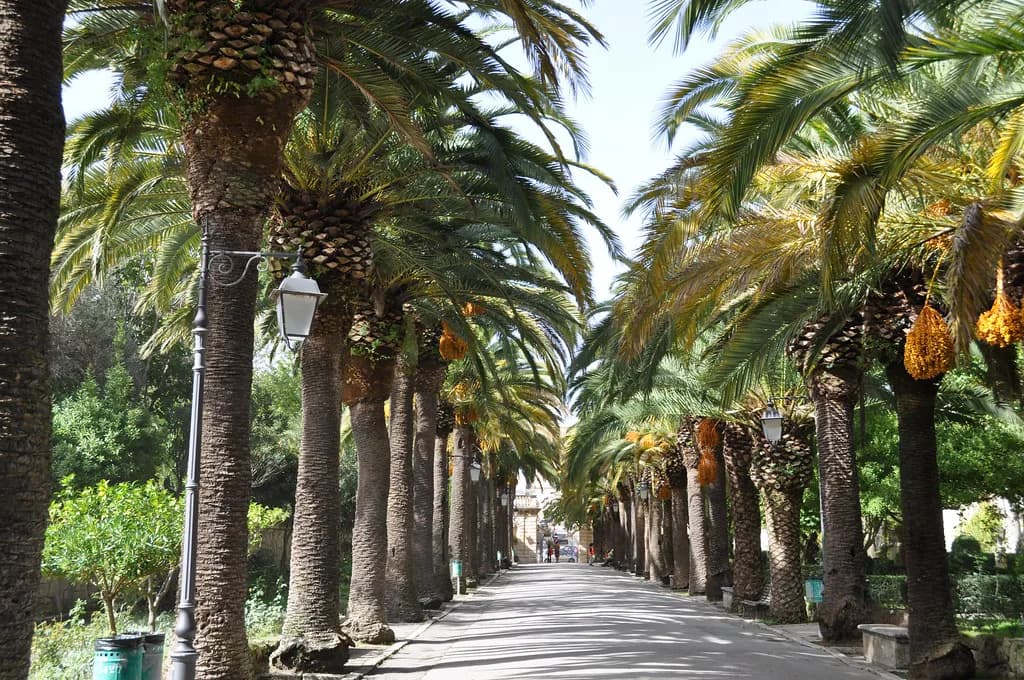
The visit begins on the Viale delle Palme, an avenue lined with roughly fifty Canary Island date palms that is the garden's most photographed axis. From there the grounds split into distinct phases: the original 19th-century core with its Viale delle Colonnine, an early 20th-century addition with geometric flowerbeds, and a quieter pine grove known as the Boschetto della Rimembranza.
Older descriptions add pools of water lilies, fountains, sculptures and shaded benches along the paths, plus Mediterranean and exotic planting. Because the sections date from different periods, the garden reads as a small anthology of Italian public-park taste rather than a single uniform design.
A war memorial stands at the centre of the garden, and a limestone-balustraded balcony marks the outer edge of the promontory. Neither requires scheduling: you meet them simply by walking the length of the grounds.
The Churches Inside the Grounds
Three churches sit within the garden: San Domenico with its maiolica-tiled bell tower, San Giacomo, and the Capuchin church next to the Diocesan Museum. Treat these as separate places of worship rather than parts of one ticketed complex, since the garden's free access says nothing about the museum or any interiors.
The Capuchin fathers moved into their building in the early 17th century, and it now stands in the Iblei gardens beside the diocesan collection. If a church interior matters to your visit, ask at the door or check the city's church-visiting information before you count on it being open.
One small deconsecrated church by the garden entrance, San Vincenzo Ferreri, has been used as a public auditorium since 2010, so do not expect a conventional church interior there.
The Portale di San Giorgio Vecchio
Shortly before the entrance, on the right, stands what remains of the old cathedral: a Gothic-Catalan portal known as the Portale di San Giorgio Vecchio. It was built in the first half of the 13th century and belonged to the church of San Giorgio that disappeared after the earthquake; the lunette shows the saint spearing the dragon while the queen of Berito kneels.
It is easy to walk past because it is a fragment rather than a facade, but it is the single object that ties the garden to the city before 1693. Our guide to the Chiesa di San Giorgio Vecchio in Ragusa Ibla explains what survives and how the old cathedral's story connects to the present Duomo.
The Balcony, the Gorge and the Archaeology
The garden's main balcony looks over the deep gorge of the Irminio River and the bare Hyblaean slopes beyond, and it is the reason photographers time their walk to end here. The garden also holds archaeological traces of walls and pavements from the city that existed before the 1693 earthquake.
Because the viewpoint faces east and the old town lies behind you, late afternoon light falls on Ibla rather than on the valley. If you want the classic view of stacked Baroque houses instead, you will get it from the stairs and from the Santa Maria delle Scale side, which is covered in our guide to the Chiesa di Santa Maria delle Scale.
Practical Planning: Time, Access and What to Check
Allow roughly thirty to sixty minutes if you want the palms, the churches from outside, the balcony and the portal; fifteen minutes covers a quick pass through the main avenue. The garden is a public space with free access, but no reliable published visitor hours, so confirm locally or through the city's tourism pages before making it a fixed appointment.
There is no single circuit or audio route through the grounds, and the paths are informal rather than signposted as a trail. Bring water in warm months, since shade is generous but the surrounding streets between Ibla and Superiore are exposed.
Parking in Ragusa Superiore is easier than in Ibla, where the old centre is closed to non-residential traffic; some visitors leave the car near Piazza della Repubblica and walk down.
For other sights to pair with the garden, from the Duomo to the castle at Donnafugata, start with our Ragusa Attractions hub and build the day around walking distances.
Best Time to Visit and How to Pair It with the Stairs
Spring and autumn are the most comfortable seasons for walking Ibla, since summer heat is real even though Ragusa sits on the Hyblean hills and stays cooler than much of the island. October still tends to be mild and swimming weather can last to the end of the month on the coast, but the garden itself is a shaded stop rather than a beach day.
A good sequence is to explore Ibla in the morning, visit the garden at midday for shade and the valley view, then climb the long staircase up to Ragusa Superiore in the cooler afternoon. The climb is the experience rather than a chore, and the light on the pastel facades improves as the day ends.
If you are basing yourself in the upper town, the local bus connects the two halves and stops near the entrance to the old town by the garden, which shortens the return leg.
Who the Garden Suits
The garden rewards slow travellers and photographers most: it has layered planting, three churches, the portal and a valley panorama within a compact area. Families with children get open paths and shade, and anyone building a Baroque-focused itinerary can use it as the natural full stop after the Duomo di San Giorgio.
Ragusa Ibla is part of the UNESCO-listed Late Baroque Towns of the Val di Noto, and the city rarely sees the crowds of Noto or Syracuse, so the garden usually stays a calm interlude rather than a sight to queue for.
Plan Your Visit
Treat the Giardino Ibleo as the closing scene of a day in Ibla: see the Duomo and the alleys first, pass the old San Giorgio portal, then let the palms and the valley balcony end the walk. Confirm locally that the grounds are open on your chosen day, since no dependable public schedule is published.
For the city's official notices and any temporary closures affecting streets around Ibla, the Comune di Ragusa website is the source to check before setting out.
Frequently Asked Questions
Is the Giardino Ibleo free to visit?
Yes. It is a public garden in Ragusa Ibla with free access, as described in visitor accounts. That free entry covers the grounds only; the churches inside and the Diocesan Museum are separate places, so check individually rather than assuming one shared ticket.
How long does it take to walk around the Giardino Ibleo?
There is no official route length. A quick pass along the main palm avenue takes about fifteen minutes, while thirty to sixty minutes lets you see the historic core, the 20th-century flowerbeds, the pine grove, the churches from outside and the balcony over the Irminio valley.
What churches are inside the garden?
San Domenico, with its maiolica-tiled bell tower, San Giacomo, and the Capuchin church next to the Diocesan Museum. A small deconsecrated church near the entrance, San Vincenzo Ferreri, has been used as a public auditorium since 2010.
What is the Portale di San Giorgio Vecchio?
It is the surviving Gothic-Catalan portal of the cathedral of San Giorgio destroyed in the 1693 earthquake, built in the first half of the 13th century and now standing just outside the garden entrance. Its lunette shows Saint George spearing the dragon.
When is the best time to visit the Giardino Ibleo?
Spring and autumn are the most comfortable seasons for walking Ibla, and the garden's shade helps at midday in warmer months. The garden publishes no visitor hours, so check locally on the day you plan to go rather than relying on assumed opening times.
Can you see the Irminio valley from the garden?
Yes. A large balcony at the edge of the promontory looks over the deep gorge of the Irminio River and the surrounding Hyblaean landscape, which is why the garden works well as a photographic stop at the end of an Ibla walk.
Does the garden have an entrance fee for the Diocesan Museum?
The garden is free, but the Diocesan Museum beside the Capuchin church is a separate collection. Pricing and opening arrangements are not published consistently, so ask on site or check the city's tourism information before planning around it.
Sources
- Comune di Ragusa
- Giardino Ibleo, Tourist Attraction in Sicily, Italy
- Visiting the Giardino Ibleo: The Green Oasis of Ragusa | Hi!Ragusa
- A Local's Guide to Ragusa, Sicily — Go Ask A Local
- Giardini Iblei - All You SHOULD Know Before Going (2026 ...
- Travel Guide to Ragusa, Sicily
- Visit the churches in Ragusa
- What to do and see in Ragusa Ibla - Sicily | Consigli in viaggio
- Ragusa Ibla: the Baroque heart of the city - Visit Sicily
Continue exploring
More guides you'll find useful