Duomo di San Giorgio, Ragusa: A Practical Visitor's Guide
Plan a visit to the Duomo di San Giorgio in Ragusa Ibla: what to see on the Baroque façade and inside, the separate museum collection, and time needed.
On this page
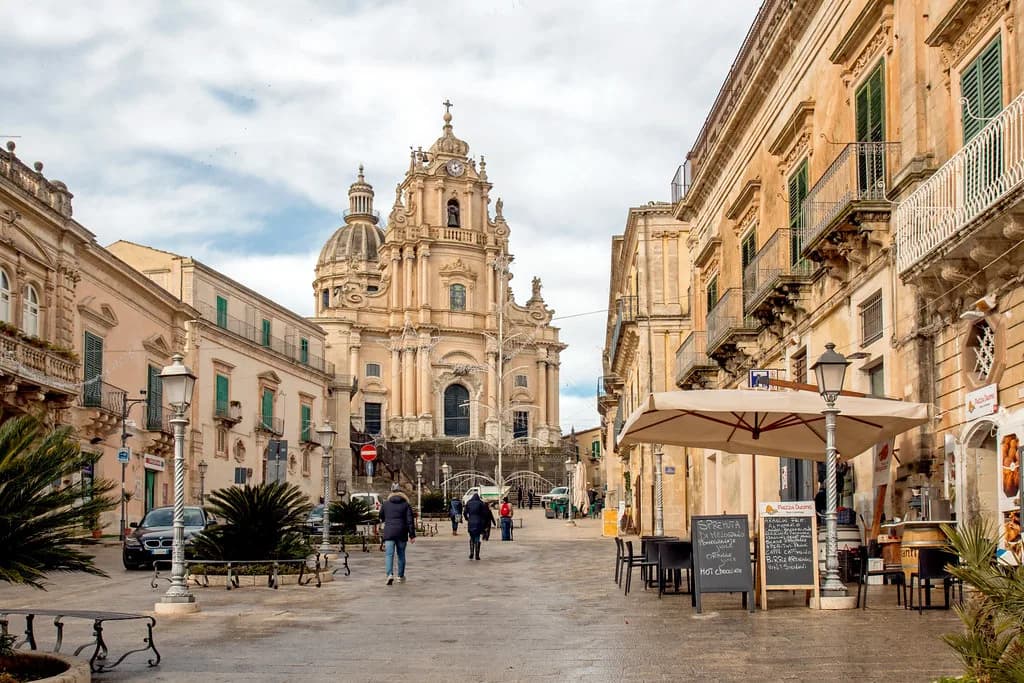
The Duomo di San Giorgio sits at the top of a broad staircase in Ragusa Ibla, the historic lower district of Ragusa, and its slightly convex, tower-like front is the image most visitors carry home. Rosario Gagliardi was commissioned to design the rebuilt church in 1738, and the foundation stone followed in June 1739, so the façade you photograph is the product of a long eighteenth-century project rather than a single campaign. Related guide: Palazzo La Rocca in Ragusa Ibla: What to See Outside.
Read this guide as a way to make decisions rather than a timetable: whether to stop for the exterior and nave or stay for the chapels, sacristy and the separate museum collection. The figures circulating for opening hours and museum tickets are third-party reports, not confirmed current rules, so treat the parish and diocese as your final check. Nothing here assumes that one ticket covers the whole complex.
Where the Duomo Stands in Ragusa
Ragusa is split between Ragusa Superiore, rebuilt on higher ground after the 1693 earthquake, and Ragusa Ibla, the older core below where the Duomo stands as a symbol of the city's recovery. The church occupies the site of the earlier Church of San Nicola, which had followed the Greek rite until the sixteenth century. Knowing which district you are in matters for planning, because the two halves sit at different elevations and are linked by stepped lanes and roads rather than a single flat centre.
The approach is part of the experience. The façade is set at the head of a grand staircase, and the building's front is slightly angled to heighten its grandeur as you climb toward it. If stairs are a concern, plan the visit around the climb and pace yourself through the lanes rather than treating the cathedral as a drive-up stop, and check current access arrangements with the parish if you need specifics.
Rebuilding After 1693: Gagliardi's Commission
The Val di Noto earthquake of 1693 destroyed much of south-eastern Sicily, including Ragusa, and the rebuilding of the mother church dedicated to Saint George became part of a wider reconstruction programme. Gagliardi, a leading figure of Sicilian Baroque also associated with Noto, received the commission in 1738; the first stone was laid on 28 June 1739, and construction effectively began in 1744.
The façade was completed in 1775, a date marked on the spire below the cross, so the front you see belongs to that phase. The dome came later, in 1820, which explains why the building reads as a layered project with a Baroque body and a Neoclassical crown. That timeline is worth keeping in mind when you compare the Duomo with other churches in the Val di Noto.
A ruined predecessor survives elsewhere in Ibla, and it helps explain the relocation: the older church near the Giardino Ibleo was left in ruins after the earthquake, with only fragments such as a large Gothic portal remaining. If you want the before-and-after story in one walk, the older site makes a useful companion stop to the current cathedral.
If you are building a Baroque itinerary across the city, the Comune di Ragusa lists the Duomo di San Giorgio among the city's headline sights alongside Donnafugata Castle and San Giovanni Battista, so it is a reasonable anchor for a day rather than a detour.
Reading the Façade
The front is unusual among Sicilian Baroque churches because it incorporates the bell tower into a single tower-like composition, with a slightly convex central body and free-standing columns linked by volutes. Statues of Saint George and Saint James occupy the lower level, with Saint Peter and Saint Paul above, so the sculptural programme is legible from the street before you enter.
The main portal is framed by an elaborate mixed-line structure, and its wooden doors were carved by Vincenzo Fiorello in 1793 with scenes of Saint George's martyrdom. Look at the doors before stepping through, because they are easy to miss when the entrance is open and the interior draws your eye.
For a different vantage point on the same skyline, the church of Santa Maria delle Scale sits on the route between the two districts and is often paired with views back over Ibla. It makes a sensible bookend to a façade-focused morning.
The Dome and Its Attribution Question
The dome was completed in 1820, stands 43 metres high and rests on an octagonal drum supported by sixteen columns, which is why it dominates the Ibla skyline from several streets below. It arrived decades after the façade, so the building's crowning feature belongs to a later, more Neoclassical phase.
Who designed it is genuinely unsettled in the published accounts. Tradition credits the Ragusan master builder Carmelo Cultraro, said to have been inspired by the Pantheon in Paris, while more recent studies attribute the work to the architect Stefano Ittar. Read that as an open question rather than a fact to repeat with confidence.
Inside, the dome's double-shell structure lets light filter down onto the crossing, which is the moment to stop rather than walk straight to the transept. If you are short on time, the dome interior and the nave are the two elements that repay a slower look.
Inside: Scale, Light and the Three Naves
The interior follows a Latin cross with three naves separated by ten pillars, each with sculpted capitals, and a semicircular central apse. These proportions are more intimate than a major metropolitan cathedral, so set your expectations for light and atmosphere rather than monumental scale.
At the end of the central apse the high altar is carved from marble, with finely worked choir stalls behind it. Much of the interior detailing belongs to the Neoclassical phase rather than the first Baroque campaign, which is why the surfaces read comparatively cool and ordered.
Because this is an active parish church, worship takes precedence over sightseeing, and published Mass timetables vary by season. Check the current schedule with the parish rather than relying on third-party listings, and plan your interior time around services.
Chapel-by-Chapel Highlights
In the right nave, the wooden statue of Saint George by Rosario Bagnasco, carved in 1874 and showing the saint slaying the dragon, is among the most reproduced works in the church. Nearby chapels hold an altarpiece of Saint Basil and a painting of the Immaculate Conception attributed to Vito D'Anna.
The left nave includes the Chapel of the Rosary with a painting of the Madonna of the Rosary and the Chapel of the Guardian Angel with a 1763 work by Vito D'Anna; the Chapel of Saint Gaudenzia holds a painting by Antonio Manno dated 1782. The Holy Ark, a reliquary urn carried in procession during the patronal festivities, is also kept here.
In the transept, the Chapel of the Blessed Sacrament has a marble altar with silverwork by Domenico La Villa (1747), while the Chapel of the Holy Crucifix holds a seventeenth-century crucifix. Works by Dario Querci include the Rest on the Flight into Egypt of 1864 and a Saint George painting of 1866.
Pick two or three chapels that match your interests instead of trying to catalogue all of them. A short written list of the works you want to see keeps a fifteen-minute nave stop from becoming a rushed circuit.
The Sacristy and the Gagini Workshop Cona
The sacristy holds a Renaissance limestone altarpiece attributed to the Gagini workshop and commissioned in 1573, showing Saint George on horseback with Saints Hippolytus and Mercurius. It was damaged in the 1693 earthquake and later resized for the new church, and recent restoration has brought out details such as medallions of Adam, Eve and David.
The sacristy also preserves Gagliardi's original architectural drawings, which make the design process visible in a way the finished stone cannot. Access to the sacristy is not something to assume, so ask on arrival whether it is open and whether any conditions apply.
If you have an interest in pre-earthquake sculpture, this is the single strongest reason to extend a short visit. It also explains why the present building matters historically, not just architecturally.
The Treasury and the Duomo Museum
The Treasury of Saint George has been displayed in the Duomo Museum since 2009 and includes a sixteenth-century Byzantine enkolpion reliquary, an eighteenth-century gold monstrance by the Palermo goldsmith Giuseppe Vella set with diamonds, emeralds and rubies, silver busts of Saints Gaudenzia and George, and a large Crucifixion canvas used to veil the apse during Lent.
Treat the museum as a separate collection rather than part of the church visit. One third-party guide reports a full museum ticket of €3.00 and a reduced ticket of €2.00, with summer daily opening from Easter to October and winter weekend opening, but these are historical third-party figures and rules, not confirmed current policy, so confirm with the parish before you rely on them.
The museum sits at Salita Duomo, 15, a short walk from the church, so it is easy to add once you have checked that it is open. If the treasury is the main draw for you, build the day around that confirmation instead of assuming a combined church-and-museum stop.
Church or Museum? Practical Decisions
Decide first whether you are visiting the church, the museum collection, or both, because the two have different access rules and are not covered by a single ticket in any of the published accounts. The church is an active place of worship; the museum is a curated display with its own reported entrance arrangements.
For current hours, any entrance conditions and festival arrangements, the parish and the Diocese of Ragusa are the sources to check before travelling; the Comune di Ragusa publishes city notices and event listings but not the cathedral's daily timetable.
Midday heat and stepped lanes shape the visit more than any queue. Plan the climb for cooler hours, carry water, and keep the church interior as a shaded pause between walks through Ibla.
The Feast of Saint George: Tradition, Not a Timetable
The liturgical feast falls on 23 April, marked by solemn Masses inside the Duomo as preparation for the larger celebrations. The main festivities traditionally take place on the last weekend of May or the first weekend of June and run across three days of religious and folkloric events.
In the traditional sequence, the statue of Saint George carved by Giuseppe Bagnasco in 1842 and the Holy Ark are brought out on the Friday, with the statue kept overnight at the Church of San Tommaso and reunited with the Ark at the Church of Purgatory before the Sunday procession and fireworks. The famous moment is the Ballata del Santo, when bearers lift and "dance" the statue while the crowd chants.
Do not treat that window as a confirmed programme. Dates, procession order and timings change year to year, so confirm them with the parish or the diocese before planning a trip around the feast.
Suggested Time and Sequencing
As a suggestion only, not an official recommendation, allow around thirty to forty-five minutes for the façade, nave and two or three chapels. Add roughly half an hour if you want the sacristy and the transept works, and a further period for the museum if it is open.
Sequence the visit with the lanes of Ragusa Ibla and the Giardino Ibleo, which sits close to the site of the ruined predecessor church, so the Baroque rebuild and its predecessor are seen within one walk. If you want more overlooked corners in the city, our guide to hidden gems in Ragusa is a natural companion for the rest of the day.
If your interest is architecture rather than relics, a short stop plus time in the lanes will feel better than a compressed dash through every chapel. If the treasury is the priority, invert that and check museum access first.
Mistakes to Avoid
The most common error is assuming one ticket covers the church and the museum. Published third-party accounts describe separate access, so budget and plan accordingly and confirm on site rather than treating a combined visit as guaranteed.
A second is treating any online hours or prices as confirmed current rules. Report times and ticket figures for the church and museum circulate through third-party pages, so verify with the parish and diocese before you set out.
A third is skipping the doors and the dome attribution while rushing to the statue. Slow down at the portal and look up at the drum; those two details carry much of the building's story.
Before You Travel
Build the day around confirmed opening information rather than reported figures. Check the Diocese of Ragusa and the parish for current hours, museum access and festival arrangements a few days before travelling, and keep a fallback plan in the lanes of Ibla.
If you want the wider context, use our Ragusa Attractions hub to compare the cathedral with nearby churches and the historic district, then choose the combination that matches your available time.
Frequently Asked Questions
Is entry to the Duomo di San Giorgio in Ragusa free?
None of the available sources confirms a current admission policy for the church itself, and it operates as an active parish church rather than a ticketed monument. Rather than assume entry is free, ask the parish directly or check the Diocese of Ragusa website before you travel, since the museum collection is discussed separately from the church in published accounts.
Is the Duomo Museum included in a church visit?
No source in this guide supports a combined ticket. The treasury is displayed in the Duomo Museum, which third-party accounts describe as a separate stop at Salita Duomo with its own access arrangements. Treat the church and museum as two visits and confirm both with the parish before you go.
How long should I allow for a visit to the Duomo di San Giorgio?
This is a suggestion rather than an official recommendation: around thirty to forty-five minutes covers the façade, nave and a few chapels, with more time if you want the sacristy and transept works. Add a separate block for the museum if it is open, and check access before you plan the day around it.
When is the Feast of Saint George in Ragusa celebrated?
The liturgical feast is on 23 April, while the main patronal celebrations traditionally fall on the last weekend of May or the first weekend of June across three days. That is a customary window rather than a confirmed programme, so check the current year's arrangements with the parish or the Diocese of Ragusa before planning around it.
What should I look for on the façade and inside the cathedral?
On the façade, note the tower-like composition with statues of George, James, Peter and Paul, and Fiorello's 1793 wooden doors with scenes of the saint's martyrdom. Inside, the dome drum, the marble high altar, the D'Anna and Querci paintings, the 1874 Saint George statue and the Holy Ark are the highlights worth lingering over.
Sources
Continue exploring
More guides you'll find useful