Santa Maria dell'Itria, Ragusa Ibla: Visitor Guide
Plan a visit to Santa Maria dell'Itria in Ragusa Ibla: its majolica bell tower, Knights of Malta link and quiet square, plus how to fit it into a walk.
On this page
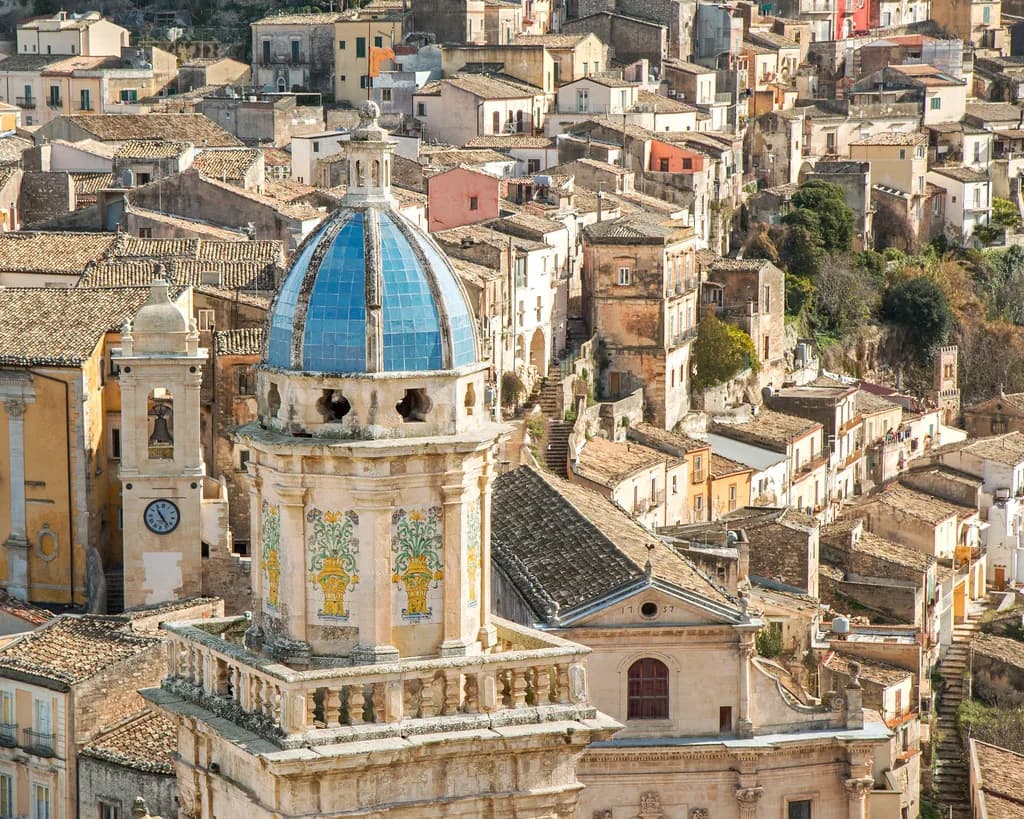
Most visitors to Ragusa Ibla plan their morning around the Cathedral of San Giorgio, whose staircase and three-tiered facade draw the crowds. Santa Maria dell'Itria sits a short walk away, and its bell tower, clad in coloured majolica tiles, is one of the most distinctive details in the whole village. For a small outlay of time it adds a different note to a day otherwise dominated by the big Baroque set pieces.
One warning shapes this guide: no reliable source consulted for it sets out year-round opening hours or entry rules for the church interior. Ragusa Welcome does publish dated visiting times for several Ibla churches across December 2025 and January 2026, which shows that access is managed period by period rather than fixed for the year, but that notice does not give specific times for Itria and those dates have passed. Treat any schedule you find elsewhere as needing confirmation.
Where the Church Sits in Ragusa Ibla
The church stands in a small, quiet square away from the busier routes through the district, according to a walking guide to the historic centre. That positioning matters more than it sounds: Ibla is dense with churches for a village of its size, and the ones off the main flow tend to be easier to look at without a crowd filing past. Build it into a loop rather than a there-and-back errand.
Ibla is the older half of Ragusa, rebuilt in Baroque style after the 1693 earthquake that devastated south-eastern Sicily, and it has held UNESCO World Heritage status since 2002 alongside other Val di Noto towns. Its core is a tangle of uphill alleys, stairways and noble palaces. Reading Itria as one thread in that fabric is more useful than treating it as an isolated monument.
For orientation across the district as a whole, including how the two halves of the city relate, the Ragusa Ibla Guide covers the layout in more depth. It helps to know before arriving that Ibla and Ragusa Superiore sit on opposite sides of a valley, connected by steep routes rather than a flat grid.
Seventeenth-Century Origins and the Knights of Malta Link
What can be stated with confidence is limited and worth setting out plainly. The building dates to the seventeenth century, and it is linked to the presence of the Knights of Malta in Ragusa, a connection that gives the church its historical interest beyond the facade. The exact construction dates are not established in the available sources, so treat round figures you see online with caution.
The same source describes the interior as more sober than other churches in Ibla, though it offers little detail beyond that. Detailed descriptions of altars, artworks and furnishings at Itria are not available here, so this guide does not attempt them. If that level of detail matters to you, ask locally or check with the parish.
What to Look For on the Exterior
The bell tower is the reason to make the detour. It is clad in coloured majolica tiles, and the source that describes Ibla's churches singles it out as one of the most distinctive details in the entire village. Majolica work of this kind is a calling card of southern Italian church architecture; here it gives a modest building a colourful vertical accent against the limestone.
Approach from a side street rather than head-on if you can, so the tower reads against the sky, and give yourself a few minutes in the square itself, which is small enough to take in at a glance. The exterior is the reliable part of a visit here: it can be seen whatever the interior arrangements turn out to be on the day.
Ibla's Baroque Context
Itria makes most sense against the Cathedral of San Giorgio, Ibla's most famous building and a masterpiece by Rosario Gagliardi whose facade dominates its square. The cathedral was rebuilt after the 1693 earthquake, with the commission entrusted to Gagliardi in 1738 and construction running across the following decades. Seeing the grand statement first sharpens your eye for the quieter churches around it.
The Duomo di San Giorgio, Ragusa covers the cathedral's architecture, its interior chapels and the treasury in detail. Note that the cathedral and its museum operate on their own arrangements, with separate hours and a paid museum; none of that carries over to Itria or any other church in the district.
Beyond the famous set pieces, the smaller churches and overlooked corners of the city reward a slower pace, and the hidden gems in Ragusa guide is a useful companion for planning which ones to add. Itria belongs naturally in that company rather than at the top of a must-see list.
Building a Walkable Route Around Itria
Start at Piazza Duomo with the Cathedral of San Giorgio, then work downhill through the alleys rather than trying to cover the village in a straight line. A sensible suggested shape, and this is a suggestion rather than any official route, is San Giorgio first, San Giuseppe second, Itria third, and the Giardino Ibleo last as a place to sit down. Allow two to three hours on your feet for the historic centre, a duration also given by a walking guide to Ibla.
The Chiesa di San Giuseppe in Ragusa Ibla stands in Piazza Pola a short walk from the cathedral and is often less crowded than its neighbour, which makes it a good lower-key counterweight before Itria. Its elliptical plan and statue-filled facade are worth a look in their own right.
Between the churches, slow down for the civil architecture. Palazzo Cosentini on Via del Mercato has balconies whose supporting corbels are carved with grotesque figures, masks, animals and mythological characters, each balcony different from the last. It is exactly the kind of detail visitors walk past without noticing, and it costs nothing to stop.
For the full picture of what the district holds, from palaces to viewpoints, the Ragusa Attractions hub groups the individual sights so you can decide what to drop when time is short. A compact route of four or five stops usually serves Ibla better than an ambitious checklist.
Ending at the Giardino Ibleo
The Giardino Ibleo sits at the eastern tip of Ibla and is a public park, free for all visitors, commissioned in the mid-nineteenth century by three wealthy local citizens and later opened to the public. Its Viale delle Palme is lined with around fifty Canary Island date palms, and a large balcony at the garden's edge looks over the Irminio valley and the caves characteristic of the Hyblaean landscape.
Within the grounds are historic churches including San Giacomo and the Capuchin church next to the diocesan museum, along with archaeological remains of walls and pavements from before the 1693 earthquake. One of the churches inside the park, San Giorgio Vecchio, survives as a ruin with a Gothic-Catalan portal, and it has its own guide. The park is a natural place to finish a walk that began at the cathedral.
Practical Planning: On Foot, Parking and Timing
Ibla is best covered on foot: the streets are narrow, some climbs are steep and comfortable shoes are essential. Parking sits outside the village, with the Porta Napoletana car park free and convenient for arrivals from Ragusa Superiore, the Via Tenente Distefano car park paid and close to Piazza Duomo, and a free car park at the Giardino Ibleo for starting at the eastern end. Spaces fill quickly on summer weekends, so arriving before nine in the morning helps.
The historic centre is also subject to a limited traffic zone covering Ibla and Marina di Ragusa, and the city publishes the rules and updates for it. Check the restrictions before driving in, especially if your accommodation is inside the zone, since access rules and enforcement are set by the municipality rather than by individual businesses.
For Itria itself, plan on a short stop: fifteen to twenty minutes for the square and the tower, longer if the interior happens to be open. That is a suggested allowance, not an official figure. Pair it with San Giuseppe nearby so the detour earns its place in the day.
Before You Go: Confirming Access
Because no current, church-specific schedule could be verified, the sensible step is to ask before travelling. The parish and the Diocesi di Ragusa are the bodies that would know about liturgical use and any visiting arrangements, and the diocesan website is the right starting point. A phone call or a message a day or two ahead is usually enough.
The Ragusa Welcome page is still worth a look as a model of how these things are published locally: it groups several Ibla churches with dated visiting windows rather than a permanent timetable, which tells you to check the current edition rather than assume last season's pattern holds.
Is Itria Worth the Detour?
Yes, if you are already walking Ibla and have a spare half hour. The majolica bell tower and the calm of a small square are a different experience from the queue-and-photograph rhythm of the cathedral, and the church sits naturally between San Giorgio and the gardens.
Go with modest expectations on the interior, confirm arrangements with the parish or diocese, and let the walk itself, the balconies, the stairways and the valley views do the rest. A city like Ragusa rewards the stops that are not on the standard circuit.
Frequently Asked Questions
What is the Chiesa di Santa Maria dell'Itria in Ragusa known for?
Its majolica-tiled bell tower is the defining detail, described as one of the most distinctive features in Ragusa Ibla. The church also has historical interest as a seventeenth-century building linked to the Knights of Malta, and it sits in a small square away from the busiest routes through the district.
Is the church free to visit, and when is it open?
No verified source confirms current opening hours or whether the interior is free or ticketed, so this guide does not state either. Visiting patterns for Ibla churches are published locally in dated windows rather than as a fixed annual timetable. Confirm arrangements with the parish or the Diocesi di Ragusa before you travel.
How long should I spend at Santa Maria dell'Itria and in Ragusa Ibla?
A suggested fifteen to twenty minutes covers the square and the exterior, but that is an editorial estimate, not an official figure. For the historic centre overall, plan two to three hours on foot, which is the allowance given by a walking guide to Ibla. Add more if you plan to enter several churches or stop at the gardens.
Where does the church sit within a walking route of Ragusa Ibla?
It works well as a third stop after the Cathedral of San Giorgio at Piazza Duomo and the Chiesa di San Giuseppe at Piazza Pola, before finishing at the Giardino Ibleo at the eastern end of the village. The route is on foot through narrow, often steep alleys, so wear comfortable shoes.
Can I drive to the church, or where should I park?
The historic centre is not open to casual driving, and parking is outside the village. Options include the free Porta Napoletana car park for arrivals from Ragusa Superiore, a paid car park near Piazza Duomo, and a free one at the Giardino Ibleo. Spaces fill quickly in high season, so an early start helps.
What else is worth seeing near the church in Ibla?
The Cathedral of San Giorgio and its square are the obvious anchors, and Palazzo Cosentini on Via del Mercato has carved balcony corbels that reward a pause. The Giardino Ibleo offers free public grounds, valley views and churches within its walls, including the ruined San Giorgio Vecchio with its Gothic-Catalan portal.
Sources
Continue exploring
More guides you'll find useful