Chiesa di Santa Maria delle Scale: Ragusa's Stairway Church
Plan a stop at Chiesa di Santa Maria delle Scale between Ragusa Superiore and Ibla: its hospice origins, Gothic portals, and views from the stairway.
On this page
Chiesa di Santa Maria delle Scale is described by the city's tourism portal as one of the oldest and most interesting churches in Ragusa, and its position is as much a reason to stop as its interior. It stands on the steep slope that separates the two halves of the city, so most visitors meet it while walking between them rather than seeking it out. Further visitor details appear in Visit the churches in Ragusa.
That position shapes how you should plan the visit. Treat the church as a pause inside a route decision: descend on foot through the stairways toward Ibla, or come up from the old town and see it on the way. Either way, build in a few minutes for the exterior and the view over the valley before continuing. A suggested allowance is fifteen to twenty minutes, an editorial estimate rather than an official figure.
Where the Church Stands Between Two Ragusas
The church occupies a ridge on the descent from Ragusa Superiore to Ragusa Ibla, above the Valle del Gonfalone. According to local tradition recorded in visitor descriptions, a small shrine to the Madonna probably stood here first, followed by a hospice. That setting on the brink of the slope explains both the name and the reason the site once served people moving between the upper town and the old centre.
Ragusa's dual layout is itself a consequence of the 1693 earthquake, after which one group rebuilt on the old site and another on the higher plateau. Knowing that split helps you read the walk: you are crossing between two different reconstructions of the same city. The wider context is covered in the Ragusa Ibla: Complete Guide to the Baroque Historic District and the Ragusa Superiore: Guide to the Upper Town's Sights.
From Hospice of the Cataratte to Parish Church
Local tradition places a small shrine to the Madonna on this spot before anything larger was built. A hospice followed, known as the hospice of the Cataratte because it overlooked the steep drop toward the Gonfalone valley, and it was entrusted to Cistercian friars who cared for the image kept there.
In the fourteenth century the hospice was transformed into a church, Santa Maria delle Cataratte. The dedication later settled as Santa Maria delle Scale, a reference to the stairways that now define the approach rather than to the old hospice.
Institutional details for Ragusa's churches are best checked through the diocese, while the Comune di Ragusa publishes civic notices, event listings and information on temporary street closures. Neither source functions as a live timetable for this church, so confirm locally rather than relying on a guidebook edition.
After the 1693 Earthquake: A Rotated Church
The 1693 earthquake caused serious damage, and the rebuilding that followed enlarged the structure while turning its axis. The former apses became the portals of today's right aisle and the rooms attached to them, which is why the building reads differently from the outside than its medieval plan would suggest.
Of the original central entrance, only the left portion survives, walled into an exterior wall to the right of the left-aisle doorway. Look for it before you go in; it is easy to walk past while heading for the view.
What Survived: Gothic Portals and the Central Nave
Four portals now face the central nave, and they carry the strongest evidence of the pre-earthquake building. The first, to the right of the entrance, rests on carved columns rising into a pointed Gothic arch; the second is a pointed arch topped by a Madonna and Child.
The third portal was rebuilt in the sixteenth century, keeping Gothic columns below and adding Renaissance floral detail above. The fourth closes the sequence with a bundle of small columns forming another pointed arch, giving the nave an unusually layered architectural history in a single glance.
Inside: The 1538 Transit of the Virgin
At the altar corresponding to the third portal, a terracotta work dated 1538 depicts the Transit of the Virgin, with the Madonna surrounded by the Apostles at the moment she gives her soul back to God. It is a historical artwork in a working church, not a separately ticketed exhibit, so there is no reason to expect an extra admission charge to see it.
Beyond that piece, the nave portals and the aisles are the main things to read slowly if the church happens to be open when you pass. Ragusa has many churches whose visiting arrangements change seasonally, and the city's tourism portal lists openings for a selected group rather than every building, so treat this one as a stop to attempt rather than a guarantee. Further visitor details appear in Visit the churches in Ragusa.
The Views from the Stairway
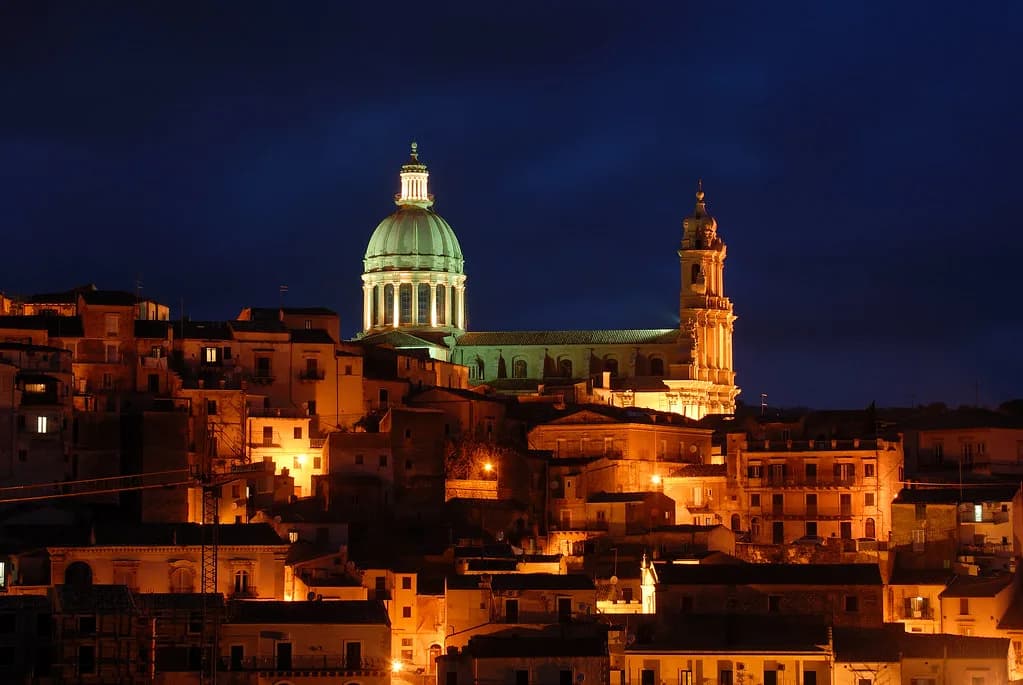
The church's value as a viewpoint comes from its position rather than any constructed terrace. Standing on the slope above the Gonfalone valley, the building sits where the descent opens out, and the view is the one that makes the walk between the two districts worth doing on foot.
The route between the levels is a recognised panoramic descent, with the way down from the upper town and the climb from Ibla offering different angles on the rooftops and domes. A villa-rental travel guide notes that the view from the Church of Maria delle Scale features in panoramic establishing shots of Ragusa Ibla in the Inspector Montalbano television series.
Walking the Steps or Arriving by Car
One widely read visitor account puts the stairway between the two districts at roughly 242 steps, but that figure comes from a single travel guide rather than the comune or the diocese. Use it as an order of magnitude, not a precise measurement, and judge your own stamina against the heat of the season.
On foot, the church falls naturally on a descent from Ragusa Superiore toward Ibla, which is the easier direction for most people. By car, roads reach Ibla without the stairs, though parking in the historic centre is its own exercise. A transfer company's guide to the city sets out the broad transport options, but it is a commercial page rather than an official timetable.
The city also publishes notices on temporary street closures and traffic restrictions, including measures affecting routes around Ibla. Check the Comune di Ragusa before driving on a day when you plan to combine the church with a wider loop.
How Much Time to Allow
A suggested allowance is fifteen to twenty minutes at the church itself, plus however long the stairway takes you; that is an editorial estimate, not an official figure. If the doors are shut, the exterior, the portals and the view still justify the pause.
Build the stop into a half-day in Ibla rather than treating it as a separate excursion. Descend, see the church, then continue to the Duomo di San Giorgio and the Giardino Ibleo, which was established in 1858 and remains the oldest of the city's four gardens.
Pairing the Church With Ibla's Other Sights
The Duomo di San Giorgio dominates its own piazza in Ibla with Rosario Gagliardi's facade, begun in the eighteenth century, while its neoclassical dome was added later. Save it for after the descent so the climb up its staircase does not compete with the one you have just walked down.
Two smaller churches make a natural continuation through the alleyways: the Chiesa di San Giorgio Vecchio in Ragusa Ibla, which preserves the memory of the pre-earthquake dedication, and the Chiesa di San Giuseppe, Ragusa, whose eighteenth-century facade belongs to the same Baroque repertoire.
The upper town repays a separate block of time, with the Cattedrale di San Giovanni Battista as its anchor. Its own website carries parish news, liturgical celebrations and information on the cathedral museum and bell tower, which makes it the reliable place to confirm arrangements before crossing back up. For wider planning, see Cattedrale di San Giovanni Battista, Ragusa: Visitor Guide.
What to Confirm Before You Go
Opening access is the one thing you cannot settle from published guides. The city's church-visiting page groups openings by period and lists only selected buildings, so use it as a pattern rather than a promise for Santa Maria delle Scale, and confirm at a tourist information office on arrival.
Also ask about restoration work and the state of the steps, neither of which is reliably reported. The stairway is a public route through the city rather than a managed attraction, so conditions depend on weather and maintenance rather than a published schedule.
A Slow Descent Pays Off
Santa Maria delle Scale rewards the visitor who treats it as part of the walk rather than a box to tick. The portals, the 1538 terracotta and the rotated plan only make sense if you give them a few quiet minutes, and the view needs no ticket at all.
Go down on foot if you can, keep the church conditional on its doors being open, and let the rest of the day flow toward San Giorgio and the gardens. For more corners that fall outside the main circuit, the hidden gems in Ragusa make a useful second list, and the Ragusa Attractions hub gathers the guides to individual sights.
Frequently Asked Questions
Where is Chiesa di Santa Maria delle Scale located in Ragusa?
It stands on the steep slope between Ragusa Superiore and Ragusa Ibla, above the Valle del Gonfalone, on the route that links the upper town with the historic centre. Visitors normally reach it on foot while descending the stairway, or by road from the Ibla side.
How many steps are there between the two districts via the church?
One villa travel guide puts the stairway at roughly 242 steps, but that figure is not confirmed by the comune or the diocese. Treat it as an approximate idea of the climb and plan around your own fitness and the season rather than a precise count.
What survived the 1693 earthquake in Santa Maria delle Scale?
The rebuilding after the earthquake rotated the church's orientation, turning the former apses into today's right-aisle portals. Four Gothic and Renaissance portals still face the central nave, and the left part of the original central entrance survives walled into an exterior wall to the right of the left-aisle doorway.
What can you see inside the church?
The main artwork is a terracotta Transit of the Virgin dated 1538, at the altar corresponding to the third portal, showing the Madonna among the Apostles. The nave portals themselves are the other thing to study, since each records a different building phase.
Are the views from the church worth the climb?
The appeal is the setting rather than a purpose-built terrace: the church sits where the descent opens over the valley, and the route between the two districts is a recognised panoramic one. Late afternoon light on the limestone is the best reason to time the walk rather than rush it.
Is the church free to visit and when is it open?
No reliable current opening information is published for this church, so check with the tourist information office or the diocese when you arrive. Do not assume it will be open just because it appears in a citywide church list.
How much time should I allow for the church and the staircase?
A suggested allowance is fifteen to twenty minutes at the church, plus whatever the stairway takes you; that is an editorial estimate, not an official one. If the doors are closed, the portals and the view still make the pause worthwhile.
Can you reach the church by car instead of on foot?
Roads reach Ibla without the stairs, and the city publishes notices on temporary street closures that can affect routes in the area. Check those notices before driving, and expect parking in the historic centre to be limited.
Sources
Continue exploring
More guides you'll find useful