10 Essential Tips for Your Strahov Monastery Library Visitor Guide
Plan your visit to the Strahov Monastery Library with our guide to tickets, opening hours, and the 10 essential tips for seeing the Theological and Philosophical Halls.
On this page
10 Essential Tips for Your Strahov Monastery Library Visitor Guide
High above the Vltava River sits one of the most beautiful libraries in the world.
The Strahov Monastery Library serves as a beacon of knowledge and stunning Baroque art in the heart of Prague.
Visitors often feel transported back in time when they step into these hallowed halls.
This guide provides everything you need to know for a seamless and memorable visit.
Learn the History of the Premonstratensian Monastery
The Premonstratensian order founded Strahov Monastery in 1140, making it one of the oldest continuously operating monasteries in Central Europe. Over the following centuries it was destroyed by fire and war multiple times, yet the monks always rebuilt it and prioritized their library above almost everything else. That resilience is why you can stand here today surrounded by nearly 200,000 volumes accumulated across nine centuries.
The library began taking its current two-hall form in the second half of the 17th century. Baroque architects worked closely with the monastic community to create spaces that honored both theological scholarship and artistic beauty. Every gilded shelf, cartouche, and fresco was designed with a specific purpose within the intellectual program of the order.
A critical moment in the library's survival came in the late 18th century when Emperor Joseph II began dissolving monasteries across the Habsburg lands. The Strahov abbot Václav Mayer strategically opened the library to the public, arguing its educational value, and even placed a medallion of Joseph II on the library facade to curry favor. That pragmatic move saved the institution. After 1989, following decades as a state museum under communist rule, the library was returned to the Premonstratensian order, which still operates it today.
Verify Current Opening Hours and Admission Fees
The library is open every day from 09:00 to 17:00, including weekends. Last entry is at 16:30 and ticket sales close at 16:15, so do not plan a late afternoon arrival expecting a full visit. The site closes on Christmas Eve, Christmas Day, and Easter Sunday. Always confirm the latest schedule on the official Strahovskyklaster.cz site before you go, as special liturgical events occasionally affect access.
In 2026, the library-only self-guided admission costs CZK 190 for adults. A reduced ticket is CZK 90 for children aged 6–17, ISIC students under 26, and seniors over 65. A family ticket covering one or two adults with up to five children under 14 costs CZK 390. Tickets can be bought at the ticket office near the main gate or online in advance.
If you want to combine the library with the Strahov Art Gallery, the joint ticket costs CZK 340 for adults (reduced CZK 190, family CZK 390). The gallery is housed in a separate building and holds an impressive collection of Gothic, Baroque, and 19th-century Czech and European paintings. Most visitors find the library alone takes about 40 minutes at a comfortable pace.
- Library-only self-guided: CZK 190 adult / CZK 90 reduced / CZK 390 family
- Joint Library + Art Gallery: CZK 340 adult / CZK 190 reduced / CZK 390 family
- Photography permit: CZK 50 (video permit CZK 100) — paid separately at the ticket desk
Last entry is at 16:30 and ticket sales close at 16:15, so plan your arrival well before mid-afternoon to ensure you have enough time to view both halls comfortably.
Navigate the Route via Tram 22 or Petřín Hill
The most reliable way to reach the monastery is Tram 22, which runs from the Malostranská metro station (Line A) up through the castle district. Ride it to the Pohořelec stop, then walk downhill for about five minutes to the monastery gate. The tram is frequent, inexpensive, and offers views of Lesser Town as it climbs the hill.
If you prefer to walk, the ascent through Petřín Hill is genuinely scenic. From the Petřín Lookout Tower it takes roughly 15 minutes on paved paths with panoramic views of the city opening up as you climb. Wear shoes with grip, since some stretches of the park path are cobbled and can be slippery after rain.
Taxis and ride-sharing apps drop off directly at the monastery gate, which is useful if you have heavy bags or limited mobility. Street parking in Hradčany is extremely restricted; public transport is the practical default for almost all visitors. Note that the monastery is about 500 metres west of Prague Castle, so many people combine both in a single half-day walking between the two.
View the Baroque Splendor of the Theological Hall
The Theological Hall was built between 1671 and 1679 to a design by architect Giovanni Dominik Orsi, a Prague resident of Italian origin. His influence shows in the elaborate stucco ceiling decorations and the elegant proportions of the low vaulted space. Siard Nosecký painted the ceiling frescoes in the 18th century; they depict the correct relationship between faith and knowledge, with Latin quotations from the Bible woven into the composition.
Above the bookshelves you will notice gilded wooden cartouches with painted pictures and inscriptions. These identify the type of literature stored on the shelves directly below — essentially the first library cataloguing system. The hall holds around 18,000 volumes focused on theology and religious studies, many of them rare editions accessible only to scholars with written permission.
Standing at the doorway, look toward the center of the hall for the pair of 17th-century terrestrial and astronomical globes. They were crafted to sit alongside the books as working reference tools, not decorative objects. The architecture here is among the finest early Baroque work surviving in Prague. If this style appeals to you, the Klementinum library offers a different take on the same era just a short tram ride away in the Old Town.
Experience the Grandeur of the Philosophical Hall
The Philosophical Hall was created in the 1790s when the monastery needed space for a much larger collection. Architect Ignác Palliardi converted the former granary into a two-storey Classicist library hall, 32 metres long, 10 metres wide, and 14 metres tall. The walnut shelving was brought from the dissolved Premonstratensian monastery in Louka near Znojmo and reassembled here, preserving an earlier generation of craftsmanship inside a new building.
Anton Maulbertsch spent over six months painting the massive ceiling fresco, working with just one assistant. The painting carries the theme "Journey of Mankind to Wisdom" and is packed with historical figures — Socrates, Diogenes, Alexander the Great, Noah — arranged to show the interplay between religious faith and rational inquiry. The composition rewards slow study; new faces and scenes keep appearing the longer you look.
One detail almost everyone misses: the spiral staircases in the hall's corners, which give access to the upper gallery, are hidden behind doors painted to look like rows of book spines. The trompe-l'oeil is convincing enough that first-time visitors often walk past them without noticing. The hall currently holds over 42,000 volumes covering philosophy, science, medicine, law, and geography — evidence that this was never a purely religious collection.
Inspect the Rare Artifacts in the Cabinet of Curiosities
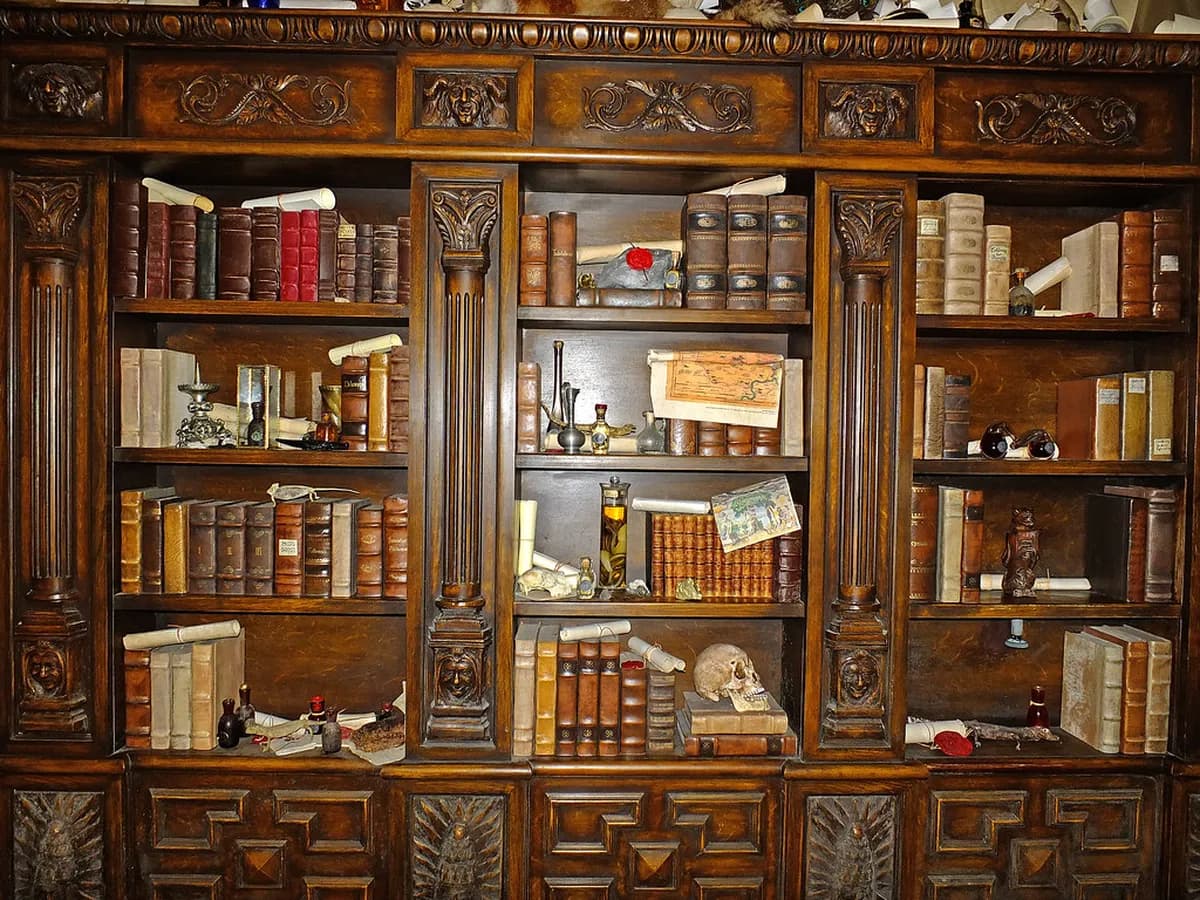
The corridor connecting the two halls functions as an extended Cabinet of Curiosities, a collection assembled from the estate of Karel Jan Erben and brought to the monastery in 1798. It reflects the 18th-century Wunderkammer tradition: wealthy collectors gathered remarkable objects — animal specimens, minerals, weapons, ceramics, wax fruit replicas — as conversation pieces and demonstrations of worldly curiosity. The cabinet at Strahov is one of the best-preserved examples of this tradition in the country.
A centrepiece of the Theological Hall side is the compilation wheel, a large mechanical desk fitted with a rotating rack. Scholars placed several books open simultaneously on the wheel's shelves and used a counterweight mechanism to turn between them without the volumes falling or losing their page. It functioned as a physical multi-source reference tool long before any digital equivalent existed, and it remains in the hall essentially as it was used in the 17th century.
Do not rush past the Xylothek at the end of the corridor. These 68 volumes, prepared by Karel of Hinterlagen around 1825, are bound in the bark of the specific tree they describe and contain actual samples of that tree's wood, leaves, seeds, and blossoms inside. They look like books but are effectively a tactile botanical library. For more unusual historical collections nearby, the Speculum Alchemiae in the Old Town is worth pairing with your Strahov visit.
Relax at the Strahov Monastery Brewery (Klášterní Pivovar)
The Klášterní Pivovar began brewing on these grounds in the 1600s, when the monks produced beer as a practical income source for the order. Today it operates as a brewpub serving several varieties of St. Norbert beer — named after the founder of the Premonstratensian order — including a dark, a light, and rotating seasonal brews. The copper tanks are visible from the bar area.
The brewery garden faces west across the valley toward Prague Castle, which makes late afternoon the optimal time to arrive. Visit the library between 09:00 and around 14:00, then take a table outside with a cold glass while the light softens over the city skyline. This is the practical version of what regular visitors call the "Sunset Strategy" — it works especially well from May through September in 2026 when evenings are long. The restaurant also serves traditional Czech dishes: roasted pork knee, duck with red cabbage, and bramboráky (potato pancakes).
Reservations are advisable during peak summer months, particularly on weekends. The terrace fills quickly after 17:00 when the library closes and visitors drift over. Walk-ins at 15:00–16:00 on a weekday rarely have trouble finding a table.
Choose Between Standard Viewing and VIP Private Access
Standard tickets allow you to view the Theological Hall and Philosophical Hall only from the entrance doorways — you cannot step onto the historic floors. This is not a restriction unique to budget visitors; it applies to everyone without a pre-booked private tour. The reason is conservation: body heat, humidity from breath, and foot traffic would accelerate deterioration of the parchment and pigments over time. Even from the doorway, both halls are entirely visible including the ceiling frescoes.
If walking inside the halls is a priority, you need to book a VIP private tour through a licensed guide. The library charges around CZK 700 per person for this access, plus a booking fee per group. Availability is limited and bookings must be made days to weeks in advance depending on the season. The Prague City Tourism site lists current contact details for arranging private tours.
For most visitors, standard access is entirely satisfying. The viewing corridors are narrow, so position matters more than proximity. Arrive within the first hour of opening — between 09:00 and 10:30 — before the large guided tour groups start arriving mid-morning. By 11:00 the doorways can get congested with multiple groups queuing simultaneously; at 09:15 you may have the view to yourself for several minutes at a time.
Flash photography is prohibited to protect the frescoes and manuscript pigments; a smartphone on automatic mode handles the low-light conditions well without additional lighting equipment.
Remember to Purchase a Photography Permit
Photography inside the library requires a separate permit costing CZK 50, purchased at the ticket desk alongside your entry ticket. A video permit costs CZK 100. Payment is accepted by card or cash in Czech crowns. The permit comes as a small sticker; attach it visibly to your jacket, bag strap, or camera so the hall custodians can confirm it at a glance. Staff check actively and will ask you to put your camera away if you are photographing without one.
Flash photography is prohibited throughout the library to protect the frescoes and manuscript pigments. Tripods and professional lighting rigs are also not permitted on a standard permit. A modern smartphone on automatic mode handles the low-light conditions well: the halls are lit to a warm, even level that suits handheld shooting. Switch to your phone's "night mode" or simply keep your ISO high and shutter speed moderate if you want sharper results without flash.
The best photo position in the Theological Hall is standing just inside the doorway threshold and shooting slightly upward to capture both the globes and the ceiling fresco in the same frame. In the Philosophical Hall, step to one side of the doorway to get an angled view along the full length of the shelving rather than shooting straight in. Both techniques work better with a wider lens.
Plan Your Visit Around Nearby Hradčany Attractions
The monastery sits in the Hradčany district, roughly 500 metres west of Prague Castle's main gate. A natural half-day route starts at Strahov, walks east through the castle grounds, and descends into Lesser Town via the Old Castle Steps. This direction — downhill all the way — is considerably easier on the legs than the reverse, and gives you the major sights in a logical sequence without backtracking.
The Lobkowicz Palace inside the castle complex adds history, music, and a rooftop café to the day. The Loreto Sanctuary, just a few minutes' walk from Strahov, houses an extraordinary treasury of Baroque metalwork and a famous carillon that plays on the hour. Both are quieter than the main castle route and reward the detour.
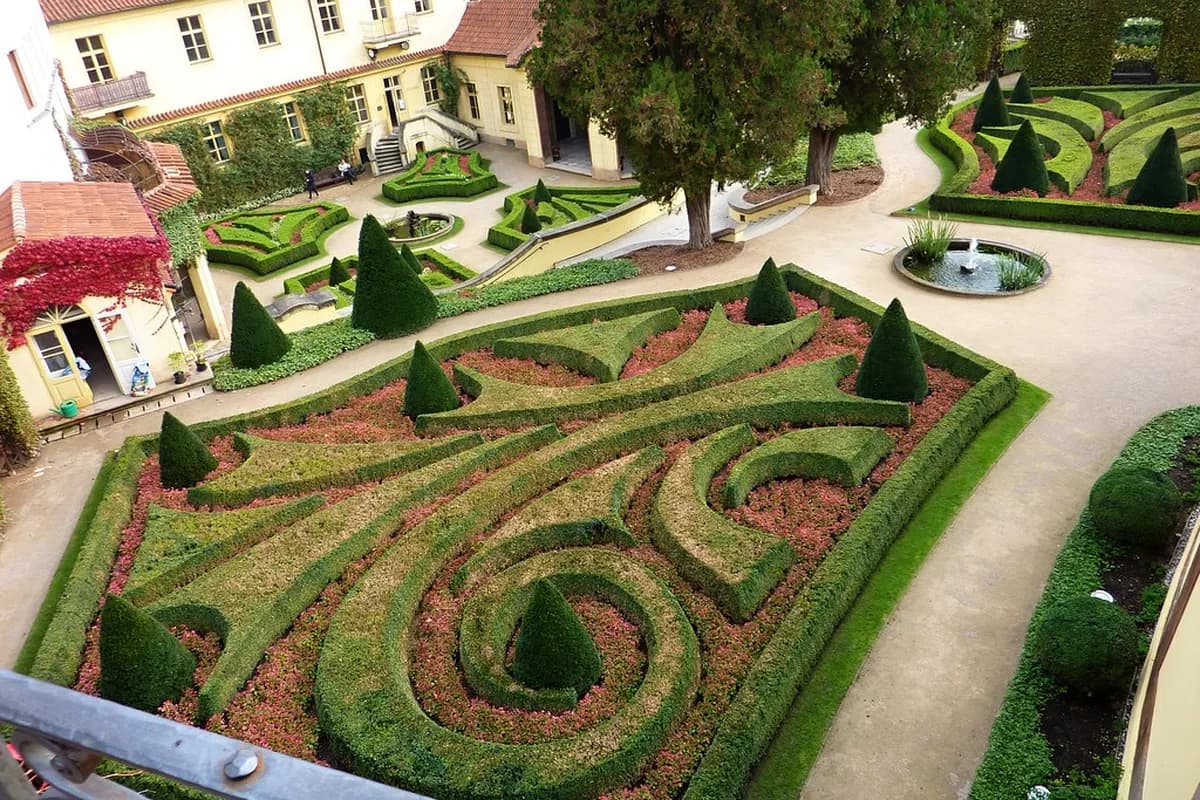
For something more contemplative, the Vrtba Garden in Lesser Town is one of the finest Baroque gardens in Prague and connects the castle district to the riverbank. The walk between Strahov and the garden takes about 20 minutes through streets lined with palaces and embassies. Combine all three — library, castle, garden — and you have a full half-day itinerary in one of the most atmospheric parts of the city.
Frequently Asked Questions
Is the Strahov Library worth it?
Yes, the Strahov Library is absolutely worth visiting for its stunning Baroque architecture and historic book collections. Even though you view the halls from the doorway, the visual impact of the frescoes and globes is unforgettable. It is a must-see for anyone interested in history or art in Prague.
Can you go inside the Strahov Library halls?
Standard ticket holders can only view the halls from the doorway to protect the ancient books. To actually walk inside the Theological and Philosophical Halls, you must book a private VIP tour well in advance. These tours are limited and come at a significantly higher price point.
How much is the entrance fee for Strahov Monastery?
The basic entrance fee for the library is 150 CZK for adults in 2026. If you wish to visit the Art Gallery as well, a joint ticket is available for 280 CZK. Don't forget that a separate photography permit is required if you want to take pictures inside the halls.
How do I get to Strahov Monastery from Old Town?
The easiest way is to take Tram 22 from the Malostranská metro station up to the Pohořelec stop. From there, it is a simple five-minute walk to the monastery gates. You can also walk through the Wallenstein Garden area and then hike up the hill for a more scenic route.
Other Monastic Foundations Still Standing
The Theological and Philosophical Halls are still shelved as the Premonstratensians left them, with the cabinet of curiosities in the corridor between. London's Charterhouse survived the Dissolution by becoming an almshouse and has run as one since. Madrid's Descalzas Reales stayed enclosed and kept its Titians and tapestries in place.
The Strahov Monastery Library remains a crown jewel of Czech culture and history.
Planning your visit with these tips ensures you won't miss the hidden details like the compilation wheel.
Whether you are an art lover or a history buff, the halls will leave you inspired.
For even more depth on the library secrets, read the guide at Thecreativeadventurer.com before you go.
For official details, visit the Strahov Monastery Library on Wikipedia.
Continue exploring
More guides you'll find useful