Piazza dell'Anfiteatro Lucca: Visitor Guide to the Oval Square
Plan a visit to Piazza dell'Anfiteatro in Lucca: how the Roman amphitheatre shaped this oval square, what to look for in the ring of buildings, and when to go.
On this page
Most squares in a Tuscan city announce themselves with a straight facade and a regular grid. Piazza dell'Anfiteatro does the opposite: it curves, closes in on itself and leaves you standing in an ellipse whose edges never quite meet a right angle. The shape is the main reason to seek it out, and understanding why it looks this way turns a quick photo stop into one of the more memorable half hours in Lucca.
The square is free public space, so the only decision is when to arrive and how to move through it. A sensible approach is to enter by one of the gateways, walk the inner ring once, then sit down only if the atmosphere suits you. As an editorial suggestion rather than any official guidance, allow roughly twenty to forty minutes, more if you plan to eat or drink at one of the surrounding cafes.
Why Piazza dell'Anfiteatro Is Shaped Like an Ellipse
The oval is not a stylistic flourish. The piazza occupies the site of the ancient Roman amphitheatre that once stood on this ground, and the ring of houses around it still traces that original curve. Descriptions of the site explain that the surrounding buildings follow the form of the structure that came before them, which is why the square reads as a bowl rather than a rectangle.
This matters for how you navigate. Because the perimeter is fairly continuous, you arrive through openings in the ring rather than from a wide avenue. Expect to feel the space close around you within a few steps, and look back at the entrance you used to see how completely the buildings enclose the centre.
From Spectacle Venue to Fortified Ruin to Rebuilt Piazza
In Roman times this was an entertainment building rather than a residential square, used for the kind of mass spectacle that amphitheatres were designed to host. The structure was later fortified during the Gothic Wars, when the old arena became part of the city's defences instead of a venue. Over the following centuries, buildings went up on the ruins, and the site gradually lost any readable resemblance to its original purpose.
The square you see today is the product of a later intervention by the architect Lorenzo Nottolini, who recovered the elliptical plan and gave the space its current form. One account dates his work to the early nineteenth century, while another places the restoration in the eighteenth; because the sources disagree on the timing, it is safer to remember the architect and the idea rather than a precise date. What survived the rebuilding was the geometry: a round-edged public space fitted into the old arena's dimensions.
Not every arcade you see is ancient. Some shops facing the square have old structures emerging inside them as vaults and arches, but the arches visible around most of the piazza are more recent work, so avoid pointing at every would-be ruin and calling it Roman. For official context on the city's monuments, the city tourism board and the municipality publish background that is worth checking before you go deeper into Lucca's history.
Reading the Ring of Buildings
Stand in the middle and turn slowly, and you will notice that the facades are not uniform. Heights vary, roofs sit at different levels and the curve is made up of individual houses rather than one continuous monumental front. This patchwork is the clearest sign that the amphitheatre outline was reused by ordinary buildings rather than reconstructed as a single monument.
Look for doorways and ground-floor openings that follow the bend instead of cutting across it. Those adjustments are where the old shape is easiest to read, and they reward a slow lap of the perimeter more than a photograph taken from the centre. If you want a similar exercise in close reading of historic fabric, the towers and churches of the historic centre offer other examples, collected in the hidden gems in Lucca guide.
The Gateways and the Central Cross
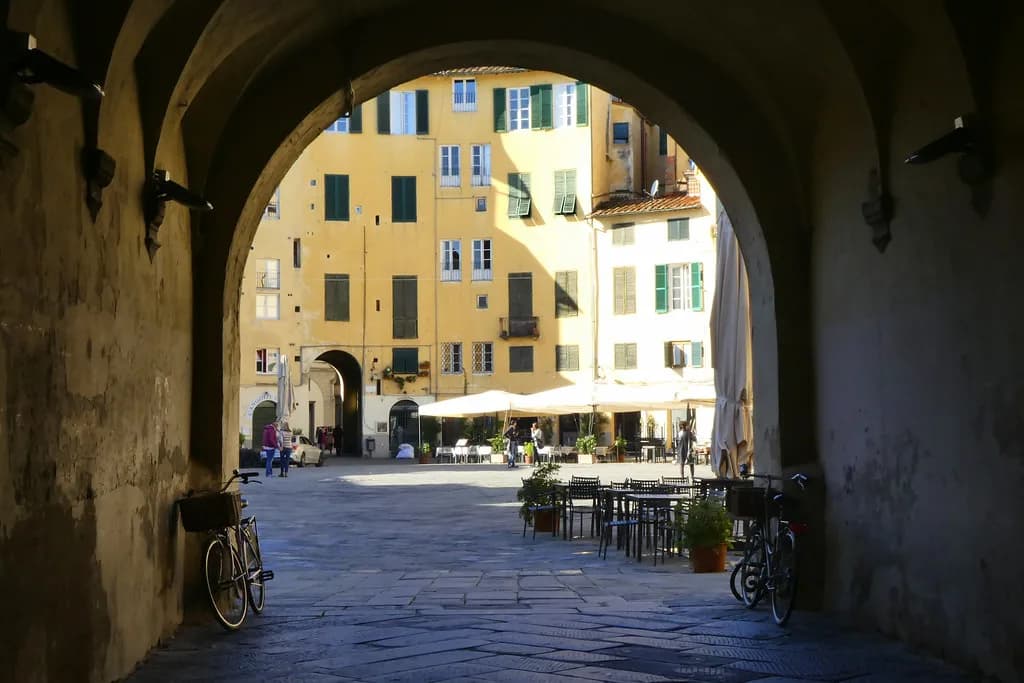
The square is reached through four openings that break the ring of buildings. The paving at the centre carries a cross whose arms point towards these gateways, a quiet piece of design that tells you how the space was planned to be crossed. Find the cross before you pick a direction and you will understand the layout instead of wandering through it.
According to one account of the site, the left arch is the surviving part of the ancient amphitheatre that visitors see directly on entering, while the other arches now found in the square were built in the last century. Treat that detail as a way to look more carefully at the masonry rather than as a fixed rule, and check what you are standing in front of rather than assuming every opening is original. Then cross to the centre, check the cross underfoot, and choose a second exit to leave by so you see two different approaches.
Using the Cafes and Shops as a Pause
The ring of buildings is occupied by cafes, restaurants and small shops, which makes the piazza a natural resting point rather than a sight to tick off. Treat it as a break in a longer walk: the seating outdoors is pleasant in good weather, but menus, opening times and whether a particular business is trading today are not published in any consistent way, so check on arrival rather than relying on a planner.
For prices and hours, read the posted menu or board outside each establishment and ask before sitting down where a cover charge is unclear. That small check matters more here than in a purpose-built dining district, because many of the businesses are small, seasonal or family-run. If you would rather keep the stop brief, a coffee or a drink at the edge of the square still lets you watch the space fill and empty.
Budget-conscious visitors can treat the square as a free pause and spend elsewhere. The architecture costs nothing to look at, and the main expense is whatever you choose to order. Staying on foot is easy, since the piazza sits inside the walled centre, close enough to connect to the rest of the historic core without transport.
Timing Your Visit: Season, Hour and Crowds
Lucca works as a year-round destination, but the piazza's outdoor character makes warmer months the period when the square feels most alive. That same appeal brings street performers, musicians and artists in the busier season, so you trade calm for atmosphere. If your priority is the architecture rather than the buzz, the shoulder seasons usually give you a better balance.
For a quieter experience, aim for early morning or late afternoon, when the square is typically less crowded according to one visitor description. Those windows are general guidance on ambience, not a guarantee, and they can shift with school holidays, weekends and events in the city. Before fixing a time, check the local tourism calendar for anything scheduled in the centre that day, and expect the crossing point of the four gateways to be busiest.
Where the Square Sits in a Lucca Walking Route
Piazza dell'Anfiteatro lies in the heart of the walled centre, so it fits naturally into a walking loop rather than demanding its own trip. A practical order is to start on the walls, come down into the streets, and use the piazza as a mid-route pause before continuing to the churches and towers. The Lucca City Walls visitor guide explains the circuit that frames everything inside.
Nearby, Via Santa Zita is listed as the address associated with the piazza in one visitor listing, so it is a useful reference point when you are navigating on foot. From here it is a short walk to other landmarks, so pair the piazza with one climb or one church rather than trying to see everything in a single push. The Guinigi Tower (Torre Guinigi) visitor guide covers the best-known ascent in the centre and helps you judge whether to add it to the same outing.
Two churches make good companions on the same walk. The Church of San Frediano Lucca visitor guide covers a landmark in the northern part of the centre, while the Church of San Michele in Foro Lucca visitor guide covers the church on what was the Roman forum. Either pairing keeps the walk compact and lets you see the piazza twice, from different directions.
Plan Your Visit
Piazza dell'Anfiteatro rewards a little preparation more than most squares: arrive through a gateway, read the ring of buildings, find the cross underfoot, and you will see a Roman arena in the outline of an ordinary town square. Keep the visit short, use the cafes as a pause rather than the point, and check current menus and city events on the spot. For the wider picture, the Lucca Attractions hub sets this square alongside the city's other visitor guides.
Frequently Asked Questions
Is Piazza dell'Anfiteatro free to visit?
The square is public open space, so walking in and looking around costs nothing. Cafes, restaurants and shops around the ring set their own prices, which you should check on their posted menus before ordering.
How long should you spend at Piazza dell'Anfiteatro?
As an editorial suggestion rather than official guidance, plan on about twenty to forty minutes if you want to walk the ring, find the central cross and take a few photographs. Add time if you stop for a drink or a meal at one of the surrounding businesses.
Why is Piazza dell'Anfiteatro oval?
The square follows the footprint of the Roman amphitheatre that once occupied the site. Its buildings trace that curve, and the architect Lorenzo Nottolini later restored the elliptical plan that shapes the piazza today.
When is Piazza dell'Anfiteatro likely to be quieter?
Early morning and late afternoon are generally calmer, while warmer months bring performers and larger crowds. These are ambience patterns rather than fixed rules, so check the city tourism calendar for events on your dates before setting a time.
How do you get into Piazza dell'Anfiteatro?
You enter through openings in the ring of buildings, with four gateways aligned to the cross in the paving. One account identifies the left arch as the visible remnant of the ancient structure, while most of the other arches are more recent construction.
Is there anything to see inside the ring of buildings?
Yes: look at the varied heights and curved ground-floor openings of the facades, and at the shops where old vaults and arches emerge. Not every arch is Roman, so check which elements are original before assuming the whole ring is ancient.
Sources
Continue exploring
More guides you'll find useful