Jardines de Monforte Valencia: A Guide to the City's Secret Garden
Visit Jardines de Monforte in Valencia: free entry, opening hours, the marble Congress lions, and why this neoclassical garden beats the crowds at Turia Gardens.
On this page
Jardines de Monforte: Valencia's Most Romantic Neoclassical Escape
Last updated July 2026, this guide to Jardines de Monforte Valencia covers everything needed for a quiet hour among neoclassical hedges and marble statues. Tucked into Plaza de la Legión Española, this walled garden predates the sprawling Turia riverbed park next door by more than a century and rarely draws the same foot traffic. Expect bougainvillea-covered pergolas, a domed pavilion, and free entry that keeps it one of the city's more overlooked stops.
Jardines de Monforte at a Glance
Jardines de Monforte sits in Valencia's Exposición district, a walkable distance from the city center. The grounds are compact enough to see in under an hour, yet dense enough with statues and fountains to reward a slower pace. Before stepping through the pavilion entrance, here is what to expect.
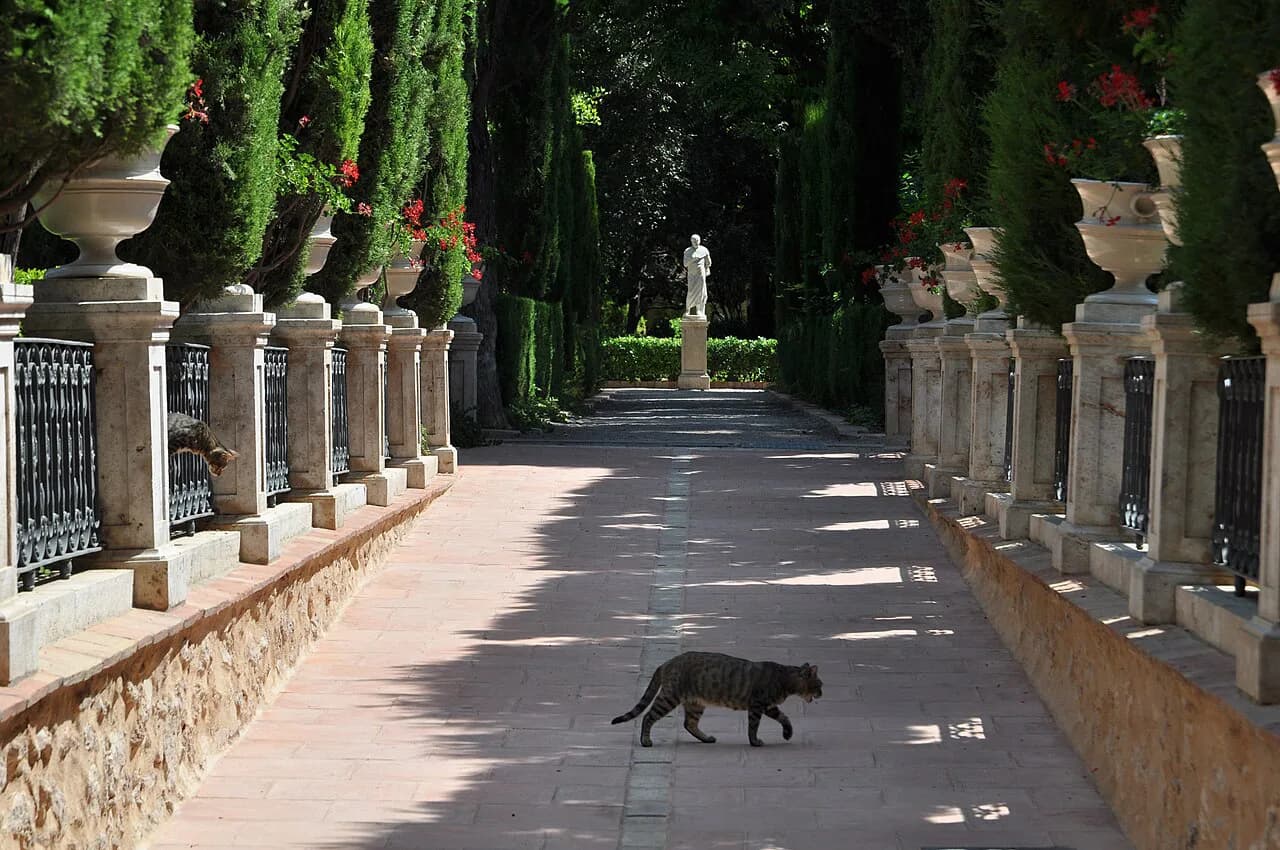
Despite its compact 12,000 square-meter footprint, the garden contains distinct formal and romantic zones: clipped hedges and parterres near the entrance transition to bougainvillea-covered pergola tunnels in the western section.
- Location: Plaza de la Legión Española, Valencia
- Entrance fee: Free
- Time needed: 45 to 60 minutes
- Size: roughly 12,000 square meters (about 3 acres), fully walled
- Style: 19th-century neoclassical, with a later romantic-garden zone
- Protection: Bien de Interés Cultural since 1941, with regional protection added in 1998
- Best for: photography, quiet walks, and 19th-century architecture
History: From the Hort de Romero to a National Artistic Garden
The garden began as farmland outside Valencia's old city walls, part of an estate known as Hort de Romero. José Vich, Barón de Llaurí, owned the plot until 1849. That year he sold it to Juan Bautista Romero Almenar, the Marqués de San Juan.
The marqués commissioned architect Sebastián Monleón y Estellés to redesign the grounds starting in 1859. Monleón's plan followed strict neoclassical geometry: straight axes, clipped hedges, and statuary set on a formal grid. That structure survives largely intact today, and it remains the reference point for the garden's Bien de Interés Cultural protection, first granted in general form in 1941 and reinforced by the Generalitat Valenciana in 1998.
The garden took the Monforte name after passing to that family when the marqués died in 1872. It stayed a private estate for decades afterward.
Restoration work in the 1940s, led by landscape designer Javier Winthuysen Losada and carried out by municipal gardener Ramón Peris, focused on replanting and repairing the fountains rather than altering Monleón's original layout.
Spain declared the garden a Jardín Artístico Nacional in 1941. It remained state property until 1970, when Valencia's city council took ownership. Workers restored both the palacete and the neoclassical grounds, and the garden reopened to the public in 1973.
Must-See Highlights: The Congress Lions, the Palacete, and 33 Marble Statues
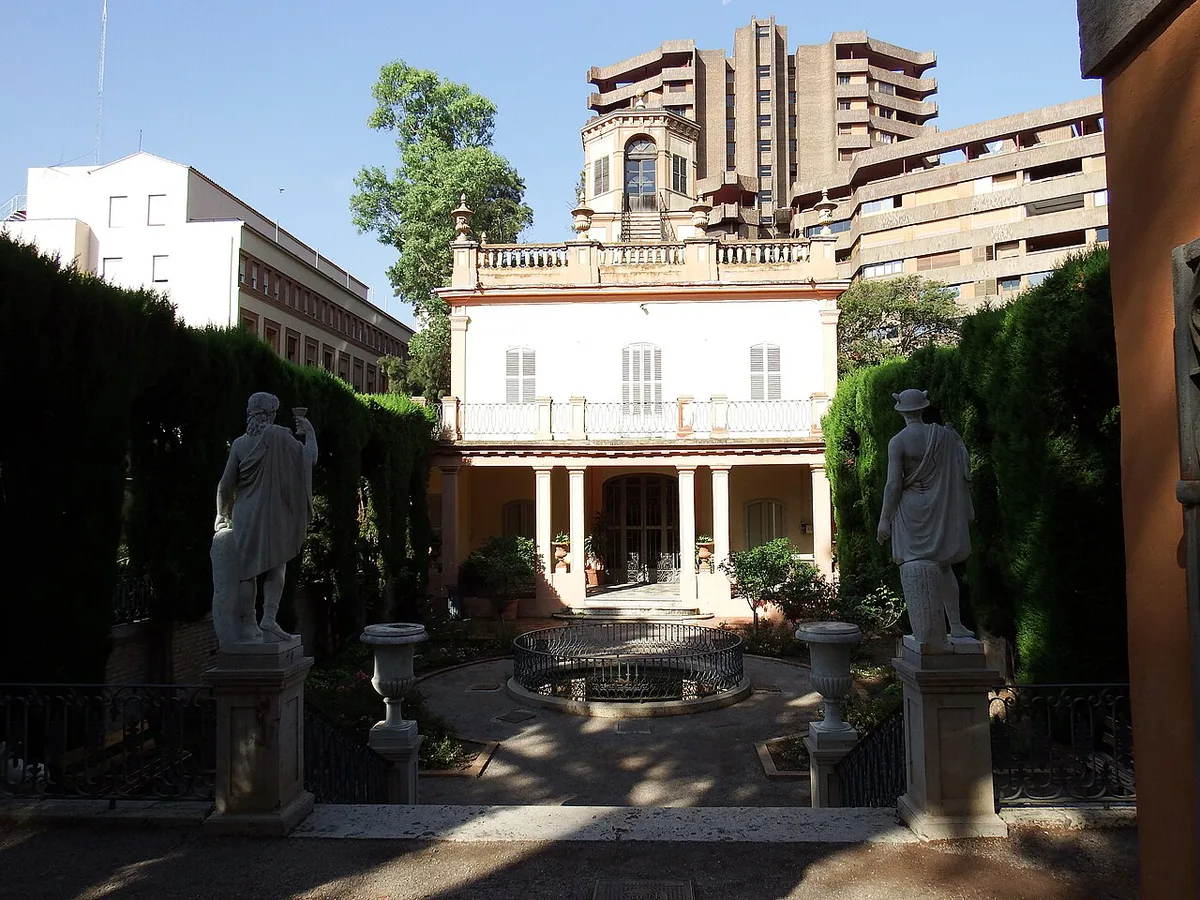
Walking in through the palacete's vestibule leads first to a semicircular plaza enclosed by an iron railing and lined with philosopher busts on pedestals. Beyond it stands the garden's neoclassical entrance portal, flanked by two marble lions.
Sculptor José Bellver carved those lions for the staircase of the Spanish Congress of Deputies in Madrid. Larger bronze lions were chosen instead, so Bellver's marble pair never left Valencia and now guards this garden portal.
Past the entrance sits the palacete, a recreational pavilion the marqués built for his family. A staircase inside carries nine painted female figures and cherub medallions along its walls. It leads to a central hall in neopalladian style, covered by an octagonal dome painted with allegorical scenes. Balconies and a balustraded terrace on this floor look out over the grounds below.
Thirty-three marble statues fill the garden, most depicting gods and goddesses from Greek mythology. Fountains and pools punctuate the paths at regular intervals.
The contrast between zones is deliberate. Clipped box hedges and formal parterres sit near the entrance. Further toward the west end, past the Glorieta de los Arcos, the layout loosens into a romantic zone, where bougainvillea and other climbing plants cover pergola tunnels.
- Fuente de las ninfas Dafnis y Cloe: a Carrara marble group in the Parterre Nuevo, often described as the garden's emblem
- Fuente de los Naranjos: between the old and new parterres, next to the rose garden
- Plaza de la Diosa Flora: a statue of the goddess Flora at the center of the Patio de los Surtidores
- Fuente de Poseidón: a white marble fountain near the grotto entrance, showing the god reclining on a large fish
- Fuente de la Serpiente: a cast-iron drinking fountain with a coiled snake at its base and plantings on top
- Estatua de Sócrates: along the garden's east-west axis, just past La Montañita, a small mound within the grounds
- Glorieta de los Arcos: twin fountains with children playing with dolphins and blowing conch shells, under a dragon-carved arch topped by statues of Bacchus and Mercury
- Fountain of the boy on a swan: in the west end of the romantic zone, set in a Greek-cross pool
Visiting Jardines de Monforte in Valencia: Hours and How to Get There
Jardines de Monforte keeps seasonal hours. From March through October, the garden opens 10:00 to 20:00. From November through February, hours run 10:00 to 18:00. Municipal opening hours can shift around local holidays and decrees, so confirm current times before a visit.
Morning visits bring softer light for photography and fewer visitors near the main fountains. Valencia's summer afternoons run hot, making a morning or early-evening visit more comfortable. For a broader seasonal strategy across the city, this guide to visiting Valencia without crowds covers timing beyond this one garden.
Entry runs through a single point: the zaguán, or vestibule, of the palacete pavilion. There is no separate gate. Visitors who circle the perimeter walls looking for an entrance often miss it entirely.
The garden sits on Plaza de la Legión Española, within walking distance of Valencia's city center and close to the Alameda metro station. Check current line and schedule information before traveling, since routes are occasionally adjusted. Valencia's neighborhoods guide covers how the surrounding districts connect on foot for anyone building a longer route.
Jardines de Monforte vs. Turia Gardens and Viveros: Which One to Visit
Jardines de Monforte is not the only garden in Valencia, and it is not trying to be. The table below compares it against the city's two other major green spaces.
Turia Gardens extend for several kilometers through the old riverbed, linking multiple neighborhoods along a single green corridor. Viveros neighbors the Museum of Fine Arts and adds structured play areas that Monforte does not offer.
Skip Monforte if the plan calls for cycling or a playground stop. Neither is part of this garden. The Turia Gardens handle that role instead, running through the old riverbed with far more room to spread out.
Roundups of the city's 9 Hidden Gems in Valencia: A Local's Guide to Secret Spots and Off-Path Eats consistently place Monforte near the top of the list. The reasons are consistent: intimate over sprawling, quiet over active.
| Garden | Character | Entry Fee | Best For | Bikes & Playgrounds |
|---|---|---|---|---|
| Jardines de Monforte | Intimate, enclosed, 19th-century neoclassical | Free | Photography, quiet walks, architecture | Not permitted |
| Turia Gardens | Sprawling, open-air, follows the old riverbed | Free | Running, cycling, sports | Yes |
| Viveros (Jardines del Real) | Large, landscaped, family-oriented | Free | Playgrounds, picnics, open lawns | Yes |
Mistakes to Avoid and Local Tips
A few missteps are common enough to flag directly.
Protected as a Bien de Interés Cultural site in 1941, Jardines de Monforte enforces strict behavioral rules: no picnics, ball games, loud gatherings, climbing on statuary, removing plants, or disturbing the fountains, as required by its heritage-site designation.
Finding the entrance trips up most first-time visitors. The gate is not on the perimeter wall. It sits inside the palacete's vestibule, facing Plaza de la Legión Española.
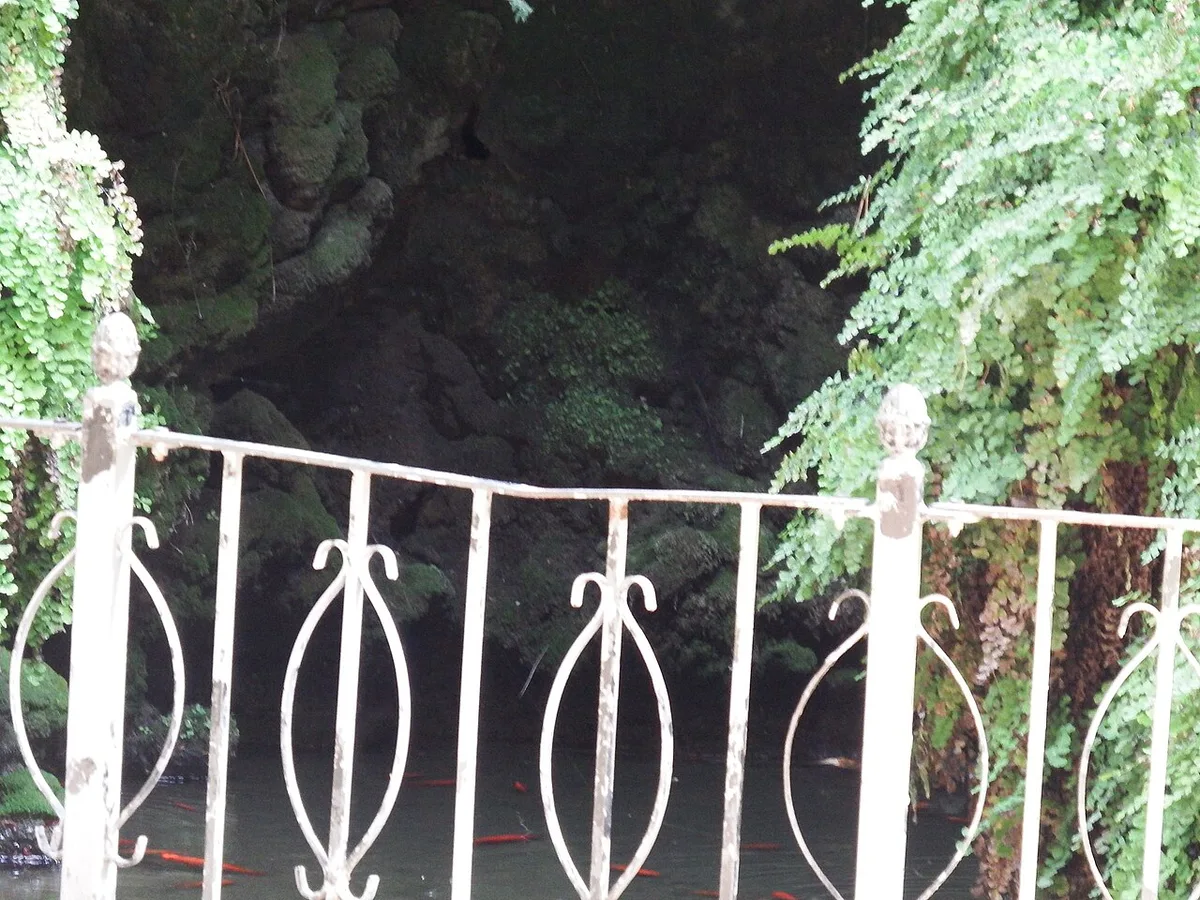
The mirador, a small mound with a cascade and paths circling it, sits away from the main axis. It is easy to miss on a quick walk-through, so budget a few extra minutes to find it.
Monforte holds Bien de Interés Cultural status, and its rules are enforced accordingly. Skip picnics, ball games, and loud gatherings. Removing plant cuttings, climbing on statuary, or disturbing the fountains are the kinds of behavior that put protected sites like this one at risk.
Anyone planning a wider Valencia itinerary around quieter corners can start from this roundup of Secret Spots in Valencia: A 2026 Guide to Quiet Corners. A second list of off-the-beaten-path places in Valencia covers more low-traffic stops nearby. For a shorter, no-cost shortlist, this guide to Free Things to Do in Valencia: The Complete 2026 Budget Guide groups Monforte with other zero-admission stops.
- Enter through the palacete's zaguán on Plaza de la Legión Española, not a perimeter gate
- Visit weekday mornings for softer light and fewer visitors near the fountains
- Set aside extra time to find the mirador and its cascade, off the main path
- Treat it as a protected site: no picnics, ball games, or loud gatherings
Nearby Attractions to Pair With Your Visit
Jardines de Monforte works well as one stop in a longer afternoon near the city center.
Bombas Gens, a contemporary art center, gives the afternoon a change of pace from statues and fountains. The Bombas Gens guide covers current exhibitions and visiting hours.
The Albufera Natural Park guide covers Valencia's wetland reserve, an option for anyone with a full day to spend outside the center. The Museu de Belles Arts adds an indoor option nearby, useful if the weather turns during a day built around gardens.
Afterward, the El Carmen neighborhood guide covers the old town's streets within easy reach of the garden. The Ruzafa neighborhood guide covers a restaurant-heavy district on the other side of downtown. Anyone building a longer list of 8 Unique Things to Do in Valencia: Hidden Gems and Local Secrets can slot Monforte in as a quiet midpoint between busier stops.
Those staying in Valencia longer can pair a Monforte morning with a trip covered in this guide to day trips from Valencia. For a sit-down meal after walking the grounds, this list of local restaurants in Valencia covers options within a short distance.
Further reading: Valencia on Wikivoyage · Valencia on Wikipedia
Frequently Asked Questions
Is Jardines de Monforte free to enter?
Yes, entry is free. The garden is one of the city's no-cost historic sites, alongside its formal parterres and fountains.
How do you find the entrance to Jardines de Monforte?
Entry runs through the zaguán, or vestibule, of the palacete pavilion, not through a gate in the perimeter wall. The pavilion faces Plaza de la Legión Española.
Why are there lions at the entrance of Jardines de Monforte?
Sculptor José Bellver carved the two marble lions for the staircase of the Spanish Congress of Deputies in Madrid. Larger bronze lions were chosen instead, so Bellver's pair stayed in Valencia and now flanks the garden's neoclassical portal.
How much time should you plan for a visit to Jardines de Monforte?
Most visits run 45 to 60 minutes, enough time to see the palacete, the main fountains, and the romantic garden zone at an unhurried pace.
What are the opening hours of Jardines de Monforte?
The garden has run 10:00 to 20:00 from March through October and 10:00 to 18:00 from November through February. Municipal hours can shift, so confirm current times before a visit.
How do you get to Jardines de Monforte from central Valencia?
The garden sits on Plaza de la Legión Española, within walking distance of Valencia's city center and close to the Alameda metro station.
What should visitors avoid doing inside Jardines de Monforte?
As a protected Bien de Interés Cultural site, Jardines de Monforte does not allow picnics, ball games, or climbing on statues and fountains. Treat it as a heritage site rather than a park built for active recreation.
Continue exploring
More guides you'll find useful