Trapani in One Day: An Old Town and Sunset Itinerary
A flexible one-day Trapani plan: the morning fish market, the baroque Corso, the free cathedral, the Mura di Tramontana walk and a sunset at the western tip.
On this page
Trapani curves around a natural harbour on the western tip of Sicily, a city whose economy grew on salt production and tuna fishing rather than on a long list of blockbuster sights. That history still shapes a day here: a working port, a baroque main street, and a coastline you can follow on foot.
One concrete timing detail frames the day: the fish market near the port gets going as early as six in the morning, and around nine is when it is busiest according to one visitor account. Plan the rest of the day around that early start, and label everything else as a suggestion rather than a schedule.
Why Trapani Suits a Single Day on Foot
Most of what you will want to see sits inside a compact historic centre, so the old town rewards walking rather than hopping between transport. The restored centre has pedestrianised streets that open onto small piazzas and a waterfront promenade, which makes a self-directed loop easy to hold in your head.
Treat the day as a walk rather than a count of sights. One writer's summary is that you visit Trapani for the strolling rather than the attractions, with churches and a handful of museums as extras and evening life on the main street as the real draw. Build in unclaimed time and the city gives you more than a checklist would.
If you have already browsed a list of hidden gems in Trapani, resist the urge to bolt all of them onto this route. Pick one or two that sit naturally along the walk and save the rest for another visit; a second day is where the quieter corners fit more comfortably.
Start Early at the Mercato del Pesce
The fish market is the one part of the day with a genuine timing constraint. Fishermen dock their boats and sell the catch right off them early in the morning, activity starts as early as six, and around nine is when it is busiest. Arriving late in the afternoon, as one visitor did, means you see almost nothing of the trade.
An indoor market hall also operates nearby, but it is described as considerably less atmospheric than the open-air selling by the boats. Use the hall as shelter if the weather turns, and treat the outdoor stalls as the reason to get up early.
Because market rhythms vary with weather and season, do not build a minute-by-minute plan around any published opening time. Ask at your accommodation the evening before, or simply arrive early and accept that the best of the activity may already be winding down. Carry small change and watch your footing on wet stone near the water. For wider planning, see Trapani Fish Market (Piazza Mercato del Pesce) guide. Related guide: Where to Stay in Trapani: Old Town, Market Square or Seafront.
Corso Vittorio Emanuele and the Free Cathedral
From the port, head for Corso Vittorio Emanuele, the ceremonial spine of the old town since the Middle Ages and the address local nobility chose for their palazzi. The result is a dense run of baroque and neoclassical facades, including the town hall at Palazzo Cavarretta, best absorbed at an unhurried pace.
The Cattedrale di San Lorenzo sits among the palazzi on the main street, which makes it hard to appreciate from outside but easy to slip into. One visitor found the interior decorated with many light blue details and reported that entry was free, unlike several other churches in the city where a small charge applies. Individual churches set their own arrangements, so treat that as a reported detail rather than a citywide rule.
If you want the street's architecture explained rather than merely admired, a self-guided walk format suits this stretch well. The historic centre self-guided walk pairs naturally with this itinerary and can be dipped into for a few buildings rather than completed in full.
Lunch: Couscous alla Trapanese and Sicilian Timing
The dish to order in Trapani is couscous alla Trapanese, a seafood couscous of durum wheat semolina topped with fish and often small fried squid, served with a pitcher of fish stock to pour over so it does not dry out. It is filling enough that sharing one portion as a first course is a sensible strategy.
Plan lunch around Sicilian hours rather than your own hunger. Restaurants commonly serve lunch from around noon until mid-afternoon, then close and reopen in the evening, and locals tend to eat dinner considerably later than visitors expect. A late, large lunch pushes dinner back, which suits a sunset on the wall.
If you would rather plan meals around specific dishes and neighbourhoods, work from our Trapani local food guide before you set out, then choose one sit-down lunch and keep the rest of the day light.
Afternoon on the Mura di Tramontana
Behind the cathedral, steps climb to the Mura di Tramontana, the old defensive wall along the northern edge of the centre. It began in the Middle Ages and was substantially expanded under Spanish rule in the sixteenth century to guard against attack from the sea and pirate raids, and part of the surviving wall can still be walked on top.
The promenade runs above the wall from the fish market area toward the city beach, giving open views of the sea and the Egadi Islands. Below the wall lie small sandy and rocky coves that now serve as informal urban beaches, useful for a quick dip rather than a proper beach day.
Be honest about the swimming question. The strip by the wall is convenient but far from idyllic; a nicer beach, Spiaggia di San Giuliano, sits a short drive away and needs a car. With one day, the wall strip is the realistic option, and on a windy off-season afternoon even that may be for looking only.
Out to Torre di Ligny
Continue along the wide promenade to the Torre di Ligny, a defensive and observation tower whose approach along the waterfront gives the walk a destination. Inside is an archaeological museum, making the tower an optional stop rather than a compulsory one.
Treat any opening hours you find online for the tower with suspicion, including on mapping services. One visitor explicitly warns that the listed hours could not be relied on, so check locally rather than planning the day around a published time. In summer, classical concerts are sometimes held near the tower around sunset, which is another thing to ask about on arrival.
Past the fishing boats and the remote parking area near the water stands the Lazzaretto, used from 1831 to 1885 to quarantine people with infectious diseases away from the city. You can walk onto the grounds, though one visitor found little to see and observed the small sea castle Torre Peliade only from a distance.
Sunset at Piazzetta del Tramonto
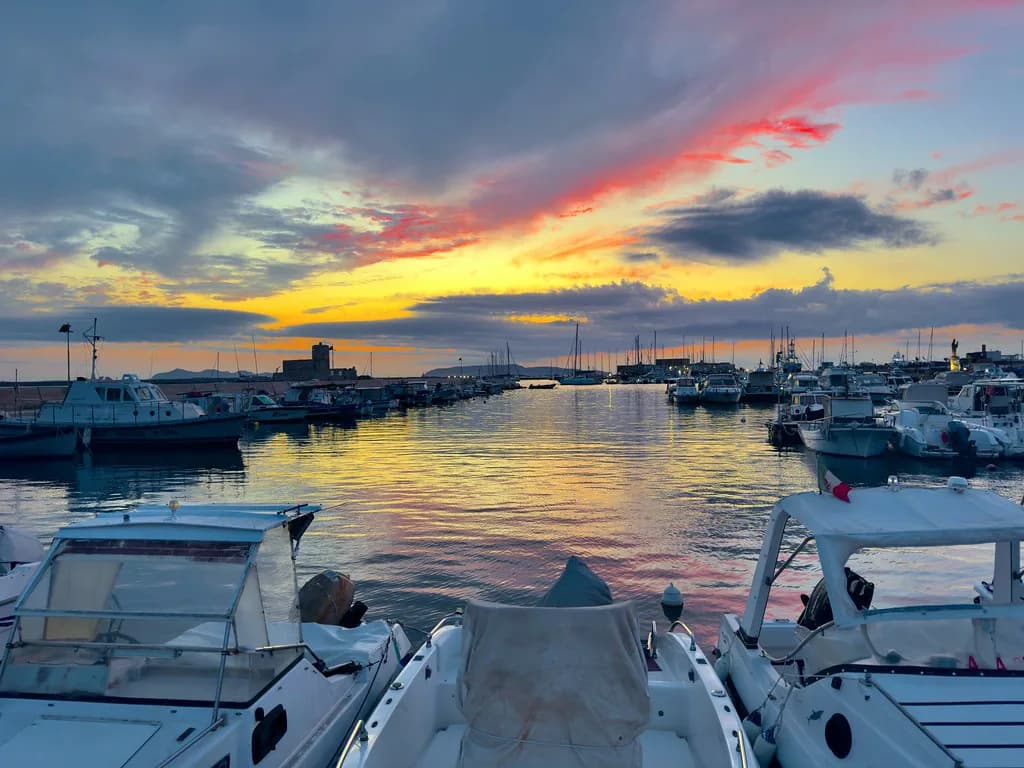
Trapani is known for its sunsets, and the westernmost point near the tip of the old town is the place to watch one. Piazzetta del Tramonto is the aptly named spot, and the terraces along the wall also work if you arrive half an hour early.
Check the sunset time for your date and secure a seat before the light starts to change. One visitor suggests arriving about half an hour ahead and names MOAI Sunset Restaurant on the old wall as an option for a table with a view. The same walk along the wall leads toward open views over the coast and the salt pans beyond.
Off-season, do not count on a bar being open at the viewpoint: in November one writer found the wooden drinks stand boarded up and winterised. Bring your own water, wear a layer against the wind off the sea, and enjoy the view without the aperitivo if the season is against you.
Salt Pans or Erice: Choose One Add-On
If the day has room, the obvious extension is the Saline di Trapani e Paceco, the salt pans just outside the city where sea salt has been harvested for centuries and traditional windmills stand over shallow pools. There is a museum on site and you can see the production, and the Via del Sale route toward Marsala begins here.
The alternative is the cable car up to Erice, the medieval hilltop town whose atmosphere is markedly different from the port below. It is a compact trip once you are up there, but the cable car ride itself is not for everyone, and one visitor describes it as nerve-wracking before the calm of the town takes over.
Do not attempt both on a one-day visit. Check cable-car operating times and salt-pan museum access before committing, since neither should be assumed to suit your dates, and decide the evening before based on the weather forecast. A clear, still day favours the salt pans; a cloudy one makes the hill town and its views the better bet.
Arriving, Getting Around and Where to Stay
Trapani's Vincenzo Florio Airport connects the west coast with a number of Italian and other European cities, while many travellers fly into Palermo and continue by bus or train. Trains and intercity buses also reach Trapani from elsewhere on the island, and tickets are relatively inexpensive and available online or at stations.
Allow for the fact that Sicilian buses are heavily used by locals and visitors alike, and popular routes can fill up in high season. Board early rather than assuming a place, and keep the journey to Trapani separate from your sightseeing plan so a delay does not collapse the day.
Once in the city, the old town is genuinely walkable, and that is the whole basis of this itinerary. You do not need a car for the centre, though one helps for the beach at San Giuliano, the salt pans or a wider sweep of western Sicily. An apartment near the harbour shortens the walk to the fish market and the ferry point; a base on the Corso gives you the evening life on the doorstep.
Off-Season Reality and Local Verification
Trapani's centre can feel remarkably empty outside high season. One writer found the elegant main street nearly deserted on a windy Monday in November, with few shops open and businesses whose online hours did not match reality, which is a planning factor rather than a reason to stay away.
The practical response is to confirm rather than assume: ask ahead for a museum, check at your accommodation about the fish market and any concerts, and keep a second option for lunch in mind. None of this requires a rigid plan; it just means the day should bend rather than break when a door is closed.
Should You Add the Egadi Islands?
The Egadi Islands lie just off the coast and are reached by ferry or boat tour from the port, with Favignana the main island and easy to explore by electric bicycle. They are wonderful, but they are a day in themselves, not a stop on a one-day city itinerary.
If the islands are the reason you came, read our Egadi Islands day trip guide and give them a dedicated day. Trying to squeeze a ferry crossing, an island and the old town into the same hours shortchanges all three.
Plan Your Day in Trapani
The shape of a good day here is simple: an early market, a slow walk along the Corso with the free cathedral as a pause, a proper seafood lunch, the wall promenade in the afternoon and the western tip at sunset. Everything else, from the tower museum to the salt pans or Erice, is optional and should be chosen rather than stacked.
Verify the volatile details before you go: ask locally about market activity, museum access and cable-car operation, and do not rely on mapping-service hours for small sites. Leave an unscheduled hour on the Corso in the evening, because that is when the city is at its most alive.
Frequently Asked Questions
Is one day in Trapani enough to see the old town?
Yes, for the historic centre. The compact, largely pedestrianised old town covers Corso Vittorio Emanuele, the cathedral, the Mura di Tramontana promenade and the walk out to Torre di Ligny in a single unhurried day. What one day does not cover is the surrounding area, so treat the salt pans, Erice and the Egadi Islands as separate trips rather than extras squeezed in.
What should you not miss on a one-day visit to Trapani?
The morning fish market near the port is the one element with a genuine timing constraint, since selling by the boats happens early and is largely winding down by mid-morning. After that, prioritise the walk along Corso Vittorio Emanuele, the free entry reported at the Cattedrale di San Lorenzo and the Mura di Tramontana at sunset. The Torre di Ligny museum is a worthwhile optional stop.
Can you visit Erice and the salt pans in the same day in Trapani?
Not comfortably. Each is a half-day excursion in its own right, one by cable car up a hill and the other out among the salt flats toward Marsala. Choose one based on the weather and confirm operating times in advance, because neither the cable car nor the salt-pan museum can be assumed to run on your schedule.
What is the local dish to try in Trapani?
Couscous alla Trapanese, a seafood couscous with fish and often fried squid, served with fish stock to pour over the semolina. It is rich and filling, so sharing a portion as a first course is a reasonable approach if you plan to eat again later. Look for it on restaurant menus around the old town at lunch.
Where can you watch the sunset in Trapani?
The western tip of the old town, at Piazzetta del Tramonto, is the established viewpoint, and the terraces along the Mura di Tramontana also face the right way. Arrive about half an hour before sunset to claim a spot. Outside high season, do not assume a bar at the viewpoint will be open.
Is Trapani crowded, and when is it liveliest?
It is a working port city rather than a polished resort, and visitors often travel out to Erice or the Egadi Islands during the day. In low season the centre can feel almost empty, with some businesses keeping unreliable online hours. Evening on the Corso is the liveliest time.
Sources
Continue exploring
More guides you'll find useful