Trapani Rainy Day Plan: Indoor Ideas and Covered Wanderings
Plan a rainy day in Trapani with a realistic half-day route, a porticoed piazza and coastal watchtower museum, plus how to verify hours before you go.
On this page
Trapani sits on a narrow sickle of land between two seas, so a wet day here is less about hiding from a downpour and more about choosing stops that work when the sky turns. The city's indoor options are modest, which is exactly why a little sequencing helps: one genuinely indoor stop, one covered architectural pause, and a coastal walk you can abandon without regret.
A useful anchor is the waterfront itself. Piazza Mercato del Pesce is a semicircular porticoed square whose present look dates from an 1874 project by the Venetian engineer Giambattista Talotti, and the arcade gives you real shelter while you decide what to do next. Treat every duration below as a suggestion, not an official timetable, and verify opening details with the operator before you travel.
Why a Wet Day in Trapani Is a Planning Problem, Not a Write-Off
Trapani's appeal outdoors is largely horizontal: the promenade, the salt pans, the beaches stretching north toward San Giuliano. Rain removes the pleasure from those without removing the geography, so the sensible response is to swap the long coastal stretch for a compact loop through the historic centre. The centre is small enough that you can retreat indoors quickly when the weather turns.
The useful mental model is to separate truly indoor time from exposed time and never let the second run long. A porticoed square gives you ten minutes of shelter and something to look at; a museum gives you an hour or two; a sea-wall walk gives you views but no protection once the wind picks up. Build the day in that order of security and you will not spend the afternoon negotiating with the weather.
Rain in this part of Sicily is seasonal rather than constant. Autumn and winter carry most of the wet weather, which is also when the city is quieter and easier to move through indoors. If your dates fall in a wetter month, plan one indoor anchor per day and treat everything else as optional. For wider planning, see The Best Time to Visit Trapani for Weather and Fewer Crowds.
Quick Answer: A Suggested Half-Day Indoor-Leaning Route
A workable half-day plan runs: Piazza Mercato del Pesce first for its porticoes and central fountain, then a short walk to Torre di Ligny for the small museum if it is open, then the Mura di Tramontana and Bastione Conca only if the rain is light. Allow roughly half a day in total, with the museum absorbing the bulk of it. Those durations are suggestions for pacing, not published opening times.
The logic of the sequence is that the sheltered stop warms you up, the indoor stop keeps you dry through the worst of a shower, and the exposed walk comes last so you can cut it short without wasting the effort of getting there. If the tower is shut, fold the museum time into the square and the walls, then add a second indoor option from the list further down.
Stop 1: Piazza Mercato del Pesce, the Porticoed Exedra as Shelter
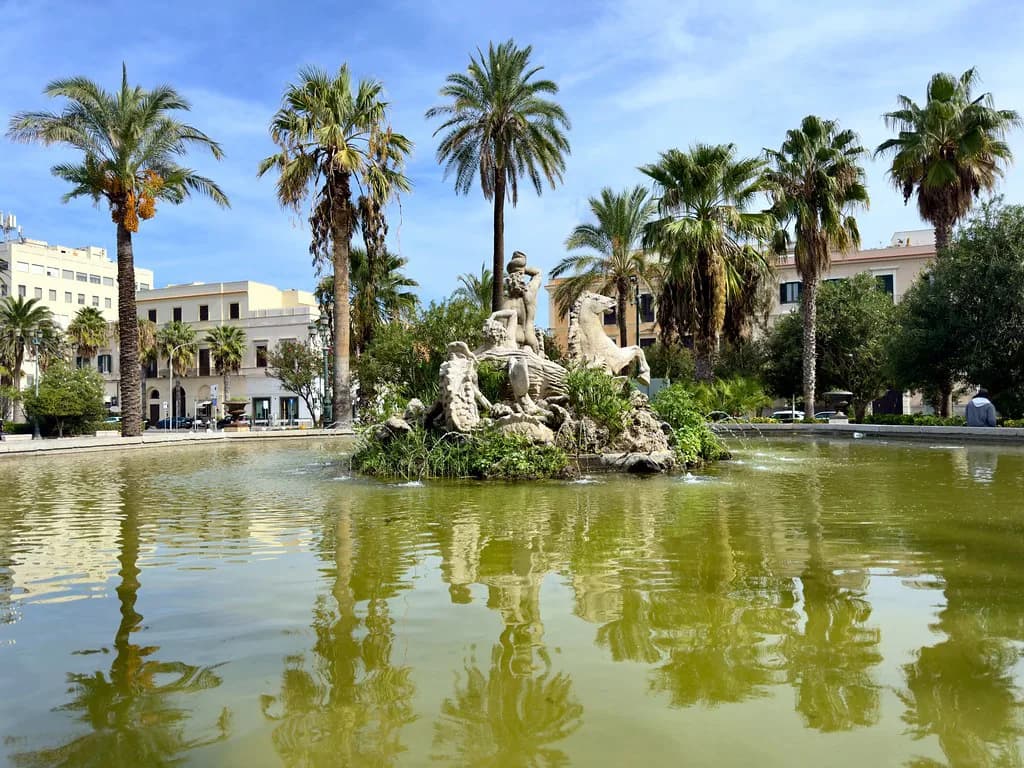
Piazza Mercato del Pesce is a semicircular square on the northern promenade, built as a porticoed exedra of round arches arranged around a central fountain with a statue of Venus emerging from the water. The exedra and fountain arrangement is described by the West of Sicily tourism district as the result of the 1874 project by the Venetian architect Giambattista Talotti, and the arcade is the reason the square earns a place on a wet-day route.
The name is historical. This was where the city's fish trade was concentrated, at a natural widening of the beach outside the original walls, and it no longer functions as a working fish market. The square is now used for cultural, sporting, theatrical and recreational events, which means it can be busy, empty or partly occupied depending on what is scheduled. Check the city's own notices before you build a visit around something happening there.
Treat this as a fifteen- to twenty-minute stop rather than a destination in itself, and use the arcade as a place to wait out a shower while deciding whether the tower is worth the walk. The fountain and porticoes photograph well in flat grey light, and the promenade position means you are already partway to the western coastal sights. Standing under the arches costs nothing.
Stop 2: Torre di Ligny, the Coastal Watchtower Museum
Torre di Ligny is a coastal watchtower built between 1671 and 1672 at a strategic position on Trapani's western coast, and it now operates as an archaeological museum open to the public. It is the most genuinely indoor stop on this route, which makes it a plausible anchor for a rainy half-day. The tower stands on a narrow strip of land, so the walk to it is exposed even though the interior is not.
Opening hours here need care. A third-party mapping listing shows a Tuesday-to-Saturday schedule with a short late-morning window and a short early-evening window, while user reviews on the same listing mention a June-to-October season and closing on other days. The listing is not an official operator source, and its own information does not agree with itself. Re-check by phone or through the city before travelling, and do not assume the tower is open simply because it is indoor.
If it is open, the museum is small and the visit short, so pair it with the walk rather than planning the day around it. If it is shut, the same headland still gives you the coastal view and the exercise, and you can redirect the indoor hours elsewhere. Either way, do not build a fixed schedule that only works if one small museum cooperates.
Stop 3: Mura di Tramontana and Bastione Conca, the Covered-ish Wander
The Mura di Tramontana are the surviving stretch of the city's northern sea walls, of which roughly a kilometre remains, and they form part of the fortification system built during the Spanish period. Walking them gives you the sea on one side and the historic centre on the other, and from the path you can reach the Bastione Conca, created to defend and control the wide stretch of water that the old town overlooks. The appeal in rain is proximity to shelter, not dryness.
Be honest about exposure. The walls are open to the weather, and wind funnels along them, so this is a light-rain walk, not a downpour activity. In heavy rain, skip it and spend the time indoors. In drizzle, it is one of the better ways to see the shape of the city without committing to a long outdoor itinerary.
The same fortification story continues inland at Porta Oscura, dominated by the clock tower, and at Porta delle Botteghelle, which opens toward the sea; both are remnants of the medieval gates that once pierced the walls. They make short, sheltered pauses on the way back into the centre. For a longer orientation walk, use a self-guided route and adapt it as the weather dictates.
How to Sequence the Day Around Showers and Wind
Check the forecast on the morning itself rather than the night before, and read it for wind as well as rain. A windy drizzle makes the sea walls unpleasant, while a still drizzle makes them atmospheric. Use the porticoed square as your decision point: if the rain is heavy when you arrive, stay in the centre and move to an indoor collection; if it is light, continue west toward the tower.
The practical rule is one indoor anchor and no more than two exposed stretches per day. Trying to force a full outdoor itinerary in rain usually ends with wet shoes and a rushed museum visit. If the weather clears unexpectedly, swap the plan around and take the long walk while you can, keeping a museum in reserve for the next wet morning.
For a second wet day, the obvious anchor is the Regional Pepoli Museum (Museo Regionale Agostino Pepoli) guide, which covers a collection housed in what was once a Carmelite convent. Admission details and opening hours change, so confirm them with the museum before you go rather than trusting a directory listing. Keeping it in the centre rather than on the coast shortens your walking between indoor stops.
What Trapani Rainfall Data Actually Tells You
Trapani receives on average about 592 mm of precipitation a year, with November the wettest month at roughly 84 mm across 11 rainy days, and July the driest at around 3.1 mm over a single rainy day. Those are climate averages for the city rather than a forecast for your dates. They tell you which months are more likely to interrupt outdoor plans; they say nothing about whether next Tuesday will be wet.
The averages also point to a seasonal decision: if you are choosing dates partly for weather, aim for the drier months and accept that summer heat brings its own trade-offs. November still shows a mild average daytime maximum of about 20°C in the same dataset, which is comfortable for walking between indoor stops. That is one reason a wet November day in Trapani is easier to manage than a wet November day further north.
What the data cannot do is tell you whether a given museum will be open when the rain arrives. For that, check the operator directly in the days before you travel and again on the morning. If your trip also includes boat days to the Egadi Islands, keep those plans separate so that a wet day can be moved rather than cancelled.
Rainy-Day Alternatives if the Tower Is Shut
If Torre di Ligny is closed, the sensible substitute is a museum collection in the city rather than a seaside detour, because you are already in the centre. Trapani's museums are individually listed with their own conditions, and the attractions hub lets you compare what is available before choosing. Confirm hours and admission with each site, since published details are not always current. For wider planning, see Trapani Attractions: Visitor Guides to 9 Sights.
A second option is simply to extend the covered wandering: use the arcades, the gates and the church interiors near the centre as a series of short stops between showers, and accept that you will cover less ground. On a genuinely heavy day, the correct answer is to stop sightseeing for an hour or two somewhere warm and pick up again later. For orientation, the hidden gems guide shows what lies in the back streets, including Corso Vittorio Emanuele, the long spine of the old town. For wider planning, see Hidden Gems in Trapani.
The salt pans and the coast are the first things to drop in heavy rain, however tempting the photographs. Save them for a clear evening, when the light is better anyway. That way a wet day costs you nothing you would not rather do in drier conditions.
Mistakes to Avoid When It Rains in Trapani
The commonest mistake is assuming the fish market square is still a fish market and timing a visit around an early-morning market that no longer happens there. It is a porticoed piazza and events venue now, so check what is scheduled rather than what the name suggests. The second mistake is trusting a single hours listing for a small museum; cross-check it and carry a phone number.
The third is treating the sea walls as a rainy-day shelter. They are exposed, and wind makes them colder than the temperature suggests. Wear shoes that cope with wet paving and keep the wall walk short if the rain is steady. A raincoat beats an umbrella on these narrow, gusty streets.
Finally, do not overbook the day. Trapani is compact, and two indoor stops plus one short walk is a full wet afternoon. Leaving slack in the plan is what lets you take advantage of a sudden clear spell.
Plan Your Visit
A rainy day in Trapani works best with one indoor anchor, one sheltered pause and one short, optional walk. The porticoed square and the sea walls are the flexible pieces; the watchtower museum is the piece you must verify. Build the day around that hierarchy and a closed door or a sudden downpour costs you very little.
Before you go, check the city's site for civic notices, confirm the museum's hours directly, and read the forecast on the morning for wind as well as rain. None of that takes long, and all of it prevents the small frustrations that make a wet day feel wasted. Further visitor details appear in Official event website.
Frequently Asked Questions
What can you do indoors in Trapani on a rainy day?
The most clearly indoor stop on this route is Torre di Ligny, a coastal watchtower that operates as an archaeological museum, but its hours need checking directly because the third-party listing that covers it is inconsistent. Beyond that, the city's museum collections are the natural fallback, and each publishes its own visiting conditions. Combine one indoor anchor with the arcades at Piazza Mercato del Pesce and you have a workable wet afternoon without long walks between stops.
Is the Trapani fish market square worth visiting in the rain?
Yes, but for the architecture rather than for shopping. Piazza Mercato del Pesce is a semicircular porticoed exedra with a central fountain, whose present appearance follows an 1874 project by Giambattista Talotti, and the arcade gives you genuine shelter while you look at it. It no longer operates as a working fish market and is now used for cultural and recreational events, so check what is scheduled before building a visit around it.
What are the opening hours of Torre di Ligny?
There is no single reliable figure across the sources that cover it. A third-party mapping listing shows a short late-morning window and a short early-evening window on certain weekdays, while user reviews on the same listing mention a seasonal opening and other closed days. The listing is not an official operator source, so confirm the current schedule directly with the museum or through the city before travelling.
Can you walk the Mura di Tramontana when it rains?
In light rain, yes, and the walk gives you sea views and a link to the Bastione Conca. Roughly a kilometre of the northern sea walls survives, forming part of the city's Spanish-era defences. They are exposed to wind and weather, though, so skip them in heavy or driving rain and save them for a drizzle or a clear evening instead.
How much rain does Trapani get in autumn and winter?
Trapani averages about 592 mm of precipitation across a year, with November the wettest month at roughly 84 mm over around 11 rainy days and July the driest at about 3.1 mm. These are climate averages for the city, not a forecast for a particular date. Use them to choose which months to visit, then check a short-range forecast on the morning for wind as well as rain.
Is a rainy day in Trapani still worth it?
Usually yes, provided you plan around one indoor anchor and keep outdoor stretches short and optional. The centre is compact, so retreating from a shower takes minutes, and the wetter months are also quieter. The main risk is a museum that is unexpectedly closed, which is why confirming hours before you set out matters more than building an elaborate schedule.
Sources
Continue exploring
More guides you'll find useful