Trapani Historic Centre Self-Guided Walk: Old Town Route
Plan a self-guided walk through Trapani's old town, linking the cathedral, the fish market square, the Tramontana walls and Torre di Ligny at your own pace.
On this page
Trapani's centre is a narrow sickle of land squeezed between the Tyrrhenian Sea and the Sicilian Channel, which means the old town folds back on itself and a walking route naturally loops rather than runs in a straight line. That compactness makes it one of Sicily's easier cities to explore on foot, with no need for a car once you are inside the historic core. This route links the main street, the cathedral, a cluster of baroque churches, the surviving Spanish-era walls, the old fish market square and the tower at the tip of the peninsula.
Why Trapani Rewards Walking
The city's shape does most of the work for you. Because the centre sits on a slim peninsula, almost everything on this route is within a continuous stretch of lanes and waterfront, and you can double back through different streets without losing much time. Slow Active Tours describes Trapani as a place where baroque buildings, churches and castles sit close to the smells of the Mediterranean, which is a fair summary of what a morning on foot actually feels like.
As a Yondli suggestion rather than an official figure, allow around two hours for a compact centre loop covering the main street, the cathedral and the fish market, or three to four hours if you extend along the walls to Bastione Conca and Torre di Ligny with pauses. Wear shoes that handle worn, uneven stone, and carry water in warm months because shade is patchy along the exposed wall section.
Before You Set Off: Entry Fees, Free Squares and Pacing
Plan on a clear split between what is free and what is not. Public squares, the waterfront promenade and the walkable stretch of the city walls cost nothing, while several church interiors in the centre ask for a small contribution at the door. The exact amount varies by church, so carry some cash and check at each entrance rather than assuming one ticket covers several buildings.
Start in the morning if you want the market area at its liveliest, or in the late afternoon if the walls and tower are your priority. The two plans are not interchangeable: an early start suits the cathedral and churches, while a late start suits the seafront and the sunset end of the route. Decide which one you want before you leave your accommodation.
Stop 1: Corso Vittorio Emanuele and the Cathedral
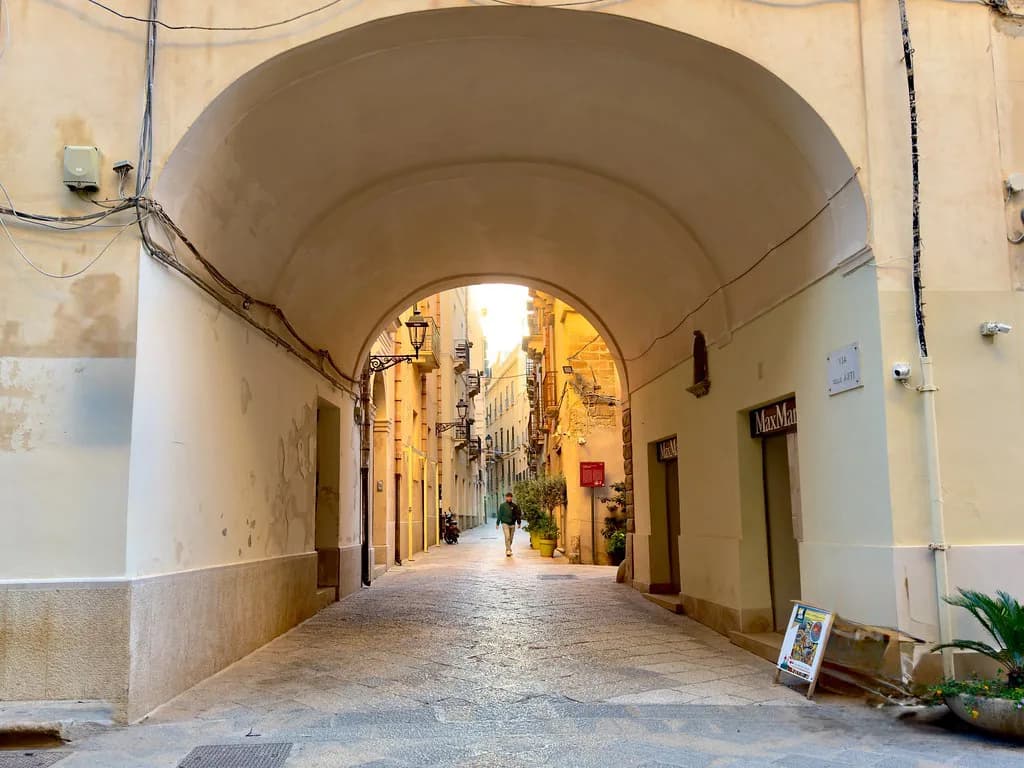
Begin on the main axis of the old town, where pastel townhouses line the street and the everyday life of the city is most visible. This is also the best place to get your bearings, because the street runs through the centre and gives you a reference point for every later turn. The same street holds one of the city's more disorienting sights: a cathedral squeezed among the facades.
The Cattedrale di San Lorenzo sits so tightly among the surrounding buildings that you can walk past without registering it, and its interior, decorated in pale blue tones, comes as a surprise after the plain exterior setting. Entry here is free according to Trip Unlocked, which makes it an easy first stop. For the layout, what to look for inside and how it fits the rest of the centre, use the Trapani Cathedral (Cattedrale di San Lorenzo) visitor guide.
Stop 2: Baroque Backstreets and the Church Cluster
From the main street, turn into the narrower lanes where the baroque layer of the city is concentrated. A guided walking tour offered locally moves from a coffee stop to the Church of the Holy Souls of Purgatory, which holds the wooden Misteri figures used in the city's Good Friday procession, then to the Church of Saint Lawrence and the Church of the Jesuits with its marble work. You can follow the same sequence independently, treating the tour description as a map of what sits close together rather than as an itinerary you must book. Further visitor details appear in Giulia D'Angelo-work.
The Misteri connection is worth understanding before you go in, because it explains why these otherwise modest churches matter so much to the city. Slow Active Tours records that the Good Friday procession of the Mysteries is said to have Spanish origins, involves twenty sacred groups and runs for roughly twenty-four hours. Seeing the carved figures in their home church, out of procession season, gives the tradition a physical setting.
Stop 3: Mura di Tramontana and Porta Botteghelle
Head for the seaward edge of the old town and the Mura di Tramontana, the surviving wall built under Spanish rule. West of Sicily notes that about one kilometre of these walls remains, and that the sixteenth-century defensive system was strengthened with bastions designed by the engineer Ferramolino, isolating the city from the mainland with a moat and a navigable canal against pirate raids. Walking the top of the wall gives you the open sea on one side and the density of the old town on the other.
Porta Botteghelle is the gate on this stretch that opens towards the water, and Slow Active Tours dates it to the end of the thirteenth century, when Giacomo d'Aragona completed the city's expansion. Below it sits a small cove used by fishermen's boats, which makes the gate a natural pause rather than a quick photo. Note that only a couple of the original eleven city gates survive; Porta Oscura, topped by the clock tower, is the other one to look for.
If you want a swim, the beaches directly under the walls are the closest option to the centre, though they are better for a quick dip than for a beach day. I Mulini Resort notes that these city coves are free to access and lack organised bathing facilities, so bring what you need and take care on the rocks. Save the long sandy stretches for a separate trip.
Stop 4: Piazza Mercato del Pesce
The old fish market square is the route's best single lesson in how Trapani has changed. Its arcades and the Anadiomene fountain at the centre come from an 1874 project by the Venetian architect Giambattista Talotti, so the elegance you see is nineteenth-century civic design rather than medieval fabric. West of Sicily describes the square as having moved from a working fish-trading site to a stage for cultural displays and events.
Arrive early if you want to see the market side of the square at work, since Trip Unlocked notes that activity begins around six in the morning and is busiest at about nine, with fishermen selling from their boats. Later in the day the same space reads as a monument rather than a market. For orientation, seating and what surrounds the arcades, see the Trapani Fish Market (Piazza Mercato del Pesce) guide.
Optional Detour: Bastione Conca and the Sunset Strip
Where the walls meet the open water at Bastione Conca, the old town ends and the view opens up towards the sea. Treat this as a public viewpoint rather than a ticketed sight: it is part of the defensive circuit, and the reward is the panorama back across the bright water towards the historic centre. This is the natural decision point of the walk.
Time this end of the route deliberately. The wall walk and the tower are at their best in the hour before sunset, when the light hits the water and the stone at a low angle, and Trip Unlocked suggests securing a terrace seat half an hour before sunset rather than arriving at the last minute. If you only have a short window, choose either the walls or the tower rather than rushing both.
Stop 5: Torre di Ligny
Torre di Ligny closes the route at the far tip of the old town, a quadrangular tower that narrows upwards, built in 1671 during Spanish rule. Slow Active Tours notes that it now houses the Museum of Prehistory and the Museum of the Sea, which gives the stop a purpose beyond the photograph at the door. The approach along the wide promenade is part of the experience, with the city skyline behind you and open water ahead.
Do not build your afternoon around a fixed opening time, because reliable current hours are not published in the sources consulted here. Trip Unlocked warns explicitly against trusting mapped opening hours for this tower, so check with your accommodation or the city's official pages before making it the centrepiece of your day. If the interior is shut, the exterior and the promenade still justify the walk.
Back Through the Maze: Rua Nova and the Lanes
Return on a different line through the centre rather than retracing the waterfront. Rua Nova, flanked by grand Italian townhouses, is the street the local walking tour uses to close its loop through the old town, and it makes a satisfying exit from the tower end back towards the port area. The advantage of the loop is that you see the same district in two different lights without adding distance. Further visitor details appear in Giulia D'Angelo-work.
Use the return leg for the small things the route otherwise skips: coral jewellery workshops, bakery windows and the ordinary rhythm of the lanes. Trip Unlocked makes the case that Trapani is less about ticking off monuments than about strolling its streets and watching the city come alive in the evening. If you want more of these quieter corners, our guide to the hidden gems in Trapani picks out where to slow down.
Practical Pacing: Short Loop or Full Walls-and-Tower Route
Split the walk into two versions depending on your day. The short loop keeps to the main street, the cathedral, the baroque churches and the fish market square, and suits a morning before a longer journey. The extended version adds the Tramontana walls, Bastione Conca and Torre di Ligny, and needs a clear half-day because the walk out to the tip and back cannot be shortened without skipping the best sea views.
Two practical cautions shape the timing. First, church closures can break up the middle of the route, so build in flexibility rather than a strict schedule; if a door is shut, continue and return later. Second, the centre is walkable but not flat in surface terms, with uneven paving that slows you down more than the distances suggest.
Food and Drink Pauses Along the Way
Trapani's table reflects its tuna trade and its Arab and maritime layers, which makes a lunch stop part of the walk rather than a break from it. Slow Active Tours singles out tuna appetisers such as bottarga, seafood couscous, busiate with Trapanese pesto made with tomatoes and almonds, and cunzatu bread dressed while still warm with oil, oregano, anchovies or tuna and fresh tomato.
On timing, Trip Unlocked notes that lunch is generally served between about noon and three, after which restaurants close until roughly seven in the evening, and that Sicilians tend to dine much later than visitors expect. Plan your main meal inside that window or accept that the afternoon will be about coffee and snacks. Prices and menus change, so check at the door rather than relying on any published list.
Adding the Salt Pans or Erice to the Same Day
The salt pans near Trapani are a separate excursion, not a stroll from the old town. A community note on Komoot describes the route from Trapani to the Nubia Salt Museum on foot along the main road as long and unattractive, and recommends going by car instead. The reserve itself is recognised for its birdlife and traditional salt production, with spring and autumn flagged as the best birdwatching seasons and summer as the time to see harvesting.
Erice and the Egadi Islands are the other obvious additions, and both eat into walking time rather than complementing it. Trip Unlocked describes the cable car up to the hill town as a change of atmosphere entirely, and the ferries to Favignana as a full-day proposition best paired with a bicycle or a boat tour. Choose one addition, not two, if you want the old town route to stay unhurried.
Plan Your Visit
The most useful decision you can make before setting out is which ending you want. Choose the compact centre loop if your time is short and churches are the priority, or commit to the walls-and-tower version if you want the sea views and the sunset. Either way, start with the main street for orientation, keep cash for church interiors and treat the tower as a flexible stop rather than a fixed appointment.
For the cathedral and the fish market in more detail, use the Trapani Cathedral Guide and the Piazza Mercato del Pesce, Trapani pages before you go. Check the city's official channels for any changes to access or events on the day, and leave room for an unplanned detour: in a centre this compact, the best moments are often in the lanes between the stops. For related planning, see Bastione Conca and Trapani's Old Defences: A Walking Guide.
Frequently Asked Questions
How long does a self-guided walk of Trapani's historic centre take?
As a suggestion rather than an official figure, allow about two hours for the compact loop covering the main street, the cathedral, the baroque churches and the fish market square. Add another one to two hours if you continue along the Mura di Tramontana to Bastione Conca and Torre di Ligny and want time at the viewpoints. Church visits, coffee stops and an unhurried lunch will push the total higher.
Can you walk Trapani old town without a guide?
Yes. The historic centre sits on a narrow peninsula and the main stops are within a continuous area of lanes and waterfront, so the route works without a guide. The main things to prepare for are uneven paving, church interiors that may ask for a small contribution at the door, and the fact that reliable current opening hours for Torre di Ligny are not consistently published, so check locally before relying on it.
What should you see first in Trapani's historic centre?
Start on Corso Vittorio Emanuele, the old town's main axis, to get your bearings before turning towards the cathedral. The Cattedrale di San Lorenzo is easy to overlook because it sits tightly among the surrounding townhouses, and its pale blue interior is a contrast worth catching early. From there the baroque church cluster, the walls and the fish market square follow in a natural loop.
Do you need tickets for Trapani's churches?
Some do and some do not. Public squares, the waterfront and the walkable stretch of the city walls are free, and the cathedral has been described as free to enter, while several other church interiors in the centre ask for a small contribution at the door. There is no single shared ticket covering every church, so check at each entrance and carry a little cash.
Where does the Mura di Tramontana walk start and end?
The surviving stretch of the Spanish-era wall runs for roughly one kilometre along the seaward edge of the old town, from the area of the fish market towards Bastione Conca. Porta Botteghelle, dating to the late thirteenth century, opens from this line of walls towards the fishermen's cove below. It is a natural way to end the afternoon, with the light at its best shortly before sunset.
Is Torre di Ligny worth visiting on a walking route?
It is worth the walk for the setting alone: a 1671 tower at the tip of the peninsula, reached along a wide promenade with open water ahead. Inside, it houses the Museum of Prehistory and the Museum of the Sea. Current opening hours are not reliably published, so treat the interior as a bonus and check locally rather than planning the day around it.
What food should you try during a Trapani walking tour?
Look for seafood couscous, busiate with Trapanese pesto made with tomatoes and almonds, tuna appetisers such as bottarga, and cunzatu bread dressed with oil, oregano, anchovies or tuna and fresh tomato. Restaurants generally serve lunch in the early afternoon and reopen in the evening, so plan your main meal inside that window. Menus and prices change, so check at the door.
Sources
- Visit Trapani | Slow Active Tours
- Giulia D'Angelo-work
- Services - Fish market square - Trapani
- Services - Fortifications, City Doors, Walls and Bastions - Trapani
- Attractions and Places To See around Riserva naturale integrale Saline di Trapani e Paceco - Top 6 | Komoot
- Trapani Beaches: The Most Beautiful in the City and the Wildest
- Trapani, Sicily: 12 best things to do | Trip Unlocked
Continue exploring
More guides you'll find useful