Trapani Cathedral Guide: Cattedrale di San Lorenzo Visit
Plan a visit to Trapani's Cattedrale di San Lorenzo, from its 1421 origins and Baroque facade to the three-arch porch and church etiquette.
On this page
The Cattedrale di San Lorenzo is Trapani's main Catholic place of worship, and it sits squarely on Corso Vittorio Emanuele, the pedestrian spine of the old town. Its three-arch porch and curved upper facade are easy to pass without a second look, because the building settles into the street rather than towering over it. Treat it as a working church first and a sight second, and the visit makes more sense.
What surprises many visitors is the mismatch between age and appearance. The cathedral was founded in the 15th century but wears an 18th-century Baroque face, so the interior you walk into is not a medieval one. Allow roughly twenty to thirty minutes as a personal suggestion, not an official figure, and more if you plan to sit and look properly.
Where the Cathedral Sits in Trapani's Old Town
The cathedral stands on Corso Vittorio Emanuele, the long pedestrian street that carries most of the old town's eating, drinking and evening strolling. That position makes it a natural stop rather than a separate excursion: you can fold it into a walk between the port side and the western tip of the peninsula. It is also why the church can be easy to miss, since it merges into the street frontage instead of announcing itself from a distance.
At the eastern end of the same street stands Palazzo Senatorio, the Baroque town hall designed by the Trapanese architect Andrea Palma, with the old Porta Oscura gate just to its left. Continuing along Via Garibaldi brings you past 18th-century churches and palaces that fill with restaurant tables in the evening. Building a route around these three anchors gives the cathedral a context instead of leaving it as an isolated stop.
For orientation: the historic centre is compact and flat enough to cross on foot in a couple of hours, which is why so many itineraries treat the cathedral as one element of a morning or an evening stroll. If you are based in the centre, you can reasonably visit twice, once in daylight for the architecture and once during the evening passeggiata for the street atmosphere.
Why the Building Looks Newer Than It Is
Construction began in 1421 at the behest of Alfonso the Magnanimous, on the site of an earlier religious building. Over the following centuries the structure was altered repeatedly, so the fabric you see today is a palimpsest rather than a single campaign. Knowing this helps you read the church as a record of changing taste rather than a preserved medieval shell.
Its present appearance is usually credited to an 18th-century remodelling by the architect Giovanni Biagio Amico, a Trapanese figure whose work shaped much of the city's Baroque character. Older descriptions note earlier restructuring by Bonaventura Certo as well, which is a reminder that the building passed through several hands. If architectural history is your reason for visiting, arriving with that layered timeline in mind makes the details legible.
One widely repeated claim attributes a Crucifixion painting inside to Van Dyck, but it appears in only a single source in this research and should be treated as unverified until you see it confirmed on site or in cathedral material. Rather than chasing one attribution, look for the broader decorative programme, which is far better documented.
Reading the Facade
The lower part of the facade is a porch of three bays with rounded arches open to the outside, which gives the entrance a sheltered, almost loggia-like quality. Above it the facade curves rather than finishing in a straight pediment, an unusual outline that softens the building's profile against the Sicilian sky. Look up before you walk through the arches, because most visitors only register the porch.
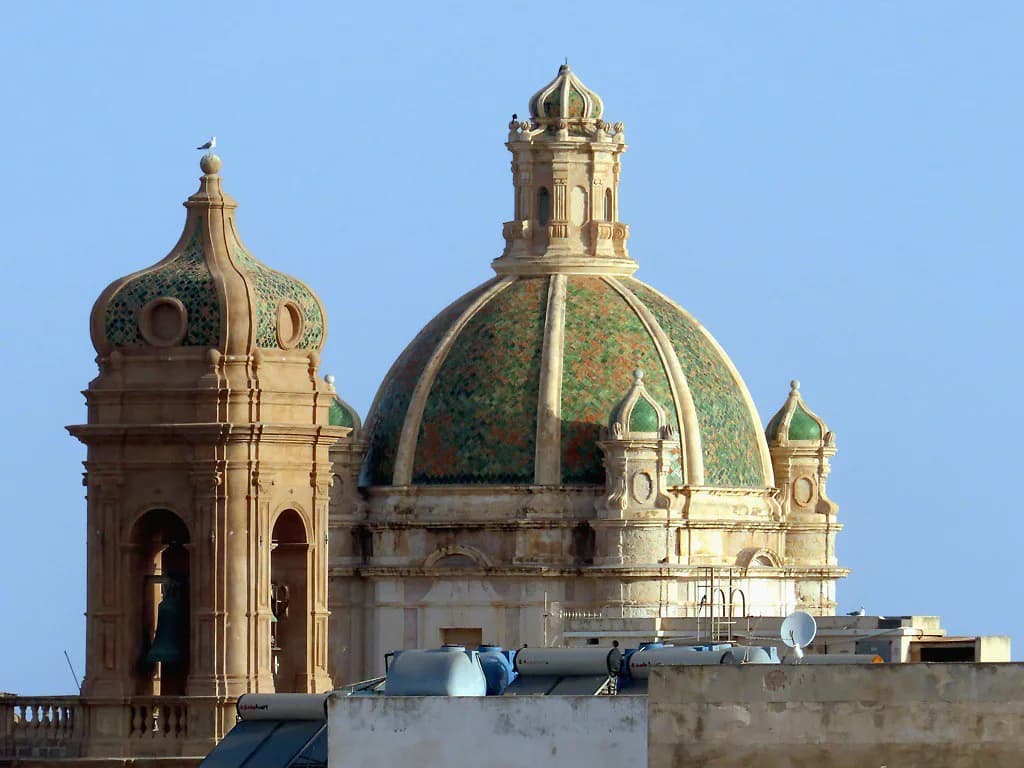
A bronze and iron gate closing the porch was designed by Ennio Tesei in 1990, a modern intervention that sits alongside much older stonework. The upper facade carries Ionic pilasters and is left without a crowning element, and the bell tower above is capped with a spire covered in polychrome majolica. That tiled spire is the detail most likely to reward a photograph from further down the street.
Inside: The 18th-Century Decoration Campaign
Between 1794 and 1801 the interior received its stucco work and paintings, which together define the church you stand in today. That date range is useful because it explains the coherence of the decorative scheme: it belongs to a single, relatively short push rather than centuries of accumulated commissions. When you look at the ceilings and wall surfaces, you are mostly reading late 18th-century choices.
Two things often listed for this church cannot be confirmed from the available material: the presence and details of a chapel of the Sacrament, and a wooden crucifix as a named highlight. Do not build your visit around them. Instead, ask at the church itself or check the parish's own notices, which will also tell you whether any part of the interior is roped off for services or restoration on the day.
Visiting a Working Parish Church
The cathedral is the principal Catholic place of worship in Trapani, which means services take priority over sightseeing and visitors may be asked to wait or keep to the back. It is not a museum with a fixed route through it. Dress and behaviour should reflect that: covered shoulders and knees, quiet voices, no flash photography during worship, and a willingness to step out if a service begins.
If you want to attend rather than simply look, treat the church calendar as the authority and check it locally or on the diocese site before planning your day around a particular Mass. Feast days and Holy Week in Trapani draw large numbers of people, and the wider city's religious calendar is heavy in spring. On those days the building functions differently, and a quiet architectural visit is unlikely.
What Is Not Confirmed: Hours, Entry and Access
No reliable opening hours, closing days or entry terms for the cathedral appear in the material used for this guide, so none are given here. Some Sicilian churches are free to enter and rely on donations, others charge for a defined visitor route or a combined church ticket, and the distinction matters. Confirm directly with the parish or the diocese before you set out, especially out of season.
The same caution applies to doors that open only for services, midday closures, and any restoration work that hides part of the interior. A tourist office can tell you what is currently open in the centre, and a phone call to the parish is usually faster than trusting an aggregator listing. Where a page shows a price or a timetable without a date, treat it as a lead to verify rather than a fact.
Because opening patterns shift, build flexibility into your day: if the cathedral is shut when you arrive, the surrounding streets offer enough to fill the time until you can return. The western seafront walk toward Torre di Ligny and the fish market square are both within easy walking distance. That way a locked door costs you minutes rather than an afternoon.
Pairing the Cathedral With Nearby Squares
Piazza Mercato del Pesce, at the point where the old town pushes into the sea, took its current form from an 1874 project by the Venetian architect Giambattista Talotti, with arcades arranged around a fountain. It is no longer a working fish market in the old sense but remains a stage for community events and a fine place to end a walk. Pairing it with the cathedral gives you two very different kinds of public space in one loop.
The Mura di Tramontana, the stretch of Spanish-era walls along the northern edge of the centre, survive for roughly a kilometre and carry a walkway with sea views. From that path you can reach the Bastione Conca, built to control the water below the historic centre. Walking the walls before or after the cathedral adds a coastal dimension that the street-level visit lacks.
If your interests run to collections rather than churches, the Regional Pepoli Museum occupies a former Carmelite convent beside the Santuario dell'Annunziata and holds coral work, sculpture and paintings. It sits further from the old town core, so it works better as a separate outing than a quick add-on. Decide between the two based on how much time you have rather than trying to squeeze both into one morning.
How Long to Allow and When to Come
A short look at the facade and a walk through the nave takes most people well under half an hour, so the cathedral works best as a component of a longer old-town wander. If you want to read the 1794–1801 decoration properly and sit for a while, budget closer to an hour and accept that services may cut it short. These are suggestions for pacing, not official guidance.
Late spring and early autumn are generally the most comfortable seasons for walking a Sicilian city, with warm but not extreme temperatures, and the historic centre is easy to explore even in the hotter months thanks to the breeze off the peninsula. Winter in Trapani can be windy and some restaurants close, so call ahead rather than trusting online hours. Whatever the season, the evening passeggiata along the main street is when the centre feels most alive.
If you have a car, be careful inside the centre: many streets fall within restricted traffic zones, and parking near the cathedral is not something to count on. Staying within walking distance of Corso Vittorio Emanuele removes the problem entirely. Otherwise, ask your accommodation about parking before you arrive.
Making a Half-Day of the Old Town
A sensible half-day starts on Corso Vittorio Emanuele, takes in the cathedral and Palazzo Senatorio, then follows Via Garibaldi toward the sea before finishing at the Mura di Tramontana for the sunset. The order matters less than the direction: walking west keeps the sea ahead of you and ends the day naturally at the water. Allow time to sit rather than treating the route as a checklist.
Budget-conscious travellers will find plenty here that costs nothing beyond a coffee, including the streets themselves, the walls and the churches that keep open doors. Checking what is free before you go helps you decide where to spend on the paid interiors and museums.
If you have a spare afternoon, the salt pans south of the city and the cable car up to Erice are the two outings most often recommended from Trapani, and both change the pace after a morning of churches. Erice in particular is easy to reach without a car. Save one of them for the day after your old-town walk rather than crowding everything together.
Plan Your Visit
The Cattedrale di San Lorenzo rewards a deliberate ten minutes rather than a passing glance: read the three-arch porch, look for the majolica spire, and step inside knowing that the decoration belongs to the years around 1800. Because hours and entry terms are not reliably published, confirm them with the parish or the diocese before you build a day around it.
Then let the street do the rest. Corso Vittorio Emanuele, the walls above the sea and the old fish market square are all within a short walk, and together they explain more about Trapani than any single building. Go slowly, dress for a church, and leave room for the evening stroll.
Frequently Asked Questions
Where is Trapani Cathedral located?
The Cattedrale di San Lorenzo stands on Corso Vittorio Emanuele in Trapani's historic centre, on Sicily's western tip. Its position on the main pedestrian street makes it an easy stop within a walking route through the old town, close to Palazzo Senatorio and the sea-facing walls.
When was the Cattedrale di San Lorenzo built?
Construction began in 1421 under Alfonso the Magnanimous, but the building was altered repeatedly over the following centuries. Its present appearance is generally credited to an 18th-century Baroque remodelling by the architect Giovanni Biagio Amico, which is why the interior reads as later than the foundation date suggests.
Is the cathedral free to enter?
Entry terms are not reliably published, and Sicilian churches vary between free access with donations and paid visitor routes. Check with the parish or the diocese before you go rather than relying on an undated listing, and be prepared for the building to be closed to sightseers during services.
What should I wear when visiting the cathedral?
This is an active Catholic parish church, so covered shoulders and knees are appropriate, along with quiet behaviour and no flash photography during worship. If a service is starting, wait at the back or return later rather than walking through the nave.
How long does a visit to Trapani Cathedral take?
As a suggestion rather than an official figure, allow twenty to thirty minutes for the facade and interior, or closer to an hour if you want to study the 1794–1801 stucco and paintings. Services and occasional closures can shorten or interrupt a visit.
What else is nearby in Trapani's historic centre?
Palazzo Senatorio and the old Porta Oscura gate sit at the eastern end of Corso Vittorio Emanuele, Via Garibaldi is lined with churches and palaces, and the Mura di Tramontana walkway follows the sea along the northern edge of the centre. The former fish market square and the seafront toward Torre di Ligny are short walks away.
Sources
Continue exploring
More guides you'll find useful