Bastione Conca and Trapani's Old Defences: A Walking Guide
Walk Trapani's old sea walls from the fish market to Bastione Conca, with the medieval castle, Aragonese gates and Spanish bastions explained.
On this page
Trapani's fortifications are not one monument with a ticket desk. They are a sequence of survivals folded into the modern street plan: the quadrilateral bulk of the Castello di Terra, two Aragonese gates, and the sixteenth-century bastions that reshaped the seaward edge. Walking from the fish market along the Mura di Tramontana and finishing at Bastione Conca is the clearest way to see how medieval and Spanish-era defence stacked on top of each other.
A useful first decision is what you expect from the castle. One regional description presents the Castello di Terra as an imposing quadrilateral building with half-curtain and corner towers, built to protect the northern side of the city and the channel linking the port to the Tyrrhenian. The same account describes no museum interior, so plan on reading the structure from outside rather than touring rooms.
The second decision is timing. A focused wall walk from the fish market area to Bastione Conca fits comfortably into a morning or late afternoon, while a fuller fortifications half-day can add the castle quarter, the gates and a pause on the small beach below Porta delle Botteghelle. Both versions depend on the same stretch of seafront paving and the same private-property break, which is why it helps to know the route before setting out.
Why the Castle and Bastione Conca Belong in One Walk
Trapani's defences changed logic over time. The medieval system relied on walls, gates and a castle controlling the neck of land; the sixteenth-century programme added powerful sloping bastions, isolating the city from the mainland with a deep moat and a navigable canal to deter pirate raids. Putting the Castello di Terra and Bastione Conca in one itinerary is really a lesson in that shift.
The medieval layer is credited to James II of Aragon at the end of the thirteenth century, when the city walls were set out with eleven gates. Of those, Porta Oscura, crowned by the Clock Tower, and Porta delle Botteghelle survive as readable fragments rather than as a continuous enceinte. The castle protected the northern flank and the port channel, which explains why it sits where it does rather than out on the open shore.
The later reinforcement belongs to Trapani under Spanish rule, and the design is attributed to the engineer Ferramolino of Bergamo during the sixteenth century. Treat the exact year as approximate and the engineering logic as the point: thick sloped walls answered the threat of naval artillery and landing parties far better than a thin medieval curtain.
Orientation: Where Each Piece Sits
Think of the route as a line along the north-west edge of the old city. Piazza Mercato del Pesce is the natural starting point because the surviving Mura di Tramontana run from there toward Bastione Conca, a stretch of roughly one kilometre. Inland from that line sit the castle quarter and the gates, so you can look along the wall and then step back into the medieval street plan.
Porta delle Botteghelle, also written putièlle, opens toward the sea at the foot of a steep basalt stairway leading down from the wall path. That stair is the practical link between the elevated walk and the small beach below, and it is the easiest place to break the walk for the water. Porta Oscura and its clock tower sit inland in the historic centre rather than on the seafront, so plan those as a separate loop.
At the far end of the walk sits Bastione Conca, with the Torre di Ligny tower beyond it along the promenade. One third-party listing files the bastion under Erice, which is a listing error: the same page gives its address as Via Mura di Tramontana Ovest, on Trapani's own seafront.
What Actually Survives of the Medieval Castle
The Castello di Terra is described as a heavy building on a quadrilateral plan with half-curtain towers and corner towers, and its mass is still legible in the urban grid. It was the northern anchor of the defensive system, guarding both the landward approach and the canal from the port to the sea. What you see today is fortification fabric embedded in the modern city rather than a staged ruin with paths and panels.
That matters for planning. No source here publishes a visitor route through the castle interior, so do not build a day around going inside. Read the exterior, note where the corner towers face, and use the building as the starting point for thinking about how the gates and walls related to it.
The same caution applies to the gates. Porta Oscura survives under its clock tower and Porta delle Botteghelle survives at the water, but the other medieval gates do not. The surviving pair is enough to understand the pattern of controlled openings in a walled city, especially if you walk between them rather than treating each as a standalone sight.
Walking the Mura di Tramontana and the Sixteenth-Century Programme
The Mura di Tramontana is the surviving seafront stretch of the Spanish-era works, running roughly a kilometre from the fish market area to Bastione Conca. Walking it gives you the city on one side and open water on the other, with the view opening progressively toward the gulf. The path is the backbone of this itinerary; everything else is a detour from it.
The same scheme produced the Bastione Imperiale, or Sant'Anna, at the north-western corner, with sloping walls topped by battlements. It later served as a prison considered impossible to escape from, which says something about how the defensive geometry was repurposed. The Conca sits at the other end of the seaward system.
Here is the honest limitation: Bastione Conca and Bastione Imperiale are not one continuous walk. Private property along the boundary separates the two fortifications, so you cannot plan a single promenade linking them. Build the day around the Tramontana stretch and treat the Imperiale as a separate point to read from nearby. Further visitor details appear in Bastione conca storia e informazioni - Trapani.
Bastione Conca in Detail
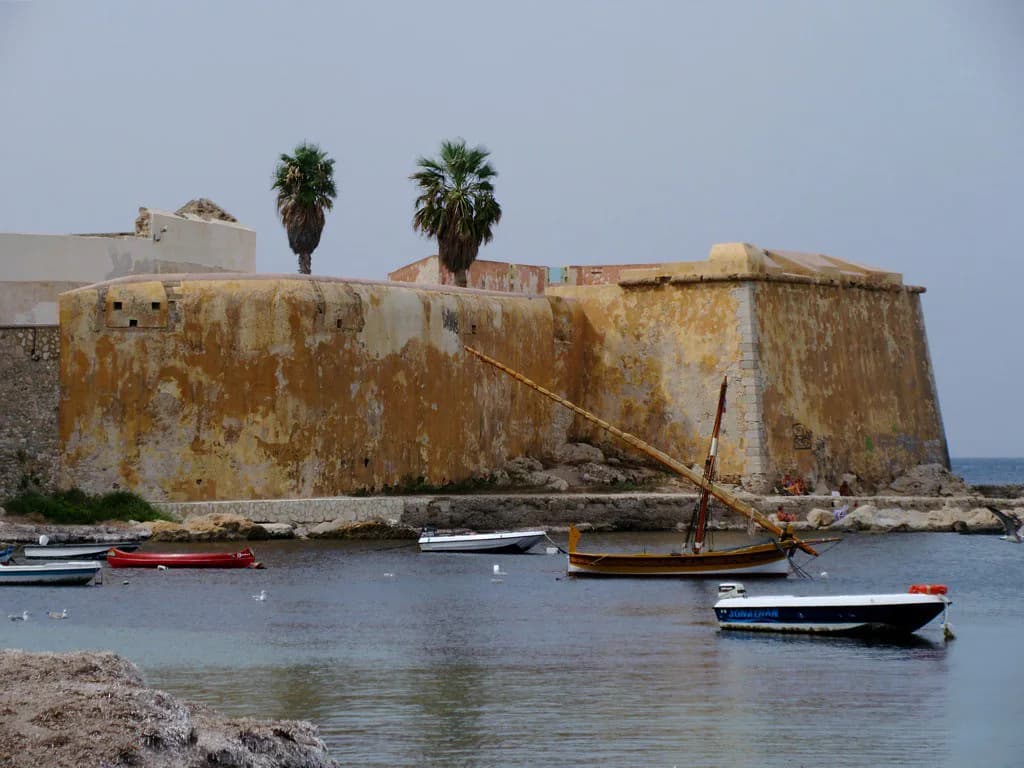
Bastione Conca takes its semi-circular, bow-like form from the shape of the rocks it was built against. Rather than imposing an abstract plan, the builders followed the offshore geology and the arc of the coastline. That is why the bastion reads as a curved platform opening onto the gulf rather than as a squared-off gun position.
Its role was to guard and control the wide stretch of sea in front of the historic centre, and the position still delivers that outlook today. Travel accounts describe the promenade as especially rewarding toward sunset, with the old city visible behind you and the water opening ahead. The same accounts note that some parts have been restored while others show signs of neglect, so expect an uneven rather than a polished monument.
One practical wrinkle: third-party listings have flagged the site as temporarily closed with opening hours to be determined, but no official confirmation accompanies that note. The bastion is an outdoor fortification on a public promenade rather than a staffed attraction, so treat the listing as unverified and check locally before making it the sole purpose of a trip.
Getting There on Foot, by Bike or from the Sea
The simplest approach is on foot from Piazza Mercato del Pesce, following the Mura di Tramontana westward. A local place page notes that walkers and cyclists both use the route, and the flat profile makes it easy to combine with a wider loop through the centre. From the wall path, a steep basalt stairway near Porta delle Botteghelle drops down to the small beach and the fishermen's boats.
From the city side, the historic centre sits on a compact grid off Corso Vittorio Emanuele, so most approaches begin there. A self-guided route through those streets works well as the inland half of the day, with the castle quarter, Porta Oscura and the cathedral all within easy reach of each other; our historic centre self-guided walk plots that loop.
Do not count on named bus lines, parking facilities or published journey times for this route, because none are established by the sources here. If you are arriving from the airport or the ferry port, confirm the current options with your accommodation or a tourism information point rather than relying on an old blog post.
Views, Light and the Best Time to Walk
The walk rewards early morning and late afternoon more than the middle of the day. Walking westward from the fish market puts the open gulf ahead of you and the old city behind, which is the better direction for the long panorama. Coming back the other way, you get the layered skyline of the centre instead.
If you time the walk for sunset, plan to be at Bastione Conca as the light drops rather than starting the walk then. Travel accounts single out the spot for evening views, and the nearby promenade toward the Tower of Ligny is a natural continuation; our Torre di Ligny guide: Trapani's sea-watching tower covers what the structure was built to do.
The castle quarter reads differently at midday, when the stone facades flatten in the sun and the streets offer shade rather than drama. If you want both the castle exterior and the wall walk in one day, do the inland part in the morning and save the seafront for the evening.
Practical Cautions Before You Set Out
Expect uneven paving on the wall path and on the basalt stairway down to Porta delle Botteghelle. The seafront sections are exposed, with little shelter from sun or wind, so carry water and a layer even in shoulder season. Sensible shoes matter more here than on the flat Corso.
The break between Bastione Conca and Bastione Imperiale is the single most important thing to know before you go. Anyone planning a full circuit along the water will meet private property and have to turn back. Build the day as an out-and-back along the Tramontana instead.
The small beach below the wall is a city cove rather than a serviced lido, so it suits a quick dip rather than a full beach day, and no source here vouches for sea conditions. For a longer stretch of sand, ask locally about San Giuliano before committing the afternoon.
How Long to Allow: Two Timing Models
The short version is a focused wall walk of one to one and a half hours, starting at Piazza Mercato del Pesce and ending at Bastione Conca. That is a suggested duration, not an official figure, and it leaves time for the Botteghelle stairway and the beach below without committing a whole morning. It is the right choice for a cruise stop or an afternoon between other sights.
The half-day version adds the castle quarter, Porta Oscura, the fish market square and a swim stop. Budget around four hours including a leisurely lunch, again an editorial suggestion, and expect the inland stretches to take longer than the map suggests because of photo stops and shade breaks. This version suits a slow stay rather than a transfer day.
A full day can stretch to the salt pans or a boat to the Egadi Islands, but resist trying to fit the fortifications and the islands into the same day. The wall walk deserves unhurried time, and island ferries and salt-pan visits each take their own half-day.
What to Pair Nearby
Torre di Ligny, at the far end of the promenade, was begun in 1671 on the north-western tip of the city to defend that area from Turkish pirates. Continue past the bastion for a natural extension of the wall walk, with a view back toward the old city; the same account notes that the tower is not accessible to disabled visitors.
Inland, the Cattedrale di San Lorenzo sits among the palazzi along the main street and is a natural stopping point on a self-guided wander. Our Trapani Cathedral (Cattedrale di San Lorenzo) visitor guide sets out what to look for inside if you are already walking the Corso.
For a paid interior on the same day, the Museo Regionale Agostino Pepoli occupies a former Carmelite convent complex next to the Sanctuary of the Holy Annunciation. Our Regional Pepoli Museum (Museo Regionale Agostino Pepoli) guide explains its coral and majolica collections, which balance an outdoor morning with an indoor afternoon.
Three Common Expectations Worth Correcting
First, the castle is not presented as a ticketed visitor attraction with a shop and a route through restored rooms. It is a standing fortification read from the outside, and its interest lies in its plan and position rather than in exhibits. Second, the bastions are not a single connected circuit; the private-property break between Conca and Imperiale means you cannot walk them end to end.
Third, the Tramontana walk is a city promenade rather than a wilderness trail. You will share it with joggers, cyclists and dog walkers, and you will be within reach of bars and shops for most of its length. That is part of its charm, but it is not a remote hike.
Plan Your Visit
Trapani's fortifications reward a slow, deliberate walk rather than a checklist. Start at the fish market square, read the castle quarter inland, then follow the Tramontana to Bastione Conca and finish toward the Tower of Ligny as the light softens. The route is short, but it holds several centuries of defensive thinking in a manageable stretch.
Before you go, check current access to the castle and the bastion with a tourism information point, since listing sites disagree and a closed listing may simply be stale. If you want to add a church or a museum interior on the same day, confirm its hours on arrival rather than trusting a guidebook.
Frequently Asked Questions
Can you go inside the Castle of Terravecchia in Trapani?
The evidence here describes the Castello di Terra as a standing fortification with a quadrilateral plan and towers, not as a museum with a visitor route. It is best read from the outside as part of the city's defensive fabric. If you want to know whether any interior access exists on your dates, ask at a tourism information point rather than relying on old blog posts.
How do you reach Bastione Conca from Trapani's historic centre?
Walk from Piazza Mercato del Pesce along the Mura di Tramontana toward the seaward edge of the old city. The bastion sits at the end of that roughly one-kilometre stretch, and a local place page notes the route is used by walkers and cyclists. A steep basalt stairway at Porta delle Botteghelle drops to the small beach below if you want a pause by the water.
How long is the Mura di Tramontana walk?
The surviving stretch runs roughly one kilometre from the fish market area to Bastione Conca. A suggested allowance is about an hour to walk it slowly with pauses for views, longer if you detour down to the beach or continue toward the Tower of Ligny. The path is exposed, so carry water in warm weather.
Are Bastione Conca and Bastione Imperiale connected?
No. Private property along the boundary separates the two fortifications, so you cannot walk a continuous circuit between them. Plan the day as an out-and-back along the Mura di Tramontana, and treat the Imperiale as a separate point to view from nearby rather than as the far end of a loop.
Is Bastione Conca free to visit?
The bastion is an outdoor fortification on a public promenade, so it does not operate like a ticketed attraction, and no source here lists a price or a formal ticket office. Some third-party listings have flagged it as temporarily closed, but without official confirmation; check locally before making it the sole purpose of a trip.
What is the best time of day to walk Trapani's sea walls?
Early morning and late afternoon give the best light and the most comfortable temperatures, and travel accounts single out the promenade around Bastione Conca for sunset views. Walking westward puts the open gulf ahead of you; returning eastward gives the old city skyline instead. Midday is better saved for the shaded inland streets around the castle quarter.
Sources
- Services - Fortifications, City Doors, Walls and Bastions - Trapani
- Bastione conca storia e informazioni - Trapani
- Services - Tower of Ligny - Trapani
- Services - Fish market square - Trapani
- Conca Bastion, Erice, Italy - Reviews, Ratings, Tips and Why You Should Go – Wanderlog
- Bastione Conca Trapani Tickets [2026] - Promos, Prices, Reviews & Opening Hours | Trip.com
Continue exploring
More guides you'll find useful