Hidden Gems in Mantua: Quiet Squares and Lesser-Known Sites
A slower Mantua guide to quieter squares, the Rotonda di San Lorenzo, artists' houses and lakeside walks, with practical checks on access before you go.
On this page
Mantua is often reduced to a pair of blockbuster palaces, but the city's quieter register comes from the stops between them. A good working plan is to count two major interiors at most in a day and thread smaller squares, church exteriors and riverside walks around them. Most of the historic centre is compact and walkable, so little of this requires transport.
The city sits in the Po Valley, ringed by three lakes formed by the Mincio, and that geography gives the centre its watery silhouette. A suggested half-day of wandering—not an official timing—is enough to link Piazza Erbe, Piazza Broletto and Piazza Mantegna on foot, leaving a palace for the rest of the day. The sources that survey Mantua's highlights note that the main sights sit within easy walking distance of each other, which makes this kind of mixing practical.
Why Mantua Suits Slow, Off-Centre Wandering
Mantua is wrapped by the lakes of the Mincio, and the parks overlooking them give a different texture from the dense brick and fresco of the centre. Use a lake-edge stretch between two interior visits and the city feels less like a checklist. The water also gives the reflected skyline views that reward an unhurried camera.
The trade-off is time. Palazzo Ducale and Palazzo Te are the two visits that absorb the most hours, and trying to squeeze both plus a scatter of smaller stops into one day produces a blur. If you have only a day, pick one palace and spend the rest on the squares and short stops described below. Travel writers who know the city suggest two days to absorb its main attractions without sensory overload, which is advice rather than a rule.
Piazza Erbe and the Rotonda di San Lorenzo
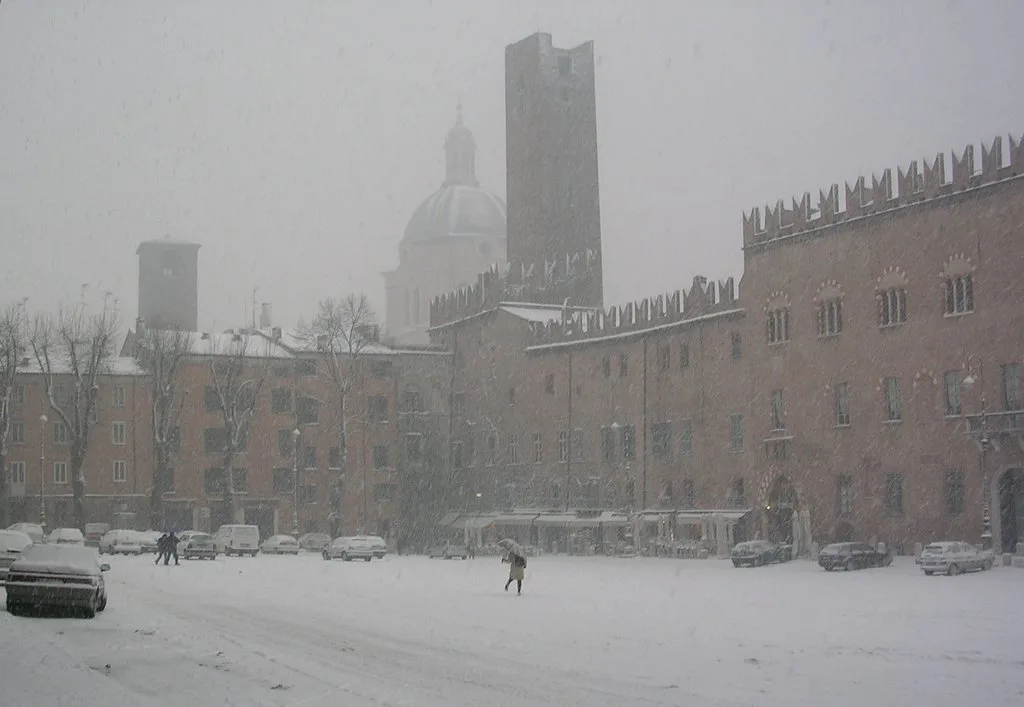
Piazza delle Erbe is the medieval heart of Mantua, an ensemble that gathers the Rotonda di San Lorenzo, Palazzo della Ragione, the clock tower and the Palazzo del Podesta around one open space. Treat it as a single stop rather than four errands: walk it slowly, look up at the tower and let the buildings stack around you.
The Rotonda di San Lorenzo is the quiet surprise here: an ancient round church in Romanesque style, dated in the sources to the 11th century, sitting right on the market square. Because it is small, it takes only minutes, which makes it an ideal low-commitment pause between larger visits. The sources do not confirm current opening arrangements or free entry, so check locally on the day rather than assuming you can walk straight in.
The clock tower above the square dates to 1472 and was designed by Luca Fancelli, with a mechanism showing Roman numerals and zodiac signs. Whether you can climb it, and when, is something to confirm at the site or the city information point before you count on the view. Even from ground level it anchors the square's composition. Further visitor details appear in 29 Crazy and offbeat roadside attractions in Mantua.
Piazza Broletto and Piazza Mantegna: Quiet Pauses
Piazza Broletto, with its medieval Palazzo del Podesta and Palazzo del Massaro, was the centre of civic power in the communal era. It works best as a two-minute crossing rather than a destination, which is exactly why it fits between bigger stops. Standing in it, you get a clean read of how Mantua's secular and religious powers arranged themselves across adjoining squares.
Piazza Mantegna is dominated by the facade of Alberti's unfinished Basilica di Sant'Andrea, a milestone of Renaissance architecture. The basilica is associated with a relic of Christ's blood brought by St. Longinus, but do not build a trip around catching a special display; the sources do not establish current viewing arrangements. The square itself is free to walk and gives you the facade at its best angle.
The four interlinking main squares—Sordello, Erbe, Mantegna and Broletto—connect through a maze of alleys and cobbled lanes. That adjacency is the practical argument for doing the quieter squares on foot rather than plotting them as separate outings. Sordello, the oldest, holds the Ducal Palace and the cathedral, so it tends to be busy; Piazza Mantegna and Piazza Broletto are the calmer breathing points.
Teatro Scientifico del Bibiena: A Rococo Interior to Admire
The Teatro Scientifico del Bibiena is a Rococo theatre that many visitors miss because it sits off the main palace circuit. Its interior is the draw: a compact, highly decorated auditorium that rewards a short, attentive look rather than a full visit. The sources do not confirm current opening arrangements, so check the theatre's own programme before travelling, since performances often determine when you can get inside.
You will often read that a young Mozart performed here; the story is widely told and worth enjoying as local colour, but treat it as tradition rather than a documented fact you can verify from a plaque. What the sources support is the theatre's architectural character and its place in the city's cultural life. If you cannot get in, the exterior and the surrounding streets still justify the detour.
Renaissance Personalities in Brick: Mantegna and Giulio Romano
Two artists shaped Mantua's built environment more than any others: Andrea Mantegna, the Gonzaga court painter, and Giulio Romano, Raphael's pupil who designed Palazzo Te. Their own houses are the kind of stop that top-ten lists skip, and they suit travellers who want to read the city through its makers rather than its rulers. Expect modest exteriors and short visits.
Neither house is a blockbuster interior, and the sources do not establish current opening arrangements, so verify visiting conditions before making either a fixed appointment in your day. The payoff is context: after seeing the Camera degli Sposi in the Ducal Palace, a look at the artist's own house rounds out the picture. The same logic applies to Giulio Romano's house once you have walked through Palazzo Te.
Within the Ducal Palace, Mantegna's Camera degli Sposi is the room most visitors come for. The palace publishes its own visiting information in English and Italian on site, and the sources note that admission to the Camera is limited, so the general principle is to check the palace's own pages and plan a slot before you go. Rather than repeat rules that change, use the palace's official information as your reference. The rest of the complex, including the Pisanello Room and the Zodiac Room, easily fills the time around it.
Pescherie di Giulio Romano: A Riverside Curiosity
The Pescherie di Giulio Romano, a fish-market arcade attributed to the same architect, is now a picturesque riverside curiosity rather than a working market experience. It is the sort of stop that takes ten minutes and photographs well, and it pairs naturally with a lake-edge walk. Do not expect a visitor centre or interpretation boards; read it as architecture and setting.
Because it is an outdoor structure in a public setting, it slots into a walk without a booking, but any nearby interiors should be checked separately. The value here is atmospheric: brick arches, water and the sense of a working city's older economy. If you are travelling with someone who tires of frescoes, this is a good change of register.
San Sebastiano: A Lesser-Visited Church and Palace Pairing
The Church of San Sebastiano and the nearby Palazzo San Sebastiano form a pairing that most short itineraries leave out. Both are associated with the Gonzaga and with Giulio Romano's architectural circle, and together they give you a quieter read of the family's building programme away from the Ducal Palace crowds. Allow a short stop rather than a half day.
Access is the catch. The sources do not establish current opening arrangements or entry terms for either building, so check with the city's tourist information service or the sites themselves before walking out. If both are closed on your dates, the surrounding streets and the walk back toward the centre still work as a leg stretch. Treat this as a flexible addition, not a fixed anchor of the day.
Piazza Virgiliana and the Lake Edges
Piazza Virgiliana is a broad green space laid out in 1801 by the architect Paolo Pozzo, with a statue of the Roman poet Virgil inaugurated in 1927. It is the city's best pause between dense sightseeing and provides shade, benches and a sense of ordinary Mantuan life. The square is also used for public events, so expect occasional activity rather than guaranteed silence.
From the water's edge you get the view that sells the city: spires, domes and towers reflected across the Mincio. A bridge crossing gives one of the best angles, and it costs nothing but time. Build this into the end of an afternoon rather than the middle of a museum day, when light and mood both improve.
If you are coming from a larger Italian city and want more of this slower register, the approach used in our guide to the hidden gems in Venice translates well: fewer stops, longer pauses, and attention to the spaces between monuments.
Rigoletto's House: Opera Lore, Not Biography
Rigoletto's house is a small landmark tied to Verdi's opera, and local tradition affectionately treats it as the jester's residence. Verdi moved the story's setting to Mantua, which is why the association stuck, but the building is storytelling rather than documented biography. Enjoy it as a piece of the city's cultural imagination and do not expect a museum of the character's life.
The stop takes minutes and sits close to Piazza Sordello, so it fits naturally on the way between the cathedral and the Ducal Palace. The sources list a tourist information point here; if it is open, it is a sensible place to pick up current city maps and confirm which smaller sites are accessible that week. Otherwise, treat the exterior as the visit.
A Worked Half-Day Plan Mixing Big and Small
Start early at Palazzo Ducale, where the scale of the complex and the draw of the Camera degli Sposi justify the biggest time block of your day. Check your entry arrangements in advance through the palace's own channels, then leave the rest of the morning flexible. Emerging into Piazza Sordello, you are already within a few minutes of Rigoletto's house and the cathedral.
After lunch, cross to Piazza Erbe for the Rotonda di San Lorenzo and a look at the clock tower, then drift through Piazza Broletto to Piazza Mantegna for the Sant'Andrea facade. This sequence is short on walking and heavy on variety: a round church, a civic square and a Renaissance church front within a few minutes of each other. None of it requires a ticket to enjoy from outside.
Finish with Piazza Virgiliana and the lake edge, or substitute the Pescherie arcade if you want water and brick instead of green space. Keep Teatro Bibiena and the artists' houses as alternatives rather than additions, so the day does not collapse under its own ambition. A second day is the natural home for Palazzo Te, which sits slightly off the centre.
Practical Decisions: Ticketing, Closures and Time Slots
The sources do not establish current ticket prices, opening hours or closure days for any of the sites mentioned here, and quoting figures would be guesswork. Check the official page for each palace, church or theatre shortly before you travel, and confirm whether interiors are open on the day you plan to visit. Public squares and lake paths are outdoor spaces, but that is not a guarantee about nearby buildings.
For Palazzo Ducale in particular, plan around the published visiting information rather than third-party summaries, and reserve time slots where the palace's own system offers them. Church interiors deserve the same caution: the sources describe the architecture and history but do not confirm free entry or visitor rules. A quick check at the tourist information point on arrival resolves most uncertainty.
If your itinerary runs through several Italian cities, the same discipline of checking each site's own notices works elsewhere; our hidden gems in Florence guide follows the same logic of fewer, better-verified stops.
Mantua as a Day Trip or an Overnight
Mantua works well as a day trip from Milan, Venice, Bologna or Verona, and it is also compact enough to cover a surprising amount on foot in a single day. The trade-off is depth: one day lets you see a palace, the main squares and a couple of smaller stops, but not both major palace complexes. An overnight buys you an early start and an evening on the lake edge.
If you have two days, give the first to the centre and the Ducal Palace, and the second to Palazzo Te with its garden and the walk back through town. That split keeps the quieter stops—the Bibiena theatre, the artists' houses, San Sebastiano—as natural punctuation rather than obligations. Travellers who prefer a light planning read can start with the city overview before committing to a schedule.
Shoulder seasons tend to suit this kind of walking itinerary better than high summer, when palace interiors and open squares both demand more stamina. There is no single right answer, but matching your pace to the day's heat is more useful than trying to see everything.
Plan Your Visit
Mantua's lesser-known corners are not hidden so much as easily skipped: a round church on a market square, a Rococo theatre, two artists' houses and an arcade by the water. Stringing three or four of them around one major palace visit produces a fuller, calmer day than chasing every highlight. The practical work is small: check access, keep the big interiors to a sensible number, and leave room to walk.
Before you go, confirm opening arrangements through official channels for anything you want to enter, and treat outdoor squares, bridges and lake paths as the flexible part of the plan. That way a closure becomes an invitation to wander rather than a ruined morning.
Frequently Asked Questions
What are the best lesser-known places to see in Mantua?
Consider the Rotonda di San Lorenzo on Piazza Erbe, the Teatro Scientifico del Bibiena, Casa del Mantegna, the House of Giulio Romano, the Pescherie arcade and Piazza Virgiliana. These are quieter or less prominent stops rather than secrets, and each takes only a short time. The sources do not confirm current access for interiors, so check before you go.
Is Mantua worth visiting, and how many days do you need?
Yes, particularly for Renaissance art and architecture. One full day covers the centre and one major palace; two days let you add Palazzo Te and the smaller stops without rushing. The historic centre is compact and easily walked.
Is Mantova the same city as Mantua?
Yes. Mantova is the Italian name and Mantua the English one, so signs, timetables and maps may use either. The city is in Lombardy, in Italy's Po Valley.
Which Mantua sights are free to visit?
Public squares, the lake edges and bridges are outdoor spaces you can walk freely. The sources do not confirm free entry for church or palace interiors, so check each site's own information before assuming you can enter without a ticket.
How do you see Mantua's quieter corners without skipping Palazzo Ducale and Palazzo Te?
Give each palace its own half day and thread the smaller stops around them, ideally over two days. On a single day, choose one palace and pair it with Piazza Erbe, Piazza Broletto and Piazza Virgiliana. Verify opening arrangements for the smaller interiors in advance.
Is Rigoletto's house a real historical site?
It is a real building tied to local tradition about Verdi's opera, which is set in Mantua. Treat the association as cultural storytelling rather than documented biography, and enjoy it as a short stop near Piazza Sordello.
Sources
Continue exploring
More guides you'll find useful