Self-Guided Walk Through Cefalù's Old Town: A Half-Day Loop
Plan a self-guided walk through Cefalù's old town with a suggested half-day loop past the cathedral, medieval washhouse and old harbour.
On this page
Cefalù packs an unusual amount of history into a small grid of lanes between the Tyrrhenian Sea and a limestone crag. A walking loop that threads Corso Ruggero, the cathedral square, the medieval washhouse and the old harbour covers the essentials in a few hours without a guide or a fixed timetable. The route below is a suggestion built around landmarks rather than a measured trail, so you can stretch or shorten it as the day goes on.
Treat the timings here as planning estimates, not official route lengths, and check the opening situation for any ticketed interior before you commit to a late start. A short self-guided sightseeing itinerary through five central sights, including the cathedral and the Mandralisca museum, is mapped at roughly 0.8 kilometres, which gives a sense of how compressed the historic centre really is.
One practical note before anything else: much of Cefalù's appeal in this loop is free, and that is what makes it a good half-day option when you would rather not build a schedule around tickets. Check the municipality's site for local notices and any event calendar changes that might affect the streets or the seafront on your chosen day.
What a Self-Guided Old-Town Loop in Cefalù Covers
The loop works clockwise from the flat spine of Corso Ruggero, dipping into the cathedral square, then west towards the washhouse and Piazza Garibaldi before dropping to the waterfront and the old harbour. Everything sits inside the compact historic centre, so you are never more than a short walk from the sea or from a cafe when you want to stop.
What it leaves out matters just as much. The climb up La Rocca and the Mandralisca museum are deliberately treated as optional branches rather than fixed stops, because both add time and both involve their own opening arrangements. The Capo Marchiafava side of town is also an extension rather than a core stop, useful when you have energy left after the harbour.
If your day in Cefalù is tightly budgeted, this loop slots neatly into a wider plan alongside beach time and meals. It pairs well with a fuller one day in Cefalù itinerary that covers the town and the sand in the same visit.
Before You Start: Shoes, Shade and Walking Early
Wear closed shoes even if you plan only the flat loop, because the cobbles and stone staircases in the old town punish thin soles, and the Rocca branch reportedly turns away visitors without proper footwear. Carry water rather than assuming you will find a fountain at the right moment, and add a hat if you are walking between late morning and mid-afternoon.
Early morning is the most comfortable window for the cathedral square and the lanes, when the light is softer and the piazza is not yet busy. The travel blog Along Dusty Roads makes the same case for visiting the Duomo square early or in the early evening, when the tables in the centre of the plaza are at their best.
Sicilian lunch hours are strict, and the same source notes that many kitchens close after about 2pm and reopen around 7.30pm, with locals often eating nearer 9pm. That rhythm is an argument for walking through the early afternoon and eating either before or well after it. If the weather turns, keep a wet-weather plan in reserve with a Cefalù rainy day indoor itinerary.
Stop 1: Corso Ruggero and Osterio Magno
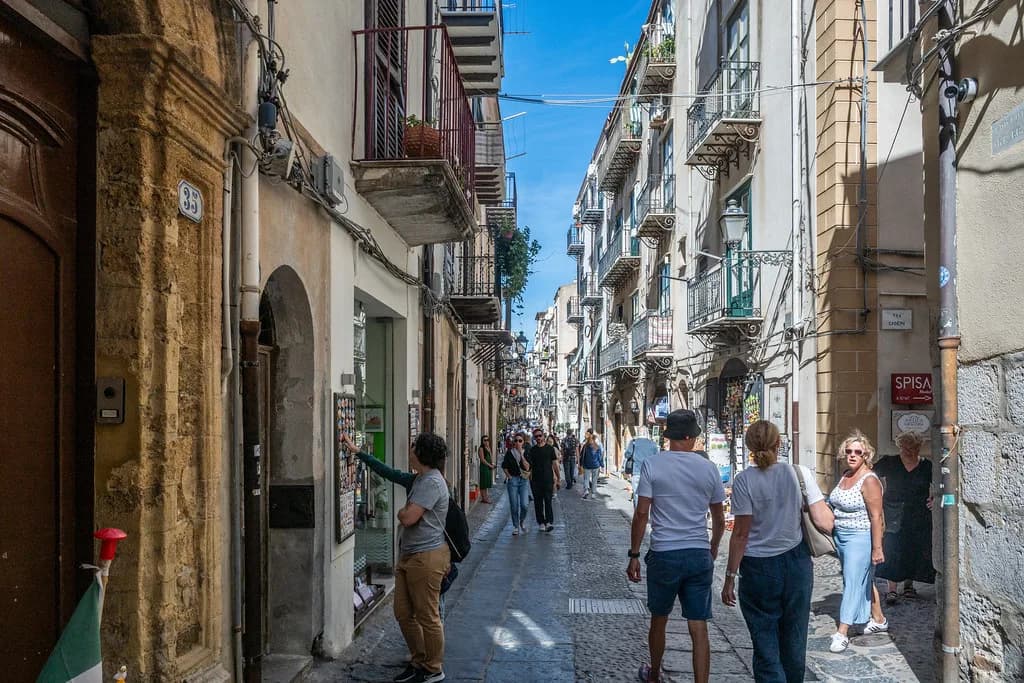
Start on Corso Ruggero, the long pedestrian street that runs through the heart of the old town and gives you a reliable orientation point for the whole walk. Shops, cafes and historic facades line it, and it is the natural place to settle in with a coffee before the sightseeing starts.
Partway along, look for Osterio Magno, a fortified palace that once belonged to King Roger II and now stands as one of the street's more imposing remnants. Visitors holding cathedral itinerary tickets reportedly get entrance to Osterio Magno included, so if you plan to buy one, check the current scope before paying separately.
The street also gives you an easy exit towards the sea whenever you want to break the loop, which is useful if you are walking with children or with limited time. Keep Corso Ruggero in mind as your return line if you wander off into the side lanes.
Stop 2: Piazza Duomo and the Cathedral
The cathedral closes the eastern end of Corso Ruggero and anchors the whole route. It is a UNESCO-listed part of the Arab-Norman chain that includes Palermo and Monreale, and inside it holds a mosaic of Christ Pantocrator described as among the island's oldest and best preserved.
Entry to the cathedral itself is free, but the towers, roof, museum and cloister are covered by separate paid itineraries sold in tiers rather than one all-inclusive ticket. Along Dusty Roads reports that these tickets are described confusingly on the official site and groups them into a red option at the highest price, a blue option covering towers and roof, and a green option for the museum and cloister.
Those rates come from a third-party travel account, not from the cathedral operators, so treat them as indicative and confirm the current options and prices at the ticket desk or the cathedral's own site before you decide. The same source warns that netting on the roof can make photography from the top difficult, which matters if the view is your main reason for climbing.
Stop 3: The Medieval Washhouse off Via Vittorio Emanuele
Turn off Corso Ruggero towards Via Vittorio Emanuele to reach the Lavatoio Medievale, a stone washhouse built over a spring and reached by a wide staircase. It remained in use into the twentieth century and was restored in 1991, and it is one of the more atmospheric free corners of the town.
Go early if you want the space to yourself, since the washhouse is small and popular later in the day. The same travel account found it quiet during a first-thing visit and much busier on returning later.
Allow a short stop here rather than a long one, because there is not much to see beyond the stepped basins and the spring itself. Read more about the site's history and setting in a fuller Cefalù medieval washhouse Lavatoio guide if you want context before you arrive.
Stop 4: Piazza Garibaldi, Gelato and the Rocca Gateway
Piazza Garibaldi sits far enough from the cathedral and the beach that the crowd thins a little, and its bars and restaurants make it a natural rest stop halfway through the loop. It is also the quickest launch point for the Rocca entrance, which you reach by way of a short flight of stairs up the narrow Via Giuseppe Fiore.
For a sweet pause, Antica Porta Terra Gelateria on the square is the spot the travel blog recommends, particularly for the Sicilian habit of gelato served inside a brioche. Bakeries and cafes around the piazza also make easy places to sit down with a drink before the second half of the walk.
If the climb up to La Rocca is on your list, this is where you decide whether to go now or to finish the flat loop first. Chapter the choice honestly: the climb is short but steep, and doing it in the middle of a hot day will change how the rest of the walk feels.
Stop 5: The Old Harbour and Capo Marchiafava
From Piazza Garibaldi, head down through the lanes to the old harbour, passing through the historic porto pescara gateway and out along the concrete walkway that pushes into the sea. The small harbour beach and the outcrop opposite are the classic photograph spot, and they come alive in late afternoon with fishermen and children jumping from the platform.
Continue towards Bastione di Capo Marchiafava for a viewing platform and a couple of swimming holes below it. The same account found these spots relatively uncrowded even in high season, but that is an observation about one visit rather than a promise, so go expecting to share the rocks.
The Bastione area also holds the Museo Digitale and the Bastione & Costanza restaurant, which gives you a reason to linger if the harbour is busy. This stretch is the natural end of the loop, and the walk back to Corso Ruggero is short whenever you decide to stop.
Optional Add-Ons: La Rocca and Museo Mandralisca
The La Rocca climb adds a 284-metre ascent to a summit once occupied by a Norman castle, with the ruins of the Tempio di Diana encountered on the way up. Opening hours reportedly change with the season, running longer from April to October and shorter from November to March, with a last-entry cut-off before closing, and staff are said to enforce it firmly.
There is also a reported entry charge at the gate, payable by card or with the right change, and a reported rule requiring closed shoes on the trail. Neither is confirmed on an official operator page in these sources, so check at the entrance or with the town's tourist information before you build your day around it.
Museo Mandralisca is the other branch, a small private museum holding the collection of Baron Mandralisca and the famous Portrait of an Unknown Man by Antonello da Messina. The travel account describes extended daily opening in July and August with reduced hours the rest of the year, and a modest entry charge, all of which you should confirm on the museum's own site.
Either add-on can replace part of the loop rather than extend it, which keeps the day balanced. Dropping the harbour for La Rocca, or the washhouse for the museum, is a sensible trade if you are short on time or the weather pushes you indoors.
Suggested Half-Day Pacing and a Shorter Version
A comfortable half-day, suggested rather than official, might give the Corso Ruggero walk and cathedral around an hour, the washhouse and Piazza Garibaldi another hour with a stop, and the harbour and Capo Marchiafava the rest. Add roughly an hour and a half for La Rocca and around an hour for the museum if you take either branch.
If time runs short, cut the Capo Marchiafava extension first, then the museum, and keep the cathedral, washhouse and harbour as the irreducible core. Walking the loop in the morning leaves the afternoon free for the beach or for a slower lunch once the kitchens reopen.
If your priorities lean towards quiet corners and lesser-known sights, swap some of the core stops for the alternatives in this guide to hidden gems in Cefalù. That works best when you have already seen the cathedral and the harbour on an earlier visit.
Self-Guided Versus a Guided Tour
A guided walk buys you context, a fixed pace and someone else handling the timing, which suits first-time visitors who want the cathedral's history explained rather than read. Independent operators list guided sightseeing options in Cefalù if that is your preference.
A self-guided loop buys flexibility, costs nothing beyond what you choose to spend at cafes and ticketed interiors, and lets you follow your own curiosity into side lanes. It also suits travellers who want to combine sightseeing with beach time in the same day, since you can abandon the route whenever the sea looks better.
The trade-off is preparation: you will need to check opening arrangements for the cathedral itineraries, La Rocca and the museum yourself rather than relying on a guide. For a town this compact, that is a reasonable exchange for most walkers.
Practical Notes: Heat, Lunch Hours and Crowds
Summer heat is the main constraint on this walk, especially on the exposed Rocca trail where there is little shade and no facilities beyond the entrance shop. Start earlier than you think you need to and carry more water than feels necessary.
Midday is also when many kitchens shut, so plan food either before roughly 2pm or after about 7.30pm and use the gap for walking rather than queueing. The same source notes most Sicilians eat around 9pm, which leaves the late afternoon free for the harbour and the seafront.
Crowds build through the day in the cathedral square and along the main beach, so front-load the walking and save the beach for later if you want space. If avoiding the busiest weeks is a priority, this guide to the best time to visit Cefalù avoiding crowds helps you choose dates.
Before setting out, check the Comune's site for any local notices that could affect streets, access or events on the day of your walk.
Plan Your Visit
Build the day around an early start on Corso Ruggero, keep the cathedral, washhouse and harbour as the fixed points, and treat La Rocca and the Mandralisca museum as decisions you make on the spot. Confirm ticket options and opening arrangements with the operators rather than trusting any published figure, including the ones quoted here from a travel blog.
The result is a walk that costs little, adapts to heat and appetite, and still leaves room for the beach. Start with the Cefalù Attractions hub if you want to plan the ticketed stops before you arrive. For related planning, see Cefalù's Megalithic Walls and the La Rocca Climb.
Frequently Asked Questions
How long does a self-guided walk through Cefalù's old town take?
The core loop around Corso Ruggero, the cathedral, the washhouse, Piazza Garibaldi and the old harbour fits comfortably into a half day, with the exact time depending on how long you linger at each stop. Adding La Rocca or the Mandralisca museum extends the day noticeably, so decide on those branches as you go rather than committing to both.
Is the Cefalù old-town walk free?
Walking the streets and squares costs nothing, and the cathedral itself is free to enter. Paid extras include the cathedral's separate itineraries for towers, roof and museum, entry to La Rocca, and the Mandralisca museum; confirm current rates with each operator before you pay.
Can you enter Cefalù Cathedral without a ticket?
Yes, entry to the cathedral building is free. The towers, roof, museum and cloister are covered by separate paid itineraries, so if you only want to see the interior and the mosaic, you can walk in without buying anything.
Should you do La Rocca before or after the old-town loop?
Doing the climb first, in the cooler morning, leaves the flat loop and the harbour for later and is easier on your legs in the heat. If you prefer to finish with a view, walk the loop first and check the last-entry time at the gate so you are not turned away.
Is a self-guided walk better than a guided tour in Cefalù?
A guided tour gives you context and takes care of timing, which helps on a first visit to the cathedral. A self-guided route costs less, allows detours and works well when you want to combine the old town with beach time, provided you check opening arrangements yourself.
What should you wear for La Rocca?
Closed shoes are reportedly required at the entrance, and trainers are a sensible choice given the loose gravel and stone steps. Carry water and sun protection, since the trail is exposed and there are no facilities once you start climbing.
Sources
Continue exploring
More guides you'll find useful