Rue Cremieux Paris Travel Guide
Plan your trip to rue cremieux paris with our top picks, neighborhood context, timing tips, and practical booking advice for a smoother journey.
On this page
Guide to Rue Crémieux Paris
Rue Crémieux is a 144-metre cobblestone lane in the 12th arrondissement, famous for its row of pastel-painted houses that look unlike anything else in Paris. It consistently ranks among the most photographed streets in Europe, drawing visitors who want a colourful scene far removed from the grand Haussmann boulevards. The street is also entirely residential, which means how and when you visit matters as much as the visit itself.
This guide covers the exact location, metro access, best visiting hours, photography rules, what the houses actually look like up close, and a handful of similarly charming secret streets worth adding to the same afternoon itinerary. These are the details that turn a rushed five-minute stop into a genuinely enjoyable experience. For a broader sweep of the city's quieter corners, our Paris hidden gems guide guide is a good starting point.
Location and How to Get There
Rue Crémieux runs parallel to Rue de Lyon in the 12th arrondissement, between Rue de Bercy and Rue de Charenton. The closest metro station is Gare de Lyon, served by lines 1 and 14, as well as RER A and RER D. From the main station exit on Rue de Lyon, the street is about a four-minute walk east. You pass under the railway viaduct and turn left onto Rue Crémieux — there is a small blue street sign at both ends.
The street opens at both its northern and southern ends with no gate during the day. Parking immediately around it is metered and fills up quickly on weekends, so arriving by metro is genuinely easier. If you are combining this with the Promenade Plantée, Gare de Lyon serves both: the elevated garden's western entrance on Avenue Daumesnil is a 10-minute walk from Rue Crémieux. See our Promenade Plantée guide for that combined route.
The address to enter into Google Maps or Apple Maps is simply "Rue Crémieux, Paris 75012." The pin drops accurately at the northern entrance near Rue de Bercy. If you type it without the accent it still resolves correctly on most mapping apps.
Best Time to Visit in 2026
Weekday mornings between 08:00 and 10:00 offer the least crowded conditions. At that hour the light comes from the east and hits the façades directly, which is ideal for photography. By 11:00 on any day — and from about 09:30 on weekends — the street can hold 30 to 50 people at a time, and because it is only 144 metres long there is genuine congestion at the most photographed sections near houses 10 through 20.
Visit on a weekday between 08:00 and 10:00 for the best light and fewest crowds. The eastward morning sun hits the pastel façades directly — the optimal window for photography without congestion.
Avoid Saturday and Sunday afternoons in summer. The combination of Instagram-driven foot traffic and guided tour groups makes it the noisiest period, and it is when residents are most likely to be home. Autumn and winter visits are underrated: the light is softer, the crowds thin considerably after October, and the flower boxes take on a different palette. In December the string lights some residents hang make early-morning visits particularly atmospheric.
There is no formal opening time, but a residents' association has previously lobbied for restricted visiting hours. As of 2026 the street remains open, though a gate at the southern entrance has been installed and is occasionally closed during private events or when noise becomes disruptive. Check recent travel forums before visiting on a public holiday.
What the Street Actually Looks Like
The street contains roughly 40 two- to three-storey terraced houses, each painted a different pastel shade. The palette runs from sky blue and mint green through lavender, coral, salmon, and warm yellow. No two adjacent houses share the same colour, which was part of a coordinated repainting project undertaken by residents in the 1980s and 1990s. The cobblestones are original nineteenth-century limestone setts, uneven in places, so flat shoes are advisable.
Several houses have hand-painted details: climbing roses in trompe-l'oeil, cat silhouettes on shutters, and ceramic house numbers in contrasting colours. Window boxes overflow with ivy and seasonal flowers throughout spring and summer. The overall effect is closer to a village lane in Provence than to a Paris side street, which is exactly why it surprises first-time visitors who come around a corner expecting another grey Haussmann block.
The street was built in 1800 as artisan housing and named after Adolphe Crémieux, a nineteenth-century French statesman and justice minister. The pastel repaints are relatively recent, so the "historic" look is partly curated. That context does not diminish the charm, but it is worth knowing the story. More background is available on the Wikipedia page for Rue Crémieux.
Photography Rules and Resident Etiquette
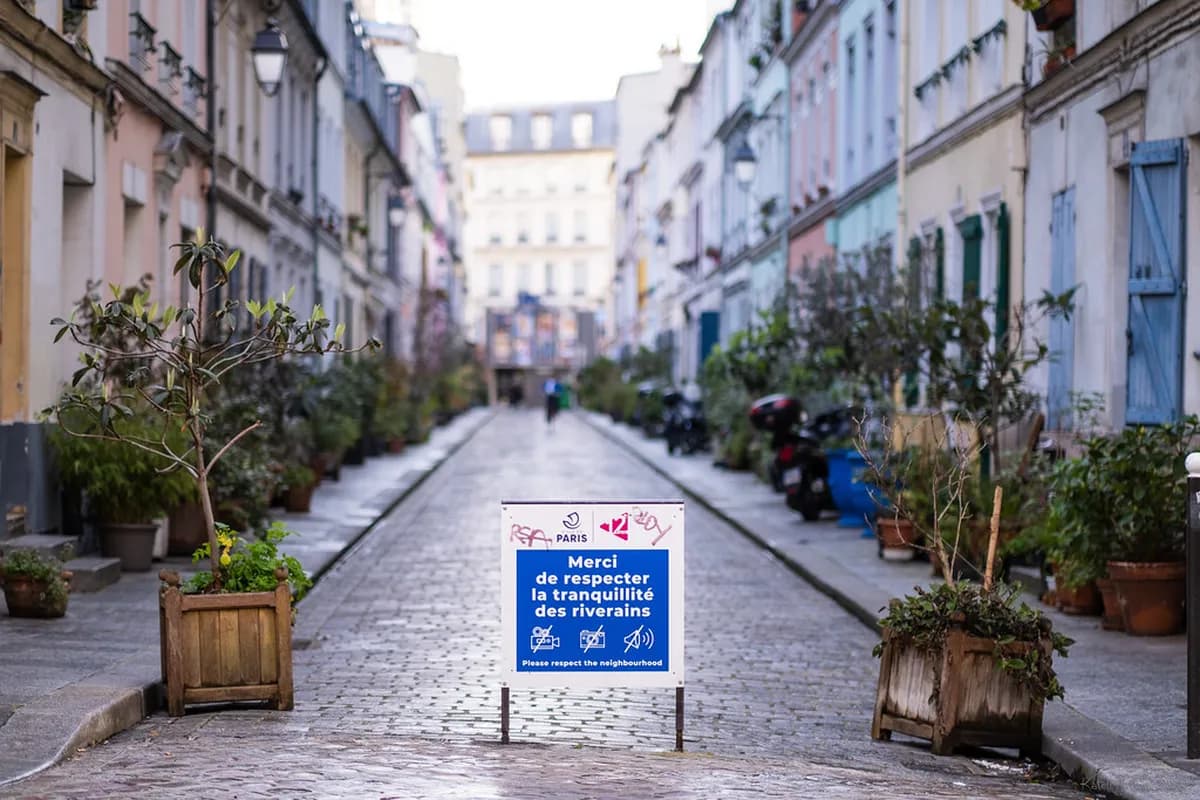
Commercial photography and video shoots require a permit from the Paris city authority and prior agreement from the residents' association. This applies to anything shot with professional equipment for paid use: brand campaigns, stock photography, film production. Personal photography for non-commercial purposes is permitted, but several specific behaviours are prohibited by signs posted at each entrance.
Tripods are prohibited on Rue Crémieux and are the most common source of friction with residents. Use a monopod instead if you need stabilisation, and never ring doorbells or sit on private doorsteps.
The posted rules ask visitors not to ring doorbells, not to sit on doorsteps, not to photograph through windows, and not to bring tripods. Tripods are the most common source of friction because they slow foot traffic in a narrow lane. A monopod is a practical workaround if you want stable shots without blocking other visitors. These restrictions exist because of documented disruptions — Instagram tourism has created real tension between residents and visitors seeking the perfect shot. Drones are not permitted over the residential section of the street.
Noise is taken seriously. Residents have repeatedly petitioned the city to limit visitor numbers after incidents of shouting, music playing, and groups gathering for extended periods. The most respectful approach is to walk the street once, take your photos, and move on. Fifteen to twenty minutes is enough to see everything.
The 2019 Resident Backlash and What Changed
In 2019 residents filed a formal complaint with Paris city hall requesting that Rue Crémieux be closed to non-residents on weekends. The petition cited early-morning noise starting before 07:00, visitors sitting on private steps for hours to get unobstructed photos, and at least one incident of a content creator blocking the entire lane with lighting equipment for an unpermitted commercial shoot. Residents even created a satirical Instagram account to document the most absurd photo shoots and poses. The complaint made national news in France and ironically increased international awareness of the street, driving more visitors.
The city declined to close the street outright but agreed to install signage, add a gate at the southern entrance, and post a notice summarising the acceptable-use rules in French, English, and Mandarin. The gate is typically unlocked during the day but can be closed by a residents' association representative at any time. If you arrive and find it locked, walk around to the northern entrance on Rue de Bercy — the street is accessible from both ends independently.
Understanding this history gives context to why a 144-metre lane has more posted rules than most Paris museums. The street is still worth visiting. It just works better as a brief, respectful stop than as a destination you build a long morning around. A fifteen-minute visit at 08:30 on a Tuesday is more enjoyable — for you and the residents — than ninety minutes at 14:00 on a Saturday.
The Surrounding Neighbourhood: Bastille and the 12th
Rue Crémieux sits in an undervisited part of the 12th arrondissement that rewards a longer walk. The Place de la Bastille is a 12-minute walk west. The tall bronze July Column at its centre marks the site of the former prison, and the Opéra Bastille on the square's eastern edge hosts productions of the Paris National Opera year-round. Tickets start at around €10 for upper-tier seats. The building itself is worth seeing from the outside at no cost.
The Viaduc des Arts, running along Avenue Daumesnil just south of Gare de Lyon, is a 19th-century railway viaduct converted into a ground-floor gallery and artisan workshops. The arches hold ceramicists, luthiers, cabinet-makers, and textile designers — it is a quieter, more local alternative to the Marais galleries. Above the viaduct runs the Promenade Plantée, one of Paris's best free things to do in Paris. The combination of Rue Crémieux, the Viaduc des Arts, and the Promenade Plantée makes a natural half-day loop in the eastern 12th.
Other Secret and Colourful Streets in Paris
If Rue Crémieux is too crowded when you arrive, or if you simply want to extend your hunt for atmospheric lanes, several other streets offer a similar quiet charm without the same visitor volume. Villa de l'Ermitage in the 20th arrondissement is a dead-end cobblestone lane lined with low houses, plants, and cats — it feels like a village hidden inside the city and sees a fraction of Rue Crémieux's foot traffic. Cité Florale in the 13th arrondissement is a network of small residential streets named after flowers, with gardens spilling out from front gates and none of the commercial tourism pressure.
Passage Plantin in the 20th arrondissement is another short residential lane with a similar scale to Rue Crémieux but almost unknown outside local walking-tour groups. Villa Santos-Dumont in the 15th is a wider, slightly more visible lane favoured by artists, with exterior murals and climbing plants covering entire façades. None of these have Rue Crémieux's pastel-house density, but all four offer the same sense of stumbling into a quieter Paris. Our guide to lesser-known corners of Paris covers several of them in more detail.
Montmartre's smaller lanes — Rue Lepic, Rue Norvins, and the steep passages around the Sacré-Coeur — are more famous but can also deliver the colourful, cobblestone aesthetic if you visit early. The difference is that Montmartre's lanes are commercial, with cafés and souvenir shops, so the resident-privacy concerns that shape Rue Crémieux's etiquette do not apply in the same way. See our Montmartre beyond the Basilica guide for the quieter corners of that neighbourhood.
Practical Tips for Your 2026 Visit
The street is free to walk and requires no booking. There is no official guided tour of Rue Crémieux itself, though several general Paris walking tours include it as a stop. Those tours are sometimes useful if you want context on the 12th arrondissement history, but they also arrive in groups of 10 to 20 people which adds to congestion. Solo visits or visits in pairs give you more flexibility on timing.
There are no toilets on the street and no cafés directly on it. The nearest public toilet is at Gare de Lyon (free with a RER/metro ticket in the station). For coffee before or after, Rue de Bercy and the streets immediately around Place de la Bastille have multiple independent cafés and boulangeries. Expect to pay €2 to €3.50 for a coffee and around €1.20 to €1.80 for a croissant at non-tourist-facing spots in this part of the 12th.
Wear comfortable shoes. The cobblestones are uneven, and the street is short enough that you will walk it more than once if you arrive at a busy moment and want a clearer photo. Bringing a wide-angle lens or using your phone's ultra-wide mode helps capture more of the façade row from the end of the street, which is the most popular shot. The best framing position is about five metres inside either entrance, shooting lengthwise down the lane.
| Secret Street | Arrondissement | Crowd Level | Key Feature |
|---|---|---|---|
| Rue Crémieux | 12th | High (weekends) | Pastel-painted houses, cobblestones |
| Villa de l'Ermitage | 20th | Low | Village lane, cats and plants |
| Cité Florale | 13th | Very low | Flower-named streets, front gardens |
| Passage Plantin | 20th | Very low | Residential lane, unknown to tourists |
| Villa Santos-Dumont | 15th | Low | Murals, climbing plants, artists |
Frequently Asked Questions
Where to find rue Crémieux in Paris?
You can find this colorful street in the twelfth arrondissement of Paris. It is located just a short walk from the Gare de Lyon railway station. Use local metro lines one or fourteen to reach this beautiful neighborhood easily.
RUE CRÉMIEUX - The Most Beautiful Street in Paris?
Many travelers consider this pastel lane to be the most beautiful street in the city. However, you can also find other stunning spots by reading our lesser-known corners of Paris guide. Each neighborhood offers its own unique architectural charms.
How much time should you plan for rue cremieux paris?
You should plan to spend about fifteen to thirty minutes exploring this short street. This is plenty of time to admire the pastel facades and take a few respectful photos. Keeping your visit brief helps protect the privacy of local residents.
What should travelers avoid when planning rue cremieux paris?
Travelers must avoid making loud noises, blocking doorways, or taking photos of residents through their windows. Commercial photography and filming are strictly prohibited on this street. Always respect the signs posted by the local homeowners to ensure a peaceful visit.
Rue Crémieux is one of those Paris streets that genuinely rewards visiting once and rewards it much more if you time it right. The combination of early weekday morning light, 144 metres of pastel façades, and a neighbourhood with real local life makes it a compelling stop. Pair it with the Promenade Plantée and the Viaduc des Arts workshops for a half-day in the eastern 12th that most visitors miss entirely.
For more Paris itinerary ideas beyond the main monuments, explore our guide to unique Paris experiences. There is a version of this city that very few tourists see, and the 12th arrondissement is a good entry point into it.
Continue exploring
More guides you'll find useful