Montmartre Guide: Ultimate Paris Travel Guide
Plan your trip with this local Montmartre guide. Discover top attractions, budget tips, and neighborhood secrets for an amazing Paris vacation.
On this page
The Complete Montmartre Guide for Your Paris Trip
Montmartre is one of the most visited neighborhoods in Paris, yet most tourists see only a fraction of it. They climb the steps to Sacré-Cœur, glance at artists on Place du Tertre, and leave. The real neighborhood — quiet vineyards, Belle Époque cinema houses, ancient pedestrian lanes, and a cemetery full of French cultural icons — stays hidden behind the selfie crowds.
This guide covers the classic landmarks and the places most visitors never find. Montmartre sits in the 18th arrondissement on the city's highest point, the Butte Montmartre. During the Belle Époque (1871–1914), Picasso, Van Gogh, Renoir, and Toulouse-Lautrec all lived and worked here. Their legacy is woven into every cobblestone street. If you want to discover more of Paris beyond this hill, our guide to Paris hidden gems guide covers the city's most overlooked neighborhoods.
How to Get to Montmartre
Four metro stops serve the hill. Abbesses (Line 12) drops you at the heart of the neighborhood and is the deepest station in Paris at 36 metres underground. The spiral staircases are lined with hand-painted murals depicting Montmartre street scenes — worth taking the stairs rather than the lift if your legs are up for it. Anvers (Line 2) puts you closest to the funicular at the base of the hill. Blanche (Line 2) is the stop for Moulin Rouge, and Pigalle (Lines 2 and 12) connects the lower edge near the red-light district.
The funicular from Square Louise Michel runs daily from 06:00 to 01:15 and accepts a single metro ticket (€2.15 in 2026 with a carnet, or covered by a Navigo pass). It saves the 200-step climb on days when your legs are already tired from the rest of Paris. Alternatively, the Petit Train de Montmartre departs from the Moulin Rouge area and winds up to Sacré-Cœur — useful for families or visitors with mobility issues.
Wear flat, non-slip shoes. The cobblestones on Rue Lepic and Rue de l'Abreuvoir are picturesque but genuinely slippery after rain. Plan to arrive before 09:00 if you want photos without crowds, especially at Sacré-Cœur and Place du Tertre.
Sacré-Cœur and What Most Visitors Miss
The Sacré-Cœur Basilica is open daily from 06:30 to 22:30 and entry is free. Built between 1875 and 1914 in Romano-Byzantine style, it was conceived as a national act of atonement after the Franco-Prussian War. The interior mosaics are worth slowing down for — the Christ in Majesty above the choir is one of the largest in the world. You will need a metro ticket to ride the funicular to the top of Sacré-Cœur.
Almost nobody climbs the dome. From inside the basilica, head to the left-hand side at the back and buy a ticket for €7. You ascend 300 steps in a narrow spiral staircase to reach an open gallery with 360-degree views across Paris. It is a harder climb than the exterior steps but delivers a completely different panorama. Open 10:30–20:30 in summer, reduced hours off-season.
Directly beside Sacré-Cœur stands Saint-Pierre de Montmartre, the second-oldest surviving church in Paris. Most visitors walk straight past it. Built in the 12th century, it predates the basilica by 700 years and has four ancient Roman columns in the choir. The interior is calm, the crowds are thin, and entry is free. It opens 09:00–12:00 and 15:00–18:00, closed Mondays.
Hidden Streets and Secret Corners
Rue de l'Abreuvoir is consistently rated one of the prettiest streets in Paris. It runs from the Dalida bust at one end to La Maison Rose at the other — the pink-fronted café that Utrillo painted and that still pulls a photogenic crowd. Walk it slowly. The ivy-covered stone walls and uneven cobblestones feel closer to a Burgundy village than central Paris.
Rue Saint-Rustique, a short pedestrian lane behind Place du Tertre, is often cited as the oldest surviving street in Montmartre and possibly in all of Paris. It connects a cluster of old stone cafés and opens onto an angle of Sacré-Cœur that almost no tourist photographs. The lane is genuinely quiet even in peak summer. Come at 08:00 and you will likely have it to yourself.
Rue Lepic winds steeply down from the windmills toward Blanche. Van Gogh lived at number 54 with his brother Theo from 1886 to 1888. The street also has a footnote in automotive history: Louis Renault made a bet with friends in 1898 that his prototype Voiturette would climb the steep slope. It did, he received 12 immediate orders on the spot, and the Renault company was born. There is no plaque marking either fact, which is exactly the sort of detail Rue Lepic specialises in.
For a completely off-radar detour, find La Folie Sandrin at 22 Rue Norvins. A pre-Revolution mansion half-hidden behind tall hedges, it dates to the 18th century and was converted into a mental health centre by 1806. Today it is private property, but the façade is visible from the road and gives the street a genuine French countryside atmosphere in the middle of the city.
Clos Montmartre Vineyard and the Harvest Festival
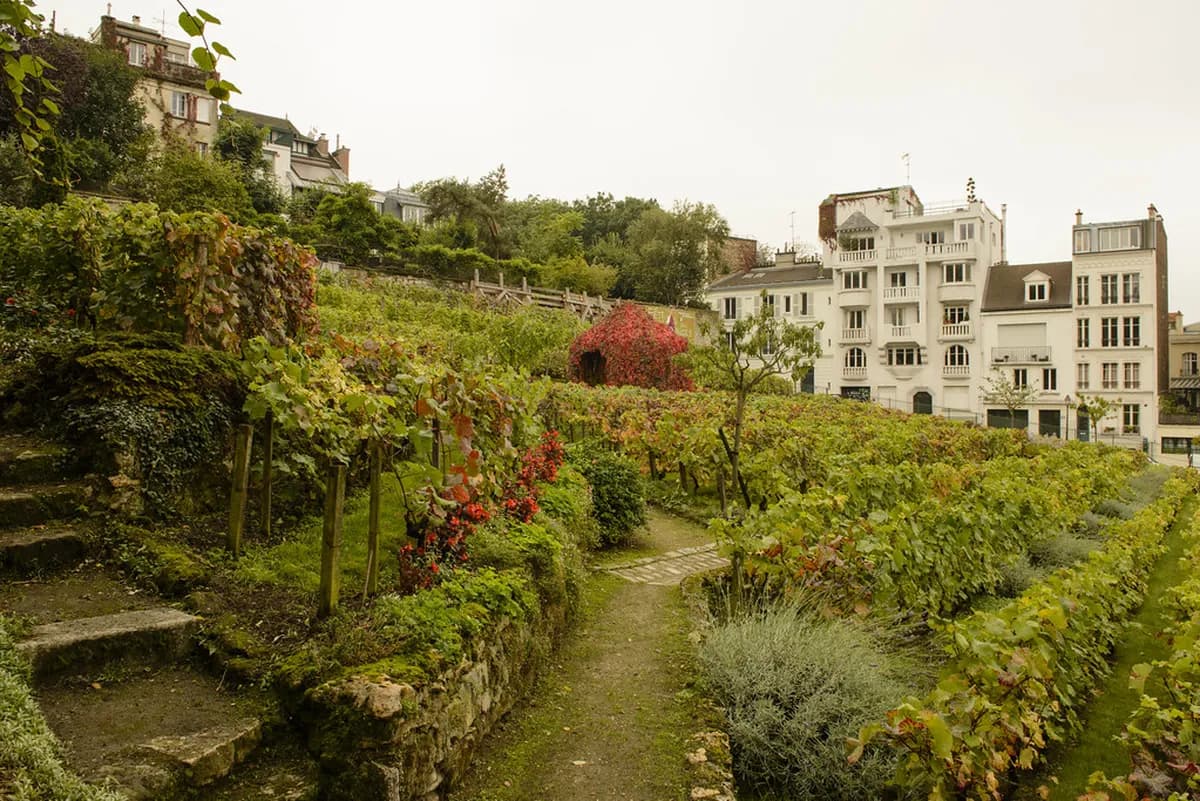
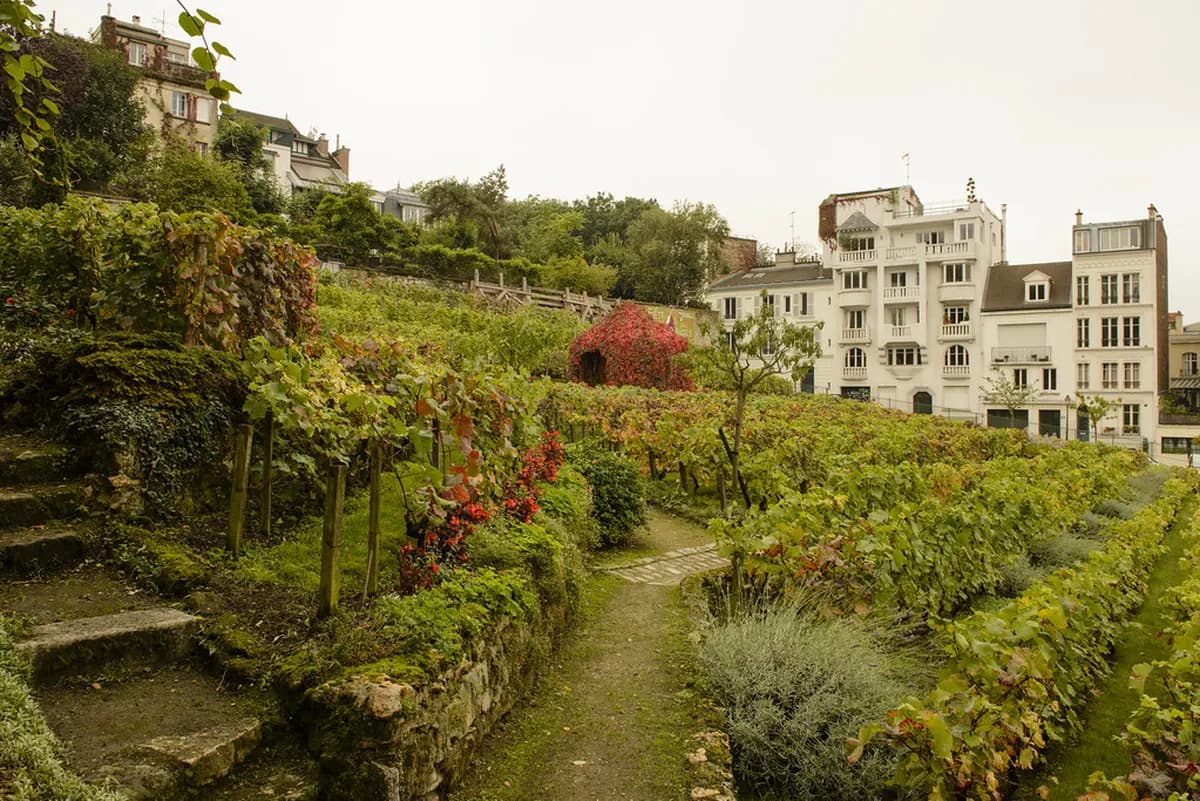
Tucked behind the Musée de Montmartre on Rue des Saules sits Clos Montmartre, Paris's last active urban vineyard. The wrought-iron fence lets you see the vines clearly even when the garden is closed to visitors, which it is for most of the year. The 1,556 vines produce around 1,500 half-litre bottles annually, labeled with artwork by a different Montmartre artist each year. Profits go entirely to community projects in the 18th arrondissement.
The vineyard hosts the Fête des Vendanges de Montmartre every year in October — typically the second weekend of the month. In 2026 it falls on 10–12 October. The festival is free to enter, fills the streets around Rue des Saules with live music and food stalls, and culminates in a procession and ceremonial first pressing of the grapes. It draws around 500,000 visitors over the weekend, so arriving Friday evening rather than Saturday midday is strongly advised. This is the one event no competitor guide consistently gives you the actual date for.
The Fête des Vendanges harvest festival (10–12 October 2026) is free to enter and draws around 500,000 visitors. Arrive Friday evening to avoid the heaviest crowds on Saturday midday — and book accommodation well in advance for that second October weekend.
The Musée de Montmartre next door is the neighborhood's best museum for context before you wander. Admission is €15 (€10 reduced) and the ticket includes access to the Renoir Gardens behind the building — terraced lawns overlooking the vineyard that served as Renoir's actual painting location. The museum traces the history of Montmartre from village to art capital, with original cabaret posters, photographs of Picasso's early years, and an atmospheric recreation of Suzanne Valadon's studio.
Le Bateau-Lavoir and the Artist Studios
At 13 Place Émile Goudeau stands one of the most important addresses in modern art history. Le Bateau-Lavoir was a ramshackle wooden building that housed Picasso, Braque, Modigliani, and Juan Gris from roughly 1904 to 1910. Picasso painted Les Demoiselles d'Avignon here in 1907, the painting widely credited as the starting point for Cubism. The original building burned in 1970; what you see today is a faithful reconstruction. The exterior is open to view at any time and there is a small plaque. Working artists still rent studios inside.
A few streets away, the Dalida trail connects several stops in a single walk. The Egyptian-born French singer Dalida, one of the best-selling artists in European music history, lived in Montmartre for most of her adult life. Her townhouse on Villa Leandre is visible from the street. Her bronze bust on Place Dalida — at the intersection near Rue de l'Abreuvoir — has been polished bright by visitors touching it for luck. The Cimetière de Montmartre, on Avenue Rachel at the base of the hill, contains her tomb alongside those of Émile Zola, François Truffaut, and Heinrich Heine. It is smaller and quieter than Père Lachaise and takes about 45 minutes to walk properly.
The two surviving windmills at Moulin de la Galette are also worth finding. The larger one, the Moulin Radet, is now a restaurant. The smaller Moulin Blute-fin sits just behind it on private property, visible through the trees from Rue Lepic. Renoir painted the outdoor dance hall that once stood here in his 1876 masterpiece. Neither windmill is well-signed; look for the blades above the roofline from the uphill side of Rue Lepic.
Quiet Gardens and Hidden Outdoor Spaces
Square Marcel Bleustein Blanchet, also called Parc de la Turlure, sits directly behind the apse of Sacré-Cœur. Almost no tourist finds it. The terraced garden was built on the site of a former windmill and offers a close-up, slightly elevated view of the basilica's domes that is far better for photography than the crowded main staircase. Bring snacks from the boulangerie on Rue de la Bonne. Afternoon light here is genuinely beautiful.
The Renoir Gardens at the Musée de Montmartre (included with museum admission) are the other reliably quiet outdoor spot. The multi-level terraces look across the vineyard to a stretch of the old vine-covered slope that has barely changed since the 19th century. This is where Renoir set up his easel. Early morning is particularly peaceful before the museum opens its main doors.
For something completely off the tourist map, seek out the Arènes de Montmartre at 25 Rue Chappe, a small open-air stone amphitheater hidden just behind Sacré-Cœur. Built on an old vineyard plot in the 1940s, it functions as a community performance space. Free jazz concerts, neighborhood theater, and open-air cinema screenings take place here in summer. Check local listings — some of the best events happen on weekday evenings and cost nothing. Almost no travel guide mentions this place.
Museums, Art, and Culture in Montmartre
Beyond the Musée de Montmartre, the neighborhood has two other worthwhile indoor stops. Dalí Paris on Rue Poulbot holds a permanent collection of around 330 surrealist sculptures and engravings. It is small enough to do in an hour and offers a useful counterpoint to the Impressionist-heavy story the rest of the hill tells. Open daily 10:00–18:00, admission €14.
Studio 28 at 10 Rue Tholozé is the oldest surviving avant-garde cinema in Paris, opened in 1928. Luis Buñuel, Salvador Dalí, and Jean Cocteau all screened work here in the early years. Today it shows restored classics and international films with subtitles alongside new French releases. The tiny café-bar at the back, under a canopy of film posters and fairy lights, is a good place to sit after a film. Check their schedule online; screenings typically run from €9.
Walking down the south side of the hill brings you to the Musée de la Vie Romantique on Rue Chaptal, a shuttered villa at the end of a cobbled lane where George Sand and Delacroix were regular visitors. The permanent collection is free and the garden café is one of the quietest in the 9th.
The Abbesses metro station itself is worth a moment when you arrive. Line 12's Abbesses stop is the deepest in Paris at 36 metres. The spiral staircase connecting the platforms to street level is lined with hand-painted Montmartre scenes — portraits, café tables, views of the basilica — created by local artists. Most visitors take the lift and miss it entirely. Art lovers seeking more off-beat cultural paths across Paris can explore our guide to lesser-known corners of Paris.
| Attraction | Cost | Hours | Note |
|---|---|---|---|
| Sacré-Cœur Basilica | Free | 06:30–22:30 daily | Largest Christ mosaic in the world |
| Dome climb (Sacré-Cœur) | €7 | 10:30–20:30 (summer) | 300 steps, 360° panorama |
| Saint-Pierre de Montmartre | Free | 09:00–12:00 & 15:00–18:00; closed Mon | Second-oldest church in Paris (12th c.) |
| Musée de Montmartre | €15 / €10 reduced | Check website | Includes Renoir Gardens |
| Dalí Paris | €14 | 10:00–18:00 daily | 330 surrealist works |
| Studio 28 cinema | ~€9 | Per screening | Oldest avant-garde cinema in Paris (1928) |
Where to Eat in Montmartre
Place du Tertre is best avoided for eating. The restaurants surrounding it are tourist traps with high prices and mediocre food. Walk two streets in any direction and the quality improves dramatically. For a genuine local lunch stop, seek out Fric-Frac Montmartre for gourmet croque monsieur sandwiches made with high-quality ingredients. It is small, often has a short queue, and is significantly better value than the square.
L'Été en Pente Douce at 23 Rue Muller occupies a small square just below Sacré-Cœur that feels more like a film set than a Parisian street. The homestyle French cooking is solid, the terrace fills with locals, and jazz musicians sometimes set up impromptu sessions in front. Arrive by 12:30 to get a table on weekdays. Their roasted duck and seasonal tarts are reliable choices.
For baked goods, Le Consulat on Rue Norvins has been a Montmartre institution since the 19th century. The façade is frequently photographed. The café itself is a little touristy, but the crêpes and café au lait are decent at the price. The better move for breakfast is a baguette and cheese from any of the small fromageries on Rue Lepic, eaten on the steps of Square Louise Michel. This is what most locals actually do. If you want more dining recommendations beyond the hill, our guide to the where locals eat in Paris covers the city's top neighbourhood spots.
Safety, Scams, and Practical Tips for 2026
Montmartre is generally safe during the day but has a few well-documented tourist traps. The most common scam near the basilica steps involves men who approach you offering a "friendship bracelet" — they tie it around your wrist before you can refuse and then demand payment. The standard response is to keep your hands in your pockets and keep walking. This happens in exactly one location: the approach path from Anvers metro to the bottom of the Sacré-Cœur stairs.
Pickpocketing is concentrated in three areas: the Sacré-Cœur staircase, Place du Tertre when it is packed, and Abbesses metro station exit. Use a zipped bag worn at the front. The lower edge of Montmartre near Pigalle becomes rowdy at night due to the red-light district. The area around Barbès, while fascinating for its market culture, can feel overwhelming for first-time visitors and requires basic urban alertness.
Practical logistics: the Navigo weekly pass (€30 in 2026) covers all metro and funicular travel and makes much more sense than buying individual carnet tickets if you are staying more than two days. Most museums in Montmartre are closed on Mondays. The Musée de Montmartre and Dalí Paris both offer reduced tickets for under-26 EU residents. Check our guide on the when to visit Paris to time your trip for fewer queues throughout the city.
The friendship-bracelet scam operates in exactly one location: the approach path from Anvers metro to the Sacré-Cœur stairs. Keep hands in pockets and keep walking. Pickpocketing is most common at the Sacré-Cœur staircase, crowded Place du Tertre, and Abbesses metro exit.
Budget and Family Options in Montmartre
Most of Montmartre's best experiences are free. Walking Rue de l'Abreuvoir, finding Le Bateau-Lavoir, photographing the windmills, sitting in Square Marcel Bleustein Blanchet, and wandering the cemetery all cost nothing. The Sacré-Cœur itself is free to enter. Saint-Pierre de Montmartre is free. The vineyard is viewable from outside at no charge.
Children tend to enjoy the vintage carousel at the base of the hill near Square Louise Michel, which runs for around €3 per ride. The funicular is a hit with younger visitors and uses a standard metro ticket. The Petit Train de Montmartre is the easiest option for families with young children who cannot manage the hills. For a broader list of cost-free activities across Paris, see our guide to free things to do in Paris.
Plan a full day to cover the neighborhood properly. Half a day gets you Sacré-Cœur, Place du Tertre, and a quick walk down Rue Lepic. A full day lets you add the museum, vineyard, hidden streets, cemetery, and a proper lunch. If you want to experience the Fête des Vendanges harvest festival in October, book accommodation in advance — the second weekend of October sees the neighborhood at its most crowded and most festive simultaneously.
Frequently Asked Questions
Which Montmartre guide options fit first-time visitors?
First-time visitors should focus on the classic highlights. Start with the stunning Sacré-Cœur Basilica, explore the lively Place du Tertre, and visit the historic Montmartre Museum. These key stops provide a perfect introduction to the neighborhood's rich artistic heritage.
How much time should you plan for a Montmartre guide visit?
Plan to spend at least one full day exploring the area. This allows you to visit the main museums, enjoy a leisurely lunch, and wander the quiet side streets without rushing. A full day ensures a much more relaxed and authentic experience.
What should travelers avoid when planning a Montmartre trip?
Avoid visiting during the middle of the afternoon when crowds are largest. Do not buy souvenirs from aggressive street vendors near the basilica steps. Be cautious of common pickpocket scams in crowded tourist areas.
Is Montmartre worth including on a short Paris itinerary?
Yes, this unique hilltop neighborhood is absolutely worth visiting even on a short trip. It offers a completely different atmosphere compared to central Paris. A quick half-day visit can still cover the basilica and main scenic viewpoints.
Montmartre rewards visitors who go slowly. The famous sites are worth seeing, but the neighborhood's real character lives in the streets that drop off the tourist map — a hidden vineyard, a 12th-century church that nobody photographs, a community amphitheater where free jazz plays on summer evenings. Plan well, arrive early, and give the hill more time than you think you need.
The best version of a Montmartre visit in 2026 combines the obvious and the obscure: Sacré-Cœur plus Saint-Pierre, Place du Tertre plus Rue Saint-Rustique, the museum plus the vineyard. That combination is what makes the neighborhood genuinely memorable rather than just another postcard stop.
Continue exploring
More guides you'll find useful