10 Best Paris Covered Passages to Visit in 2026
Discover the most beautiful Paris covered passages. Our guide covers Galerie Vivienne, Passage Jouffroy, and more, with history and rainy-day tips.
On this page
10 Best Paris Covered Passages and Visiting Tips
During my five visits to Paris, I have fallen in love with the city's secret architectural wonders. The historic Paris in winter season is my favorite time to wander through these warm, glass-roofed arcades.
Last refreshed May 2026 after a return visit to check opening hours and new shops. These historic corridors offer a unique glimpse into 19th-century Parisian high society.
Exploring these passages is one of the most unique Paris experiences when it rains. Let us dive into the history and details of these architectural gems.
History of the Paris Passageways
Paris once boasted over 150 covered passages during the early 19th century. These glass-roofed arcades offered wealthy shoppers a clean refuge from muddy, horse-drawn streets. Before Baron Haussmann modernized the city, Paris lanes had no sidewalks, open sewers, and carriages that splashed mud and worse onto any pedestrian who dared step outside. Historical records confirm that the majority of these passages concentrated in two rapid construction periods: 1823–1828 and 1839–1847.
Developers responded by creating a new kind of urban space: private pedestrian roads built between existing buildings, lined with luxury shops, cafes, and entertainment venues. Each passage typically connected two main thoroughfares and was sealed each night by iron gates or heavy wooden doors at either end — a detail that still applies today. You cannot enter after closing time because the passages remain private property.
Neoclassical architecture defined these early shopping malls, featuring iron frames, ornate columns, and beautiful mosaic tiled floors. The grand renovations by Baron Haussmann in the 1860s demolished dozens of these structures. Those that survived typically had a unique anchor — a theater, a wax museum, a famous restaurant, or simply extraordinary beauty — that kept visitors coming back even after department stores eclipsed them in popularity.
Today, 21 covered passages still exist in Paris, though Passage des Princes is closed for major works and may not reopen in its current form. These survivors represent some of the finest Paris hidden gems guide for anyone who loves architecture and local history. The government or historic-property regulations protect every remaining passage from demolition.
Two Clusters: Palais Royal and Grands Boulevards
The best passages fall into two geographic groups, each easily walkable on its own. Understanding this geography saves time and lets you plan a half-day route without unnecessary Metro hopping.
The Palais Royal cluster sits in the 1st and 2nd arrondissements and contains Galerie Véro-Dodat, Galerie Vivienne, and Galerie Colbert. These three are the most architecturally polished, with the highest concentration of upscale boutiques and serious wine and food shops. The nearest Metro stations are Bourse (line 3), Pyramides (lines 7 and 14), and Palais Royal–Musée du Louvre (lines 1 and 7).
The Grands Boulevards cluster sits in the 9th arrondissement and groups Passage Verdeau, Passage Jouffroy, and Passage des Panoramas in a tight chain along Boulevard Montmartre and Rue Faubourg-Montmartre. You can walk all three in under an hour without touching the street for more than 30 seconds at a time. Grands Boulevards Metro (lines 8 and 9) drops you right at the entrance to Passage des Panoramas.
A full-day itinerary works well if you start at the Grands Boulevards cluster in the morning — when the antique and stamp dealers are most active — then walk 20 minutes south to the Palais Royal cluster for lunch and afternoon browsing. The passages that are free to visit in Paris fill easily around midday on weekends, so arriving before 11:00 at Passage des Panoramas is worth the early start.
Best Passages: Grands Boulevards Cluster
Passage des Panoramas is the oldest surviving covered passage in Paris, dating to 1799. Its entrance sits on Boulevard Montmartre in the 9th arrondissement, steps from Grands Boulevards Metro. The interior is darker and more labyrinthine than Galerie Vivienne, which suits its character: this is where stamp and coin dealers set up alongside lively bistros and wine bars. Racines, tucked deep inside, serves natural wine with a focused lunch menu. Canard & Champagne across the passage centres its entire menu on duck dishes — one of the better food-focused surprises in any passage. Entry is free daily from 06:00 to midnight.
Passage Jouffroy is the direct continuation of the Grands Boulevards cluster heading north. It opened in 1847 as one of the first passages built with a heated floor — still a delight on a wet winter afternoon. The Musée Grévin wax museum occupies a large section of the building above it, and the Hôtel Chopin at number 10 is one of Paris's most characterful budget hotels. Pain d'épices, a toy and miniatures shop near the entrance, draws collectors of all ages. Free daily from 07:00 to 21:30.
Passage Verdeau continues north from Jouffroy across Rue de la Grange-Batelière and is quieter and more specialist. Antique book dealers, vintage photograph sellers, and old-print shops occupy most units. The glass roof here is the brightest of the three Grands Boulevards passages, and it receives far fewer tourists, making it a good place to browse slowly without crowds. Open Monday through Saturday from 07:30 to 21:00; closed Sundays.
Best Passages: Palais Royal Cluster
Galerie Vivienne is the most celebrated passage in Paris and the one most likely to appear in travel photography. It opened in 1826 and its beautifully restored mosaic floors, Greco-Roman decorative elements, and soaring steel-and-glass rotunda make it visually the strongest of any remaining passage. The official Galerie Vivienne merchants website confirms it was built by architect François-Jean Delannoy with its distinctive Pompeian neo-classical décor and colorful mosaic tiling. The wine merchant Lucien Legrand Filles et Fils stocks a serious cellar and hosts tastings in its adjacent tasting room. Bistrot Vivienne serves reliable French brasserie food at the far end. In winter, string lights are draped across the ceiling. Entrances at 4 Rue des Petits-Champs, 6 Rue Vivienne, and 5 Rue de la Banque. Open daily 08:30 to 20:30; nearest Metro is Bourse or Pyramides.
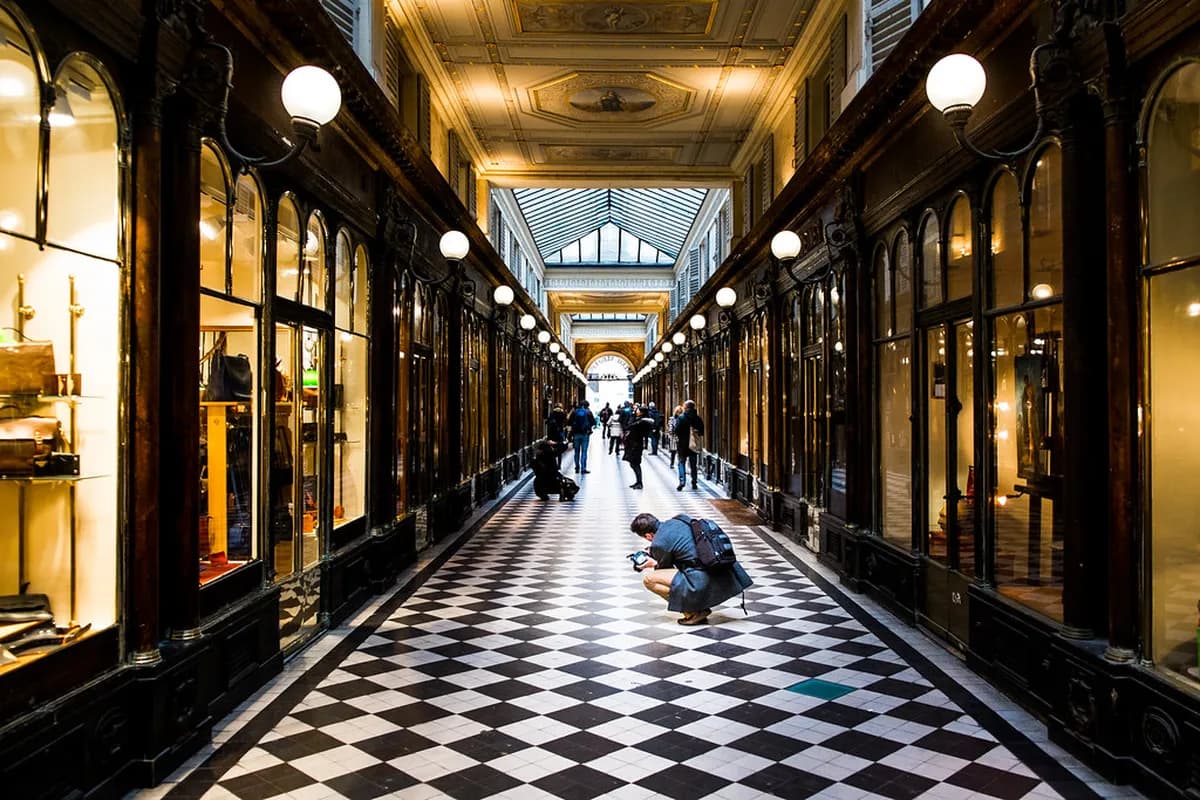
Galerie Véro-Dodat opened the same year as Galerie Vivienne and is arguably more elegant, if less visited. Its signature feature is a continuous run of identical wood-panelled shop fronts with tall arched glass windows and a black-and-white marble floor. Two Louboutin showrooms — one for women, one for men — anchor the Rue Jean-Jacques Rousseau end. Specialist dealers in antiquarian books, vintage instruments, and art fill the remaining units. Café de l'Epoque serves classic French brasserie dishes at affordable prices. Open Monday through Saturday from 07:00 to 22:00; entrances at 2 Rue du Bouloi and 19 Rue Jean-Jacques-Rousseau.
Galerie Colbert sits directly beside Galerie Vivienne and shares an entrance on Rue des Petits-Champs. It was bought by the Institut de France in the 1980s and now houses the National Institute of Art History, so there are no retail shops inside. What it does have is a spectacular central rotunda under a glass dome and one very good restaurant: Le Grand Colbert, which achieved wider fame as the brasserie in the film Something's Gotta Give. Open daily 08:00 to 20:00; nearest Metro is Bourse.
| Passage | Opening Hours | Nearest Metro | Best For |
|---|---|---|---|
| Passage des Panoramas | Daily 06:00–midnight | Grands Boulevards (lines 8, 9) | Food, bistros, stamps |
| Passage Jouffroy | Daily 07:00–21:30 | Grands Boulevards | Heated floor, wax museum, hotel |
| Passage Verdeau | Mon–Sat 07:30–21:00 | Grands Boulevards | Antique books, vintage photos |
| Galerie Vivienne | Daily 08:30–20:30 | Bourse / Pyramides | Architecture, wine, photography |
| Galerie Véro-Dodat | Mon–Sat 07:00–22:00 | Palais Royal–Louvre | Elegance, Louboutin, antiques |
| Galerie Colbert | Daily 08:00–20:00 | Bourse | Rotunda, Le Grand Colbert restaurant |
Other Notable Passages Worth Visiting
Passage du Grand Cerf in the 2nd arrondissement has the highest glass roof of any surviving passage, giving it an unusually airy, light-filled quality. The wrought-iron structure supporting the ceiling is among the most elaborate in the city. Most units sell handmade jewellery and artisan goods rather than antiques or vintage items. Open Monday through Saturday from 08:30 to 20:30; nearest Metro is Étienne Marcel (line 4). Rue Montorgueil, a lively pedestrian market street, is a two-minute walk away and makes a natural complement to the visit.
Cour du Commerce Saint-André is the sole surviving Left Bank passage and the oldest structure on this list, predating even Passage des Panoramas. It runs through the 6th arrondissement between Boulevard Saint-Germain and Rue Saint-André-des-Arts and exposes sections of the original 14th-century Philippe Auguste city wall inside some of the shops. Le Procope at number 13, operating since 1686, is the oldest continuously running café in Paris. Entry is free at all hours since this is an open courtyard rather than a gated passage.
Passage Brady in the 10th arrondissement is unlike any of the above. Known informally as Little India, it is packed with South Asian restaurants, spice importers, and traditional barbers. The architecture is modest and the glass ceiling receives minimal maintenance, but the food is genuinely good and the lunch prices among the most affordable of any covered passage. Free daily; nearest Metro is Château d'Eau (line 4).
Passage Choiseul is the longest passage in Paris, running through the 2nd arrondissement from Rue Saint-Augustin to Rue des Petits-Champs. It functions primarily as a local thoroughfare with affordable lunch spots and practical shops. Worth a quick walk-through rather than a dedicated visit. Open Monday through Saturday from 08:00 to 20:00; nearest Metro is Quatre-Septembre (line 3).
Closures, August Rules, and the Private-Property Reality
Every guide mentions Sunday closures, but August is the season that consistently catches visitors off guard. Most individual shops inside the passages close for two to four weeks in August, and some passages reduce their own opening hours accordingly. Passage Verdeau and Passage du Grand Cerf are particularly affected. If you are visiting Paris in August 2026, call ahead or plan to treat those two as walk-throughs rather than shopping destinations; Passage des Panoramas and Galerie Vivienne tend to stay livelier because their restaurant and café tenants remain open.
The passages are private property, not public streets. Iron gates at each end are locked every night — typically by 20:00 or 22:00 depending on the passage — and there is no re-entry once they are secured. This matters if you plan an evening walk: Passage des Panoramas is the most forgiving with a midnight closing, but Galerie Véro-Dodat locks up at 22:00 and Passage Verdeau at 21:00. Arriving 30 minutes before closing is fine for a walk-through; arriving one hour before is safer if you want to browse or eat. The official Paris city guide provides up-to-date opening hours and access information for all accessible passages.
Public holidays are a second blind spot. Almost all passages close entirely on 1 January, 1 May, 14 July, 1 November, 11 November, and 25 December. Galerie Colbert also closes for National Library events several times a year with no advance public notice online.
Most shops inside passages close for two to four weeks in August; Passage Verdeau and Passage du Grand Cerf are particularly affected. If visiting Paris in August 2026, treat those as walk-throughs — Passage des Panoramas and Galerie Vivienne stay livelier because their restaurant and café tenants remain open.
Rainy Day Walking Route and Photography
Rain is frequent in Paris, and the passages were literally designed for it. The tightest rainy-day chain starts at Passage Verdeau (enter from Rue de la Grange-Batelière), walks south through Passage Jouffroy, crosses Boulevard Montmartre briefly to enter Passage des Panoramas, and exits on Boulevard Montmartre. That single loop covers three passages and roughly 800 metres with fewer than two minutes of outdoor exposure.
From Passage des Panoramas you can continue by Metro (Grands Boulevards to Bourse, three stops on line 3) to reach the Palais Royal cluster and add Galerie Vivienne and Galerie Véro-Dodat in the same afternoon. The full route from Passage Verdeau to Galerie Véro-Dodat typically takes three to four hours including a sit-down lunch.
Photography works best around midday when the sun is directly overhead and light falls through the glass roofs without harsh shadows. Galerie Vivienne's rotunda is the most photogenic spot for a wide-angle shot. Galerie Véro-Dodat suits portrait photography because of its even, diffuse light and the symmetry of its identical shop fronts. Passage du Grand Cerf's high ceiling creates dramatic vertical compositions. Early morning — before 10:00 — gives you the cleanest shots with the fewest other visitors.
Practical Tips for Your Visit
All surviving passages are free to enter, though you will spend money if you eat, drink, or shop inside. None require advance booking. The passages do not publish centralized opening-hour information, so the times listed in this article are the standard published hours — verify on the day for individual shops, especially on public holidays and in August.
Wheelchair access is mixed. Galerie Vivienne and Galerie Véro-Dodat have the smoothest flooring. Passage Jouffroy and Passage des Panoramas have minor level changes at some entrances. Passage du Grand Cerf and Cour du Commerce Saint-André have the most uneven surfaces. Strollers are manageable in all passages, but narrow units make passing difficult during busy weekend afternoons.
Entrances are easy to miss from the street because they look like ordinary apartment doorways. The most reliable way to find them is to search the passage name on Google Maps and navigate to the pin rather than the street address. Metro exit numbers matter: for Passage des Panoramas, use exit 3 of Grands Boulevards station to surface directly opposite the entrance on Boulevard Montmartre.
Guided tours are available if you prefer a structured introduction. Several operators run 2.5-hour covered passages tours covering five passages with stops for food and wine tastings — a practical option for first-time visitors who want to navigate the geography efficiently without prior research.
All surviving passages are free to enter and none require advance booking. For the cleanest photography, visit around midday when sunlight falls directly through the glass roofs — Galerie Vivienne's rotunda is the most photogenic spot and works best with a wide-angle lens.
Frequently Asked Questions
How many covered passages are left in Paris?
There are approximately 20 historic covered passages remaining in Paris today. Originally, the city boasted over 150 of these glass-roofed arcades during the 19th century.
Are Paris covered passages free to enter?
Yes, all surviving covered passages in Paris are completely free to enter and walk through. However, you will need money if you plan to dine or shop inside.
Which Paris covered passage is best for food?
Passage des Panoramas is widely considered the best passage for food lovers. It features a wide variety of historic bistros, modern gluten-free bakeries, and international street food stalls.
The historic covered passages of Paris offer a delightful escape into the elegance of the 19th century. Whether you are seeking shelter from a rainy day or looking for unique vintage treasures, these arcades deliver charm.
Add these architectural wonders to your next Parisian itinerary for an unforgettable journey. They remain some of the finest historic treasures hidden in plain sight.
Continue exploring
More guides you'll find useful