Belleville Paris Guide Travel Guide
Plan your trip with our belleville paris guide. Discover top local sights, vibrant food spots, and hidden street art in this unique Parisian neighborhood today!
On this page
Belleville Paris Guide
Belleville sits on the eastern fringe of Paris, sprawling across parts of the 19th and 20th arrondissements at one of the city's highest natural elevations. This belleville paris guide covers the neighborhood as it stands in 2026 — a working-class district that has evolved into one of the most culturally layered corners of the capital without losing the gritty energy that made it worth visiting in the first place.
Home to communities of Armenian and Tunisian Jews, Greeks, and Chinese and Southeast Asian immigrants, Belleville is genuinely multicultural in a way many "diverse" neighborhoods are not. Rue de Belleville, its steep main artery, frames the Eiffel Tower between sloping buildings at the top of the hill. You get the city's best view without paying a single euro to reach it.
Must-See Belleville Attractions
Start any visit by walking the full length of Rue de Belleville from bottom to top. At number 72, a plaque marks the birthplace of Édith Piaf. Aux Folies, the café-bar where she used to perform, still packs its pavement terrace year-round. Both are free to see and give you immediate context for why the neighborhood carries so much cultural weight.
At the top of the hill, the Belleville belvedère delivers panoramic views over Paris. On a clear day you can pick out the Eiffel Tower, Notre-Dame, and the Centre Pompidou from the mosaic-tiled terrace. This is consistently the best free viewpoint in the city, and it draws far fewer visitors than Montmartre's Sacré-Cœur. Come before 10:00 on weekdays if you want it almost to yourself.
The Belleville belvedère is free to access and consistently the best panoramic viewpoint in Paris with no crowds. Arrive before 10:00 on weekdays for an almost empty terrace with views of the Eiffel Tower, Notre-Dame, and Centre Pompidou.
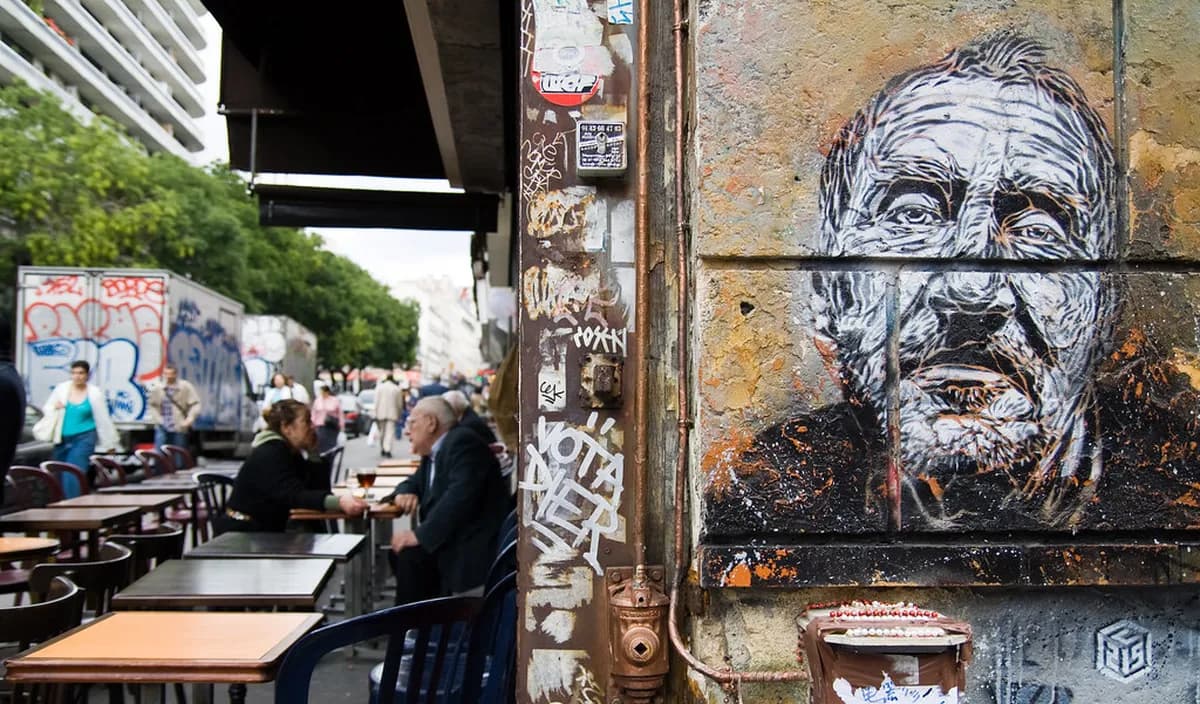
Rue Dénoyez is the neighborhood's most concentrated open-air street art corridor. Local artists repaint the walls constantly, so no two visits look the same. Hotel Babel has commissioned murals on its walls and glass elevator shaft from the same local artists, making the short stretch between the metro and the park feel like a curated gallery. The cabaret venue Le Zèbre de Belleville hosts dinner shows with trapeze artists and tightrope walkers — book at least two weeks ahead for weekend shows in summer 2026.
For live music and a rooftop that feels nothing like central Paris, La Bellevilloise is the area's main cultural center. The boho-chic terrace has rattan chairs and Mediterranean plants and runs DJ nights through the summer. It sits on Rue Boyer, about a ten-minute walk from the Belleville metro station.
Museums, Art, and Culture in Belleville
Belleville does not have a major anchor museum, but it compensates with density of independent creative spaces. Former industrial workshops along Rue Oberkampf and deeper into the 20th host open studios where painters, sculptors, and textile artists work and sell directly. The annual Portes Ouvertes des Ateliers open-studio event, held each spring, lets you walk into dozens of these spaces free of charge — dates in 2026 typically fall in May.
Rue des Cascades offers a less-visited cultural walk. The street name references the area's past as one of Paris's largest water reservoirs, and remnants of 19th-century stone aqueducts are still visible between the buildings. The road winds down through quiet residential blocks before ending at a Scandinavian-style corner café. It is an easy 20-minute detour that most visitors to the area skip entirely.
The hidden gems of Paris often converge here. Édith Piaf's former home on Rue Crespin du Gast (in the adjacent Ménilmontant quarter) houses a small private museum dedicated to her life. Entry is free but requires an advance booking by phone; group size is deliberately kept small. Fashion designer Isabel Marant and artist Lee Bae both maintain studios in Belleville, reinforcing its status as a working creative district rather than a tourist art zone.
Parks, Gardens, and Outdoor Spots in Belleville
Parc de Belleville is the neighborhood's main green space and occupies the steep hillside just below the belvedère. The park has a long water cascade running down the center, a small vineyard that recalls the area's wine-producing past, and grassy terraces ideal for sitting with food from the nearby market. The highest terrace gives you an unobstructed view south toward central Paris without climbing any stairs inside a monument.
A ten-minute walk north-east brings you to Parc des Buttes-Chaumont, a 62-acre former quarry that is one of the most dramatic parks in the city. Cliffs, a lake, and a Greek temple replica built on an island make it unlike any other Parisian green space. On sunny afternoons in summer, the grassy slopes fill with locals. Gay-friendly bar Rosa Bonheur at the park's edge runs DJ sets and drag shows on weekend evenings.
For those adding a half-day extension, Père-Lachaise cemetery borders Belleville to the south. It is the world's most visited cemetery, with the vine-covered graves of Jim Morrison, Oscar Wilde, and Édith Piaf herself. Entry is free and the grounds are calm enough to wander for an hour. Combine it with the Ménilmontant café strip nearby for a complete afternoon loop.
Where to Eat and Drink
The food scene in Belleville in 2026 is arguably the most interesting in Paris for value and diversity. Rue de Belleville hosts long-standing Asian institutions — Aux Mandarins de Belleville for Chinese specialties and Lao Siam for Thai and Laotian cooking that has been on this street since the 1980s. Raviolis Nord Est, a no-frills spot a short walk away, is widely considered the best dumplings in the city at under €10 a plate.
The newer wave has shifted toward natural wine bars and mixed-origin menus. La Cagnotte pulls a young crowd onto its small terrace for pints from the neighboring microbrewery Les Bières de Belleville. Cendrillon on a quiet side street near Parc de Belleville opened in 2024 and was an immediate hit: the menu is Mexican- and Asian-influenced, the wine list leans Austrian and German, and highlights include a pig sando and French caviar bumps with vodka shots. At La Cagnotte you can also find cocktails from Kissproof, a neon-lit Beirut transplant bar a few doors away that serves an outsized cheeseburger royale from a hallway-sized room.
Coffee starts at Belleville Brûlerie, the neighborhood's own specialty roaster and one of the most respected roasters in France. Their beans appear in half the independent cafés in Paris. For a deeper food exploration, private, Bourdain-style food tours led by restaurant consultant Wendy Lyn take small groups through the market stalls and back-street kitchens that rarely appear in any guide. Booking at least a week ahead is standard.
On the Jourdain stretch closer to the 19th, bistro Soces on cobblestone Rue de la Villette operates from a century-old building and hosts pop-up events with young chefs. La Cale nearby pours natural wine alongside Mediterranean small plates. The founders of Soces — one previously at Bar Vendôme at the Ritz, one from Clamato — aimed for a village-restaurant feel, and the result is a place where you can drop in for a glass and rillettes or stay for a full côte de veau.
For the newer Belleville restaurant wave, book 3–4 days ahead for Cendrillon and Soces on weekends. Le Zèbre de Belleville dinner shows require 2 weeks' notice in peak summer, and Wendy Lyn food tours need at least 1 week's advance booking.
Where to Stay in Belleville
Staying in the neighborhood puts you inside the scene rather than commuting to it. Hotel Babel, which opened three years ago on the cobblestone square behind the Belleville metro station, commissioned murals from local street artists and mixes Bedouin-camp textures with Turkish bazaar fabrics across 31 rooms. The terrace serves coffee from Belleville Brûlerie and craft beer from Les Bières de Belleville, so it functions as a neighborhood gathering point even for non-guests.
Mama Shelter Paris East was the first design-driven boutique hotel to bet on the 20th arrondissement, built over a former parking lot near Père-Lachaise. The 170 industrial-sleek rooms were originally conceived by Philippe Starck and range from compact studios to terrace suites. The plant-filled rooftop with its striped parasols hosts regular sunset parties that have become a local fixture. Rates are considerably lower than equivalent design hotels in the Marais.
A newer alternative sits near La Villette: the hotel above brasserie Au Bœuf Couronné, a 1930s neighborhood institution, offers 42 light-drenched rooms with metro tile walls, marble sinks, and minimalist wood shelving. Its location near the Philharmonie de Paris makes it a logical base for visitors with tickets to the concert hall.
Navigating Belleville: Three Sub-Quarters Worth Knowing
Most guides treat Belleville as a single block, but the neighborhood divides into distinct zones with different personalities. The core around metro Belleville (lines 2 and 11) is the most concentrated: street art, Asian food, the belvedère, and the main nightlife strip all sit within a ten-minute walk. This is where first-time visitors should anchor their day.
The Ménilmontant slope, accessible via metro Ménilmontant (line 2), has a quieter, more residential feel. Independent bookshops, small wine bars, and the Rue de la Mare residential passages sit here. The Piaf museum is in this sub-quarter. It rewards slower, less agenda-driven walking and is better suited to a second visit or a late-morning start before crowds arrive.
The Jourdain stretch in the 19th arrondissement (metro Jourdain, line 11) is where rents drove the most recent wave of restaurant openings. Soces, La Cale, and Cendrillon are all here. The crowd skews slightly older and more local than the Belleville core. If you are primarily interested in the restaurant scene rather than street art, starting from Jourdain and walking south toward the park gives you the best sequence of stops.
| Sub-Quarter | Metro | Best For | Character |
|---|---|---|---|
| Belleville core | Belleville (lines 2, 11) | Street art, belvedère, Asian food | Busy, multicultural, lively |
| Ménilmontant slope | Ménilmontant (line 2) | Bookshops, wine bars, Piaf museum | Quieter, residential, slow walking |
| Jourdain (19th) | Jourdain (line 11) | New restaurant wave, Soces, Cendrillon | Slightly older, more local crowd |
Family-Friendly and Budget-Friendly Options in Belleville
Belleville is one of the most budget-accessible neighborhoods in Paris for a full day out. Both Parc de Belleville and Parc des Buttes-Chaumont are free to enter and have large open lawns, playgrounds, and benches. The belvedère panorama is free. The street art walks cost nothing and keep children occupied for longer than most paid attractions.
Food is genuinely cheap here compared to the tourist center. A plate of dumplings at Raviolis Nord Est runs under €10. Vietnamese and Chinese set lunches on Rue de Belleville are typically €12–15 for two courses. Belleville Brûlerie sells filter coffee to go at standard café prices, not tourist-zone premiums.
Families spending a full day here can structure the visit around the free things to do in Paris that Belleville concentrates in one area: the street art circuit, the park, the viewpoint, and a walk through the market stalls on Rue de Belleville on Tuesday and Friday mornings. Add a picnic on the Buttes-Chaumont lawns and the day's cost is entirely optional.
How to Plan a Smooth Belleville Attractions Day
A half-day is enough to see the core: the belvedère, Rue Dénoyez, a meal or coffee on Rue de Belleville, and Parc de Belleville. A full day adds Parc des Buttes-Chaumont, a detour along Rue des Cascades, and an evening at La Bellevilloise or a dinner reservation in the Jourdain sub-quarter. Père-Lachaise makes sense as a morning add-on before the neighborhood gets busy.
Metro access is straightforward. Station Belleville (lines 2 and 11) puts you at the bottom of Rue de Belleville. Station Pyrénées (line 11) drops you near the top of the park. Walk downhill from Pyrénées to Belleville and you cover the main strip in one direction without backtracking. Wear flat-soled shoes; the cobblestones and gradients are harder on feet than they look on a map.
Market days on Rue de Belleville run Tuesday and Friday mornings until around 13:30. Street art visibility is best mid-morning before parked delivery vans block sightlines on the narrower alleys. Restaurants in the newer wave do not take walk-ins easily on Friday and Saturday evenings — book at least three to four days ahead for spots like Cendrillon or Soces. For Le Zèbre de Belleville dinner shows, two weeks' notice is standard in peak summer.
- Metro entry points: Belleville (lines 2, 11) for the main strip; Pyrénées (line 11) for the park top; Jourdain (line 11) for the restaurant quarter; Ménilmontant (line 2) for the quieter residential slope
- Market days: Tuesday and Friday mornings, Rue de Belleville, until approximately 13:30
- Booking lead times: Le Zèbre dinner shows — 2 weeks; Cendrillon, Soces — 3–4 days; Wendy Lyn food tours — 1 week minimum
Frequently Asked Questions
Which belleville paris guide options fit first-time visitors?
First-time visitors should start with a walk up Rue de Belleville and a visit to Parc de Belleville. These spots offer a great introduction to the area's culture and views. They are easy to navigate and highly rewarding for newcomers.
How much time should you plan for a Belleville visit?
You should plan to spend at least half a day exploring the neighborhood. This gives you enough time to view the street art, enjoy a local meal, and relax in the park. A full day allows for a much more leisurely pace.
What is the best time to visit Paris without crowds to explore Belleville?
The when to visit Paris is during the late spring or early autumn. Belleville is particularly beautiful during these shoulder months. The weather is perfect for walking and the local parks are peaceful.
Is Belleville safe for solo travelers?
Yes, Belleville is generally safe for solo travelers during the day. Like any busy urban area, you should stay aware of your surroundings and keep your belongings secure. Stick to well-lit main streets after dark for a comfortable experience.
Belleville in 2026 is what many Paris neighborhoods claim to be but rarely are: genuinely local, genuinely diverse, and affordable without feeling like a compromise. Its three sub-quarters reward different kinds of visitors — come for the street art and views, stay for the food, and return for the quieter residential lanes that most guides skip entirely.
The neighborhood works equally well as a half-day excursion from the center or as a base for a longer stay in eastern Paris. Either way, start at the Belleville metro, walk uphill, and let the belvedère view from the top reorient your sense of what the city actually looks like when you step away from the tourist core.
Continue exploring
More guides you'll find useful