Siena Evening Guide: Passeggiata, Sunset Views & Early Closings
Plan a slow Siena evening with a passeggiata through the pedestrian centre, sunset viewpoints, Piazza del Campo after dark and the sights that shut early.
On this page
Siena rewards the traveller who stays put after the day crowds thin out. The historic centre is small, almost entirely closed to ordinary traffic and easy to cover on foot, so an evening here is less about covering ground than about timing things in the right order.
The one hard constraint is that the Duomo monumental complex keeps daytime hours and closes in the early evening for most of the year, so cathedrals, museums and tower climbs belong before dinner rather than after. That leaves the passeggiata, the viewpoints and the shell-shaped square for the softer hours.
Why Siena Suits an Evening Visit
Siena is a compact city of roughly fifty thousand people, large enough to hold serious art and small enough that the centre is walkable end to end. Traffic in the old town is tightly restricted, which makes the evening streets unusually calm for a city with this many visitors.
The city is also a university town, and the oldest university in Italy sits here, which shows in the number of cafes and restaurants that stay lively into the evening. That student presence is part of why an after-dinner walk still feels like a city rather than an empty film set.
Practically, this means you can treat the evening as a single loop on foot: start near the Duomo, drift downhill through the lanes, end at Piazza del Campo, and walk home through lit streets. No bus, no taxi, no parking negotiation once you are inside the walls.
Start Before Sunset: Do the Duomo Complex First
The published 2026 season for the cathedral, Piccolomini Library, cathedral museum, Facciatone panorama, crypt, baptistery and Porta del Cielo runs from 10:00 to 19:00 between 1 April and 31 October, with last entry thirty minutes before closing. Treat those hours as the backbone of your evening plan rather than an afterthought.
Ticket scopes differ, so decide what you actually want before you queue. The OPA Si Pass covers the museum sites of the complex, while the Porta del Cielo rooftop visit is a separate booking with its own timed slot, and a single cathedral ticket buys much less than either.
If a rooftop slot matters to you, reserve it well ahead; the Porta del Cielo is a guided walk with limited places and specific times. A 25-minute tour of the roof and terraces is the usual shape of it, which is easy to fit before an early dinner.
One seasonal quirk worth knowing: the inlaid marble floor is only uncovered for part of the year, and for 2026 that window runs from late June to the end of July and again from mid-August to mid-October. If the floor is your reason for visiting, check the published dates before you book anything.
A Passeggiata Route Through the Car-Free Centre
Begin high, near the cathedral, and let gravity do the work. From there the natural line runs through Via di Città, one of the main streets parallel to the square, which mixes shop windows, small churches and sudden views down narrow vicoli.
The pleasure here is not a checklist. The medieval lanes open onto small squares, and the walk works best when you allow time to double back, look up at a Gothic arch, or follow a contrada flag around a corner. Siena is a city that rewards wandering rather than efficiency.
If you want more structure than that, the city's own events calendar lists exhibitions, theatre seasons and temporary shows worth folding into an evening, and it is the place to confirm what is actually on during your dates.
Finish the loop at the northern end of Piazza del Campo, where the slope of the square and the surrounding palaces give you a natural stopping point before the walk home. From there, most addresses inside the walls are ten or fifteen minutes away on foot.
Sunset Viewpoints: Terrace, Facciatone or Tower
The terrace by the Basilica of San Domenico is the easiest of the classic panoramas, and one local hotel describes it as one of the most evocative evening views of the old city. There is no ticket and no queue, which makes it the sensible choice if you have already spent the day on your feet.
The Facciatone is a different experience entirely: it is the unfinished facade of the cathedral reached through the cathedral museum, and a limited number of people are allowed on the terraces at once, so the line moves slowly even when it looks short. It is part of the Duomo complex and closes with it.
The Torre del Mangia is the third option and the most demanding. It rises above the Palazzo Pubblico in Piazza del Campo and involves a long climb of roughly four hundred steps with no lift, which is worth knowing before you commit after a full day of walking.
Whichever you pick, remember that all three are daytime propositions. The tower and the Facciatone shut with their parent sites, so an evening plan that saves them for after dinner will end at a locked door.
Piazza del Campo After Dark
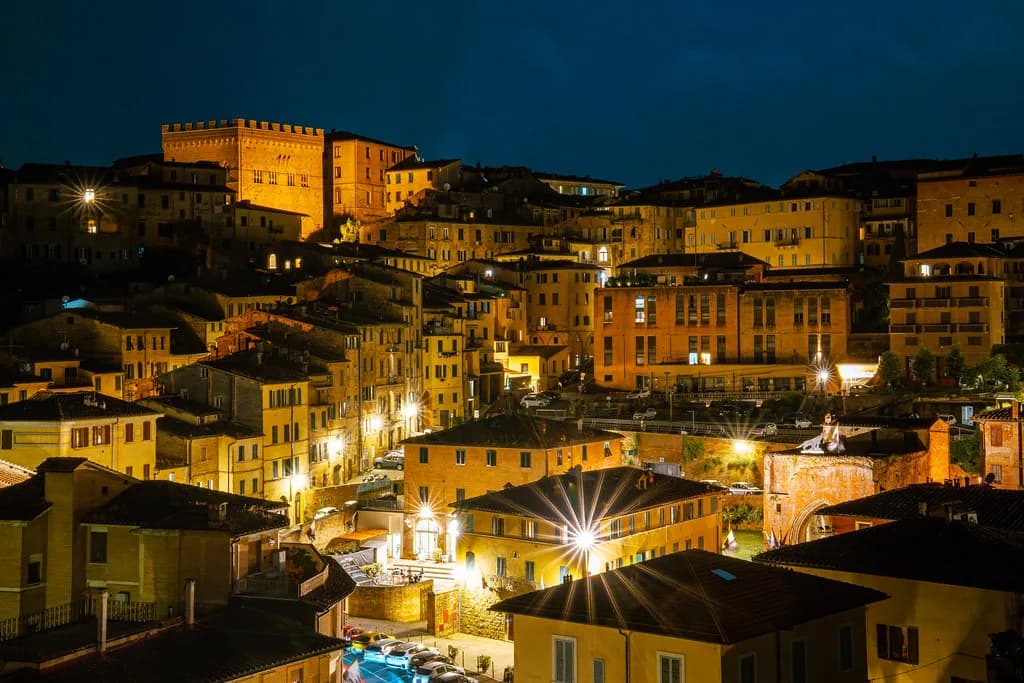
Piazza del Campo is not a rectangle. It is a shallow shell or fan shape that tilts gently downhill, framed by the Palazzo Pubblico and its tower, and it reads completely differently at night, when the stone turns amber and the crowds thin to couples and students.
The fountain at the northern end, Fonte Gaia, is the obvious meeting point and a good place to end the walk. What you see is a nineteenth-century replica carved by Tito Sarrocchi in 1858 from Jacopo della Quercia's 1419 original, so it is a copy standing in for a civic symbol rather than the Renaissance marbles themselves.
The original panels are preserved elsewhere and are worth seeking out if sculpture interests you; the fountain's sculptural elements were moved indoors for protection, and the display is associated with the collections at Santa Maria della Scala.
One correction to a common assumption: the water in the fountain is recirculated for decoration, not drinking water, so bring a bottle from elsewhere. The pool of light around the basin is far better used for sitting on the sloping pavement and watching the square settle.
Free Versus Ticketed: What Costs What
Almost everything people picture when they imagine an evening in Siena is free. The streets, the viewpoints that are not attached to a museum, the exterior of the Palazzo Pubblico and the open space of Piazza del Campo cost nothing, and the fountain is viewed from the square rather than entered.
Ticketed sites are the enclosed ones: the cathedral interior, the Piccolomini Library, the cathedral museum with the Facciatone, the crypt, the baptistery and the Porta del Cielo rooftop. The baptistery sits beneath the apse of the cathedral and is included in the OPA Si Pass but not in every ticket tier, so check what your ticket actually covers.
The Museo Civico inside the Palazzo Pubblico, with Lorenzetti's frescoes of good and bad government, is a separate ticketed collection again. If your evening is short, this is the one to weigh against a tower climb rather than trying to squeeze in both.
Prices change and are published by each site rather than by us, so check the official pages for current rates and any combined options before you commit. Do not plan your budget around numbers in older blog posts.
Where Aperitivo and Dinner Fit
The honest answer is that aperitivo belongs after the last timed entry, not before it. Once the Duomo complex has closed and the light has gone soft, find a table near the square or along the lanes, order something local, and let the evening slow down.
For the food itself, Siena's own repertoire is the point: pici, ribollita, pecorino, panforte and the local wines of the surrounding hills. Our Siena local food guide covers what to order and where the dishes come from, which is more useful than a list of restaurant names that may have changed hands since publication.
Opening hours vary by venue and season, and no guide should pretend otherwise. Check the door or the venue's own page on the day, and if a place matters to you, book ahead rather than arriving at nine and hoping.
What Closes Early and How to Sequence Around It
The single most important rule is that the monumental complex shuts in the early evening, so it goes first. In the April to October 2026 season the complex runs 10:00 to 19:00, but religious celebrations can shift hours, so confirm on the day you visit.
After that, sequence outward: a viewpoint while there is still light, then the passeggiata downhill, then the square as darkness arrives, then dinner. The result is a plan that never depends on a site staying open late.
If you are visiting around 2 July or 16 August, remember that the Palio is a recurring tradition held on those days each year, not something that can be treated as a quiet evening. Expect crowds and restricted movement in the centre around those dates.
A Short Evening Versus a Full Evening
With two or three hours, pick one ticketed interior, one viewpoint and the square. A realistic shape is a late-afternoon cathedral visit, the terrace by San Domenico at sunset, and Piazza del Campo afterwards, all on foot with time to sit down.
With a full evening, add a second site before closing time, take the passeggiata more slowly, and allow for a proper dinner rather than a standing snack. Our Siena three days itinerary shows how the evening slots into a longer stay if you are basing yourself here.
If rain sets in, the plan changes: interiors, covered passages and a long dinner replace the viewpoints. Our guide to a rainy day in Siena covers the fallback options, and the spring and autumn shoulder seasons are the periods most likely to test it.
Practical Notes for Walking After Dark
Siena is built on hills and paved with stone, so the evening walk involves slopes, steps and uneven surfaces. Wear shoes you can climb in, and if you are heading for the tower or the Facciatone, remember that the ascent is the hard part and the descent is the slow one.
Because the centre is pedestrian-only, arriving by car means parking outside the walls and walking in, so plan your arrival while there is still daylight. Allow more time than a map suggests for the final stretch with luggage.
Book timed slots for the rooftop and any tower you want to climb, and treat sunset as a popular slot rather than a quiet one. An early-morning start to the next day is often the better trade than chasing the last light from a tower.
Finally, check the season before you build the plan. The best time to visit Siena for warm evenings and manageable crowds is not the same as the best time for the uncovered cathedral floor, and the two priorities rarely line up.
Plan Your Evening
Treat Siena's evening as a sequence: ticketed interiors first, a viewpoint while there is light, then the slow walk to Piazza del Campo and dinner. The city is small enough that this works without a car and without rushing.
The only fixed points are the published closing times and the timed rooftop slots, both of which you should confirm on the official pages before travelling. Everything else, from the fountain to the terrace by San Domenico, asks nothing more than your own pace.
Frequently Asked Questions
How long does an evening in Siena need?
Three hours is enough for one ticketed interior, a viewpoint and the square at a relaxed pace. A full evening adds a second site before closing time, a longer passeggiata and a proper dinner. The city centre is compact and walkable, so the limit is your energy rather than distance.
Is the Duomo complex open in the evening?
In the main April to October season the cathedral and the associated museum sites close in the early evening, with last entry shortly before that. Hours vary by period and can shift for religious celebrations, so check the Opera della Metropolitana website for the date you plan to visit rather than assuming.
Where are the sunset viewpoints in Siena?
The terrace near the Basilica of San Domenico offers a wide view of the old city and costs nothing. The Facciatone, reached through the cathedral museum, gives a closer terrace view, while the Torre del Mangia requires a long climb of around four hundred steps. All three close with their parent sites.
Can you visit Piazza del Campo for free in the evening?
Yes. The square is public space and needs no ticket at any hour. The Palazzo Pubblico and its civic museum are separately ticketed, but the sloping pavement, the surrounding facades and a view of the fountain are free.
Do you need tickets for the Facciatone or the Torre del Mangia?
Both are paid sites. The Facciatone is part of the Duomo monumental complex and is reached through the cathedral museum, so it depends on which complex ticket you hold. The tower is accessed from the Palazzo Pubblico. Check each official site for current ticket scopes and booking arrangements.
Can you drink the water at Fonte Gaia?
No. The water in the fountain is recirculated for decorative purposes rather than supplied for drinking, so it is not a place to refill a bottle. Treat the fountain as a landmark and a meeting point rather than a public water source.
What can you do in Siena in the evening if museums are closed?
Walk the car-free historic centre, watch the light change from a free terrace, cross Piazza del Campo after dark and eat. The city's streets are themselves the attraction, and the passeggiata needs no opening hours. Confirm any venue's hours directly before planning dinner around it.
Sources
- Homepage | Comune di Siena
- Best of Siena: The Ultimate Travel Guide & Top Things to Do - Sommertage
- Best Things to Do in Siena: Your Ultimate Guide ⭐️ 2026
- One Perfect Day in Siena, Italy | A Detailed Itinerary
- Siena by Night: Evening Magic with Hotel Athena
- Fonte Gaia – Siena’s Historic Fountain of Beauty and Symbolism
- Opera Duomo Siena – Siena Opera della Metropolitana
- The Baptistery of San Giovanni: Extraordinary Mosaics and Frescoes - Hotel Minerva Siena
- Santa Maria della Scala – Museo, Arte e Storia a Siena
Continue exploring
More guides you'll find useful