Livorno Self-Guided Walk: Canals, Fortresses & Old Harbour
Follow a self-guided Livorno walk from the Duomo to the Four Moors, both fortresses and the Venezia Nuova canals, with suggested pacing for heat and rain.
On this page
Livorno rewards a walking day because its best sights sit close together, strung between the old harbour and a canal quarter that feels more like a small northern European port than a Tuscan hill town. One published walking route links the shuttle stop, Duomo, Four Moors, both fortresses, the Venezia Nuova canals, Piazza della Repubblica, the covered market and the synagogue, and its author estimates the loop at roughly 3 km, or 2 miles.
Treat that distance as a reference figure from one walker rather than an official measurement, and add time for stopping, since the route is dense with squares, bridges and waterfront viewpoints. The town beyond the port is a compact grid, so you can shorten or reorder the walk without losing the thread. This guide sequences the stops so the canal district is walked continuously, and it keeps exteriors, which you can always see, separate from interiors you should verify before relying on.
Orientation: Where the Walk Sits in Livorno
The cruise port occupies an industrial area on the edge of the city, and a shuttle service is the usual way to bridge the gap to the centre. One walking guide describes the shuttle dropping passengers on Via Cogorano, close to the Duomo and the top of Via Grande, but shuttle arrangements change, so confirm the current pickup point and frequency with your cruise line or the port on the day.
If you are staying in Livorno rather than arriving by ship, you can start the same loop on foot from the centre, since every stop lies within the area between the waterfront and the canal quarter. The city's own events and notices are a useful check on anything that might close a street or square during your visit.
Stop 1: The Duomo and Via Grande
Begin at the Cathedral of San Francesco, known locally as the Duomo, whose facade carries rounded arches attributed to the English architect Inigo Jones and whose interior holds paintings worth a short pause. The church fronts a square that feeds directly into Via Grande, the main shopping street, which runs toward the water under porticoes on both sides.
Those porticoes matter more than they look: they give you a covered spine through the centre if rain sets in, which is why this route returns along Via Grande in bad weather. Walk the length of the street toward the waterfront and use it to get your bearings before turning to the sights, rather than treating it as a mere corridor.
Stop 2: The Waterfront and the Four Moors
At the end of Via Grande, turn right along the waterfront to reach the Monumento dei Quattro Mori, the bronze group in which Grand Duke Ferdinand I stands above four chained prisoners, commemorating victory over the Ottomans. A local legend says good luck comes to anyone standing where all four prisoners' noses line up, and a white brick in the surrounding paving is said to mark the spot.
This stretch is the old harbour's public face: free to walk, open to the sky, and the natural place to decide whether the weather will hold. Boat tours of the canals depart from near the statue and from the north end of Piazza della Repubblica, but schedules and prices change, so check with the operator rather than assuming a departure time.
Stop 3: Fortezza Vecchia and the Matilda Tower
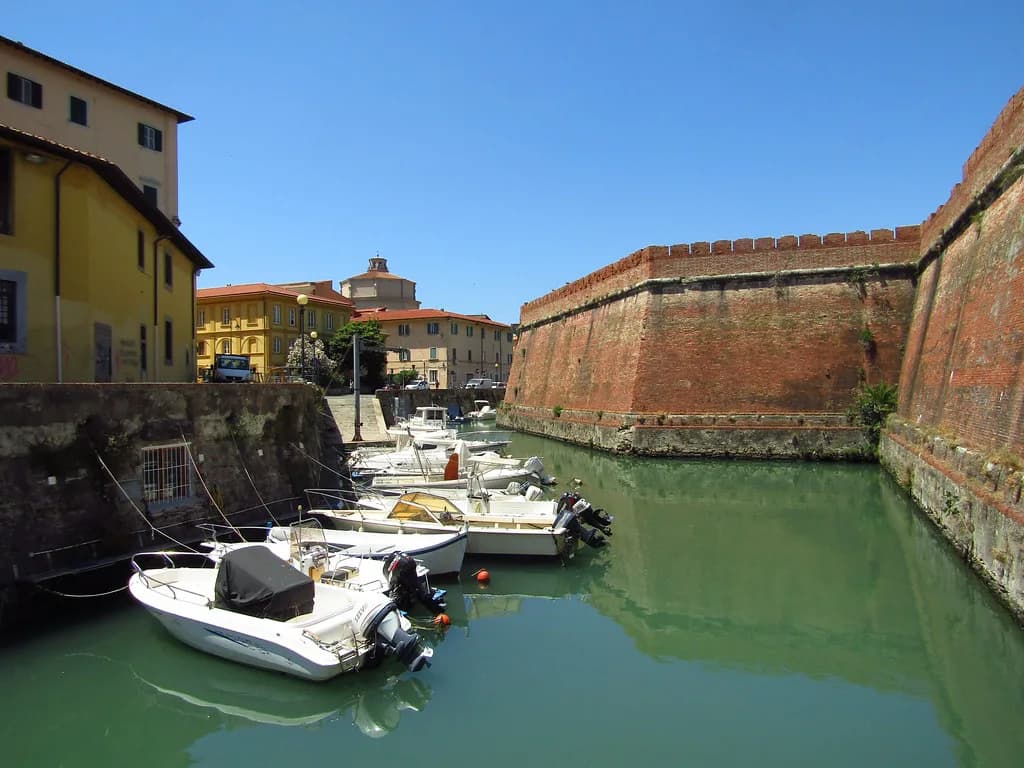
From the waterfront viewing area you can take in the Fortezza Vecchia, the old fort built to guard the harbour entrance after Cosimo I de' Medici had a canal cut from Pisa so ships could reach the sea at Livorno. The complex incorporates an eleventh-century tower, the Matilda Tower, which has been repaired over the centuries.
For a self-guided day, the fort's value is largely as an exterior: you see the massing and the tower from across the water without committing to a visit inside. Whether the interior is open on your date is a separate question, so check before you build the day around it and treat any entry as an optional add-on rather than a guaranteed stop.
Stop 4: Into the Venezia Nuova Canal Quarter
Descend the steps at the end of the viewing area and follow the canal path to the first bridge, cross it, then turn right and keep to the water to reach the baroque Church of Santa Caterina. This is the entrance to the Quartiere Venezia, the New Venice district, where merchants built houses and warehouses directly on the canals for easy loading.
Walk this quarter continuously rather than darting in and out, because its character comes from the sequence of bridges, water and narrow fronts. If the canals are what draw you to Livorno, spend your lingering time here and trim elsewhere; the wider set of overlooked corners in the city is covered in the guide to hidden gems, including the Venezia Nuova waterways.
Stop 5: Chiesa di Santa Caterina
Santa Caterina opened in the mid-eighteenth century, yet its facade was never completed, which makes the exterior easy to misread. Inside, the church is octagonal, with a dome modelled on the Pantheon in Rome, arches on each of the eight sides and several chapels with artwork.
The gap between plain outside and surprising interior is the reason to step in if the doors are open, but church access depends on services and local arrangements. Check at the door or with the parish before counting on it, and keep the stop brief so the canal walk stays the backbone of the day.
Stop 6: Fortezza Nuova
Cross the bridge out of the canal quarter and follow the water to the Fortezza Nuova, built at the end of the sixteenth century as part of a much larger scheme of city fortifications. Most of those outer defences were dismantled by the end of the seventeenth century, leaving the fort you see today, which was heavily damaged in the Second World War and later turned into a park.
Entry is through a single dark tunnel where a drawbridge once stood, and little of the original structure survives beyond fragments near the entrance. As with the old fort, the grounds are the reliable part of the visit; check locally if you want to know whether anything inside is open on your date.
Stop 7: Piazza della Repubblica, a Square Built on a Bridge
Piazza della Repubblica is an unusually large square with a canal running beneath its full length, which effectively makes it a very wide bridge. At the north end stands the monument to Leopoldo II of Tuscany, and at the south end a figure of his father, Ferdinando III, and the square hosts large events and concerts during the year.
Read the square as a hinge in the route: you arrive from the canals and leave toward the market, so it is a good place to sit, reorient and decide how much energy remains. Its scale also makes it a natural rain refuge if you only need a breather rather than a full change of plan.
Stop 8: Mercato Centrale and the Outdoor Produce Stalls
Leave the square on Via Biontalenti and walk to the Mercato Centrale, also known as the Mercato delle Vettovaglie, one of the largest covered markets in Italy, with a French-influenced building, dozens of shops and hundreds of stalls selling meat, cheese, bread, wine and more. The fruit and vegetable market sits outdoors at the end of the building and is one of the most photogenic corners of the walk.
The building described by that walking guide trades early in the day and generally winds down in the early afternoon, but market hours are exactly the kind of detail that shifts with season and stallholder, so confirm before making it your lunch anchor. Arriving earlier in the day gives you the best chance of finding the hall in full swing.
Stop 9: The Synagogue and the Return Leg
From the market, walk around the building to reach the synagogue, a striking building best appreciated by circling it to see its different faces before heading back through the arch toward the Duomo. The Jewish community here dates to the Medici era, when Livorno was promoted as a port of religious tolerance and merchants of several nations settled in distinct quarters, which is why the city's churches include Protestant, Anglican and Greek Orthodox as well as Catholic.
The synagogue is a working place of worship, so treat the exterior as the default view and check with the community if you hope to see inside. From there the Duomo and the shuttle stop lie a couple of short blocks away, closing the loop where you began.
Suggested Timing: An Editorial Pacing Plan
The following timings are our suggestions, not official figures, and they assume an unhurried walker who stops for coffee and photographs. Allow around four hours from shuttle to shuttle: roughly 45 minutes on the Duomo, Via Grande and the Four Moors, 30 minutes for the Fortezza Vecchia viewpoint, 60 to 75 minutes through the canal quarter with Santa Caterina, 30 minutes at the Fortezza Nuova and Piazza della Repubblica, 45 minutes at the market and synagogue, and the rest for walking and pauses.
If you have only a couple of hours, cut the fortresses to viewpoints and walk the canal quarter once, ending at Piazza della Repubblica. A structured operator-led version of the same ground runs about two hours from the Old Fortress to New Venice, which is a useful benchmark for how much fits into a short slot.
Adapting the Route for Heat, Rain and Low Energy
In heat, front-load the exposed waterfront and fortress viewpoints in the morning and save the shaded canal lanes and the market hall for the hottest hours. Carry water, since the route's squares offer little shade, and plan a proper sit-down rather than treating the market as a quick pass-through.
In rain, use Via Grande's porticoes as your covered spine: see the Duomo, walk the arcades, and shorten the canal section to Santa Caterina and back over the nearest bridges. Skip the fortress parks, whose value is mostly outdoor, and give the covered market more time instead.
If energy is limited, drop the return along the canals and finish at Piazza della Repubblica, where you can rejoin the direct line back toward the Duomo and the shuttle. Deciding this at the square is easier than deciding at the far end of the quarter.
Practical Cautions Before You Go
Separate what is always visible from what needs a door to be open. The streets, squares, bridges, waterfront and fortress exteriors are part of the public cityscape; church interiors, museum collections and any ticketed displays are individual decisions, and a ticket for one site never implies entry to another.
Check current opening times and any entry conditions for the Duomo, Santa Caterina, the synagogue, the fortresses and the market before you set out, since published hours vary and special services or works can close a building at short notice. The city's official site is the sensible starting point for notices that affect streets and squares.
Plan Your Visit
This walk works because it asks little of you beyond a pair of shoes and a rough sense of direction: the stops follow one another through the centre, and the canal quarter supplies the stretch worth slowing down for. Start at the Duomo, keep the waterfront and fortress views as your free backbone, and treat interiors as optional extras to confirm on the day.
If the weather turns, the porticoes of Via Grande and the covered market will carry the day; if you have longer, the one-day plan shows how to stretch the same ground into a fuller schedule. Either way, check hours and access before you go rather than after you arrive. For related planning, see Cisternone Livorno: Poccianti's Neoclassical Reservoir Guide.
Frequently Asked Questions
Is Livorno walkable from the cruise port?
Not directly on foot in any pleasant sense: the port sits in an industrial area, and a shuttle is the usual link to the centre. Confirm the current drop-off point and frequency with your cruise line or the port before you rely on it, then the sights themselves are close together and easily walked.
How long does a self-guided Livorno walking route take?
Our suggested pacing is about four hours from shuttle to shuttle, including pauses at the Duomo, the waterfront, both fortresses, the canal quarter, the market and the synagogue. That is an editorial estimate rather than an official figure, and a two-hour version covering the core is realistic if time is short.
Do you need tickets to see Fortezza Vecchia and Fortezza Nuova?
The fortresses are best treated as exterior sights on this route: you can see the old fort and its tower from the waterfront viewing area, and the new fort's grounds are now a park entered through a single tunnel. Anything beyond that depends on current access arrangements, so check before you plan around going inside.
What can you see in Livorno's Venezia Nuova canal district?
The quarter is a grid of canals, bridges and merchant houses built for loading goods from the water, with the baroque Church of Santa Caterina at its heart. Santa Caterina has an unfinished facade but an octagonal interior with a Pantheon-style dome, which is worth stepping in for if the doors are open.
What should you skip on a short stop in Livorno?
On a short stop, skip the fortress interiors and any long detour, and walk the canal quarter once rather than doubling back. Use the Duomo and Via Grande at the start, the Four Moors and the waterfront as a quick viewpoint, and finish at Piazza della Repubblica or the market depending on the time of day.
Sources
Continue exploring
More guides you'll find useful