Cisternone Livorno: Poccianti's Neoclassical Reservoir Guide
Plan a look at the Cisternone in Livorno: what Poccianti's neoclassical reservoir is, how it fits the Colognole water system, and how it slots into a city walk.
On this page
Most travellers meet the Cisternone by accident, walking between Livorno's canal district and the waterfront and finding a Pantheon-like half-cupola staring across a piazza. It is not a palace or a museum but a covered water reservoir, built to store spring water from Colognole and designed by the Arezzo architect Pasquale Poccianti. The building's odd double life, as monumental architecture and working infrastructure, is exactly why it rewards a deliberate stop rather than a passing glance.
The dependable experience is exterior: the piazza, the Tuscan portico, the coffered semicupola and the scale of the thing against the surrounding streets. Treat anything beyond that as uncertain and check before you plan around it. Start with the wider Livorno Attractions hub if you are still deciding which sights deserve your limited time.
What the Cisternone Actually Is
The Cisternone, also called the Gran Conserva, is a large covered cistern built as part of Livorno's Colognole water system. Its job was to filter and hold spring water from Colognole, in the municipality of Collesalvetti, and guarantee the city's supply if the aqueduct failed. Reading it as infrastructure first makes the architecture legible: the grand front is a civic statement wrapped around a tank.
The building sits on Piazza del Cisternone, not in the historic core, and one older description places it near Sant'Andrea and the A. Gherardesca complex, at a busy modern crossroads. That location is part of its story: Poccianti imagined a grand tree-lined approach, now Viale Carducci, linking the springs to the reservoir. When you arrive, the piazza is the room the façade was designed to command.
Construction Timeline: Late 1820s to the 1842 Inauguration
Construction began in the late 1820s, though sources do not agree on the exact year: one account says work started in 1829, while another gives 1828. The façade went up first and evolved as Poccianti revised his design, adding the eight-column portico and the coffered semicupola rather than the simpler Tuscan front he initially planned. By 1833 the dome structure was complete enough for celebrations around the wedding of Grand Duke Leopold II and Princess Maria Antonia.
The building was inaugurated by Grand Duke Leopold II of Lorraine in 1842, a date treated as the operational start in the older scientific-itinerary description. One visitor-oriented source instead gives 1848 as the completion year, which is a genuine discrepancy rather than a typo to resolve silently. For practical purposes, 1842 is the safest date to quote for the inauguration, and you can mention the later figure as a variant if it matters to your reading.
Why It Looks Like This: Poccianti's Façade
The façade is the reason people stop. A Tuscan portico eight columns wide frames a large semicupola decorated with coffers, a clear nod to the Pantheon in Rome, and the whole composition is often described as one of Italy's foremost neoclassical structures. Poccianti's design is not decorative dressing on a tank; the shell-shaped half-dome announces the building's purpose while borrowing the authority of ancient baths and temples.
A scholarly debate surrounds the design. Some accounts suggest Giovanni Antonio Antolini, known for the Foro Bonaparte in Milan, may have influenced the portico, and the surviving correspondence between the two architects is cited as support. Treat that as an attribution question rather than settled fact, and enjoy the façade for what it demonstrably does: turn a water works into a piece of urban theatre.
Scale and the Cistern Hall
The numbers explain why the building feels bigger than a civic monument. The cistern measures roughly 38 metres wide and 42 metres long, with a capacity usually given as about 10,000 to 11,000 cubic metres depending on the source. That range matters less than the effect: this was a serious piece of city infrastructure, sized for a growing port.
Inside, older descriptions record a hall divided into five aisles in width and seven in length by Tuscan pillars carrying hemispherical vaults. Water from Colognole entered at the rear and was filtered through layers of gravel and charcoal, a system later removed when chlorine treatment made it redundant. Giuseppe Piombanti's nineteenth-century guide describes a semicircular atrium and a cast-iron conduit, which gives a vivid sense of what a visit once involved.
Interior Access and Practical Cautions
Reader be warned: the sources here do not establish opening hours, admission arrangements, regular interior access or guided tours. One older profile notes only that the reservoir was still in use at the time of writing, which is not the same as saying you can walk in today. Plan the exterior as the reliable visit and treat the interior as a bonus you confirm locally.
Before you build a day around going inside, check the Comune di Livorno's site and the Visit Livorno tourist portal for current notices and events. Neither source is likely to publish a permanent schedule for the Cisternone, so also look for seasonal openings or heritage events. If nothing is listed, the façade and piazza remain a legitimate stop in their own right.
Cinema and City-History Footnotes
The Cisternone has a small film career. In 1962 it appeared briefly in Vittorio De Sica's I sequestrati di Altona, with its façade dressed as a Nazi-era theatre, and more recently in Lino Capolicchio's Il diario di Matilde Manzoni alongside other aqueduct locations. These are footnotes rather than reasons to visit, but they underline how readily the building plays a role bigger than its function.
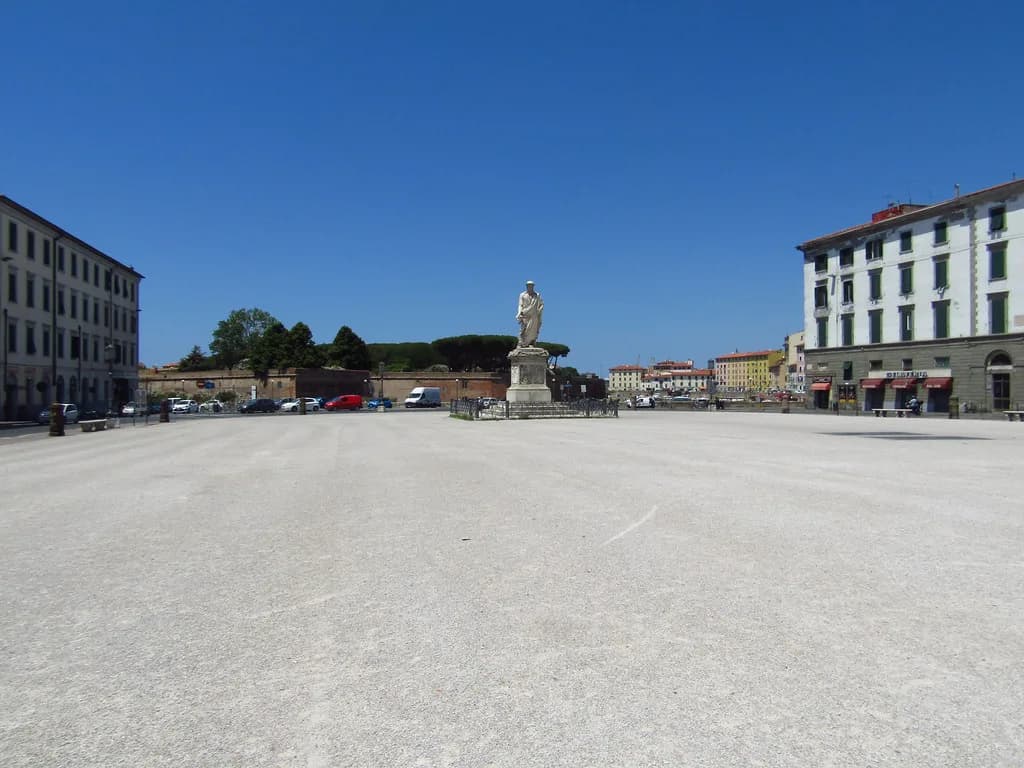
A quieter trace of the aqueduct sits elsewhere in the city. The base of the statue of Grand Duke Ferdinando III in Piazza della Repubblica carries a bas-relief, carved by Temistocle Guerrazzi, depicting the duke urging the construction of the Colognole aqueduct. It is a good pairing with the Cisternone if you want the infrastructure story in two stops.
Building the Walk: The Cisternone and Venezia Nuova
The Cisternone works best as one link in a half-day architectural walk rather than a standalone destination. Begin in the Venezia Nuova district, where canals thread between former warehouses and the Chiesa di Santa Caterina Livorno rises under its 63-metre dome, then make your way toward the reservoir. That sequence keeps the great water monument in conversation with the port city it served.
For a canal-side route that stitches the fortresses, the old harbour and the Cisternone into a coherent stretch, use the Livorno Self-Guided Walk as a skeleton and add the reservoir as a short detour. The Fortezza Nuova survives as a canal-island park accessible by drawbridges from Piazza della Repubblica, and walking its ramparts gives a useful view back across the district before you head north.
Pairing It With Other Free and Low-Cost Stops
If you are watching your budget, build the day around the free parts of Livorno first. Public squares, waterfront walks and fortress grounds cost nothing, and the city rewards aimless wandering as much as formal sightseeing. Free things to do in Livorno: what costs nothing and what doesn't sets out the honest split between free stops and the ones that charge.
For the seafront half of the day, pair your Cisternone visit with Terrazza Mascagni, a checkerboard of black and white tiles laid out beside the Tyrrhenian Sea. It is the opposite architectural register to Poccianti's solemn reservoir, and the contrast makes both seem sharper. If you are looking for less obvious corners, the hidden gems in Livorno guide will help you avoid circling the same piazza twice.
Who Should Make the Detour
The Cisternone is for architecture lovers, engineering enthusiasts and anyone who enjoys seeing a utilitarian building dressed as a temple. If you only have time for Livorno's seafront and market, skip it without guilt; if you are walking the canal district anyway, the detour to Piazza del Cisternone earns itself in twenty minutes of looking.
Confirm current access locally before planning an interior visit, and bring your expectations back to the exterior, which never depends on a schedule. Then follow the walk through the canals and fortresses to see how one reservoir fitted into a much larger machine for moving water and goods.
Frequently Asked Questions
What is the Cisternone in Livorno?
It is a large covered reservoir, also called the Gran Conserva, built in the first half of the nineteenth century to filter and store spring water from Colognole for the city. Pasquale Poccianti designed it, and its grand neoclassical façade camouflages a tank measuring roughly 38 by 42 metres.
Can you go inside the Cisternone, and is there an entry charge?
Sources do not establish regular interior access, opening hours or admission arrangements. The dependable experience is the exterior and Piazza del Cisternone. Check the Comune di Livorno and Visit Livorno for any temporary openings before you plan a visit around the interior.
When was the Cisternone built and who designed it?
Construction began in the late 1820s, with one source giving 1828 and others 1829, and the building was inaugurated in 1842. The architect was Pasquale Poccianti, whose evolving design produced the eight-column portico and coffered semicupola inspired by the Pantheon in Rome. At least one account gives 1848 as completion, so the dates are not fully consistent.
How big is the Cisternone and how much water could it hold?
The cistern is usually described as about 38 metres wide and 42 metres long, with capacity reported as roughly 10,000 to 11,000 cubic metres depending on the source. Inside, older descriptions record a hall arranged in five aisles by seven and supported by Tuscan pillars.
Was the Cisternone ever used as a film location?
Yes. Its façade appeared briefly in Vittorio De Sica's 1962 film I sequestrati di Altona, and more recently in Lino Capolicchio's Il diario di Matilde Manzoni. Those appearances are footnotes to its main role as water infrastructure.
Sources
Continue exploring
More guides you'll find useful