Roman Brescia Guide: Walking Brixia's Layers on Foot
Walk Roman Brescia in one slow loop: the Capitolium, theatre and Republican sanctuary, then Santa Giulia and the twin cathedrals.
On this page
Brescia rewards the traveller who arrives without a checklist. In a compact, largely pedestrian centre you can move in a few dozen metres from a Roman temple to a Lombard monastery raised in what was once a wealthy district of ancient Rome, all beneath a hilltop castle. That layering is the reason to come, and it makes a single unhurried loop more satisfying than a dash between highlights.
This guide follows the city's own chronology, starting with Roman Brixia in the archaeological park, continuing into the museum complex built over a Roman quarter, and finishing among the Venetian and Baroque squares to the east. Practical details stay deliberately general: the organiser of the park and museum, Brescia Musei, publishes current ticketing, opening hours and booking arrangements, and those should be checked before you travel.
Why Brescia Reads Like a History Book
Few Italian cities show their succession of rulers so plainly. One writer traces Ligurians, Gauls, Romans, Lombards and Venetian doges in the same streets, and notes that several monuments, including the Lombard-era monastic complex, form part of a UNESCO World Heritage Site listed as the Longobards in Italy. That same layering puts Roman, medieval, Renaissance and twentieth-century architecture within a short stroll.
Brescia also sits outside the busiest tourist circuits of northern Italy. One account describes it as one of the country's most underrated cities, seeing far fewer visitors than nearby Verona or Milan, which means the historic centre stays manageable on foot. The trade-off is that English-language orientation is thinner than for its neighbours, so a little reading beforehand pays off.
Orientation: Arriving and Walking the Centre
Brescia's historic core is compact and mainly pedestrianised, which makes walking the natural way to connect the Roman sights with the later squares. Rough Guides notes that the easiest route from the main station to the historic centre is one metro stop to Vittoria, with a ten-minute walk as the alternative. Treat those as orientation rather than a timetable and confirm service details locally.
The city is on the main line between Milan and Verona, so it works as a stopover or a day trip rather than a separate expedition. Brescia also has its own metro linking the station area to the centre. If you are weighing whether the city deserves more than an afternoon, our guide to the hidden gems in Brescia covers the corners that most day-trippers miss.
Start in the Archaeological Park: the Capitolium
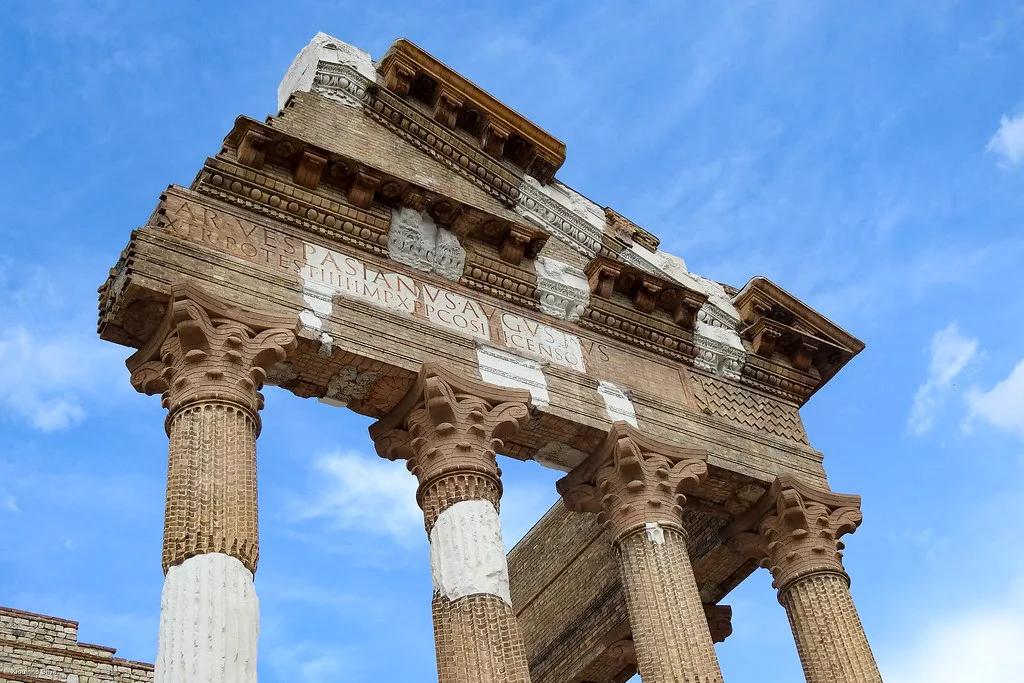
The Parco Archeologico di Brescia Romana concentrates the essential Roman remains in one place. At its centre stands the Capitolium, the Capitoline temple built under Vespasian, where original coloured-marble flooring, fragments of cult statues and limestone altars survive. An installation adds narrative voices and images, which helps if you are visiting without a guide.
The temple's later history is part of the story: it was destroyed in the late fourth century and only rediscovered in 1823, so much of what you see is the result of nineteenth-century excavation and modern presentation. Allow time to look rather than photograph, because the decoration is the point. Confirm current entry arrangements through Brescia Musei before setting out.
The Theatre and the Chamber of Pillars
Beside the temple lies the Teatro Romano, dating to the Augustan period and once able to hold a crowd reported at around fifteen thousand spectators. The tiered seating is cut into the slope of Cidneo Hill, and a covered passage known as the Chamber of Pillars links the theatre to the temple precinct. Standing between the two makes the scale of ancient Brixia easier to picture than any plan.
This is a good place to slow down, because the theatre and temple were designed as one monumental ensemble rather than separate monuments. Read them together and the forum area starts to feel like a designed civic space. If you want a broader overview of what else the city offers, the Brescia Attractions hub groups the individual sights into separate guides.
The Republican Sanctuary: The Reason to Slow Down
If one part of the park justifies the journey, it is the late-Republican sanctuary, with frescoed walls and mosaic floors that preserve the atmosphere of a vanished way of life. Rough Guides describes its wall paintings as the only surviving monumental example of Republican Roman painting in northern Italy. That claim alone makes it worth lingering over.
Because the paintings are fragile and displayed in a controlled setting, the experience depends on how the site is being managed when you visit. Check with Brescia Musei for what is currently open and whether any section is restricted, rather than assuming everything in the park is viewable. A guided visit can add context here more than anywhere else in the city.
Santa Giulia: A Roman Domus Inside a Convent
The Museo di Santa Giulia occupies a former Benedictine convent built over a Roman quarter of frescoed villas, so the museum's own fabric is an exhibit. Inside, three churches span the centuries, and the collection includes a life-size bronze Winged Victory, mosaics and frescoes preserved in place, and the eighth-century Cross of Desiderius set with more than two hundred gemstones.
One traveller singles out the Roman Domus dell'Ortaglia, the oratory of Santa Maria in Solario, the basilica crypt and the Renaissance cloister as the rooms that stayed with her. The museum traces Brescia from Roman Brixia to the nineteenth century, so it works as the connective tissue between the archaeological park and the medieval city. Budget a couple of hours at least, and check current opening times and tickets directly. Related guide: Domus dell'Ortaglia in Brescia: A Visitor Guide.
From Roman Forum to Venetian Square
Piazza della Loggia is the city's prettiest square, laid out from 1433 when Brescia invited Venice to protect it from Milan's Visconti. The Venetian influence shows in the Loggia, on which both Palladio and Titian are said to have had a hand, and in the clock tower modelled on Venice's campanile. Enter through the arch beneath the clock and the effect is immediate.
The square also carries harder history: a monument marks the 1974 bombing of a trade-union rally, in which eight people were killed and more than a hundred injured, and blast damage is still visible on a pillar. Walk through to the austere Fascist-era Piazza della Vittoria and the layers of the twentieth century join the Roman and Venetian ones. These public squares cost nothing to wander.
Piazza Paolo VI and the Two Cathedrals
Passages lead east to Piazza Paolo VI, one of the few Italian squares with two cathedrals. The Duomo Nuovo hides an 80-metre cupola behind its Neoclassical facade, while the adjacent twelfth-century Duomo Vecchio, known as the Rotonda, is a circular church of local stone sunk below the level of the square.
Inside the Rotonda, glass set into the transept pavement reveals the remains of Roman baths, including a wall and geometric mosaics, plus the apse of an eighth-century basilica that burned down in 1097. The crypt rests on a random array of reused Roman columns. It is the clearest place in the city to see Roman fabric absorbed into a later building, and entry arrangements should be confirmed on site.
Uphill to the Castello
A climb to the Castello completes the defensive story, from the hill above the Roman theatre to the fortifications added by Visconti, Venetian, French and Austrian rulers. Rough Guides calls it Europe's second largest fortification, a claim worth attributing to them rather than treating as settled fact. Today it holds the Museo delle Armi Luigi Marzoli and the Museo del Risorgimento, and the grounds double as a hilltop park.
Go late in the day if you want the view back over the domes and the Roman park without rushing the museums below. The walk up is part of the experience, so wear shoes that cope with cobbles and slopes. Check opening arrangements for the castle museums before you commit an afternoon to them.
One Day or Two: Choosing Your Pace
For a single day, take the archaeological park first, when attention is freshest, then Santa Giulia, then walk east through Piazza della Loggia to the cathedral square. That order follows the chronology and avoids backtracking in a compact centre. It is a suggested route, not an official itinerary, and it will feel tight if you read every label.
With two days, spread the same sights across a morning and an afternoon and add the Castello, the Pinacoteca Tosio Martinengo or the Mille Miglia Museum, which occupies an eleventh-century monastery complex and covers the rally from 1927 onward. One writer notes that two days allow a more relaxed visit including the castle and the car museum. Keep the second day flexible so a slow lunch does not derail it.
Practical Notes on Food and Getting Around
Brescian cooking is robust: look for casoncei, large meat-filled ravioli, polenta with the local bagòss cheese, and brasato d'asino. Central Brescia has plenty of reasonably priced places serving these dishes. Ask at your accommodation for current favourites rather than relying on older recommendations, since restaurants change hands.
The metro has one line running daily until midnight, and until 1am on Saturdays, according to Rough Guides, but you will mostly walk. Journey times and service patterns change, so confirm before relying on a late connection. Hotels cluster around the centre and the station area, and booking sites list current options with reviews.
What to Save for a Return Visit
The Mille Miglia Museum, the Vantiniano cemetery and the underground tours run by volunteers are all worth a second trip, and none belongs in a rushed first day. The same applies to the Pinacoteca Tosio Martinengo, whose collection runs from the fourteenth century to Canova and Hayez. Choose one and do it properly rather than squeezing it in.
A good local guide genuinely earns their fee in a city this dense with history, particularly in the archaeological park and Santa Giulia. If your budget or schedule rules that out, read up beforehand and use the on-site installations. Either way, leave something unseen so the city has a reason to pull you back.
Plan Your Roman Brescia Visit
Roman Brescia is not a single sight but a sequence: temple, theatre, sanctuary, museum, square, cathedral, castle. Walking that sequence in order, at a pace that allows for looking, is the whole point. Check Brescia Musei for current tickets and hours, and the city's tourism information for transport, before you fix your dates.
If you have only an afternoon, choose the archaeological park and one cathedral square. With a full day, add Santa Giulia. With two, climb to the castle and pick one museum from the city's longer list, and you will leave with a clearer picture of how a Roman colony became a Lombard, Venetian and modern city.
Frequently Asked Questions
Is Brescia worth visiting for Roman ruins?
Yes. The archaeological park holds the Capitolium with original marble flooring, a Roman theatre cut into the hillside, and a late-Republican sanctuary whose wall paintings are described as the only surviving monumental example of Republican Roman painting in northern Italy. Santa Giulia adds a Roman domus preserved inside a former convent, so the Roman layer continues beyond the park.
What is the difference between the Capitolium and the Republican sanctuary?
The Capitolium is the Capitoline temple built under Vespasian, dominating the terraced sanctuary and preserving coloured-marble floors, cult statue fragments and altars. The Republican sanctuary is a separate, earlier structure whose frescoed walls and mosaic floors survive in situ. They sit close together in the same park, but they reward different kinds of attention.
Do I need to book the Brescia Roman park and Santa Giulia museum?
Booking arrangements are not fixed and can change by season. Check the Brescia Musei website, which manages the park and the city museums, for current ticketing, opening hours and any reservation requirement before you travel, rather than relying on older guidebook advice.
How long do you need to see Roman Brescia?
A full day covers the archaeological park, Santa Giulia and a walk east through Piazza della Loggia to the twin cathedrals at a reasonable pace. Two days allow the Castello, the Mille Miglia Museum and time to eat properly. Treat these as suggestions rather than official durations.
Is Brescia walkable from the train station?
Yes. The historic centre is compact and mainly pedestrianised, and the station is roughly a ten-minute walk from it, with a one-stop metro ride to Vittoria as the alternative. Once in the centre, most of the Roman and medieval sights are within easy walking distance of each other.
Why is Brescia a UNESCO World Heritage Site?
The monastic complex of San Salvatore-Santa Giulia and the Roman monumental area form part of the listing known as the Longobards in Italy, Places of Power, inscribed in 2011 to group the most important surviving Lombard-era sites across the country. Brescia's combination of Roman and Lombard remains makes it one of the richest entries.
Can you visit Brescia as a day trip from Milan or Verona?
Brescia sits on the main line between Milan and Verona, so a day trip is realistic if you focus on the park, Santa Giulia and the central squares. Check current timetables for your dates, and consider an overnight stay if you also want the castle and one of the city's other museums.
Sources
Continue exploring
More guides you'll find useful