Piazza della Cisterna San Gimignano: Well and Towers Guide
A guide to Piazza della Cisterna in San Gimignano: the 1273 well, the triangular slope and the towers and palaces around it, plus how to use the square to orient.
On this page
Piazza della Cisterna is the open, sloping square that most travellers picture when they think of San Gimignano: a ring of tall medieval houses and towers around a stone well. The official destination site records the well's construction in 1273 and its enlargement in 1346, which gives you a concrete starting point for reading the space around it.
That long history is the point of the square. It is not a hidden corner or a remnant: it was the town's marketplace and gathering place for centuries. The practical advice that follows is about orientation, so you can identify what you are looking at and know what to verify before you arrive. Further visitor details appear in Piazza della Cisterna - San Gimignano.
What Piazza della Cisterna Is
This is a public square in the centre of San Gimignano, in the province of Siena in Tuscany. The destination site calls it one of the most evocative piazzas in the town, ringed by noble houses and medieval towers. It is a place you walk through and stand in rather than a monument with a entrance.
The official material describes the outdoor space, not a ticketed interior. For the wider set of sights in town, the San Gimignano Attractions overview helps you choose which towers, churches and museums to visit separately.
The town's municipal website is the place to confirm any current administrative notices affecting the historic centre, including the video-controlled restricted traffic zone, before you drive or arrive by taxi.
Two Roads and a Market: The Square's Origins
The square grew at the crossing of two important medieval roads: the Via Francigena and the route linking Pisa and Siena. Because of that position it served as the town's marketplace and the setting for festivals and tournaments, making it a civic space rather than a decorative forecourt.
Its earlier name was Piazza delle Taverne, after the many inns where pilgrims and other travellers stopped to rest. When you stand in the square today, that origin explains the density of doorways and facades facing inward: this was accommodation and commerce before it was scenery. Visittuscany also notes the square as the old home of the city's market and tournaments and its position along the ancient Via Francigena.
The Cistern Itself: 1273, 1346 and the Wear on the Rim
The well at the centre was built in 1273 and enlarged in 1346 under the podestà Guccio di Malavolti, whose name appears on the cistern's coat of arms. Its purpose was practical: it let the population draw water more easily, raising jugs on chains and ropes.
Look closely at the edge of the well. The destination site points to the grooves cut into the rim by those chains and ropes as surviving evidence of daily use. It is a small detail that turns the cistern from a decorative centrepiece into an object with a working history.
Because the well is an artefact in an open square rather than a museum exhibit, handle expectations accordingly: the official material publishes no separate ticket or opening time for it. Check the town's tourism pages for any protective measures before you plan to lean in for a photograph.
Why the Square Is Triangular and Sloping
Piazza della Cisterna is roughly triangular and has a natural slope rather than a level pavement. The destination site describes the shape and the gradient as original characteristics, preserved as they were laid out in the thirteenth century under the town's Ghibelline administration.
That shape is the key to reading the buildings. The slope forms a kind of arena, so the towers and palazzi on each side are seen at an angle rather than head-on, which is why the square photographs as a ring of facades rather than a flat backdrop. Walk to the higher side and look back across the well to see how the composition works.
Visittuscany likewise frames the square as the historic setting for markets and tournaments, which fits the open, sloping plan. If you want to understand how this square relates to the town's other main space, the guide to Piazza del Duomo San Gimignano makes a natural companion read before or after your visit.
Tower by Tower: What to Identify on the Edges
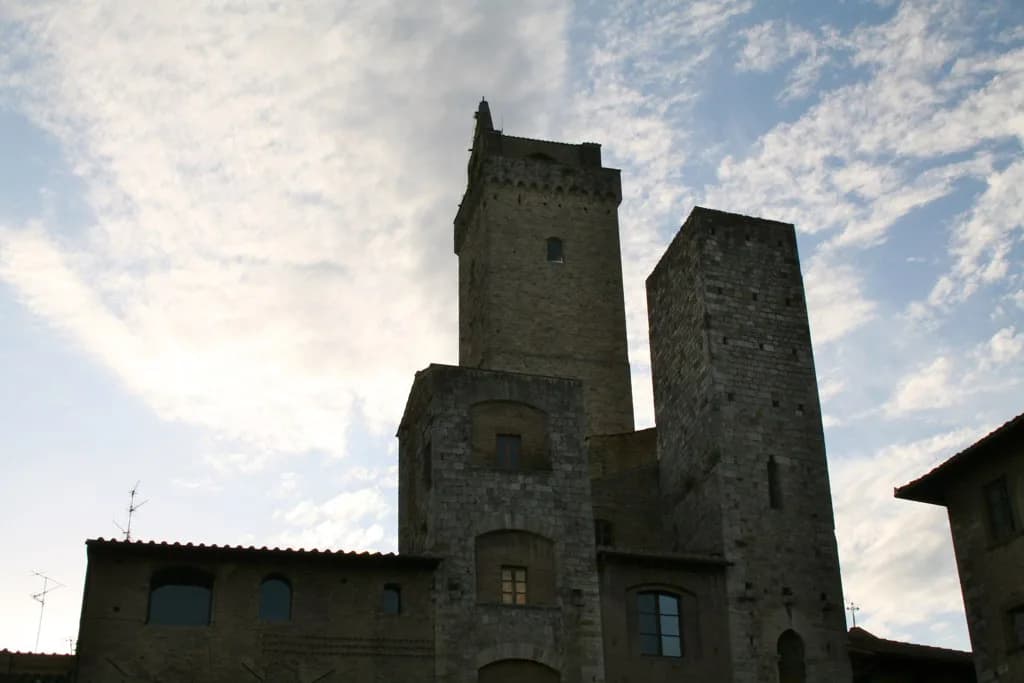
The destination site names the structures around the square, so you can identify them rather than scanning a generic skyline. They include the Torre del Diavolo, the towers of the Ardinghelli family, and Palazzo Razzi and Palazzo Tortoli-Treccani.
Toward the south-west side stand the Arco dei Becci and the tower of the same name, a gateway and tower combination that marks one of the square's exits. Opposite the cistern is Casa Salvestrini, described as an old refuge for pilgrims, which ties the built fabric back to the square's role on the pilgrim road.
If tower-spotting is the point of your trip, extend the exercise beyond this square. Our guide to hidden gems in San Gimignano covers less obvious corners of town, while the town's best known tower, Torre Grossa, gives you a comparison for scale and construction.
Palaces, Pilgrim Refuge and the Square's Civic Role
Palazzo Razzi and Palazzo Tortoli-Treccani are named among the noble buildings around the square, and Casa Salvestrini served as a shelter for pilgrims. Read together, they show a square that mixed prestige and hospitality: private palaces and a charitable refuge facing the same open space.
The destination site notes that despite the passage of time the square has remained the nerve centre of San Gimignano across the centuries. That continuity is the most interesting thing about it: the market, the festivals and the tournaments are gone, but the function of a central meeting place persists.
Visittuscany's description of the square as the old home of markets and tournaments supports the same reading. The square's page describes the outdoor space, not interiors, so do not assume any of the surrounding palaces or towers can be entered on a casual pass through.
Practical Orientation: Pairing the Square with Nearby Sights
Use the square as a starting point rather than a destination in itself. Stand at the well, identify the Torre del Diavolo and the Ardinghelli towers, note the Arco dei Becci exit, and then choose a direction: deeper into the historic centre or out toward the walls and the churches.
A self-guided walk through San Gimignano is the most flexible format because you can stop when a facade interests you. Keep the square early or late in your route so you are not trying to read buildings while moving with a group.
For a church stop nearby, the Chiesa di San Francesco in San Gimignano is a separate building with its own arrangements, so check its details independently rather than assuming the square's public status carries over.
Timing deserves its own thought. The official sources describe the square's history and appearance but publish nothing about when tour groups arrive or leave, so any claim about a quiet late afternoon is guesswork. Our guide to the best time to visit sets out seasonal considerations, and if you are interested in the local white wine, the Vernaccia di San Gimignano material explains the denomination.
Plan Your Visit to the Square
Piazza della Cisterna rewards a deliberate look: the 1273 cistern with its rope-worn rim, the triangular slope, and the named towers and palaces on each edge. Treat it as the town's living room and use it to orient yourself before heading deeper into San Gimignano.
Before travelling, check the municipal website for current notices affecting the historic centre, including the restricted traffic zone, and the official destination site for descriptions of the square and nearby attractions. Neither publishes a fixed entry time for the square, so plan around the town's opening patterns rather than an assumed schedule.
Frequently Asked Questions
Why is the square called Piazza della Cisterna?
It takes its name from the cistern at its centre, built in 1273 and enlarged in 1346. Before that it was known as Piazza delle Taverne, after the inns that served travellers arriving on the Via Francigena and the Pisa–Siena road.
When was the cistern in Piazza della Cisterna built?
The official destination site gives 1273 for its construction and 1346 for its enlargement under the podestà Guccio di Malavolti, whose name appears on the cistern's coat of arms. Look for the grooves worn into the rim by chains and ropes used to raise water.
What towers and palaces surround Piazza della Cisterna?
Named structures include the Torre del Diavolo, the Ardinghelli family towers, Palazzo Razzi, Palazzo Tortoli-Treccani, and the Arco dei Becci with its tower. Casa Salvestrini, opposite the cistern, is described as an old refuge for pilgrims.
Sources
Continue exploring
More guides you'll find useful