Chiesa di San Francesco in San Gimignano: What Survives Today
Only the facade of San Gimignano's Chiesa di San Francesco still stands. Learn its Hospitaller and Franciscan history, what to look for, and how to plan a stop.
On this page
Most travellers arrive in San Gimignano expecting towers, but one of the town's more intriguing walls stands at eye level on Via San Giovanni. The Chiesa di San Francesco, often listed as the Ex Chiesa di San Francesco, survives as a single facade rather than a full church, so there is no interior to tour and no nave to walk through. Understanding that before you arrive makes the stop far more rewarding than a puzzled glance.
The building began as a Hospitaller hospital on the Via Francigena and later passed to the Franciscans, before a private buyer demolished the complex in 1787 and left only the front wall standing. That sequence is documented in local descriptions of the site, and it explains why a Romanesque front now rises above a shopping street with nothing behind it. If your trip is short, treat this as a ten-minute architectural pause rather than a destination in itself.
Quick Answer: What the Chiesa di San Francesco Is Today
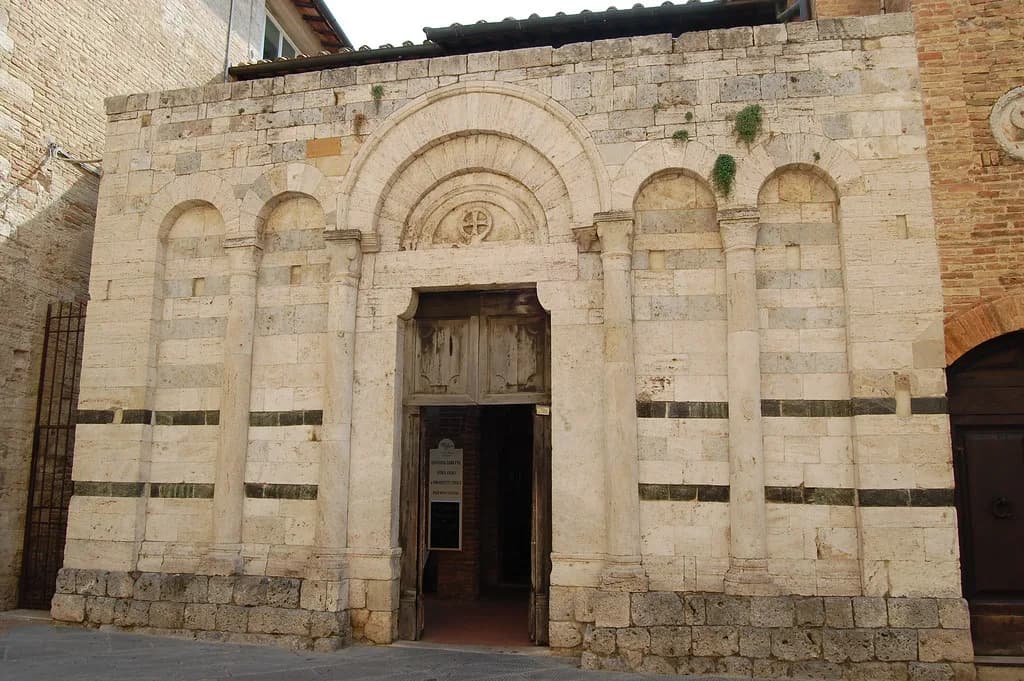
Today the Chiesa di San Francesco is a free-standing exterior, not an active church or a museum. The surviving structure is the facade up to the first floor, with a blind gallery of five rounded arches and a central portal; the interior was destroyed when the complex was pulled down. Visitors look at it from the street, and there is nothing to enter.
That makes the detour decision simple. It is worth stopping if you like reading stonework and want a concrete piece of the town's medieval pilgrim history, or if you are already walking Via San Giovanni. It is not worth planning a day around, and anyone hoping for frescoes or a quiet nave will find the neighbouring churches better suited to that.
Where It Sits on Via San Giovanni
The facade stands on Via San Giovanni, the main approach into the historic centre from Porta San Giovanni. That puts it directly on the natural walking route between the gate and Piazza della Cisterna, and then Piazza del Duomo, so you pass it without adding any distance to your route. If you are following a self-guided walk through the town, mark it as a stop rather than a branch.
Because it is embedded in a commercial street, the wall is easy to miss if you are watching shopfronts. Look up on the left-hand side as you climb towards the centre; the travertine front and its arcade sit above street level rather than at ground level. The official tourism portal for San Gimignano also publishes orientation material for the historic centre if you want to plan the sequence of your walk.
For a wider set of stops in the same compact centre, the San Gimignano Attractions hub groups the main sights by type, which helps you decide what to keep and what to skip. Our collection of hidden gems in San Gimignano is a better fit if you want quieter corners beyond the two main piazzas.
From Hospitaller Hospital to Franciscan Church
The building did not start life as a church. Sources describe a Hospitaller hospital dedicated to Saint John of Jerusalem, with documents from the early thirteenth century recording its existence and a priest mentioned in 1221. Its position on the Via Francigena made it useful to pilgrims and travellers, and the institution accumulated income and civic weight over the following century.
By the sixteenth century the site had changed hands and purpose. Franciscan friars took over the complex in the mid-1500s and changed its dedication, and a description of the period notes that only a handful of brothers remained by 1576. The convent was formally suppressed in 1782, which set up the sale and demolition that followed.
The 1787 Demolition and the Surviving Wall
The reason only a front wall remains is unusually specific. A buyer named Salvatorelli purchased the entire complex in 1787 and had the building demolished almost immediately, leaving the facade standing. What you see on Via San Giovanni is therefore a deliberate remnant rather than a ruin in the ordinary sense, and that is the single most useful fact to carry with you when you look at it.
A second description of the site confirms the same outline: the convent was suppressed in 1782, the church was sold, and partial demolition followed, with only the facade surviving. The two accounts differ slightly in emphasis but agree on the outcome, which is that no liturgical interior exists today.
Reading the Facade: Arcades, Stone Bands and the Maltese Cross
Start with the five blind arches of the gallery. They rest on slender travertine columns with carved capitals, and the central and largest arch frames the portal; the arrangement is linked stylistically to Pisan and Lucchese Romanesque models filtered through local workshops. Give the capitals a moment, because they carry most of the surviving carving.
Next, look at the colour of the wall. Light travertine is interrupted by two horizontal bands of dark gabbro, a contrast that gives the blind gallery visual depth and makes the arcade read clearly from street level. Above, the crowning cornice carries carved rosettes and plant motifs that reward a closer look.
Then find the portal itself. The lintel sits on simple convex brackets, the arch has a carved rope motif along its inner edge, and one corbel is cut with a ram's head. In the lunette above the door, an eight-pointed Maltese cross is carved in relief, a direct reminder of the building's Hospitaller origin.
What the Record Does and Does Not Say About Access
No official source in the current record publishes opening hours, access arrangements or interior visits for the Chiesa di San Francesco, and that is consistent with a facade that has no interior. Do not expect a ticket desk, a caretaker or a published timetable. Treat any claim that you can go inside with caution unless it comes from the Comune di San Gimignano or the town's tourism office.
Because the wall faces a public street, the practical questions are about when the street is busy rather than when the site is open. Early morning and late afternoon are generally calmer on Via San Giovanni, though this is a planning suggestion rather than an official schedule. If access matters to you, ask at the tourist office on arrival rather than relying on older blog posts.
Why It Suits a Short, Low-Commitment Pause
This is a stop for travellers who enjoy architectural detail and medieval pilgrim history, not for anyone seeking a full church visit. The whole encounter is a few minutes of looking and reading the stonework, and it costs nothing to stand in front of a public facade. That makes it easy to fit into a walk without displacing anything else.
It also works well for travellers who have already seen the major sights and want something that explains how the town changed over centuries. The facade is a lesson in suppression, sale and survival rather than a display of treasures, and that different register is exactly what makes it a useful contrast. Our guide to the San Gimignano Chiesa di Sant'Agostino covers a fuller church interior if you want the opposite experience nearby.
Pairing It With Nearby Sights
Continue uphill and you reach Piazza della Cisterna, the triangular square built in the thirteenth century around a cistern that gave the population a water supply. The tourism portal notes that the square once hosted markets and tournaments and is framed by towers and palazzi, which makes it a natural next stop after the facade.
From there, Piazza del Duomo holds the Palazzo Comunale, which has housed the civic collections since the thirteenth-century building became the seat of local government. The town's own destination page describes the council hall, the chamber frescoes and the picture gallery inside, all of which require a ticket rather than a street-side glance.
The Collegiata di Santa Maria Assunta, known locally as the duomo, is a separate visit again and is commonly confused with the civic museum. Visiting the Collegiata di Santa Maria Assunta in San Gimignano explains its fresco cycles and its own ticketing, which is not the same as the civic circuit.
Separate Ticketed Circuits: Civic Museums, Pass and Collegiata
The ticketed sights around the facade are managed as distinct circuits, and none of the published material connects them to the Chiesa di San Francesco. The civic museums publish seasonal hours: from 1 April to 31 October they open from 10:00 to 19:30 with last admission at 19:00, and from 1 November to 31 March from 11:00 to 17:30 with last admission at 17:00.
Those same pages list a single civic ticket at full price, a reduced rate for ages 6 to 17, and a combined San Gimignano Pass that also covers the Collegiata complex and other museums, with both tickets valid for three days. The operator's own site confirms the same Pass structure and adds a small presale fee.
The Collegiata publishes its own hours and prices separately, including closures in mid-January, on 12 March, in mid-to-late November, on 25 December and on 1 January. Last admission is thirty minutes before closing. Check the basilica's own pages before you go, because these schedules are seasonal and can change.
Practical Cautions Before You Go
Verify access rather than assume it. There is no current official statement about opening the Chiesa di San Francesco, so the safe assumption is that you will view it from the street. If a guidebook or blog claims otherwise, check the date of that claim and look for confirmation from the Comune or the tourism office before building it into your day.
Be equally careful with ticket assumptions. The San Gimignano Pass and civic museum tickets are well documented, but no source says they include this facade, and the facade needs no ticket to view. If you are paying for a Pass, pay for the museums you actually plan to enter, and treat the wall on Via San Giovanni as a free extra on the walk.
Finally, keep the stop in proportion. A few minutes is enough for the arcade, the stone bands and the cross, and it fits neatly between the gate and the piazzas. Building it into a broader walk, rather than making it the reason for one, is the most sensible way to use it.
Plan Your Visit
The Chiesa di San Francesco is best understood as a fragment that tells a whole story: a pilgrim hospital, a Franciscan house, a suppressed convent and a bought-and-demolished complex, with one wall left facing the street. Approach it expecting architecture and history rather than a church interior, and it earns its place on your route.
Walk up Via San Giovanni, pause at the arcade, then continue to Piazza della Cisterna and the museums around Piazza del Duomo if you want a ticketed visit. Check the Comune and tourism office pages for anything time-sensitive, and confirm museum hours and ticket scope with the operators on the day. If you have time for one more climb, Climbing the Torre Grossa in San Gimignano pairs naturally with this lower-town walk.
Frequently Asked Questions
Is the Chiesa di San Francesco in San Gimignano still an active church?
No. The complex was suppressed in 1782, sold, and largely demolished in 1787, leaving only the facade standing on Via San Giovanni. There is no nave or interior to visit, and no source describes it as an active place of worship today.
Why does only the facade of the church remain?
A buyer named Salvatorelli purchased the entire complex in 1787 and had the buildings demolished almost immediately, deliberately leaving the front wall in place. What you see is a preserved remnant rather than an accidental ruin.
Is there an entrance fee to see the facade?
No published source lists a fee or ticket for the facade, and it stands on a public street. Assume you view it from outside at no cost, and check with the tourist office on arrival if anything about access matters to your plans.
How long should I allow for this stop?
As an editorial suggestion, a few minutes is enough to look at the five blind arches, the travertine and gabbro bands, the carved capitals and the Maltese cross in the lunette. There is no interior, so it works as a pause on a walk rather than a standalone visit.
Is the church included in the San Gimignano Pass?
No source supports that. The Pass is documented as covering the civic museums and the Collegiata complex, and the facade is not described as part of either circuit. Confirm current Pass inclusions with the museum operator before buying.
Is it worth detouring from the main street to see it?
You do not need to detour at all, because the facade stands on Via San Giovanni between Porta San Giovanni and the centre. It rewards a few minutes if you are interested in Romanesque stonework and the town's pilgrim history, but it is not a substitute for the churches and museums nearby.
Sources
- Comune di San Gimignano
- Facciata della Chiesa di San Francesco – San Gimignano | Stonepath
- chiesa di San Francesco (San Gimignano)
- Official event website
- Civic Museum and Town Hall - Fondazione Musei Senesi
- Home - Musei San Gimignano
- Palazzo Comunale - San Gimignano
- Duomo di San Gimignano - cattedrale collegiata museo arte sacra san gimignano
- Piazza della Cisterna - San Gimignano
Continue exploring
More guides you'll find useful