Duomo di Orvieto Visitor Guide: Facade, Chapels & Visit Planning
Plan a visit to Orvieto's Gothic Duomo: the mosaic facade, San Brizio frescoes, the Corporal chapel and undergrounds, plus what is free and how long to allow.
On this page
Orvieto's cathedral rises at the edge of a small volcanic plateau, and the first view of its mosaic front is the moment most travellers remember. The building was begun in 1290, and its decoration accumulated across centuries rather than arriving in one burst. That layered history is why a little planning pays off: the facade, the chapels and the separately offered extras each ask for different attention.
This guide walks you through what to look at and how to sequence the visit, with a suggested pacing clearly labelled as editorial advice rather than an official duration. Prices, opening hours and temporary access changes are published by the Opera del Duomo, and the operator's own notices are the only reliable source before you travel.
Orientation: Where the Duomo Sits in Orvieto
The cathedral stands on Piazza del Duomo at number 26, in the upper historic centre of Orvieto, and the Opera del Duomo lists that address along with its contact details. Most visitors arrive on foot from the town's lanes, so the facade appears suddenly rather than gradually. Allow a few minutes simply to stand back on the square before going closer.
Because the Duomo anchors one end of the centre, it pairs naturally with a walk through the surrounding streets rather than a dash from the car park. If you want to build a wider day around it, the city's other churches, towers and viewpoints are covered in the Orvieto Attractions collection. Treat the cathedral as the fixed point and let the rest of the town fill the hours around it.
Reading the Facade Up Close
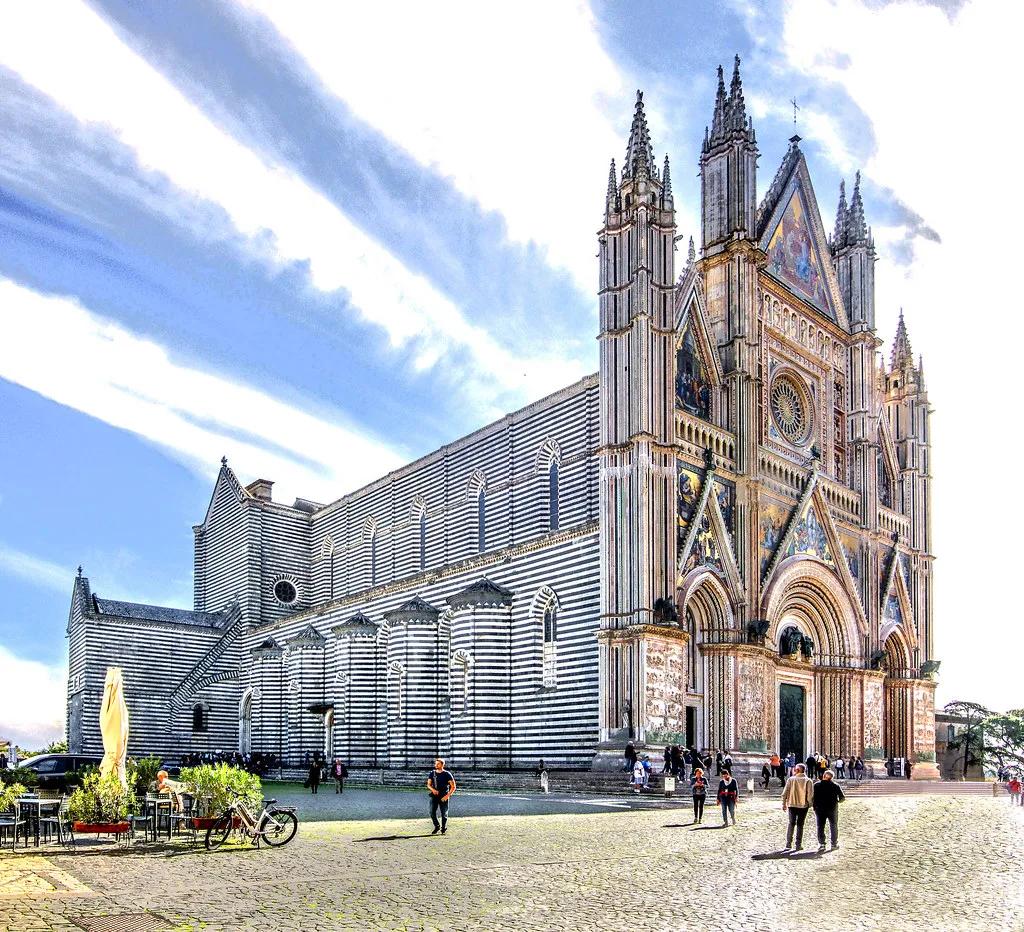
The front is a storyboard in stone and glass, and it makes most sense read from the ground upward. The four great piers between the doorways carry relief panels carved across the fourteenth century, depicting Genesis, the tree of Jesse, the life of Christ and the Last Judgment. Above them stand bronze symbols of the four Evangelists, and higher still the mosaics trace scenes from the life of Mary toward the rose window at the centre.
Look closely at the pier reliefs and you will notice the programme was conceived as a visual Bible for people who could not read, which is why the Last Judgment panel is so crowded and dramatic. The central bronze doors are a twentieth-century addition by Emilio Greco, installed long after the medieval work. Knowing that the facade is a collage of several centuries of decisions turns a photo stop into a twenty-minute study.
Inside the Nave
Step through the doors and the mood flips from ornament to proportion. The nave is striped in alternating dark and pale stone, a local variation on the banded interiors of Tuscany, and the effect is horizontal and calm after the busy front. Alabaster windows filter a soft amber light, and some have been partly replaced with stained glass because the material is so fragile.
Do not walk straight to the chapels without pausing at the sculpture. Ippolito Scalza's Pietà, carved from a single block of marble in the late sixteenth century, sits near the altar, and a row of apostle figures by different sculptors lines the nave. These are the pieces most visitors pass without noticing, and they reward the ten minutes it takes to circle them slowly.
The Chapel of San Brizio: A Slow Look at the Last Judgment
The chapel to the right of the altar holds the cycle that justifies the trip on its own. The operator records that Fra Angelico began the frescoes of the Last Days in 1447 and Luca Signorelli completed them between 1499 and 1504, producing one of the most ambitious Renaissance treatments of the end of the world. The preaching of the Antichrist, the resurrection of the flesh and the damned cast into hell fill the walls with bodies in motion.
Give this room real time rather than a lap of the perimeter. The details that stay with people are small: the whispering figure behind the Antichrist, the demons hauling the condemned, the faces of the saved. Signorelli's nudes are often described as anticipating Michelangelo's later work in the Sistine Chapel, a comparison worth holding in mind as you look.
The Chapel of the Corporal and the Bolsena Miracle
The cathedral exists because of a Eucharistic miracle said to have occurred at nearby Bolsena in 1263, when a doubting priest saw blood on the altar linen. That cloth, the corporal, is preserved in the Reliquary of the Corporal, and the operator notes that the chapel built to house it in the mid-fourteenth century takes its name from the relic. The chapel's frescoes narrate the miracle for anyone who wants the full story before seeing the linen itself.
One planning detail catches people out: entry to the chapel is through a separate side entrance rather than from inside the nave, so you may need to walk around the church to reach it. The reliquary itself is a gilded silver shrine and a masterpiece of Sienese metalwork in its own right. Check the current access arrangement on site before assuming you can step straight in.
Tickets: What You Pay For
Visitors often ask whether the cathedral is free, and the honest answer is that the scope of any ticket changes over time, so it must be checked with the operator rather than assumed. The Opera del Duomo sells tickets online and separates single tickets, group tickets, school tickets and bookings, which signals that different visitor types and areas are handled distinctly. Read the current fare page before you arrive instead of relying on older guidebook figures.
Do not assume one ticket covers everything on the site. The Sotterranei beneath the transept, the Torre del Maurizio and the Museo Emilio Greco are presented by the operator as places to visit in their own right, and some combinations may be bundled while others are not. Decide in advance which of these you actually want, because buying access you will not use is the most common waste of money here.
Beyond the Cathedral: Undergrounds and Museums
Under the transept and chapels lies an area of roughly 800 square metres that the operator describes as a tunnel-like space revealing the cathedral's old storage and the long story of its building works. It is a genuinely different experience from the church above, cooler and more archaeological, and it suits travellers who want context rather than more art. Treat it as an add-on with its own scope rather than part of the cathedral visit.
The Torre del Maurizio and the Museo Emilio Greco round out the complex for anyone with a half day to spare. The Etruscan Museo Claudio Faina sits in the same square, and the operator advertises that it can be visited alongside the Duomo with a small supplement on the standard ticket, so confirm the current combination when you buy. Pick one or two extras that match your interests instead of trying to see them all.
If your tastes run to quieter corners, the town rewards wandering away from the main square between visits. Our guide to the hidden gems in Orvieto covers the lanes, viewpoints and small sites that rarely appear on a short itinerary, and it works well as an afternoon counterpart to a morning in the cathedral.
Suggested Timing and Pacing
As an editorial suggestion rather than an official figure, allow around ninety minutes for the cathedral alone if you want to read the facade, walk the nave and spend real time in both chapels. Add thirty to forty-five minutes for the undergrounds or a museum, and more if you like audio guides or sketching. Rushed groups typically spend twenty minutes and leave remembering only the front, which is a shame given what sits behind it.
Time your arrival with the light in mind. The facade faces the square and reads best in the morning and late afternoon, while the interior chapels are lit artificially and can be seen at any hour. If you are sensitive to crowds, aim for the first hour after opening or the last hour before closing, and confirm those times on the operator's site first.
Practical Decisions Before You Go
The single most useful page to check is the operator's notice on upcoming closures and access variations, listed on the official site as prossime chiusure e variazioni di accesso. It records days when visits are suspended for liturgical celebrations, and it explicitly states that the information is subject to updates. Read it in the week before you travel rather than months ahead, since individual dates on that page may already refer to future years.
Dress as you would for any working church, with shoulders and knees covered, and keep your voice low in the chapels. Photography rules, bag restrictions and access for visitors with limited mobility are all published by the operator, so check the accessibility and FAQ pages rather than guessing. If you are visiting in a group or on a pilgrimage, the site has separate booking channels that should be used in advance.
Pairing the Duomo with the Rest of Orvieto
The cathedral is the obvious first stop but not the whole town. The city council publishes a rolling events calendar that regularly fills Piazza Duomo with markets, festivals and performances, so a visit can be timed around something larger. Checking the municipal site before booking accommodation is worthwhile if you want atmosphere rather than quiet.
On the ground, the historic centre sits on its plateau above the railway station, and walking between the Duomo and the surrounding lanes is the natural way to link sights. Drivers should expect to park outside the walls and continue on foot. Build in time for the lanes between the Duomo and the cliffs, which are where Orvieto feels most like itself.
Plan Your Visit
Orvieto's Duomo rewards anyone willing to look longer than the average stop. Read the facade from the ground up, sit with Signorelli's frescoes, find the Corporal chapel through its side entrance, and decide deliberately whether the undergrounds or a museum are worth your remaining hours.
Before travelling, confirm current fares, opening times and any access suspensions directly with the Opera del Duomo, since these change and are subject to updates. With those verified, the only remaining decision is how much of your day to give the cathedral and how much to the town around it. For related planning, see Museo dell'Opera del Duomo Orvieto: Visit Guide & Tickets.
Frequently Asked Questions
Is Orvieto Cathedral free to enter?
Access arrangements are set by the Opera del Duomo and have changed over time, so there is no safe blanket answer. The operator publishes current fares and ticket types, including separate options for individuals, groups, schools and tour operators. Check the official site before you travel and treat older guidebook statements as unreliable.
How long does it take to visit the Duomo di Orvieto?
As an editorial suggestion, plan about ninety minutes for the facade, nave and both main chapels. Add half an hour or more if you include the undergrounds or a museum. This is our pacing advice, not an official duration, and individual interests vary widely.
Do I need to book Duomo di Orvieto tickets in advance?
The operator sells tickets online and also handles advance requests for groups, schools and pilgrims. Whether advance booking is necessary depends on your date and party size, so consult the official booking pages. Individual visitors with flexible timing often decide on the day.
What should I not miss inside Orvieto Cathedral?
The Chapel of San Brizio, with frescoes begun by Fra Angelico in 1447 and completed by Luca Signorelli, is the highlight for most visitors. The Chapel of the Corporal and its reliquary, the Pietà by Ippolito Scalza and the carved facade piers also deserve time.
Can I visit the Chapel of San Brizio separately?
The chapel is part of the cathedral interior rather than a stand-alone attraction, and access is governed by the operator's ticket and closure rules. Because visits can be suspended for liturgical celebrations, check the official closures notice before relying on seeing it on a given day.
Are there closures or access restrictions at the Duomo?
Yes. The Opera del Duomo maintains a notice of upcoming closures and access variations, including days when visits are suspended for religious celebrations. That page states the information is subject to updates, so check it in the days before your visit rather than weeks in advance.
Why was the Duomo di Orvieto built?
It was built to honour the Eucharistic miracle associated with nearby Bolsena in 1263, when a doubting priest is said to have seen blood on the altar linen. Construction began in 1290, and the relic itself is kept in the Chapel of the Corporal.
Sources
Continue exploring
More guides you'll find useful