Fortezza di Montepulciano: Visitor Guide to the Hilltop Fortress
Plan a stop at Montepulciano's Medicean fortress: what Sangallo rebuilt, how it fits a walk from Piazza Grande, and what to expect from the wine bar inside.
On this page
Montepulciano ends in a fortress. The Fortezza Medicea occupies one of the highest points of the hill town, a short walk from Piazza Grande, and it has been recycled repeatedly over the centuries rather than preserved as a single period piece. Today it works as an event and exhibition space, hosts university programmes, and shelters the Consorzio del Vino Nobile wine bar. Treat it as a flexible stop on a walk through town rather than a museum with a fixed route.
The fortress is easy to combine with the rest of the old town, but it is not the only thing to see uphill. If you are still choosing what to cover, the Montepulciano Attractions hub lays out six sights and their guides, and the broader Montepulciano pages group the town's main stops by area.
Where the Fortezza Sits in Montepulciano
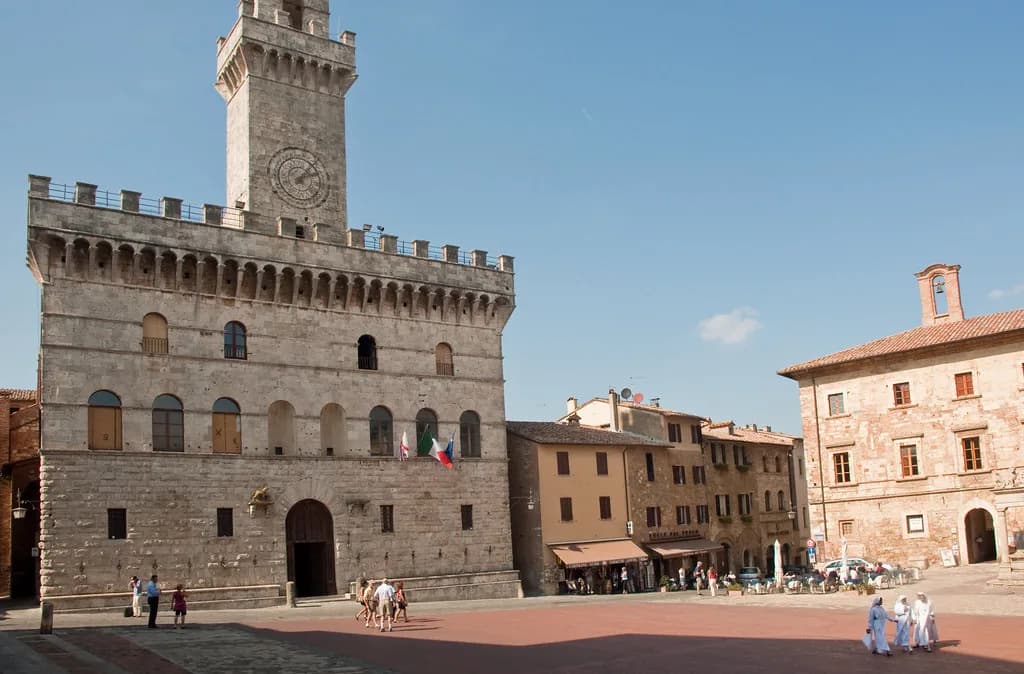
The fortress stands on the upper edge of the historic centre, close to Piazza Grande and the highest part of the ridge. That position means it works naturally as the end point of the climb along Il Corso, or as a first stop if you take the town shuttle or tourist train up and walk back down. Either way, plan it as part of a loop rather than a separate excursion.
The climb is real. Montepulciano's main street rises continuously from the lower gate to Piazza Grande, and the fortress sits above that level. Comfortable shoes matter more than any route choice. If the uphill walk is not appealing, the small tourist shuttle and the electric city tour both exist to cut the ascent, though schedules should be checked locally rather than assumed.
Why a Fortress Here: Siena, Florence and Sangallo
Montepulciano spent centuries caught between Siena and Florence, and the fortress reflects that contested position. It was built in the thirteenth century, destroyed and rebuilt more than once as control of the town changed hands, and later associated with a reconstruction attributed to Antonio da Sangallo the Elder. That attribution explains why the fortress is often described alongside the town's Renaissance palaces rather than as a purely medieval ruin.
The wider story of Florence's influence is visible all over town, from the Palazzo Comunale to the Florentine symbols on the well in Piazza Grande. The Piazza Grande and Palazzo Comunale Montepulciano visitor guide covers that square in detail, and reading it before the fortress makes the hilltop sequence easier to follow.
What You Actually See at the Fortress Today
What remains is a compact fortified complex rather than a full castle circuit. The walls and ramparts frame open ground, and the terrace gives a wide view across the Valdichiana on one side and toward the Val d'Orcia on the other. The fortress is also used for events, exhibitions and study-abroad programmes, so parts of it can be occupied by temporary installations or closed off for a residency.
The wine bar inside the complex has a glass floor that reveals archaeological remains found during renovation work, which is one of the more unusual details in town. That feature is part of the Enoliteca, not a separate museum, so expect to see it while tasting or browsing the wine selection rather than on a formal guided route. The town's official site is the place to check for notices about works or temporary changes, while event listings should be confirmed with the organiser.
Inside the Complex: Events, Exhibitions and University Use
The fortress is not a static heritage site with one permanent display. It has been adapted for cultural use, hosting temporary exhibitions and events, and it houses study-abroad programmes run by American universities. That mixed use is the main reason to check ahead rather than assume the whole complex is open for wandering on any given day.
For a visitor, this means the fortress rewards flexibility. If an exhibition is on, it can add a reason to linger; if a section is in use, the terrace and wine bar still give the stop a purpose. Do not build a day around a specific show unless you have confirmed it is running, and do not expect a ticket bought for one part of the complex to cover everything.
The Enoliteca and the Consorzio del Vino Nobile
The wine bar inside the fortress belongs to the Consorzio del Vino Nobile di Montepulciano, the consortium that represents producers across the appellation. That makes it a useful first stop for orientation: you can compare a range of Vino Nobile from different estates in one place rather than committing to a single winery. It is a consortium tasting room, not a family cantina with its own vineyards beneath the floor.
That distinction matters when you plan. The Enoliteca is convenient and has the terrace, but it is not the same experience as descending into a historic cellar cut beneath a palazzo. The fortress bar is best used to sample broadly or to end a walk with a glass and a view, while a dedicated cellar visit gives you the tunnels, barrels and family history that the consortium room does not.
Enoliteca Versus the Underground Cantinas in Town
Montepulciano's historic cellars are one of the town's defining experiences. De' Ricci Cantine Storiche sits just off Piazza Grande and is known for cavernous tunnels and rows of large oak barrels. Ercolani offers a self-guided look at underground passages and cisterns, Contucci has vaulted cellars beneath its palazzo on the square, and Talosa is another option inside the walls. They trade on atmosphere and history, not on views.
The fortress wine bar trades on the opposite: daylight, altitude and a terrace over the valleys. If your time in town is short, the Enoliteca is the lower-effort choice because you are already at the top. If wine is the reason for the trip, budget for at least one underground cantina as well, and treat the fortress tasting as a complement rather than a substitute.
Tasting Etiquette and Reservations
Many cantinas in Montepulciano ask for advance bookings, especially for guided cellar tours and structured tastings. Some, like Talosa, have been walk-in friendly in practice, but that is not a rule you should rely on for a group or a weekend. The safest approach is to book the cellar you care most about and leave the fortress bar as the flexible option.
The fortress bar's own booking requirements and tasting formats are not published in a stable form, so check with the Consorzio or the bar on arrival rather than assuming a walk-in is fine. If you are visiting with a group, call ahead. For a broader comparison of cellars and their styles, the Vino Nobile wine cellars in Montepulciano guide is a sensible starting point before you commit. For wider planning, see Vino Nobile Wine Cellars in Montepulciano.
Views and How Long to Allow
As an editorial suggestion rather than an official figure, allow around forty-five minutes to an hour for the fortress and its terrace if you are not tasting, and up to ninety minutes if you settle into the wine bar. That fits comfortably into a half-day in Montepulciano alongside Piazza Grande and the cathedral. If you are also walking down to San Biagio, add time for the descent and the climb back.
The fortress is one of several elevated viewpoints in town, and the best light tends to come late in the afternoon when the valleys soften. The best viewpoints in Montepulciano guide covers the alternatives, including the terrace near Santa Maria dei Servi, so you can decide whether to chase the sunset from the fortress or somewhere quieter.
Access, Effort and Getting Up the Hill
There is no verified information in the current record about lift access, step counts or wheelchair routes inside the fortress, so treat accessibility as something to confirm directly with the Comune or the Consorzio before you rely on it. What is certain is the town's topography: Montepulciano is a sustained climb, and the fortress is near the top of it.
If walking uphill is a concern, use the shuttle or the electric tourist train for the ascent and walk down through the Corso. The descent is easier on the legs and puts the wine bars, shops and churches in a more natural order. Wear shoes with grip, since the stone paving can be slick after rain.
Practical Planning: Parking and the Traffic Zone
Driving inside the walls is restricted, so park outside and walk in. The lots around the lower town are the usual choice, and the largest ones fill later in the day during high season. If you are staying overnight, ask your accommodation about parking before you arrive, because space near the historic centre is limited.
Public transport is possible but slow. Montepulciano's station is some distance from the centre, and bus connections usually involve at least one change from Florence or Siena. A car makes the surrounding countryside and nearby towns far easier, which matters if the fortress is one stop on a wider Val d'Orcia itinerary.
Pairing the Fortress With the Rest of Town
A sensible half-day runs from the lower gate up the Corso, into Piazza Grande, then on to the fortress for the view and a glass, before descending to San Biagio. The cathedral on the square is worth a look for Taddeo di Bartolo's altarpiece, and the Duomo di Montepulciano guide explains what to look for inside the unfinished brick shell.
Below the walls, the Tempio di San Biagio is the town's Renaissance set piece, a Greek-cross church by Sangallo the Elder set among cypresses. Walking down is easier than walking back up, so pair it with the end of the day or with a meal in the lower town. If you want a longer walk, the trails out toward Monticchiello and Pienza are the classic options.
Making the Fortress Part of Your Day
The Fortezza Medicea is not Montepulciano's main attraction, and it does not need to be. Its value is in the combination: a high point with a view, a consortium wine bar with a glass floor, and a history that explains why the town looks the way it does. Go for the terrace and the orientation, then choose a historic cellar for the deeper wine experience.
Before you go, check the Comune's site for any works or event closures and confirm tasting arrangements with the Consorzio. Build the fortress into a walk rather than a detour, and leave time for the climb down. If you are still mapping the town, the hidden gems in Montepulciano guide covers the quieter corners that pair well with the hilltop.
Frequently Asked Questions
Is the Fortezza di Montepulciano free to visit?
The current record does not confirm whether rampart access is free or ticketed, so do not assume. Check with the Comune or the Consorzio before you go, and treat any wine tasting inside the complex as a separate arrangement from simply walking the walls.
Can you do a wine tasting inside the fortress?
The Consorzio del Vino Nobile runs a wine bar inside the complex with a terrace and a glass floor over archaeological remains. Its tasting formats and booking requirements are not published in a stable form, so confirm on arrival or in advance if you are a group.
How long does it take to visit the fortress?
As an editorial suggestion, allow around forty-five minutes to an hour for the walls and terrace, or up to ninety minutes if you stay for a tasting. This is a planning estimate, not an official figure, and event or exhibition use can change how much of the complex is open.
Is the fortress worth visiting if you don't drink wine?
Yes, if you want the view and the sense of the town's defensive history. The terrace over the Valdichiana and the Val d'Orcia is the main draw, and the fortress sits naturally at the end of a walk up the Corso. Skip the bar if wine is not your interest.
How do you get up to the fortress from the town centre?
Walk up Il Corso from the lower gate to Piazza Grande and continue to the upper edge of town. The climb is sustained, so the tourist shuttle or electric city tour is a reasonable alternative for the ascent if you would rather save your legs for the descent.
Is the fortress wine bar the same as the De' Ricci cellar?
No. The fortress bar is run by the Consorzio del Vino Nobile, while De' Ricci Cantine Storiche is a separate historic cellar just off Piazza Grande. They offer different experiences, and a visit to one does not include the other.
What is the difference between Vino Nobile di Montepulciano and Montepulciano d'Abruzzo?
Vino Nobile di Montepulciano is a Tuscan red made mainly from Sangiovese around the town of Montepulciano. Montepulciano d'Abruzzo is a different wine from the Abruzzo region, made from the Montepulciano grape. The shared name is a coincidence of place and grape, not the same wine.
Sources
Continue exploring
More guides you'll find useful