Torre della Gabbia Mantua: A Visitor Guide to the Caged Tower
Plan a quick stop at Mantua's Torre della Gabbia: how it became a prison tower, where it sits near Piazza Sordello, and why the belvedere is not open.
On this page
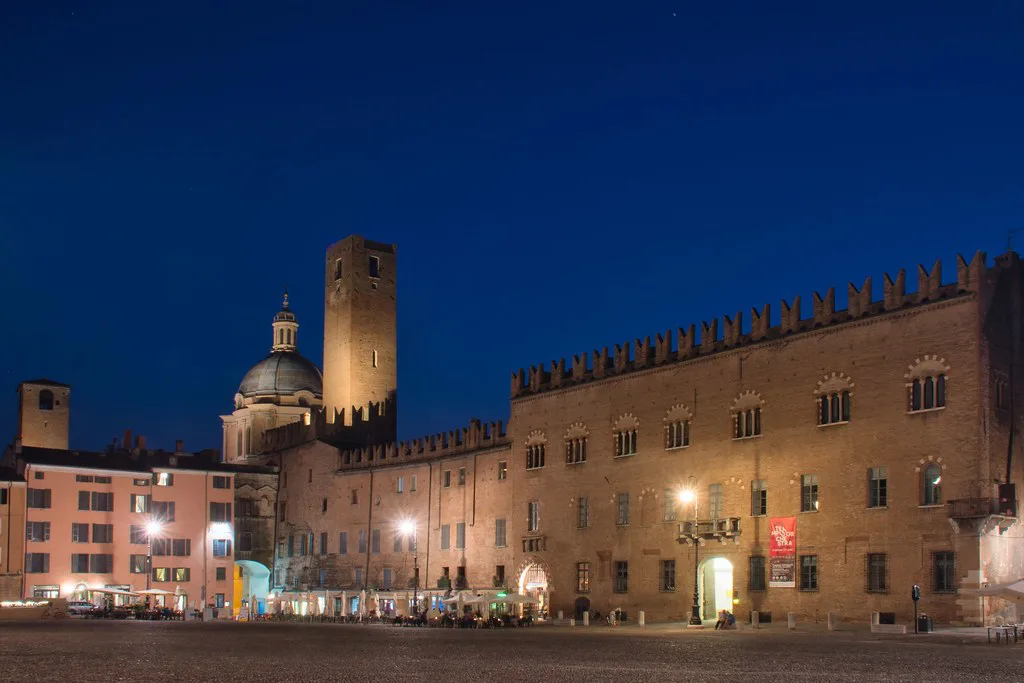
The Torre della Gabbia is easy to miss and hard to forget: a tall brick tower on Via Cavour with an iron cage jutting from its face. It sits in the dense knot of medieval and Renaissance streets between Piazza Sordello and Piazza delle Erbe, so most travellers pass it without knowing what the cage was for. This guide explains the building's layered history, what you can and cannot do on site today, and how to fold a short stop into a broader walk through the centre.
Where the Torre della Gabbia Stands in Mantua
The tower rises on Via Camillo Benso Conte di Cavour, close to Palazzo Acerbi and a handful of minutes on foot from Piazza Sordello. Nearby landmarks include the Basilica di Sant'Andrea, the Rotonda di San Lorenzo and the Palazzo della Ragione, so the tower works best as a point on a route rather than a destination in itself. Because the streets around it are narrow and lined with other historic buildings, look up as you approach rather than searching at eye level.
One common confusion is worth clearing up before you arrive. Piazza delle Erbe has its own clock tower, a different structure that some itineraries list separately from the Torre della Gabbia. If you are hunting for the iron cage, you want the tower on Via Cavour, not the astronomical clock by the market square. Official material from the Comune di Mantova focuses on civic notices and events rather than a dedicated visitor listing for the tower, so treat the building itself as street furniture you observe rather than a managed museum.
Origins: Acerbi, Bonacolsi and a Family Empire
The tower began as the property of the Acerbi family and was sold in 1281 by the brothers Monzono, Antonio, Acerbino and Montino to Pinamonte Bonacolsi. That transaction matters because it explains the building's double identity: a private family tower that was absorbed into the fortified palace complex of a ruling clan. The Bonacolsi then began working from this tower and the surrounding palazzo toward a defensive scheme linking other nearby family towers.
When the Bonacolsi were driven out in 1328, the complex was neglected for a long period before renewed investment in the interiors and the facade facing Via Cavour. Part of the story belongs to the Guerrieri family, who acquired a portion of the complex in the early sixteenth century. A plaque uncovered during restoration work records that in 1526 Federico II Gonzaga formally granted the tower and the palazzo beneath it to Ludovico Guerrieri, so the chain of owners is long and visible in the masonry.
From Tower to Prison: The Cage and Public Shame
The name most travellers know, Torre della Gabbia, is not medieval at all in origin. The tower is thought to have acquired it in the sixteenth century, when the tall red-brick block was converted into a prison and the iron cage was fixed to its wall under Duke Guglielmo Gonzaga. The cage was not decoration. It was an instrument of public punishment, hoisting offenders into view and exposing them to the weather and the gaze of anyone walking past.
The most concrete documented case dates to 1576, when a pickpocket known as Marchino Ziganti was held inside the cage for more than three months. That detail matters for interpretation: the cage was used for shaming ordinary offenders, not only for grand political prisoners. A nearby plaque dated 1760 mentions the same property transaction from 1526, showing how the building accumulated records and inscriptions across centuries.
For a visitor, the cage is the story. It shows how Gonzaga-era justice mixed deterrence with spectacle, and it explains why the tower is described in some accounts as a symbol of punishment as much as power. The 1576 imprisonment is the anchor point for the tower's role as a place of detention rather than a defensive post.
The Guerrieri-Gonzaga Facade and Its Decoration
The facade visible today belongs largely to the sixteenth-century reworking under the Guerrieri Gonzaga, who updated the house on Via Cavour to match the style of the moment. It is framed by marble lesenes and topped by a frieze with putti and tritons, with traces of a Mantegnesque decoration featuring interlocking polygons on the wall surface. Those fragments are easy to overlook if you only look at the cage, so step across the street and look at the upper wall.
Looking Up: Height, Skyline and the Closed Belvedere
The tower is often described as roughly 55 metres tall, rising above the surrounding rooftops and giving the city a rare elevated point over the historic centre. That measurement appears in tourism material rather than an official survey, so treat it as an approximate description rather than a certified statistic. Travel accounts call the summit a belvedere, and the tourism portal is open about the problem: the Comune owns the tower but has not put in place a system to open that space to the public.
The practical consequence is simple. Do not build a day around climbing the tower or reaching a viewpoint, because there is no visitor route to the top. Instead, treat the belvedere as a historic idea: a place from which the city could be surveyed, now visible only as a silhouette from the street. If you want a panorama of Mantua, plan for a different vantage point elsewhere in the centre.
Practical Viewing Notes: An Exterior Stop Only
There is no visitor entrance, ticket desk or roof access at the Torre della Gabbia, so plan on viewing it from the street. The stop takes only a few minutes and is best treated as one piece of a walking loop rather than an attraction to schedule. It is safe to say there is nothing to book, and there are no published opening hours because there is no interior visit to arrange.
Because the tower stands on a working street rather than a fenced site, conditions change with traffic, weather and time of day. A calm morning walk is more comfortable for reading the facade than a busy afternoon, but you should not expect any fixed arrangements at the site itself. For current civic notices and any changes affecting the historic centre, the Comune di Mantova website is the place to check before travelling.
Building a Half-Day Loop Around the Tower
Since the tower is a quick stop, combine it with the main sights in the same core. Start at Piazza Sordello, look at the Palazzo Ducale from the square, and continue to Via Cavour for the cage, the Guerrieri facade and the nearby Palazzo Acerbi. Then cross toward Piazza delle Erbe, where the Rotonda di San Lorenzo and the Palazzo della Ragione sit within a couple of minutes of each other, before finishing at the Basilica di Sant'Andrea.
The Palazzo Ducale is a large complex with timed entry and its own ticket arrangements, which are separate from anything at the tower. Many travellers budget an afternoon for the palace's courtyards, apartments and the Camera degli Sposi, and it makes sense to book that slot in advance rather than squeeze it between street stops. The tower then slots into the gap before or after that visit.
If you want the broader city context, the best way to combine these sights is a self-guided walk through the compact historic centre. Mantua's UNESCO-listed centre and its three lakes reward slow wandering, and the walk from the Palazzo Ducale area to Palazzo Te is roughly a kilometre and a half, so a full day can cover both palaces with the tower as a brief pause between them.
Plan Your Visit
The Torre della Gabbia is a five-minute lesson in how Renaissance cities used architecture to police behaviour. See it from the street, read the facade, and move on to the palaces and squares that make Mantua worth a full day. Check official tourism and city sources before you travel for any changes, and keep the tower in your plan as a landmark rather than an attraction with a door.
Frequently Asked Questions
Can you go inside the Torre della Gabbia?
No. There is no visitor entrance, no interior route and no access to the rooftop belvedere. The tower is observed from Via Cavour and the surrounding streets, and tourism material is explicit that the city has not established a way to open the summit to the public.
Why is there a cage on the tower in Mantua?
The iron cage was fixed to the tower in the sixteenth century when the building served as a prison under Duke Guglielmo Gonzaga. It functioned as a public shaming device, holding offenders in view of passers-by. A recorded 1576 case describes a pickpocket held inside for more than three months.
Where is the Torre della Gabbia in relation to Piazza Sordello?
The tower stands on Via Camillo Benso Conte di Cavour, a short walk from Piazza Sordello and the Palazzo Ducale, and close to Piazza delle Erbe and the Basilica di Sant'Andrea. It is part of the dense medieval and Renaissance core rather than a separate district.
How long do you need to see the tower?
As an editorial suggestion, five to ten minutes is enough to read the cage, the marble lesenes and the frieze from street level. Because there is no interior visit and no scheduled programme, the stop is best combined with a walk through the surrounding squares.
Is the tower free to see from the street?
The tower is viewed from a public street with no visitor infrastructure at the site. No admission fee, ticket or booking is published for the tower, and there is no ticketed collection attached to it. Confirm any current city arrangements on official municipal channels before travelling.
Is the Torre della Gabbia the same as the clock tower on Piazza delle Erbe?
No. The Torre della Gabbia is a separate medieval structure on Via Cavour associated with the Acerbi and Bonacolsi families and later used as a prison. The clock tower and its astronomical mechanism belong to the Palazzo della Ragione on Piazza delle Erbe.
Sources
Continue exploring
More guides you'll find useful