Lucca Cathedral Guide: What to See at the Duomo di San Martino
Plan a visit to the Duomo di San Martino in Lucca: its Romanesque facade, bell tower, Puccini family link, and how to slot it into a walk inside the walls.
On this page
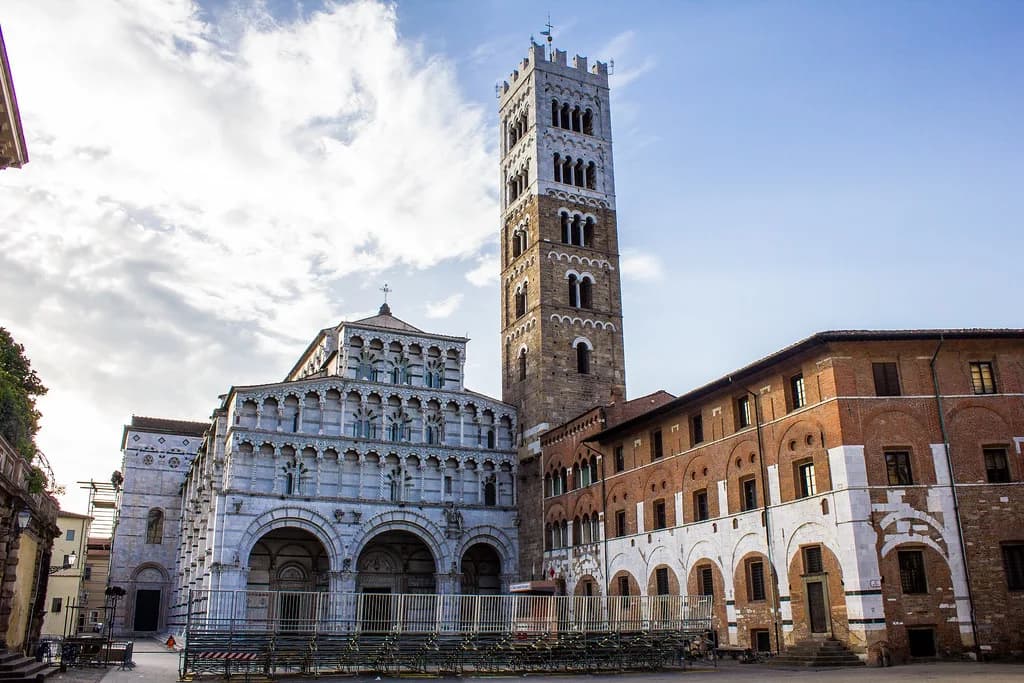
The Duomo di San Martino is the seat of Lucca's archbishop and the city's cathedral, standing in the south-eastern corner of the historic centre rather than at its geographical heart. Its stone facade, square bell tower and position on Piazza San Martino make it one of the anchors of any walk inside the walls. Because it is a working cathedral, not a ticketed museum, the smartest approach is to treat it as a stop on a route through the centre and to verify current access terms with the cathedral and the city's tourism office before you go.
Why the Duomo di San Martino Matters in Lucca
Lucca's centre is compact enough that most visitors pass the cathedral without planning to, since the main pedestrian streets funnel walkers toward Piazza San Martino. The building's Romanesque-Pisan character places it in the same architectural family as the city's other medieval churches, with a carved marble frontage and a bell tower that gives the skyline its shape. Understanding that shared language makes the Duomo easier to compare with San Michele in Foro and San Frediano rather than viewing it in isolation.
The cathedral also matters historically as an institution: the Puccini family held musical posts at San Martino for generations, and Giacomo Puccini was born in Lucca in 1858. That thread turns the cathedral from a single monument into part of a Puccini-themed walk through the centre. If music is your reason for visiting, plan the cathedral alongside the composer's birthplace and the city's musical addresses rather than rushing the church in ten minutes.
Where the Cathedral Sits Inside the Walls
The Duomo di San Martino stands on Piazza San Martino in the south-eastern quadrant of the walled city, an area you reach on foot from Piazza Napoleone in a short stroll along Via Fillungo and the surrounding lanes. Lucca's Renaissance walls run roughly four kilometres around the centre, and the historic core inside them is flatter and more walkable than many Tuscan cities. That makes a church-to-church route realistic without transport, provided you accept slow progress through the shopping streets.
For orientation, think of the cathedral as the southern bookend of a triangle: Piazza Napoleone to the north-west, San Michele in Foro on the old forum site to the north, and San Martino to the south-east. A sensible loop starts at Piazza Napoleone, cuts through Via Fillungo, reaches the cathedral, then returns past San Michele. This order keeps the longest walking stretch early and leaves easier wandering for the afternoon.
Reading the Outside Before You Step In
The facade repays a few minutes of slow looking: a sequence of stone arcades and carved reliefs stacked above the entrance portals, with the bell tower rising beside and behind it. Many visitors photograph the frontage and move on, but the side elevations and the piazza itself show how the cathedral sits within the street fabric rather than standing free. Walk a full circuit of the exterior if time allows, since the building's mass changes noticeably from the south side.
Practical caution applies to the interior: the cathedral has been through restoration campaigns, and notices about closed sections, screening or rearranged access are common in Italian churches of this age. Rather than relying on any guide's description of the interior, check the cathedral's own site and the city tourism pages for current notices before travelling. Treat any detail you read about chapels, floors or artworks as something to confirm on site.
The Puccini Thread at San Martino
Puccini's connection to the cathedral is institutional rather than sentimental: his ancestors served as musical directors at San Martino from the early eighteenth century, and the family's grip on the city's music scene lasted roughly a century. Giacomo himself was involved with the cathedral as a boy, singing in the choir and eventually taking the organist's post that had been effectively reserved for him. Knowing this changes how you hear the building's interior acoustics.
Use the cathedral as the starting point for a Puccini walk that continues to the Puccini Museum in his birthplace on Corte San Lorenzo, a short walk north through the centre. The composer's world in Lucca also takes in the Teatro del Giglio on Piazza del Giglio and the café where he and his circle gathered. One afternoon covers this comfortably if you resist adding every church en route.
Pairing the Duomo With Nearby Churches
San Michele in Foro, a short walk north, is the most direct comparison: a twelfth-century church with a highly decorated Pisan-style facade set on the site of the Roman forum. Visitors often find its frontage more arresting than the cathedral's, which makes the pairing worthwhile for anyone trying to understand what Lucchese Romanesque actually looks like. Read our Church of San Michele in Foro Lucca visitor guide before you go so you know what you are looking at.
The Basilica di San Frediano, north-west of the cathedral, adds a third variation: a Romanesque church whose facade carries a large golden mosaic, with the body of Saint Zita preserved inside. Its small piazza is one of the pleasantest places to pause in the centre. Our Church of San Frediano in Lucca guide explains the mosaic and the saint's story in more detail, and it makes a natural third stop on a church-focused morning.
Two further Romanesque survivals round out the picture, and both sit close enough to the cathedral to include without a detour. Santa Maria Forisportam, nicknamed Santa Maria Bianca for its white limestone front, began life outside the Roman walls and was absorbed into the medieval circuit as the city grew. Meanwhile, the towers rather than the churches pull many day-trippers, so see our hidden gems in Lucca piece if you want to spread the crowds out.
One architectural point ties these buildings together: Lucca's churches share a Pisan-derived vocabulary of arcaded facades and polychrome stone, but each adapts it differently. San Martino's bell tower, San Michele's soaring front and San Frediano's mosaic give you three distinct answers to the same design problem. Noticing those differences is the real reward of a church-heavy day in Lucca.
A Half-Day Route: Cathedral, Piazza and a Tower
Start at Piazza Napoleone, the wide square built over the old fortress site where the Palazzo Ducale and Teatro del Giglio frame open space rare in this dense centre. From there, walk east along Via Fillungo to the clock tower and turn south to Piazza San Martino. This sequence gives you a city-scale introduction before you reach the cathedral itself.
After the cathedral, pick one tower rather than both. Torre Guinigi, topped with holm oaks, involves a climb of roughly 230 narrow steps and has limited capacity at the top, so it rewards an early or late slot. Torre delle Ore sits a few minutes away and offers a comparable panorama with fewer people queuing. Choose based on whether you want the tree-crowned roof or the quicker ascent.
Finish with a coffee or a slice of buccellato near Piazza San Michele, where café seating spills into the square. If the weather turns, the cathedral and the two nearby churches give you a wet-weather version of the same loop without much extra walking. Build in slack: Lucca rewards detours into side lanes more than it rewards strict schedules.
Practical Planning: What to Confirm Before You Go
Do not rely on any article, including this one, for the cathedral's opening hours, admission arrangements or restoration closures. The reliable sequence is to check the cathedral's official site first, then the city tourism portal for any city-wide notices, then the notice board at the entrance on the day. If a section is closed for works, that is normal in a monument of this age rather than a reason to skip the visit.
Dress code is worth planning for, as with any Italian church: covered shoulders and knees avoid awkwardness at the door. Photography rules vary between churches, and some Lucca sites restrict tripods or professional equipment, so ask rather than assume. Carry a little cash for small purchases even though card payment is widely accepted in the centre.
As a rough editorial suggestion, allow about three hours for the cathedral, Piazza Napoleone, one tower and a coffee stop, treating that figure as a planning aid rather than an official estimate. Anyone with a serious interest in church architecture should add an hour for San Michele and San Frediano. Spread the wider city over a full day using our Lucca Attractions hub to see what else fits.
Where the Duomo Fits in a Longer Lucca Stay
If you have two days, put the cathedral and its neighbouring churches on the first morning and leave the walls circuit for the second, since the tree-lined ramparts make an easy, flat walk at any hour. Garden visitors can add the Orto Botanico, founded in 1820, which occupies a green pocket in the city centre; check its own site for current opening times rather than trusting older listings.
For a change of register, Palazzo Pfanner pairs a baroque garden with a museum of frescoed rooms and historic medical instruments, and it sits inside the walls near the Basilica di San Frediano. The palazzo's own site states that the garden is open from 15 March to 31 December except for extraordinary closures, so check dates before building it into an afternoon.
Beyond the walls, the Apuan Alps offer a full-day contrast to the city, and the Grotta del Vento near Lucca runs guided itineraries of one, two or three hours with staff-led paths suitable for families. That makes a reasonable option if you have already given Lucca's centre a proper day. Keep the cathedral visit on the city day, though, since squeezing it into a mountain excursion rarely works well.
Plan Your Visit
Treat the Duomo di San Martino as the southern anchor of a walkable Lucca day rather than a standalone stop. The facade, the piazza and the Puccini family's long association with the cathedral give you enough material for a slow hour, and the nearby churches of San Michele in Foro and San Frediano make the comparisons worthwhile. Confirm current visiting terms on official sources, keep the route flexible, and let the streets between them do some of the work.
Frequently Asked Questions
Is Lucca Cathedral free to visit?
Churches in Italy often separate the free-to-enter nave from paid areas such as towers, museums or cloisters, and the Duomo di San Martino should be checked rather than assumed. Consult the cathedral's official site and the city tourism portal for the current arrangement for the nave, any treasury or museum spaces, and whether included elements change during restoration. Do not rely on older guides, whose prices and terms may no longer apply.
What is the Duomo di San Martino known for?
It is Lucca's cathedral, standing on Piazza San Martino with a Romanesque-Pisan facade and a prominent square bell tower. It is also notable for its long institutional link to the Puccini family, who held musical posts at the cathedral for generations before Giacomo Puccini became Lucca's most famous composer. Visitors often pair it with the Puccini Museum in his nearby birthplace.
How long does it take to visit Lucca Cathedral?
There is no official duration, but as an editorial suggestion allow 45 to 60 minutes for the exterior and a quiet walk through the interior, plus more if you are interested in the church's architecture. A three-hour half-day including Piazza Napoleone, the cathedral, one tower and a coffee stop is realistic in Lucca's compact centre. Add time for San Michele in Foro and San Frediano if you want the full church comparison.
Where is Lucca Cathedral located inside the city walls?
The Duomo di San Martino sits in the south-eastern part of Lucca's walled historic centre, on Piazza San Martino, within short walking distance of Via Fillungo and Piazza Napoleone. The whole centre is pedestrian-friendly and flat, so no transport is needed from the main squares. Use the cathedral's bell tower as a landmark if you lose your bearings in the lanes.
What is the Puccini connection to Lucca Cathedral?
Giacomo Puccini's ancestors served as musical directors at San Martino, and the family dominated Lucca's music scene for roughly a century. Giacomo sang in the cathedral choir as a boy and later took the organist post that the city had effectively held for him. The cathedral therefore works as the first stop on a Puccini walk that continues to his birthplace, now a museum.
Which churches should I visit near the Duomo in Lucca?
San Michele in Foro and the Basilica di San Frediano are the two most useful companions, both within easy walking distance and both offering a distinct Romanesque frontage. Santa Maria Forisportam adds a quieter, white-limestone variation nearby. Together they let you see how the same Pisan-influenced style was adapted across Lucca's medieval churches.
Sources
- Orto Botanico di Lucca, Il giardino più prezioso di Lucca, fondato nel 1820
- Palazzo Pfanner - Lucca
- Beneath the Walls of Lucca and Inside the Grotta del Vento
- Giacomo Puccini: Historical Sites in Lucca, Italy - Traveling with MJ
- Piazza Napoleone Lucca: A Guide to Lucca’s Iconic Square - Discover Tuscany | Our Journal
Continue exploring
More guides you'll find useful