Casa del Fascio Como: Exterior Guide to Terragni's Rationalist Icon
A practical guide to Terragni's Casa del Fascio in Como: what to see from outside, why interiors are restricted, and how to read its Rationalist design.
On this page
Few buildings in Italy ask as much of a passer-by as the Casa del Fascio. Giuseppe Terragni designed it between 1928 and 1932 and saw it built between 1932 and 1936 at Piazza del Popolo 4 in central Como, a short step from the cathedral apse. It is a landmark you read from the pavement rather than tour room by room, so the reward comes from knowing what to look at.
That reading is complicated by the building's purpose and its past. It began as the provincial headquarters of the National Fascist Party, passed through a brief post-war life as the Casa del Popolo, and has housed the Guardia di Finanza, Italy's financial and border police, since 1957. Approach it as a piece of architecture and a piece of political history at once, and the visit becomes far more interesting than a photo stop.
Why Casa del Fascio Matters: Italy's Rationalist Icon in Central Como
The Casa del Fascio is widely treated as a masterpiece of Italian Rationalism, the interwar movement that tried to strip architecture down to geometry, structure and light. Terragni's design went through a long gestation: the first scheme was far more conventional than what was eventually built, and the finished building was inaugurated in 1936. That gap between intention and result is part of why architects still study it.
Its importance is not only aesthetic. The building was commissioned to serve a propaganda purpose, and Terragni shaped the design around a claim that fascism was a glass house open to scrutiny. Looking at it critically, rather than simply admiring the proportions, is the most honest way to engage with what stands in front of you. Further visitor details appear in Casa del Fascio: Como’s Rationalist Masterpiece - Como, Italy | Ciceru - Travel Stories & Adventure Guides.
For travellers, the practical consequence is that this is a building to seek out deliberately rather than stumble across. If you are planning time in the city, it earns a place alongside the lakefront and the Duomo in any short list of what to see in Como.
The Shape: A Strict Half-Cube in Marble, Concrete and Glass
The plan is a square measuring 33.20 metres on each side, with a height of 16.60 metres, making the building an exact mathematical half-cube. That precision is not a footnote for architects; it explains why the mass reads as so calm and self-contained against the irregular medieval streets around it.
The structure is a reinforced concrete frame, clad on the outside in polished white Botticino marble, plate glass and industrial glass blocks. Inside, the palette shifts to Belgian black marble, Pietra di Trani and Giallo Adriatico, though most visitors will never see those surfaces at close range. Knowing they exist helps you understand the building as a designed interior, not just a facade.
Location and the Confrontation with Como Cathedral and Teatro Sociale
The building sits at Piazza del Popolo 4, directly behind the curved apse of Como Cathedral and next to the Teatro Sociale. That placement is the point: centuries of ecclesiastical and neoclassical tradition on one side, machine-age geometry on the other. Stand where you can see both and the building's argument becomes visible without any explanation.
For orientation, the Comune di Como publishes the city's institutional information and event listings, which is the sensible place to check for any civic notices affecting the centre during your visit.
History in Three Phases: Party Headquarters, Liberation, Guardia di Finanza
The first phase ran from inauguration in 1936 to the liberation of Como in April 1945, when the building was taken over by the National Liberation Committee and briefly renamed the Casa del Popolo. Ownership later reverted to the Italian state, and in 1956 the building was scheduled for public auction. A preservation campaign led by the critic Bruno Zevi and international architects stopped the sale and protected the structure from commercial alteration.
In 1957 it became the provincial command headquarters of the Guardia di Finanza, a role it still holds. It was formally listed as a protected historic-artistic monument in 1986. Those two dates matter to visitors: the building is heritage, and it is also an operating law-enforcement post.
What You Can Actually See from the Public Square
From the square you can take in the whole composition: the solid marble corner, the recessed loggias, the grids of glass and the way the ground floor opens toward the street. The ground-floor front was originally fitted with a bank of eighteen glass doors engineered to open simultaneously, creating a continuous space between square and assembly hall during party gatherings. That mechanism is a detail to imagine rather than operate, but it explains the openness of the lower level.
Notice also what is absent. Large exterior photo murals were planned by Mario Radice and Marcello Nizzoli but never permanently mounted, which left the facade as an abstract modernist composition and, incidentally, helped the building survive the fall of the regime.
The Comune di Como does not publish visitor information for the building as an attraction, so treat any claim about seeing the interior as something to verify directly with the institution rather than assume.
Interior Access: Why Visits Are Restricted
Because the Casa del Fascio operates as an active provincial command post for the Guardia di Finanza, interior access is restricted and generally closed to everyday tourists. Access is typically limited to occasional designated cultural or heritage events. Plan your visit around the exterior and you will not be disappointed by a locked door.
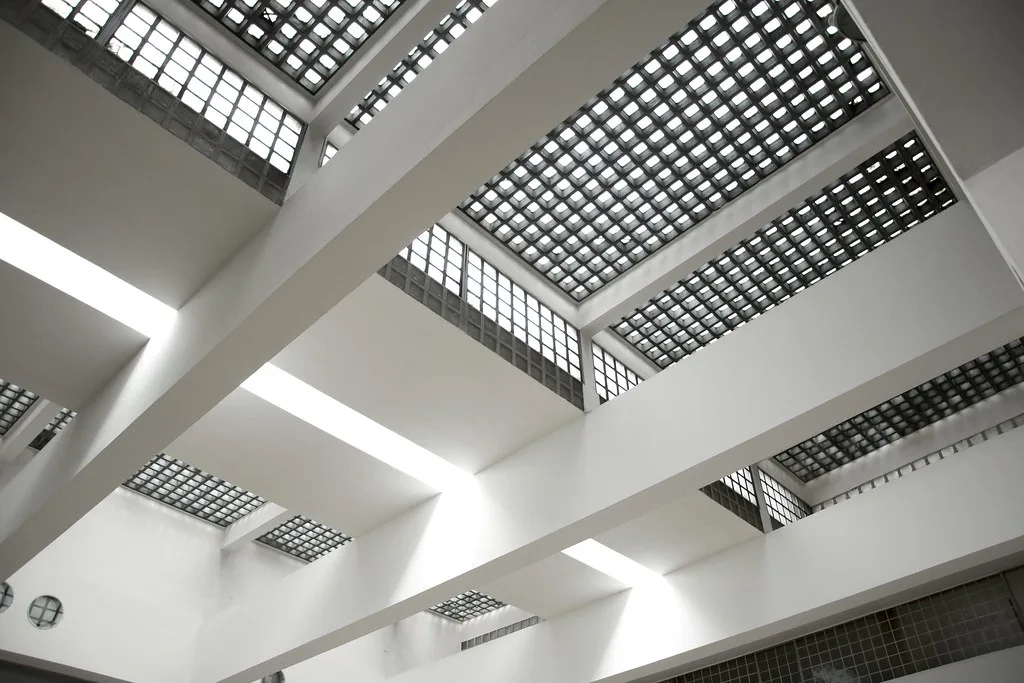
The double-height Salone delle Adunate, lit through an overhead grid of concrete-framed glass blocks, is the space most often described in architectural writing, and it is precisely the space you should not expect to walk into. If a special opening is announced, details will come from the organising institution, not from general travel listings. Check the Comune di Como's notice pages for civic announcements before you travel.
Reading the Facade: Corners, Glass Grids and Recessed Loggias
Spend a few minutes moving around the building rather than photographing it from one spot. One corner presents a solid, opaque plane of pale marble, while the remaining elevations dissolve into three-dimensional concrete grids, recessed loggias and glass curtain walls. The contrast between mass and void is the whole design in miniature.
Look up as well as across: the four-storey prism rises from a square in front that was itself formed by turning the facade outward. This is architecture that reads best in three dimensions, so a slow circuit around the public edges repays more than a quick glance from the cathedral steps.
Respectful Visiting: A Working Police Post, Not a Museum
There is no ticket desk, no cloakroom and no exhibition route here, so behave as you would outside any government building: stay on public ground, keep voices low and do not attempt to enter doorways that are not clearly open to the public. Photography from the square is the normal way to record the building.
The building's protected status since 1986 signals that its fabric is cared for, but it says nothing about visitor facilities, accessibility or security procedures. The organisers have not published those details, so if you have specific needs, ask the institution directly before making the trip rather than relying on assumptions.
Building a Short Rationalist Walk Around the Duomo Area
The Casa del Fascio works best as one stop in a compact loop rather than a destination on its own. Start at the cathedral, walk round to the apse and Piazza del Popolo, take in the Teatro Sociale, and then drift into the surrounding streets. Because the geometry of the building is a half-cube, seeing it from two or three angles within a few minutes tells you more than a single viewpoint.
If you want to stretch the walk, the city's lakefront and quieter lanes reward slow wandering, and our guide to hidden gems in Como suggests corners that pair well with an architecture-focused morning.
Allow roughly half an hour for the building and its immediate setting, treating that as a sensible suggestion rather than an official figure. The Comune di Como's city site carries notices about works and road changes that can affect a walking route in the centre.
Practical Planning: Pairing the Exterior with Nearby Sights
The cathedral and the Teatro Sociale are the obvious companions, and both are within sight of the Casa del Fascio, so no transport planning is needed once you are in the centre. Bookended this way, the stop becomes a lesson in how Como layers its centuries rather than a single-building detour.
Commercial tour listings sometimes bundle the Casa del Fascio into broader Como activity pages, and it is worth knowing that such pages sell boats, day trips and hotel rooms rather than interior access to this building.
If your interests run to more of Como's landmarks, the Como Attractions hub sets out guides to a dozen sights so you can build a route around the lake without doubling back.
Seeing Casa del Fascio on Your Own Terms
Come for the half-cube, stay for the arguments it provokes. The building gives you a precise, elegant shell and a difficult history in the same glance, and both are legible from public ground without any ticket or guided entry. Give it fifteen focused minutes at the square and you will have seen more than most passers-by.
Before you go, check the Comune di Como for any civic notices and confirm with the institution if you are hoping for one of the rare cultural openings. Otherwise, plan the visit as an exterior reading, pair it with the Duomo and Teatro Sociale, and let Lake Como's wider streets fill the rest of the day.
Frequently Asked Questions
Can the public visit the interior of Casa del Fascio in Como?
Generally not. The building is an active provincial command post of the Guardia di Finanza, so interior access is restricted and normally closed to everyday tourists. Access has typically been limited to occasional designated cultural or heritage events. Check with the institution before travelling if a specific opening matters to you.
What are the dimensions of Casa del Fascio?
It was conceived as an exact mathematical half-cube, measuring 33.20 metres along each side of its square footprint and 16.60 metres in height, divided into four storeys above the square.
What materials were used to build Casa del Fascio?
The structure has a reinforced concrete frame clad in polished white Botticino marble, plate glass and industrial glass blocks. Interiors use Belgian black marble, Pietra di Trani and Giallo Adriatico, with a double-height assembly hall lit through a glass-block ceiling grid.
Why is Casa del Fascio controversial?
It was commissioned as the provincial headquarters of the National Fascist Party and designed to embody the regime's propaganda language of transparency. Its architectural quality is widely admired even as its origins remain contested, which is why a critical rather than purely aesthetic reading is worthwhile.
Who uses Casa del Fascio today?
Since 1957 it has housed the provincial command of the Guardia di Finanza, Italy's financial and border police. It was listed as a protected historic-artistic monument in 1986 and remains both a heritage building and a working law-enforcement post.
Is it called Palazzo Terragni, and how do you find it?
The building is also known as Palazzo Terragni after its architect, Giuseppe Terragni. It stands at Piazza del Popolo 4, directly behind the curved apse of Como Cathedral and next to the Teatro Sociale, so it is easy to reach on foot once you are in the historic centre.
Is Casa del Fascio free to see from outside?
The facade and its setting on the public square can be viewed from the street without any arrangement, but there is no published visitor scheme, ticket desk or opening-hours listing for the building itself. Treat it as a public-realm landmark and verify any special opening with the institution.
Sources
Continue exploring
More guides you'll find useful