Chiesa di San Salvatore Brescia: Visitor Guide
Plan a slow visit to the Longobard church of San Salvatore in Brescia: 8th-century frescoes, the crypt and its place on the Santa Giulia museum route.
On this page
Most photographs of the Santa Giulia complex focus on the Cross of Desiderius or the mosaic floors of the Roman houses. The church of San Salvatore, reached along the same museum route, asks for a slower kind of attention: a nave of mismatched columns, faded early medieval painting and a crypt built for relics. This guide explains what you are looking at and how to place the church within a visit.
One practical point shapes everything else. San Salvatore sits inside the Museo di Santa Giulia on Via Musei, and the tourism board describes the monastery complex, the Capitolium archaeological area and San Salvatore as together forming the city's UNESCO World Heritage Site. Access is through the museum visit rather than as a separate church entry, so budget your time accordingly.
Where San Salvatore Sits in Brescia
The church is part of the Santa Giulia museum complex in Brescia's old centre, at Via Musei 81/b. The surrounding streets fall inside a restricted-traffic zone, so the tourism board suggests leaving the car at Parcheggio Arnaldo and continuing on foot, or arriving by metro at the Vittoria stop.
In 2011 the complex was inscribed on the UNESCO World Heritage List as part of the serial site covering Longobard places of power in Italy. That listing is not a single building but a group of monuments, which is why San Salvatore is usually experienced as one room in a much longer sequence.
If you are building a wider day in the city, the Brescia Attractions hub sets this museum alongside the Capitolium, the two cathedrals and the castle. A separate guide to hidden gems in Brescia helps you fill the hours before or after your timed entry without repeating the same Roman ground.
Founded by a King and Queen
The monastery of San Salvatore and Santa Giulia was founded in the mid-8th century by Desiderius, the last king of the Lombards, and his wife Ansa. It began as a Benedictine convent that received the widows, sisters and daughters of high-ranking families and accumulated substantial endowments over the centuries.
That royal origin explains the ambition of the architecture. After Napoleon's suppression of monastic orders at the end of the 18th century, some of the complex's furnishings and decoration were lost, and the site only became the city museum after restoration and excavation work completed in the 1990s.
Reading the Architecture
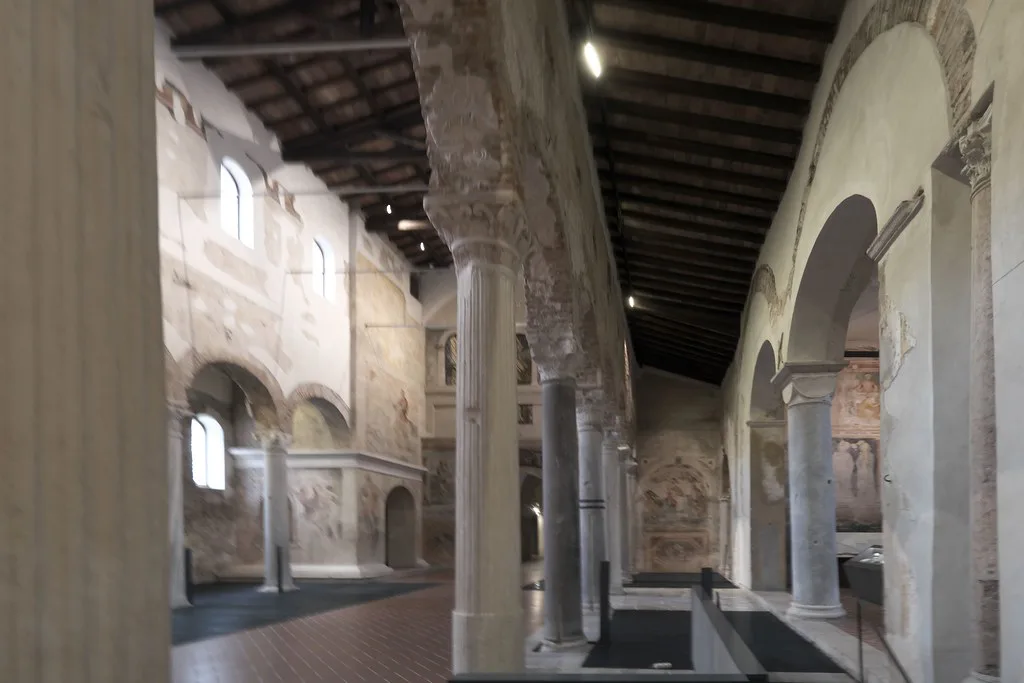
Inside the church, two rows of columns divide the nave from the side aisles. Several of these columns and their capitals were taken from older Roman buildings, and a Byzantine-style basket capital was reused in the northern aisle. Look at the joins and the mismatched stone: the building is a record of what was available to its builders, not a uniform design.
Above the arcades, fine stucco decoration with glass inserts links the arches to the painted programme. This combination of sculpture and painting is one of the reasons the church is treated as an important example of early medieval religious architecture rather than a simple parish room.
What Survives Inside
The nave and aisles carry frescoes showing episodes from the life of Christ and the martyrs whose relics were kept in the crypt. Beneath the painted panels there was once an inscription commemorating the founder, Desiderius, which anchors the building to a specific royal patron rather than an anonymous community.
A carved slab showing a peacock in detail, once paired with a mirror-image reflection to decorate a pulpit, survived along with other Longobard stonework. The peacock was a symbol of immortality, which makes the carving a piece of theology as much as ornament.
Because these are centuries-old wall paintings in a working historic building, light levels and viewing distances are not always ideal for photography. The tourism board notes that the museum's own multimedia guide, delivered by QR code with no app to install, recommends bringing headphones, which is a sensible way to get context without crowding the aisles.
The Crypt and the Relics of Saint Julia
The crypt was built in the second half of the 8th century to house the relics of Saint Julia, and it is the reason the complex later carried her name. It is not a basement that happened to be there: the space was constructed around the purpose of holding and honouring a saint's remains.
That purpose shaped how the monastery worked. The nuns kept the monastery treasure in the lower chamber of the later Romanesque chapel, and the choir above the church allowed cloistered women to follow services without entering the nave. Reading the crypt and the choir together shows a community organised around relics, prayer and separation.
How San Salvatore Fits the Museum Route
The museum itinerary runs through the monastery buildings themselves, so the architecture is part of the collection. Along the way you pass the two Roman town houses preserved under the monastery garden, with coloured mosaics and wall paintings in use from the 1st century into at least the 3rd, and the Domus of Dionysus with its mosaic of the god giving a drink to a panther.
The Roman bronze Winged Victory, found in 1826 among the ruins of the Capitolium, is another of the complex's headline pieces. The tourism board's description of the museum counts more than 11,000 works of art across a journey from prehistory to the present, which is a useful warning about scale.
The new UNESCO Corridor, created when Brescia held the Italian Capital of Culture title, connects the museum with the Archaeological Park of Roman Brescia along a single pedestrian route. That walk is open freely, which is a useful distinction: the outdoor route is free, while the museum interiors containing San Salvatore are a ticketed visit.
Walking Toward Santa Maria in Solario
San Salvatore is not the end of the religious sequence. The Romanesque chapel of Santa Maria in Solario, built around the mid-12th century, has a square plan and an octagonal upper storey with a closed loggia of reused early medieval columns and capitals, and its upper chamber was frescoed by Floriano Ferramola and his workshop in the early 16th century.
The chapel holds the Cross of Desiderius, an early 9th-century Carolingian gold-working masterpiece set with 212 gems ranging from the Roman period to the 16th century, including a cameo of a Roman matron with her children. Knowing this comes after the church helps you pace your attention rather than spending it all in the first room.
The Nuns' Choir, its walls frescoed between the 1520s and 1550s with a monumental Crucifixion by Ferramola on the end wall, closes the loop between the Lombard foundation and the Renaissance community that inherited it. Seen in order, the church, chapel and choir tell one continuous story about the same institution.
Pacing the Visit
One widely shared experience is that the complex takes far longer than expected: a visitor who planned roughly an hour and a half inside stayed well over three hours and wished she had eaten beforehand. Treat that as a traveller's caution rather than an official figure, and allow a generous margin if San Salvatore and the Roman houses both matter to you.
A sensible suggestion, clearly our own rather than the museum's, is around three hours inside the complex if you want to read the labels, sit with the church and still reach the Cross of Desiderius without rushing. If your time is tighter, decide before entering whether the early medieval rooms or the Roman domus take priority.
A Suggested Order if San Salvatore Is Your Priority
Start with the ground-floor displays on the city's past, then move to the church while your concentration is fresh, and leave the Roman houses and the treasury chapel for afterward. This order puts the frescoes and crypt before the visual competition of mosaics and goldwork, which is when you are most likely to notice the reused capitals.
If you still have energy and daylight, walk the free UNESCO Corridor to the Capitolium area afterward and see the Winged Victory's find site in context. Keep the paid museum interiors and the open-air route as two separate decisions, since they are not the same ticket.
Etiquette Inside a Former Convent
San Salvatore is a consecrated historic church inside a museum, and a Latin Mass is still celebrated in the nearby Duomo Vecchio every Sunday morning, which shows how religious buildings in Brescia continue to function. Dress modestly, keep voices low in the church and crypt, and step aside from the central aisle when groups pass.
Photography rules are set by the museum rather than by this guide, so check the conditions at the ticket desk before you rely on flash or tripods. Flash is generally the first thing to be restricted around historic wall painting, and asking costs nothing.
Finally, resist treating the church as a shortcut between other sights. It sits mid-route, and the pleasure of the room comes from pausing in it rather than passing through on the way to the next case.
Plan Your Visit
San Salvatore rewards a visitor who arrives knowing two things: that it is entered as part of the Museo di Santa Giulia rather than independently, and that its value lies in details like reused capitals, stucco with glass inserts and a crypt built for relics. Everything else, from tickets to timing, belongs to the official museum.
Check the Fondazione Brescia Musei site before travelling for current opening arrangements, ticket scope and any temporary exhibition that changes the route. Then build the rest of your day around the free outdoor corridor and the city's squares, so the paid interior and the open-air walk each get their own time.
Frequently Asked Questions
Is the Chiesa di San Salvatore included in the Santa Giulia museum ticket?
San Salvatore is part of the Santa Giulia museum complex and is visited along the museum route rather than as a separately ticketed church. Confirm the current ticket scope on the Fondazione Brescia Musei website before you travel, since combined and single tickets are an operator decision.
Can you visit San Salvatore for free?
No free entry to the church is described by the operator. The outdoor UNESCO Corridor linking the museum area with the Roman archaeological park is a free pedestrian route, but that is a separate experience from the museum interiors where San Salvatore sits.
How long does a visit to San Salvatore and the Santa Giulia complex take?
No official duration is published, so treat any figure as a personal suggestion. Allow around three hours inside if you want to read the church, the crypt, the Roman houses and the treasury chapel without rushing, and add time for the free outdoor corridor afterward.
What are the must-see works inside San Salvatore?
Look for the columns and capitals reused from Roman and Byzantine buildings, the 8th-century stucco with glass inserts, and the frescoes of Christ and the martyrs whose relics were kept in the crypt. The carved peacock slab and the founder's commemorative inscription are easy to miss if you walk straight through.
Who founded the church and when?
The monastery of San Salvatore and Santa Giulia was founded in the mid-8th century by Desiderius, the last king of the Lombards, and his wife Ansa. It operated as a Benedictine convent for women from high-ranking families and was later suppressed under Napoleon.
Is photography allowed inside the church?
Photography conditions are set by the museum and are not fixed in published guidance, so ask at the ticket desk on arrival. Expect restrictions around flash, tripods or crowded areas because the church contains historic wall paintings and stucco.
How do you get to Santa Giulia from Brescia's historic centre?
The museum is at Via Musei 81/b, inside the restricted-traffic zone. The tourism board suggests parking at Parcheggio Arnaldo and walking, or taking the metro to the Vittoria stop; the historic centre itself is compact and walkable.
Should I see San Salvatore before or after the Cross of Desiderius?
See the church first. Its frescoes, reused columns and crypt need unhurried attention, and the gold-and-gem Cross of Desiderius in Santa Maria in Solario is so arresting that it tends to dominate whatever comes after it.
Sources
- Santa Giulia Museum | Visit Brescia
- Italia: Museo di Santa Giulia – Wandering Jana
- The San Salvatore-Santa Giulia Monastery in Brescia — Google Arts & Culture
- Official event website
- Visit Capitolium of Brixia, Brescia in Brescia | Live the World
- Brescia Travel Guide | Martha's Italy
- Brescia’s Duomo Nuovo and Duomo Vecchio – Jubilee Church | Visit Brescia
Continue exploring
More guides you'll find useful