Duomo di Bergamo: Città Alta Cathedral Visitor Guide
Plan a visit to Bergamo's cathedral on Piazza Duomo: what to see inside, how it differs from Santa Maria Maggiore, and what to verify before you go.
On this page
Bergamo Cathedral, the Duomo di Bergamo, is dedicated to Sant'Alessandro, the city's patron saint, and sits in the upper town on Piazza Duomo. Its entrance is squeezed into a small, asymmetric square, which is precisely why many visitors walk past without registering that a cathedral is there. Treat it as the third piece of one compact square rather than a standalone excursion, and the visit makes far more sense.
Where the Duomo Sits in Città Alta
Piazza Duomo opens just off Piazza Vecchia in the walled upper town. Santa Maria Maggiore, the Colleoni Chapel and the cathedral stand within steps of each other, so most travellers see all three in a single stop. The square is the religious heart of Bergamo, and its tight dimensions mean the buildings feel layered rather than grandly spaced.
Reaching the upper town is part of the visit. The funicular from the lower town climbs to Piazza Mercato delle Scarpe, and a second funicular continues from Colle Aperto up to San Vigilio; walking up through the medieval gates is the other classic approach. The tourist board keeps a full inventory of sights in the historic centre if you want to plan the order of stops.
What You See From Outside
The white Neoclassical facade of Botticino marble is a nineteenth-century finish applied to a building begun centuries earlier. Construction started in the fifteenth century, stalled for long stretches, and was only completed in the nineteenth, which explains why the front reads so differently from the older fabric around it. Behind the sober exterior the interior shifts decisively into Baroque decoration.
The cathedral is dedicated to Saint Alexander, whose statue appears above the main entrance alongside other sculptural groups. Look at the monumental staircase and columns framing the door before you step in; they are the clearest signal of the building's long, mixed architectural history.
Inside: Baroque Decoration and the Tiepolo Altarpiece
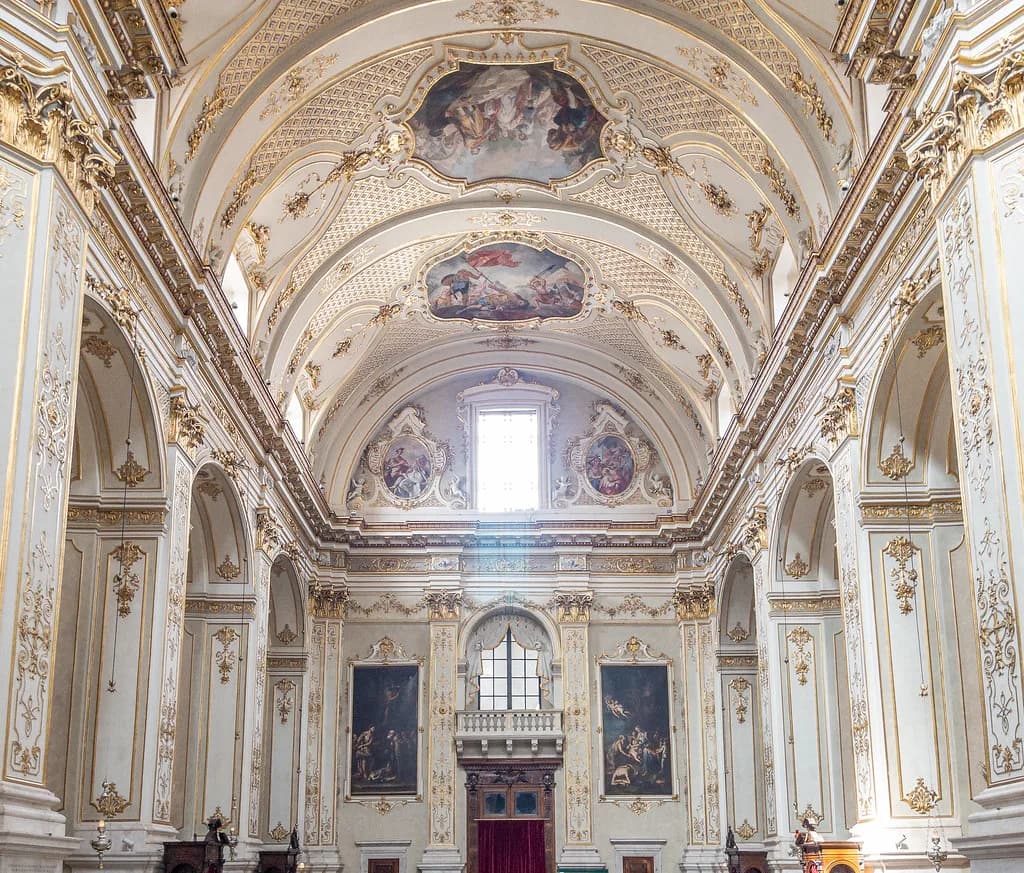
Inside, gilding, stucco and frescoes cover nearly every surface, and the dome provides a bright contrast to the decorated aisles. The scale is substantial: the building can hold well over a thousand people, which becomes obvious once you stand under the dome. Look for the altarpiece by Giambattista Tiepolo depicting the martyrdom of Saint Alexander, one of the reasons to give the cathedral more than a passing glance.
A short visit of roughly fifteen to twenty minutes covers the nave and main artworks comfortably. If you want to study the paintings, the side chapels and the crypt, allow longer and plan it as an art stop rather than a quick look.
The Crypt and the Earlier Church
Beneath the cathedral, a crypt survives from the earlier church of Saint Vincent that stood on this site, and the relics of Sant'Alessandro are associated with the underground space. The cathedral is the successor to a long sequence of religious buildings, with documentary evidence reaching back to the ninth century. Seeing the crypt makes that layering tangible in a way the decorated nave does not.
Access arrangements for the crypt are not something to assume. It may be closed for restoration, services or seasonal reasons, so ask at the entrance or check the diocesan website before building your day around it. Treat any promise that the relics are always viewable as unreliable.
Free Entry Versus the Paid Basilica Next Door
A common confusion is to treat the whole square as one ticketed complex. The cathedral nave is generally free to enter, while Santa Maria Maggiore charges non-residents of Bergamo and its province for admission, with reductions for younger and older visitors and free access during religious services. That difference matters if you are budgeting for a family or planning to duck in and out of several churches.
The basilica's published rates and opening times are useful for comparison, but check them against your travel date before relying on them. The cathedral museum is a separate entity again, so do not expect one ticket to cover the church, the museum and the basilica.
Opening Times and What to Verify
Public listings for the cathedral disagree on opening hours, especially at weekends, and third-party aggregators often repeat outdated schedules. Confirm the day's times on the official diocesan site or the city's tourism portal before you travel, and check again if a religious feast falls during your stay. Plan around services rather than assuming the doors are open whenever you arrive.
The city's tourism board publishes current events listings and practical visitor information, and the municipal site carries notices about closures and city events that can affect access to the upper town. If something looks off on the ground, the tourist information points in the lower and upper town are the sensible place to ask.
Getting There From Città Bassa
From the lower town, the simplest approach is the funicular from the Porta Nuova area up to Piazza Mercato delle Scarpe, followed by a short walk through the medieval streets. City buses also run between the two halves of Bergamo, and the bus network's own site has route maps and ticket details. Walking up is rewarding but steep, with cobblestones most of the way.
Once in the upper town, everything on Piazza Duomo is on foot within a couple of minutes. Park outside the walled centre rather than driving in; the upper town has restricted traffic zones that are enforced. Check current public transport arrangements, as routes shift during city events.
Etiquette, Dress and Common Mistakes
This is an active place of worship, so modest dress is expected: cover shoulders and avoid beachwear, and keep voices low when a service is underway. Photography may be restricted in parts of the building and the crypt, so watch for signs rather than assuming permission. If a liturgy begins, step back or wait rather than continuing a sightseeing circuit.
The other common mistake is treating the cathedral as the main event and the basilica as an afterthought, or the reverse. Decide before you arrive whether your priority is Tiepolo and the crypt or the basilica's tapestries and Lorenzo Lotto inlays, then let the other building fill the remaining time.
Pairing the Visit With the Rest of Città Alta
A sensible loop starts at Piazza Vecchia, where the Campanone bell tower gives a view over the rooftops and rings a hundred times each evening at ten, a tradition recalling the closing of the city gates. From there, Piazza Duomo, the Rocca and the Venetian Walls follow naturally. The walls run for several kilometres and are part of a UNESCO World Heritage listing, so even a short section is worthwhile.
If you enjoy finding quieter corners between the headline sights, the smaller churches and lanes away from the main drag reward slow walking. Our guide to hidden gems in Bergamo covers the sort of places that fill the gaps in a day.
Plan Your Cathedral Stop
Bergamo Cathedral rewards a short, deliberate stop rather than a rushed photo. Check the current opening arrangements with the diocese, arrive outside service times, dress for a working church, and treat the crypt as a bonus rather than a guarantee. Paired with Santa Maria Maggiore and the Colleoni Chapel, it turns a small square into one of the richest hours in the upper town.
Frequently Asked Questions
Is Bergamo Cathedral free to enter?
The cathedral interior is generally free to visit, but arrangements for the crypt and cathedral museum are separate and can change. The neighbouring Basilica of Santa Maria Maggiore has its own admission charges for non-residents of Bergamo and its province. Confirm current terms on the diocesan or tourism website before you go.
How long does it take to visit the Duomo di Bergamo?
A basic visit of the nave and main artworks takes roughly fifteen to twenty minutes. If you want to study the Tiepolo altarpiece, the chapels and the crypt, allow longer, and check in advance whether the crypt is open that day.
Is the Duomo di Bergamo the same as Santa Maria Maggiore?
No. They are two distinct churches facing the same small square in the upper town. The cathedral is dedicated to Sant'Alessandro and has a Neoclassical facade; Santa Maria Maggiore is the Romanesque basilica next door with its own ticket policy, artworks and Donizetti monument.
What should I wear when visiting Bergamo Cathedral?
Dress as you would for any active church in Italy: shoulders covered, no beachwear, and a respectful manner during services. Photography may be limited in some areas, so follow any posted signs rather than assuming you can photograph freely.
How do I get to Bergamo Cathedral from the lower town?
Take the funicular up to Piazza Mercato delle Scarpe and walk a few minutes into the upper town, or use the city buses that connect the two halves of Bergamo. Walking up is possible but steep. Check current routes and tickets on the local transport site, since services can be diverted during events.
Can I visit the crypt of Sant'Alessandro?
The crypt survives from the earlier church on the site and is associated with the city's patron saint, but access to tourists is not guaranteed and can be affected by restoration or services. Ask at the cathedral or check the diocesan website before planning your day around it.
Sources
Continue exploring
More guides you'll find useful