Ragusa in the Rain: An Indoor and Covered Plan for Ibla
Plan a rainy day in Ragusa by splitting Ibla and Superiore, choosing covered churches and museums, and sequencing stairs so you stay dry between stops.
On this page
Ragusa is built in two parts. Ragusa Superiore sits on the plateau, while Ragusa Ibla lies lower in the Cava San Leonardo gorge. That split, produced by the 1693 earthquake and the decision to rebuild both on the old site and higher ground, means a wet day here is less about finding one big indoor attraction than about choosing which half of town you are in at which hour.
The lower town is the more exposed half. Rain running off the plateau concentrates in the gorge, so Ibla can feel wetter and move faster underfoot than Superiore. A practical first step is to check a live local radar before committing to the descent and to keep the two districts as separate blocks rather than a single loop.
Why Ragusa Needs a Different Rainy-Day Plan
Most rainy-day lists assume a compact old town where you can duck from doorway to doorway. Ragusa does not work that way. The historic centre is split between a plateau and a gorge floor, and the two are connected by long flights of steps. That means every plan has a weather decision built in: which level to start on and when to cross.
The gorge setting also changes how rain behaves. Ragusa Ibla sits at the bottom of the Cava San Leonardo, and runoff from Ragusa Superiore above can reach the lower town quickly during storms, which is why the stone staircases between the two levels can turn into water channels. Treat that as a planning consideration rather than a forecast: check conditions locally on the day before you commit to the stairs.
The Ibla vs Superiore Decision Comes First
Decide where to start before you leave your accommodation. If rain is heavy at the start of the day, begin in Superiore, where the streets are wider and the covered stops are close together, then descend to Ibla only when the rain eases. If the forecast suggests a dry morning and a wet afternoon, reverse it and do the climb early, so the exposed stair leg happens while you are still fresh and the ground is drier.
The two districts were separate towns for nearly two centuries and were merged in 1927, which is why each still has its own cathedral and its own street pattern. Superiore has a grid-like layout with broader pavements; Ibla is a maze of alleys, stairs, and small squares. In rain, that difference is practical: Superiore gives you more forgiving walking between interiors, while Ibla rewards short hops within a tight radius.
Ragusa Superiore: Indoor Anchors
The Cattedrale di San Giovanni Battista is the obvious indoor anchor in the upper town. It was designed by Rosario Gagliardi and rebuilt after the earthquake in an extravagant Sicilian Baroque style, with a bell tower that can be climbed, according to the cathedral's own site. Treat the church interior, the museum, and the tower as separate visits: the cathedral's site presents them as distinct, so check what is open when you arrive rather than assuming one entry covers the complex.
Around the cathedral, the upper town's palaces and streets are best treated as short exposed hops between interiors rather than a full circuit. Palazzo Schininà di Sant'Elia, Palazzo Bertini, and Palazzo Zacco are close to the upper cathedral and make sensible punctuation points on a walk between one doorway and the next. Keep each outdoor leg to a few minutes and use the next interior as your reset.
If you want more time under a roof in Superiore, the archaeological museum below Ponte Nuovo holds collections that reach back to the Neolithic period, including material on ancient Kamarina and mosaics from Byzantine churches. It is a useful second anchor when the rain settles in for the afternoon, and it keeps you on the plateau rather than sending you back down into the gorge.
The Stair Link Between the Two Towns
The long staircase between the districts is the most exposed part of any rainy-day plan, so schedule it rather than stumble into it. The main flight runs from the lower town up to Superiore and passes the Church of Santa Maria delle Scale roughly midway, which makes the church a natural shelter and a place to reassess the weather before continuing.
Santa Maria delle Scale is worth more than a doorway pause. It is one of the oldest churches in the city, and the building retains Gothic-Catalan arches in its right aisle from before the 1693 earthquake, when it was restored and enlarged. If you are walking between levels in bad weather, this is a sensible place to wait out a shower and look at the fabric of the building rather than pressing on.
The alternative to the stairs is to use the local bus that links Superiore with the entrance to Ibla, or to take a taxi for the crossing and save your legs for the interiors. Neither is a substitute for checking conditions, and neither removes the need to be careful on wet stone, but either lets you keep the stair leg out of the day entirely when the weather is at its worst. Also note that Ibla is closed to non-residential traffic, so a car is not the answer for the final approach.
Ragusa Ibla: Churches and Museums in a Small Radius
Once you are in Ibla, the covered stops are close enough to string together in a short loop. The Duomo di San Giorgio is the centrepiece, a Baroque masterpiece by Rosario Gagliardi on Piazza Duomo, and the surrounding streets pack in the Church of Purgatorio, San Giuseppe, and Santa Maria dell'Itria within a few minutes of one another. Each doorway resets the clock, which is exactly what you want in rain.
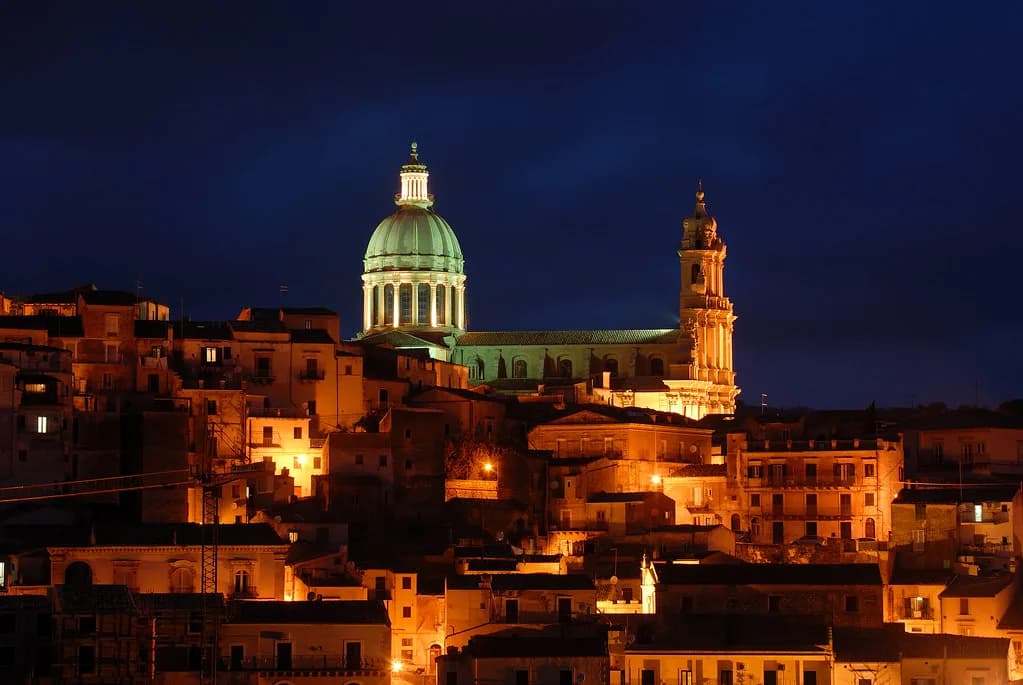
The Duomo itself repays time indoors. Construction was commissioned from Gagliardi in 1738, the facade was completed in 1775, and the neoclassical dome was added in 1820, reaching 43 metres and resting on an octagonal drum. The museum next to the church, on Salita Duomo, holds the treasury of Saint George, which was moved on display there in 2009. Check current opening windows when you arrive.
The Church of Purgatorio survived the 1693 earthquake, which makes it one of the few buildings in the city that predates the Baroque rebuild, and it is a natural stop at the top of the Ibla cluster. San Giuseppe on Piazza Pola, attributed to Gagliardi, is another short indoor stop, and Santa Maria dell'Itria, with its blue dome, is close enough to include without a long exposed walk. Keep the order flexible so you can shelter wherever the rain catches you.
For a longer indoor block, the Iblean archaeological collections give you a reason to stay inside for an hour rather than dash between doorways. Pair a museum stop with a church interior on the same small square, so you are moving only a few metres at a time. If the rain is heavy, this is the moment to abandon any idea of a panoramic circuit and settle into the tightest radius you can manage.
Giardino Ibleo: A Short Sheltered Pause
The Giardino Ibleo is not an indoor stop, but it is a useful short pause at the edge of Ibla. The garden was created in 1858 on the site of the destroyed cathedral of Ragusa, and just outside the entrance you can still see the Gothic Portale di San Giorgio Vecchio. Treat it as a brief detour between interiors rather than a long wet loop.
Inside the garden you will find a small archaeological area and three churches, San Domenico, San Giacomo, and a Capuchin church, which gives you one or two covered options if a shower arrives while you are there. Do not plan the garden as the centrepiece of a rainy afternoon. Use it to break up the walk between the Ibla churches, and keep the visit short if the rain is steady.
Donnafugata Castle as the Bad-Weather Day Trip
When the rain is set in for the day, Donnafugata Castle is the obvious move out of town. It lies about 15 km from Ragusa, and despite the name it is a sumptuous 19th-century residence surrounded by extensive grounds, with rooms and a park that includes a labyrinth. Because it moves the day indoors and away from the gorge, it solves the exposure problem rather than working around it.
The castle is a sensible anchor for a wet day, but check the official castle site or the city's tourist information before setting out, since opening arrangements can change. The park is the exposed part of the visit, so do the interiors first and treat the grounds as optional. If you want to combine it with other stops, keep them short and check the weather on the day.
A Suggested Half-Day Sequence for Steady Rain
This is a suggested sequence, not an official itinerary, and you should adjust it to the weather and what is actually open. Start in Superiore and give the Cattedrale di San Giovanni Battista the first hour: the interior, then the museum or tower if either is open, checking on arrival rather than assuming. Walk a short block to one palace or the archaeological museum, then reassess the sky before crossing to Ibla.
If the rain is easing, take the stair link down with Santa Maria delle Scale as your midpoint shelter. In Ibla, do the Duomo di San Giorgio and its museum, then Purgatorio, San Giuseppe, and Santa Maria dell'Itria within a few minutes of one another. Finish with a short pause at the Giardino Ibleo only if the rain has stopped. The half-day version should cover no more than the two districts and one crossing.
If the rain is not easing, skip the crossing entirely and stay on the plateau. Superiore has enough interiors for an afternoon, and the archaeological museum can fill a wet hour without any exposure. The point of the half-day version is to accept a smaller footprint, not to tick off every church on a list.
A Suggested Full-Day Sequence for Wet Weather
A full wet day should differ from the half-day by geography, not by a longer list of stops. Spend the morning in Superiore at the cathedral and the archaeological museum, then take the bus or a taxi across to Ibla rather than the stairs if the ground is running with water. Keep the afternoon to the Ibla cluster and the Duomo museum, and leave the garden out unless the rain breaks.
If the rain is forecast to be heaviest in the afternoon, reverse the day: do Ibla in the morning while the runoff is lower, and come back up to Superiore for the cathedral and museum later. The stair link is the one leg that changes the plan, so check a local radar before committing to it and be prepared to take the bus instead.
A third option for a full day is to leave town entirely for Donnafugata Castle, which takes the gorge out of the equation. That works best when the rain is constant rather than showery, and when you want one substantial indoor visit rather than a series of short dashes. Check the castle's opening arrangements before you go, since they are not published in the same way as the city churches.
What to Postpone When It Pours
In heavy rain, the stair circuits and valley viewpoints are the first things to drop. A plan built around standing outdoors and looking at panoramas does not work when the stone is slick and the views are greyed out. Leave the long staircase, the panoramic terraces, and the valley walks for a dry day, and do not try to fit them between showers.
Also postpone any plan that depends on a chain of short outdoor hops across the whole city. The pleasure of Ragusa is in the wandering, and in rain that wandering becomes exposure. Keep the day to one district and a small cluster of interiors, and save the crossing for a moment when the weather genuinely eases.
Practical Habits for a Wet Day in Ragusa
Check a local radar the same morning and again before you cross between levels. The gorge topography means the lower town can be wetter than the plateau, and a province-wide forecast will not tell you whether the stairs are running with water. A hyperlocal view, updated frequently, gives you a decision you can act on rather than a general warning.
Confirm church and museum hours the same morning rather than relying on a published list. The city tourist information page for visiting churches has published opening times by period, which is a useful starting point, but the dates matter and a list for one season does not guarantee the next. The cathedral's own site is the right place to check for its museum and tower.
Carry a light waterproof shell and shoes with grip, and expect stone surfaces to be slippery even after the rain stops. If you are staying in Ibla and arriving by car, note that the old town is closed to non-residential traffic, so check with your accommodation in advance about access. Parking is easier in Superiore, which makes it the sensible base on a wet arrival.
Plan Your Visit
Ragusa in the rain is manageable if you treat the two halves of the city as separate plans. Start with the decision of which level to be on, use churches and museums as covered anchors, and keep the stair link as the one leg you schedule rather than improvise. The half-day version stays on one plateau; the full-day version either adds the crossing or leaves town for the castle.
Check the local radar and the relevant official pages before you set out, and confirm opening times on the day rather than relying on a list from another season. If you want to build out the rest of your trip, the Ragusa attractions hub collects the individual guides, and the hidden gems guide covers the quieter corners worth saving for a dry afternoon.
Frequently Asked Questions
Is Ragusa Ibla still worth visiting when it rains?
Yes, provided you treat it as a short cluster rather than a full circuit. The Duomo di San Giorgio, Purgatorio, San Giuseppe, and Santa Maria dell'Itria sit within a few minutes of one another, so you can move between interiors without long exposed walks. The one thing to avoid is the long stair link between the districts in heavy rain, when runoff from above can make the stone steps unsafe.
What can you do indoors in Ragusa on a wet day?
The strongest indoor options are the two cathedrals and the museums attached to them. In Superiore, the Cattedrale di San Giovanni Battista and the archaeological museum give you two substantial stops, and Ibla offers the Duomo di San Giorgio with its museum and a tight cluster of smaller churches. Donnafugata Castle, about 15 km out of town, is the best option when the rain is set in for the whole day.
How do you get between Ragusa Ibla and Ragusa Superiore without getting soaked?
The long staircase is the most exposed part of the crossing, so schedule it for a lull and use the Church of Santa Maria delle Scale as a midpoint shelter. If the rain is heavy, take the local bus or a taxi instead and save your legs for the interiors. Check a local radar before you commit, because the lower town can be wetter than the plateau.
Are the churches in Ragusa free to enter?
Church interiors are generally free to visit, but museums and towers are separate visits with their own arrangements. The cathedral site presents the church, museum, and bell tower as distinct, and the Duomo museum in Ibla holds the treasury of Saint George as a separate collection. Check the official pages or ask at the door rather than assuming one entry covers everything.
Sources
Continue exploring
More guides you'll find useful