Ragusa at Night: An Ibla Walk and Where to Eat
Plan a Ragusa evening: a slow walk through Ibla's Baroque lanes, the staircase to Superiore, Giardino Ibleo views and where to find scacce, pane cunzato and granita.
On this page
Ragusa after dark rewards a slow walk rather than a checklist. The city is split between Ragusa Ibla, the old Baroque centre on its rocky spur, and Ragusa Superiore on the plateau above, a division created by the 1693 earthquake that destroyed the medieval town. Evening is when the stone facades soften and the alleys empty out, but it is also when you need to be deliberate about stairs, shoes and which interiors you still hope to see.
As a working suggestion rather than an official itinerary, allow roughly two hours for a loop through Ibla's lanes with a stop for food, and add time if you plan to climb to Superiore. One traveller's account of arriving after dark describes the night view over Ibla from a terrace in Superiore as the reason to return, which is a useful reminder that the two districts look best from each other.
Two Districts, One Evening
The earthquake of 1693 flattened much of the Val di Noto, and Ragusa rebuilt in two places: Ibla on the older site and Superiore on the higher ground. That split is the single most useful fact for planning an evening, because every route involves deciding which level you finish on. Walking downhill into Ibla is easy; walking back up is the part that shapes your timing.
A sensible structure is to start in Superiore while there is still light, descend into Ibla for the evening, and either climb back or take a taxi if the steps no longer appeal. If you are staying in Ibla, reverse the plan: walk the upper town first, then return downhill and eat late. Either way, fix your return leg before dinner rather than after it.
The Illuminated Ibla Loop
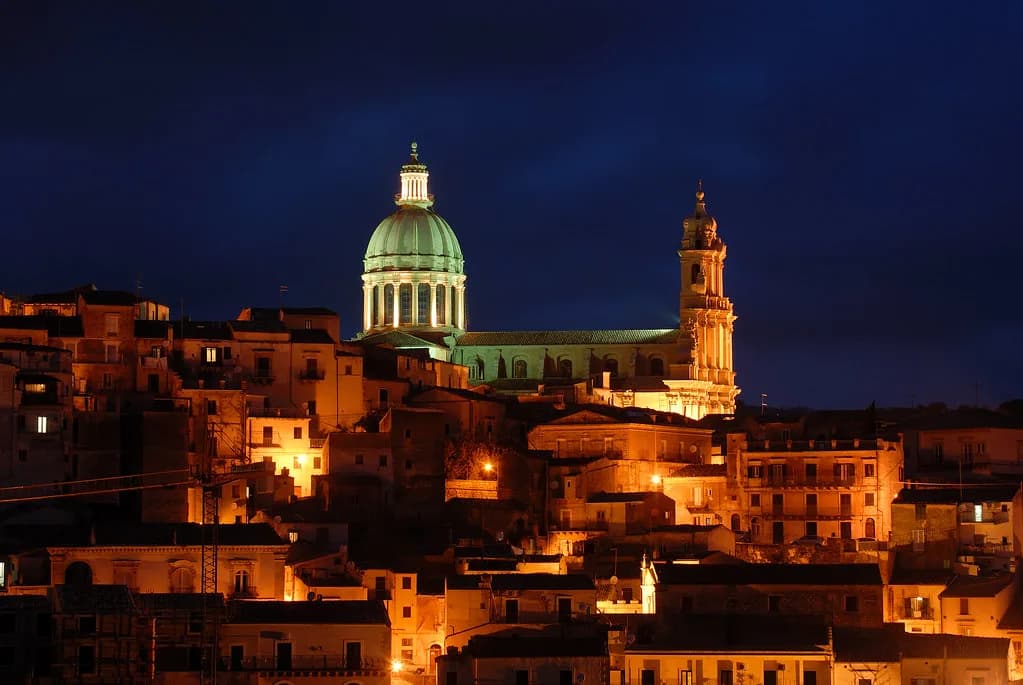
Begin at Piazza del Duomo, where the Cathedral of San Giorgio rises above the square with its convex facade and dome, designed by Rosario Gagliardi and completed in the eighteenth century. Seen from outside after dark, the church is the anchor of any Ibla walk, and the piazza itself acts as the town's drawing room in the evening. Keep the cathedral's interior for daylight unless you have confirmed opening times that day.
From the piazza, wander without a fixed route through the lanes toward Piazza Pola, where the Church of San Giuseppe stands on the site of an earlier church destroyed in 1693. The smaller streets hold carved portals and balconies on ordinary houses, including the elaborate brackets on palaces such as Palazzo Cosentini, and the belvedere at Piazza Pola gives an unusual angle back over the bell towers and domes of the lower town.
If you want one more quiet corner before eating, the Church of Santa Maria delle Scale sits between the two levels and is one of the oldest churches in the city, its Gothic-Catalan arches surviving the earthquake. It is reached by a long flight of steps, so treat it as a daylight or early-evening stop rather than a late-night detour.
The Staircase to Superiore: A Night-Time Decision
The staircase of Santa Maria delle Scale is the classic link between Ibla and Superiore, a long run of irregular steps with views in both directions. The Thinking Traveller puts the climb at 242 steps, which is the number to keep in mind when you are deciding at dusk whether to go up or down. It is a rewarding route in good weather and a punishing one in the heat of a summer evening or after a full meal.
The alternative is the road that winds between the districts, which the same guide describes as passing through olive groves, or a short taxi ride. There is no reliable basis here for quoting night bus or train times between the two, so check locally on the day rather than planning around a service you have not confirmed. Whichever way you go, carry a layer: the stone lanes and staircases cool quickly once the sun drops.
Superiore After Dark
Ragusa Superiore is the working city, with wider streets and a different rhythm from Ibla. Its main monument is the Cathedral of San Giovanni Battista on Piazza San Giovanni, a three-tiered Baroque facade rebuilt in the eighteenth century after earlier versions were lost. The cathedral's own website publishes news, celebrations and Mass information, which is the place to check if you want to attend rather than simply admire the exterior.
Corso Italia is the natural evening stroll in the upper town, running past shops and cafes toward the viewpoints over the valley. This is also where you are most likely to find a table for a proper dinner without committing to the descent into Ibla afterwards. If you are based in Superiore, plan to eat here and visit Ibla on a separate morning or late afternoon.
Giardino Ibleo and the Viewpoints
At the eastern end of Ibla, the Giardino Ibleo is the oldest of the city's four gardens, laid out in 1858, with palm-lined paths, fountains and an overlook toward the valley. It is free public ground, which makes it a good place to end a walk while there is still light. The three churches inside the garden, San Domenico with its majolica bell tower, San Giacomo and the Cappuccini convent, are deconsecrated, so do not plan an evening around visiting them as working churches.
For photographs, the golden hour before sunset is the reliable window, when the limestone warms and the lanes thin out. This guide makes no claim about scheduled monument illumination, because no published lighting timetable is available to check. If floodlit facades matter to you, ask at the tourist information office in Ragusa on arrival rather than assuming a fixed hour.
What to Eat at Night: Categories, Not Reservations
Ragusa's evening food is best approached by category rather than by named venue, since published opening hours for individual restaurants and bars are not something you can rely on from a distance. The Ragusa Local Food Guide: What to Eat and Where covers the dishes in more depth, including the stuffed flatbreads known as scacce and the seasoned bread called pane cunzato. Both are bakery and delicatessen food, which makes them the practical option if you arrive after kitchens have slowed.
For a sit-down dinner, the trattorias hidden in Ibla's side streets are the traditional choice, though quality and hours vary and no single list here can confirm evening service. Caciocavallo Ragusano DOP, the rectangular cheese made from Modicana cow's milk, works as a starter with honey or fig jam, and local fish or pasta dishes fill out a fuller meal. A restaurant ranking such as the Tripadvisor Italian list for the province can help you shortlist, but call ahead to confirm a table and a serving time.
For a lighter evening, build a picnic from a bakery: scacce, pane cunzato, a wedge of Ragusano and some almond sweets, eaten on a bench or back at your room. The trade-off is that you skip the warm restaurant atmosphere but gain flexibility when you are tired or arriving late. Either way, finish with granita, which in this part of Sicily is eaten at any hour, ideally with a warm brioche col tuppo.
Timing, Shoes and Weather
Check sunset for your dates before you set out, since the difference between a lit walk and a dark one is a matter of an hour or so depending on the season. The Best Time to Visit Ragusa: Avoiding Crowds explains the broader seasonal picture, including summer heat that makes midday walking uncomfortable and shifts the best hours to early morning and late afternoon. Evening is generally the more comfortable window for the staircase and the open lanes.
Wear shoes with grip for the irregular steps and polished stone, and carry water in warm months. Spring and autumn evenings can turn cool enough for a light jacket, particularly on the exposed staircases and at the belvedere. If you are only in Ragusa for one night, put Ibla first and Superiore second rather than trying to cover both districts in depth.
What to Verify Before You Go
Church interiors are the main thing to confirm. Ragusa Welcome publishes church visiting openings periodically, and its most recent listing covers December 2025 to January 2026, with specific times for the Cathedral of San Giovanni Battista, the Duomo di San Giorgio and others. That page is worth checking for an updated listing, but the dated times should not be treated as current 2026 hours.
If a museum or bell tower is on your list, look for current opening information and admission details from the site itself rather than from older third-party guides, which may quote outdated prices or seasonal schedules. The Cathedral of San Giovanni Battista website also carries news and event notices. Build the evening around what is confirmed open, and treat everything else as an exterior visit.
This guide does not quote patrol information, late-night safety rules, restaurant closing times or transport schedules, because none of those are reliably published in the sources available. Practical steps work better: tell someone where you are going, keep to lit streets, and ask your host which taxi numbers serve Ibla after dark. Those habits matter more than any general claim about the city at night.
Ragusa as a Base for the Val di Noto
If you are staying a few nights, Ragusa works well as a base for the other Baroque towns of the Val di Noto. Modica is known for its cold-processed chocolate, Scicli for a quieter, more melancholy set of lanes, and Noto for its planned Baroque streetscape. Each rewards a half-day, and combining two in one day is feasible by car.
The wider Ragusa Attractions hub covers the city's individual sights in more detail, including churches, the archaeological museum and the Castello di Donnafugata outside town. Use it to plan daylight hours so that your evenings can stay slow and unscripted. That balance is what makes a night in Ragusa memorable rather than rushed.
Plan Your Ragusa Evening
An evening in Ragusa comes down to three decisions: which district you finish in, whether you take the staircase or the road, and whether dinner is a trattoria meal or a bakery picnic. Get those right and the rest of the night is simply walking through one of Sicily's most atmospheric Baroque centres.
The Ragusa Local Food Guide: What to Eat and Where is the companion piece for the dishes mentioned here, and the Ragusa Ibla: Complete Guide to the Baroque Historic District covers the churches and lanes in daylight. For readers planning similar late walks elsewhere in Italy, Rome At Night and Naples at night offer useful comparisons on how Italian cities behave after dark.
Frequently Asked Questions
Is Ragusa worth visiting in the evening?
Yes, if you treat it as a slow walk rather than a sightseeing checklist. Ibla's lanes and piazzas are at their most atmospheric after the daytime heat fades, and the views between the two districts are the main reward. Churches and museums are generally better saved for daylight, since interior opening times need confirming.
Can you walk between Ragusa Ibla and Ragusa Superiore at night?
Yes, on foot, but plan the leg in advance. The staircase of Santa Maria delle Scale involves a long climb of irregular steps, and the alternative is the winding road or a taxi. Decide before dinner whether you are climbing back up, and check locally for any transport option rather than relying on a timetable you have not confirmed.
What should you eat in Ragusa in the evening?
Bakery food is the flexible choice: scacce, pane cunzato and a piece of Caciocavallo Ragusano DOP travel well and suit a late arrival. For a sit-down meal, look for a trattoria in Ibla's side streets and confirm service by phone. Finish with granita and a warm brioche, which is eaten at almost any hour here.
Are the churches in Ragusa open in the evening?
Not reliably. Ragusa Welcome publishes church visiting periods with specific times, but these are dated listings that need re-checking rather than fixed rules, and the most recent published schedule covers a winter period rather than the current season. Plan your evening around exteriors and confirm any interior you care about on the day.
How long does an evening walk in Ragusa Ibla take?
As a suggested duration rather than an official one, allow about two hours for a loop through Ibla with a food stop, and add time if you climb to Superiore and back. Walking without a fixed route is part of the experience, since the lanes are small and you will always find your way back to Piazza del Duomo.
Is the Giardino Ibleo open in the evening?
The garden is free public ground and worth timing for the last of the light, since its belvedere looks over the valley. The churches inside it are deconsecrated, so do not plan an evening around visiting them as active churches. Check locally for current garden opening hours before making it your final stop.
Sources
- Comune di Ragusa
- At night in Ragusa
- THE 10 BEST Italian Restaurants in Ragusa (Updated 2026)
- Complete Tourist Guide to Ragusa and Ragusa Ibla
- Travel Guide to Ragusa, Sicily
- Visit the churches in Ragusa
- Cattedrale San Giovanni Battista - Ragusa
- What to do and see in Ragusa Ibla - Sicily | Consigli in viaggio
- Ragusa Ibla: the Baroque heart of the city - Visit Sicily
- The Duomo of San Giorgio in Ragusa Ibla: A Masterpiece of Sicilian Baroque - Slow Sicily
- Giardino Ibleo, Tourist Attraction in Sicily, Italy
- Guide to Ragusa Ibla: Sicilian Baroque & Val di Noto
Continue exploring
More guides you'll find useful