Palermo Self-Guided Historic Centre Walk: Route & Stops
Plan a self-guided walk through Palermo's historic centre, from Quattro Canti and Piazza Pretoria to the Cathedral, with market and Kalsa detours.
On this page
Palermo's historic centre stacks Arab, Norman and Baroque layers within a compact core, which makes it well suited to a walk you design yourself. This guide gives you a stop order and a set of themes rather than a minute-by-minute timetable, so you can linger where a square or a market pulls you in and move on when it does not.
A useful calibration comes from the guided walking tours already running in the city, which generally cover the monumental heart in around two to two and a half hours on foot. Treat that as a reference for pacing, not a target, because a self-guided walk usually absorbs extra time at viewpoints, cafés and market stalls. The Comune di Palermo publishes city-wide notices and civic information that can serve as an official starting point before you set out.
Why Walk Palermo's Centre on Your Own
The pleasure of doing this without a guide is control over depth: you can spend twenty minutes in front of one facade and two minutes crossing a piazza. Palermo rewards that kind of attention because one building can show several centuries of rulership at once, from Arab emirs to Spanish kings. A scripted route tends to show you the shape of the centre without letting you notice how the pieces fit together.
The centre is also the practical place to start. Its main squares and cathedral sit close enough together that the walk between them becomes part of the sightseeing, and the guided tours available in the city work the same axis. Booking pages for free walks in Palermo describe routes that thread through Quattro Canti, Piazza Pretoria and the Cathedral across roughly two hours.
If you have only a single day in the city, this walk can be the backbone of it. A Palermo in one day itinerary pairs well with a self-guided morning in the centre, leaving the afternoon for one interior you actually want to see rather than several you rush through.
Before You Set Off: Shoes, Water and a Time Calibration
Wear shoes you would happily walk on uneven stone for several hours. Guided routes in Palermo are described as covering around two to two and a half kilometres on cobblestones with no seated rest stops, and reviewers consistently flag comfortable footwear as essential. A self-guided walk can be shorter, but the surface does not change.
Carry more water than you think you need, especially outside the cooler months, and plan a real sit-down break rather than snacking while walking. Shade in the centre comes in pockets, and a church bench or a café table resets your energy better than another square.
Set a loose time budget before you leave your accommodation: a two-hour core is realistic if you keep moving, and a half day is realistic if you add a market wander. Decide in advance which single interior matters most to you, so the day does not dissolve into indecision at each doorway.
Stop 1: Quattro Canti and the Monumental Axis
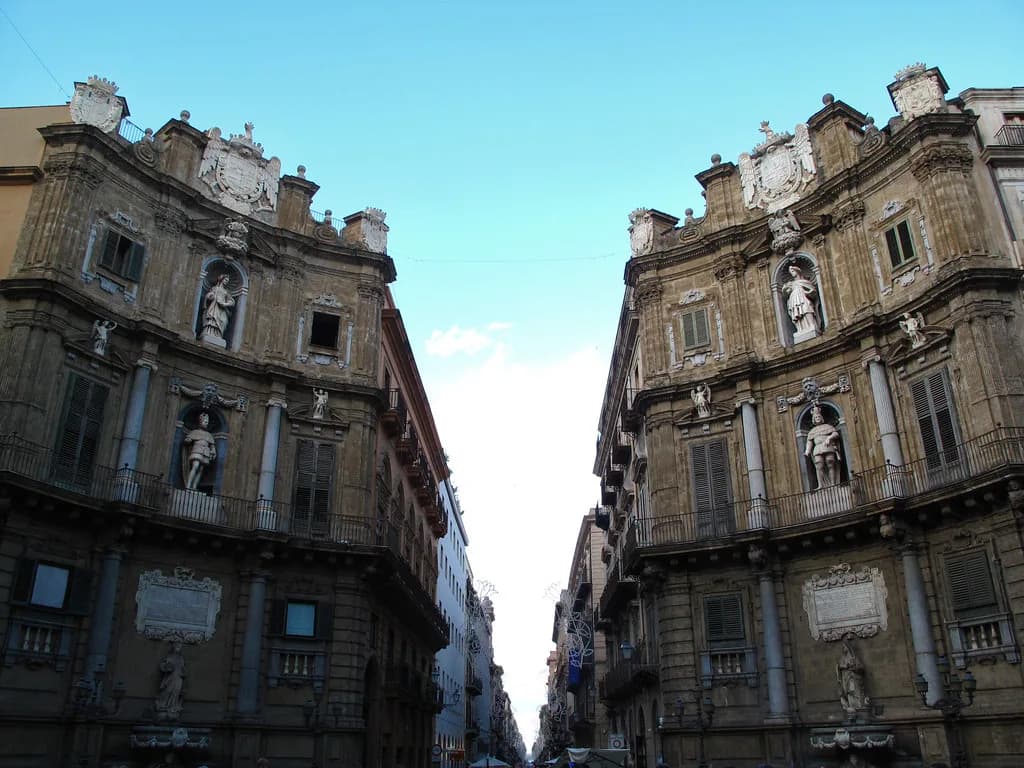
Start where the old city's two main streets meet at Quattro Canti, the four-cornered baroque junction that functions as Palermo's monumental front door. Each facade carries tiers of statues and ornament, and the space works best if you stand in the middle and turn slowly rather than photographing one corner and leaving.
From here the centre opens in several directions, and this is where a thematic approach beats a checklist. Walk toward Piazza Pretoria to follow the Baroque thread, or head west toward the Norman palaces and the Cappella Palatina to follow the Arab-Norman one. Doing both in a single loop is possible but turns the day into an endurance exercise.
Teatro Massimo, described by guided-tour operators as Italy's largest opera house, is a common meeting point for guided routes departing from Piazza Olivella, which makes it a handy landmark if you are orienting yourself against a tour group's movements. You do not need to join one to use the square as a reference point on your own map.
Stop 2: Piazza Pretoria and the Praetorian Palace
Piazza Pretoria holds the sixteenth-century Fontana Pretoria, whose nude figures earned it the nickname locals once used for it, the Square of Shame. The fountain is the centrepiece, but the surrounding buildings matter too: the Praetorian Palace alongside it houses the city's Town Hall.
This is a good place to pause and look up at the balconies and cornices rather than only at the water. The square is a working civic address, so expect people crossing it on errands alongside visitors with cameras. That mix is part of what makes the centre feel alive rather than staged.
If you are building a longer itinerary around the centre, the piazza is a natural junction between the monumental axis and the streets leading toward the markets. It also sits close to the historic core's less prominent corners, which are worth folding into a slower afternoon; the hidden gems in Palermo are often a short turn away from the famous squares.
Stop 3: Palermo Cathedral from the Outside
Approach the Cathedral slowly from the south or west so the building reveals its mixed styles gradually. In a single facade and plan you can read Gothic, Moorish and neoclassical elements, which is why it works well as the culmination of a walk organised around layers rather than periods.
Going inside is a separate decision, and you should check the current rules directly with the cathedral before you go. Visitor guidance from tour operators notes that shoulders should be covered for the Cathedral and that very short shorts should be avoided, and one operator mentions disposable ponchos available at the entrance for €1 if needed. Confirm attire and any entry conditions on site rather than relying on a blog written months earlier.
The same principle applies to the Norman sites west of the centre. Palazzo dei Normanni and the Cappella Palatina have their own visitor arrangements, and shared tickets across a complex should never be assumed. Check each site's own official page for opening times, closures and ticket scope before you commit a morning to it. For wider planning, see Norman Palace and Palatine Chapel visitor guide.
Stop 4: Market Wandering in Ballarò or Capo
Palermo's historic markets are the counterweight to its squares: louder, messier and far more useful for understanding daily life. Ballarò, Vucciria and Capo are not attractions bolted onto the city but working neighbourhood engines, and guided routes often pass through them without treating them as a scheduled stop.
Pick one market rather than trying to see all three. Choose based on where you already are at the end of the cathedral stretch, then wander a couple of aisles without a shopping goal. The stalls sell produce and street food side by side, and the pleasure is in the noise and the display rather than in ticking off a specific snack.
Market days and hours are not reliably published in the sources a visitor can easily check, so treat a market visit as a flexible detour and confirm locally or with your accommodation on the morning of your walk. If a market is quiet when you arrive, shift the visit earlier or later in your route rather than forcing it.
For travellers based near the market quarter, an Albergheria neighbourhood guide is a useful companion to this stretch, since that district wraps around Ballarò and changes character from block to block. Knowing your bearings here saves a lot of backtracking at the end of a long walk.
Optional Extension: The Kalsa District
If you still have energy and daylight, continue south-east toward the Kalsa, the district that runs down toward the water. Guided routes in the city include legend-focused storytelling walks and street art itineraries through the Kalsa and Ballarò districts among their options, which tells you the area has enough material for a second theme.
The Kalsa also gives the walk a different ending. Instead of finishing in a crowded monumental square, you can finish among quieter streets and gardens, which suits travellers who prefer to decompress rather than exit through the busiest part of the centre.
Deciding where to sleep affects how much of this extension you can realistically do. A Palermo neighbourhoods guide: where to stay helps you judge whether a base near the centre or near the Kalsa makes the walk easier to start and finish.
Building Your Own Order by Theme
Rather than memorising a fixed stop sequence, organise the day around one architectural thread and let geography follow. The Baroque thread runs from Quattro Canti to Piazza Pretoria and on toward the cathedral quarter; the Arab-Norman thread runs through La Martorana, San Cataldo and the palaces on the western edge of the old city.
A hybrid order also works: monumental axis first, then a market, then the cathedral as a finale when the light softens. The trade-off is more walking between clusters, so keep the market stop short if you choose this version and skip one of the optional squares.
If you want a single collection to break up the day, the Museo Archeologico Regionale Antonio Salinas visitor guide covers a museum close enough to the centre to slot into an afternoon. Check its current opening arrangements before you plan around it, since museum schedules change by season.
Practical Pacing: Breaks, Cobblestones and Heat
Plan at least one seated break in the middle third of the walk, not at the end when you are already tired. A café stop near Piazza Pretoria or a bench near the cathedral costs little and restores your attention for the market stretch, which is the most stimulating and most tiring part of the route.
Cobblestones make a difference to ankles and knees, and the standard guided route is described as covering around two to two and a half kilometres on cobblestones with no seated breaks over about two hours; visitors with limited mobility are advised to plan accordingly. Self-guided walkers can shorten the route or stick to the flatter squares, but no one should assume the whole centre is easy underfoot. Further visitor details appear in Free walking tour Palermo: No Credit Card Needed.
In hot weather, start early and treat the mid-afternoon as a break rather than a walking slot. In cooler months, the same route comfortably stretches into a full day with interiors added. Either way, build in a buffer so a closed door or a delayed lunch does not derail the whole plan.
What This Route Deliberately Leaves Out
This walk does not schedule interiors, ticket purchases or fixed opening hours, because those details shift and must be confirmed site by site. Treat the cathedral, the Cappella Palatina and any museum as separate decisions, each with its own entry conditions and its own official page to check.
It also does not promise quiet, untouristed stops. Quattro Canti, Piazza Pretoria and the cathedral are central landmarks and busy for good reason, and calling them otherwise would be misleading. The route simply lets you choose when to stand in the crowd and when to turn toward a market lane.
When you want more structured options, the Palermo Attractions hub collects visitor guides to individual sights, so you can swap one square for a single focused visit without rebuilding the day. Use it as a menu rather than a checklist.
Plan Your Visit
The simplest version of this walk is Quattro Canti, Piazza Pretoria, the cathedral exterior, then one market, with the Kalsa added only if time and energy allow. That sequence keeps the monumental sights together, puts the most tiring section in the middle, and leaves you free to end wherever you feel finished.
Before you go, check current conditions for any interior you plan to enter and confirm market activity locally on the day. City notices and site-specific pages are the reliable places to look, and a short check the evening before prevents most disappointments.
Frequently Asked Questions
How long does a self-guided walk of Palermo's historic centre take?
There is no official duration, because the route is one you assemble. As a reference, guided walking tours in Palermo are described as covering the monumental heart in around two to two and a half hours, so a self-guided version that includes a market stop and a seated break will usually run longer. Decide your own budget and cut stops rather than rushing the squares.
Is Palermo easy to explore on foot without a guide?
The central landmarks are close together and can be linked on foot, which is why so many guided and free routes operate in the same area. The catch is the surface: much of the centre is cobblestone, and guided route descriptions note the distance with no seated rest stops. Comfortable shoes and a planned break make the walk far more pleasant.
What should I see first on a walking route through central Palermo?
Quattro Canti is a practical first stop because it sits at the junction of the old city's main streets and orients you immediately. From there, walk to Piazza Pretoria and the cathedral, then choose a market for the final stretch. Starting at the crossing means you can change direction mid-walk without losing your bearings.
Are Palermo walking routes suitable for visitors with limited mobility?
No blanket guarantee exists. Descriptions of the standard guided route point to cobblestones and no seated breaks, which makes the full circuit difficult for some visitors. A self-guided plan can be shortened to the flatter squares and supplemented with rest stops, but check specific access details with each site directly before relying on them.
Do I need tickets for the cathedral or the Norman palace?
Treat every building as a separate decision. The cathedral, the Cappella Palatina and the Palazzo dei Normanni have their own entry arrangements, and a ticket for one should never be assumed to cover another. Check each site's official information for current admission, attire rules and any closures before you set out.
Sources
Continue exploring
More guides you'll find useful