Palermo in One Day: A Realistic Walking Itinerary
Plan one day in Palermo with a walkable route through the Norman Palace, Cathedral, Quattro Canti and Ballarò, plus what to skip when time is short.
On this page
A single day in Palermo cannot hold the city, and any plan that pretends otherwise will leave you rushing past the things worth slowing down for. The realistic approach is to pick one spine, walk it properly, and accept that the rest becomes a reason to return.
This itinerary runs along Via Vittorio Emanuele, the main street of the historic centre, where the biggest sights line up within a compact area. Italia.it sets out an eight-stage walking day from Palazzo dei Normanni through the Cathedral, Piazza Villena, Ballarò, both main theatres and the seafront, which is a sensible frame to adapt rather than follow rigidly.
Why One Day in Palermo Needs a Route, Not a Checklist
Palermo rewards wandering, but a short visit is not the moment for aimless drifting. Fixing a route along the Càssaro gives you a sequence where each stop sits naturally before the next, so you spend your hours looking rather than navigating.
A local guide based in Palermo makes the same argument for the centre, recommending that short-stay visitors base themselves within walking distance of Via Vittorio Emanuele because the major sights are strung along it. He also notes that the city's public transport is not a dependable way to compress a tight day, which makes your feet the plan.
Treat the shape below as our suggested pace rather than an official schedule: a morning of churches and palaces, a market lunch, an afternoon fork and an evening by the water or inland. If a single stop swallows more time than you expected, cut the afternoon branch rather than the morning.
Suggested Pace: A Morning-to-Evening Loop
Start early, before the day groups and cruise excursions reach the centre, and orient yourself at the intersection of Via Vittorio Emanuele and Via Roma. From there the sights come quickly, which is why the order matters more than the clock.
Think of the day in four blocks: the Piazza Pretoria and Piazza Bellini cluster, the Cathedral and Norman Palace, a market lunch, then either theatre architecture or greenery and neighbourhood wandering. An evening slot at the seafront closes the loop, and anything not reached simply drops off.
A useful cross-check for the quieter corners you will pass but not enter is our guide to the hidden gems in Palermo, which is best read before you travel rather than during a rushed day.
Morning: Piazza Pretoria and the Piazza Bellini Churches
Walking down Via Vittorio Emanuele from the Via Roma end, Piazza Pretoria arrives almost immediately. Its centrepiece is the sixteenth-century Fontana Pretoria, a Baroque fountain of nude and mythological figures that earned the square its nickname, Piazza della Vergogna, or Square of Shame.
Just behind the fountain sits Piazza Bellini, a tight cluster of three very different churches. La Martorana, officially Santa Maria dell'Ammiraglio, is the showpiece, with Byzantine mosaics and ceilings that feel closer to Eastern Catholicism than to a standard Sicilian parish church.
San Cataldo is the austere one, worth a moment outside for its red domes, while Santa Caterina d'Alessandria is the most ornate inside, with frescoes and sculpture across the walls and ceilings. Seeing all three properly takes about an hour by one local guide's estimate, so decide in advance whether you are looking or lingering.
Keep the finances straight here: entering the square and admiring the exteriors costs nothing, but the church interiors are separate visits with their own arrangements. Check current conditions at each door rather than assuming one entry covers the cluster, and look for the notice boards posted at each church.
Quattro Canti: A Brief Architectural Pause
A few steps along Via Vittorio Emanuele, Via Maqueda crosses and the street opens into Piazza Villena, known to everyone as Quattro Canti. Four symmetrical facades frame the junction, with fountains at their base representing the city's old watercourses and statues rising through the seasons and Spanish kings to the patron saints above.
There is nothing to do here beyond looking, and that is the point. Give it five minutes, take in the four corners from the centre of the crossing, and move on; itineraries that allocate half an hour to Quattro Canti are usually padding.
The Cathedral: Decide What You Are Visiting
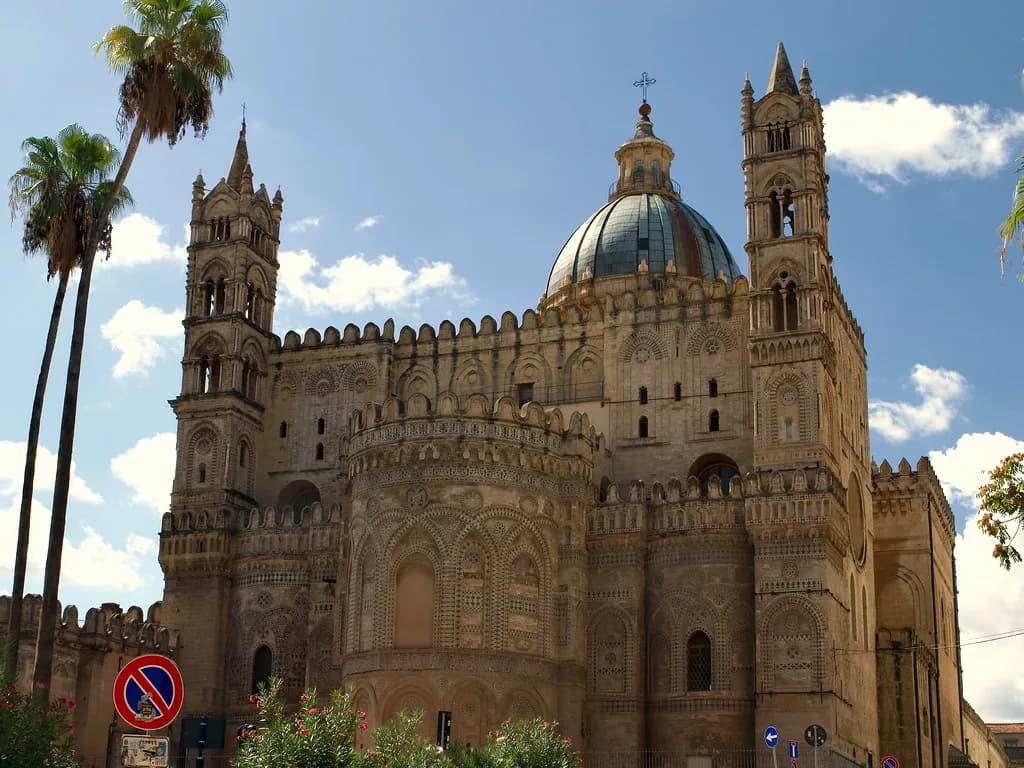
The Cathedral of Palermo stands a couple of minutes further down the street, a building whose domes, towers and battlements blend Greek, Roman, Catalan, Gothic, Arab and Norman elements into one composite exterior. Italia.it notes that the interior holds a treasury room with royal ornaments, including the golden tiara of Empress Constance of Sicily.
The practical decision is whether you want the church alone or the wider complex. One local guide is candid that the interior is less intricate than the churches you have just seen at Piazza Bellini, but rates the rooftop terrace as his favourite part of the visit, alongside royal tombs, treasury and crypts.
Those components are distinct choices, not one automatic experience, and the current scope and any charges should be confirmed at the cathedral itself or on its official pages before you commit. If the Palatine Chapel is still ahead of you, it is reasonable to keep the cathedral short and save your appetite.
Palazzo dei Normanni and the Palatine Chapel
This is the stop to protect. Palazzo dei Normanni, also called the Royal Palace, is described by Italia.it as the oldest royal residence in Europe and a UNESCO-listed jewel of Byzantine and Arab-Norman art, and it now serves as the seat of the Sicilian Parliament.
Inside, the Palatine Chapel is covered in golden mosaics made by Christian, Byzantine and Arab craftsmen, crowned by a Christ Pantocrator that most visitors remember longer than anything else in the city. Because the building is a working parliamentary seat, entry logistics can shift with institutional use, so confirm arrangements directly with the palace before you build your morning around it.
Between the Cathedral and the palace, Villa Bonanno's palms offer a shaded breather and a natural place to reset before the mosaics. For a broader comparison of what Palermo's sights demand of your time, browse the Palermo Attractions hub before fixing your priorities.
Lunch at Ballarò Market
Ballarò is the efficient lunch: the oldest of the city's markets and the direct heir of the souq that animated these alleys under Arab rule, according to Italia.it. Vendors call out their wares as you pass, which can feel confronting but is part of the theatre, and a local guide recommends it for the most authentic market atmosphere of the big three.
Street food is the sensible format when time is tight. Pane e panelle, chickpea fritters in a sesame bun, is the standard quick bite, and arancina, feminine in Palermo, is the rice ball to try next; pani ca meusa, the spleen sandwich, is for the curious. Further visitor details appear in A day in Palermo: 8 essential steps to discover the city - Italia.it.
Prices are posted at individual stalls rather than set citywide, so compare a couple of counters and pay what is displayed. Albergheria, the neighbourhood around the market, has its own character worth a look; our Albergheria neighbourhood guide covers it if you want to linger a little longer after eating.
Afternoon Fork: Theatre Architecture or Garden and Kalsa
After lunch the day splits, and you should choose one branch rather than attempting both. The architectural branch heads back up Via Maqueda to Teatro Massimo, inaugurated at the end of the nineteenth century and, per Italia.it, the largest opera house in Italy and the third in Europe, then continues to Teatro Politeama Garibaldi, a neoclassical building that now houses the Sicilian Symphony Orchestra Foundation.
The greener branch heads toward the Botanical Garden, laid out in the late eighteenth century and filled with cacti, mature trees and formal beds, then drifts into Kalsa. That neighbourhood is atmospheric in daylight, with narrow winding streets and street art, and rewards walking without a fixed destination.
Which to pick depends on what you have already seen elsewhere in Sicily. If you have had Baroque churches all week, the garden and Kalsa give you air and texture; if this is your only city stop, the two theatres tell you more about Palermo's self-image as a cultural capital.
Evening: Seafront Sunset or Villa Sperlinga
As the light softens, Italia.it suggests going down to the seafront for an aperitivo at sunset or a seafood dinner, whether at Mondello or the Molo di Sant'Erasmo. That is the simplest close to a walking day and needs no further planning.
If you prefer the inland, market-garden side of the city, Villa Sperlinga hosts a farmers' market on Saturday mornings where local specialities such as the late mandarin of Ciaculli and ancient-grain products are sold. It suits a slower evening or a following morning better than a tight one-day schedule, so treat it as an alternative rather than an addition.
What to Skip on a One-Day Visit
Skip anything that requires a detour off the Càssaro spine. Day trips to Monreale, Cefalù or Segesta, beach time at Mondello and long museum visits all eat the hours you need for the centre, and the Regional tourism site's own itineraries treat those as separate days, not add-ons.
Inside the centre, be ruthless about doubling back. If you visit the Norman Palace and Palatine Chapel, you can reasonably see the Cathedral briefly and leave its rooftop for another trip; if the rooftop is the priority, trim the church cluster instead. The one thing worth skipping entirely is the compulsion to see everything.
Readers with a second day should not try to stretch this route; our Palermo in two days itinerary handles the overflow properly, including the neighbourhoods and sights that a single loop cannot reach.
Plan Your Visit
Stay as central as you can, ideally within easy walking distance of Via Vittorio Emanuele, and plan to move on foot rather than relying on public transport to save time. Comfortable shoes matter more than any app on a route this compact.
If you would rather follow a fixed line than improvise, our self-guided historic centre walk pairs well with the morning half of this plan and keeps you on the same street. Print it or save it offline, since a phone battery is another thing a long walking day drains.
Finally, confirm the details that change, including cathedral and palace entry arrangements, directly with each site before you go. Everything else on this route is a matter of choosing well and walking steadily.
Frequently Asked Questions
Can you see Palermo in one day?
You can see a meaningful slice of the historic centre in a day, but not the whole city. The workable approach is to follow Via Vittorio Emanuele from Piazza Pretoria through the Cathedral and Norman Palace to Ballarò, choose one afternoon branch and accept that other sights wait for a return visit.
What is the one thing not to miss in Palermo in a day?
Palazzo dei Normanni and its Palatine Chapel deserve protected time, given the mosaics and the building's role as the seat of the Sicilian Parliament. Because it is a working institutional building, confirm current entry arrangements directly before building your morning around it.
Is this itinerary realistic for a cruise ship call in Palermo?
It can work if your port time is generous, but it is a suggestion rather than a guarantee. Tenders, transfers and all-aboard deadlines consume hours, so pick the morning cluster plus Ballarò as a minimum and drop the afternoon branch if your window is short. Check your ship's schedule and build in a buffer.
Should you visit the Palermo Cathedral roof or the Palatine Chapel if time is tight?
Choose the Palatine Chapel. The Cathedral's interior is less intricate than the nearby Piazza Bellini churches, while its rooftop, tombs, treasury and crypts are separate components best confirmed on site. With limited hours, the mosaics of the chapel offer more per minute.
Where should you stay in Palermo for a one-day visit?
Aim for somewhere within walking distance of Via Vittorio Emanuele, where the main sights line up along one street. Centrality beats hotel category on a short stay, because every minute spent crossing the city is a minute not spent in the centre.
What should you skip on a one-day Palermo itinerary?
Skip out-of-town trips to Monreale, Cefalù or Segesta, beach time at Mondello and any long museum visit. Inside the centre, avoid doubling back; if you have seen the Norman Palace properly, a short cathedral visit is enough.
Sources
Continue exploring
More guides you'll find useful