Self-Guided Renaissance Walk Through Mantua's Old Town
Walk Mantua's Renaissance centre on your own: Piazza Sordello, the Ducal Palace, Sant'Andrea, the Rotonda, Teatro Bibiena and where the Gonzaga plan survives.
On this page
Mantua rewards travellers who slow down. The historic centre is compact and flat, its squares linked by arcaded streets, and the whole city sits inside a ring of lakes formed by the Mincio River, so a walking loop rarely needs public transport. Treat the half-day length below as our suggestion for pacing, not an official route: a first pass through the core suits most visitors, while anyone who wants to go inside the main palaces should plan more time.
Why Mantua Suits a Slow Half-Day on Foot
Mantua's old town earned UNESCO recognition for its Renaissance architecture and town planning, and that plan is easiest to read on foot. Four interlinked squares sit within a few minutes of each other: Piazza Sordello, Piazza Broletto, Piazza delle Erbe and Piazza Andrea Mantegna, each framed by buildings from different centuries. Because the distances are short, a self-guided walk lets you linger where something catches your eye instead of following a group's pace.
The lakes that wrap the centre are part of the experience rather than a backdrop. Walking between squares, you repeatedly glimpse water at the ends of streets, and the shoreline paths give a break from stone and frescoes. If you want to extend the day beyond the Renaissance core, our guide to the hidden gems in Mantua covers quieter corners and lake-edge corners worth adding.
Free Squares, Ticketed Interiors: Know Before You Set Out
The most useful budgeting decision happens before you leave your hotel: public squares, the exterior of the basilica and a short look inside the Rotonda di San Lorenzo cost nothing, while the Ducal Palace and Palazzo Te are separate paid complexes with their own tickets. They are not one combined ticket, and each has its own opening rules, so decide which interiors you actually want rather than assuming a single pass covers everything.
For the paid stops, check the operator's own page on the day you plan to visit instead of relying on third-party listings or older blog posts. Mantua's municipal site publishes city notices and event listings that can affect a walking plan, from temporary library service limits to street works, and it is the sensible place to confirm that nothing in the centre is disrupted during your visit.
Start at Piazza Sordello: The Gonzaga Seat of Power
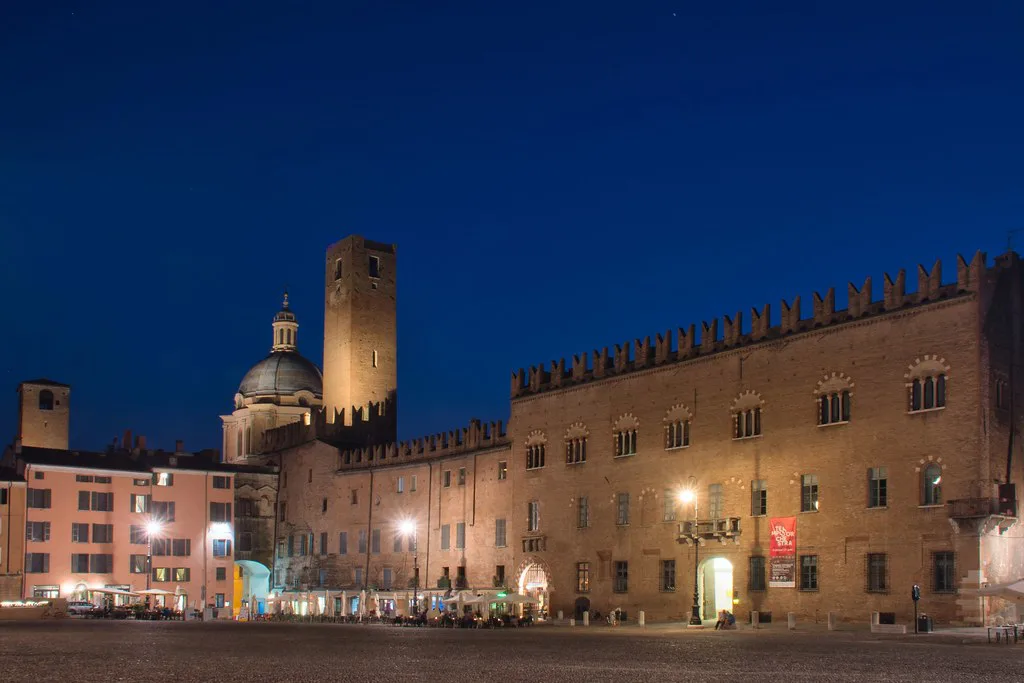
Begin where the Gonzaga family ruled. Piazza Sordello is Mantua's oldest square, flanked by the Ducal Palace, the Cathedral of San Pietro and the bishop's seat, and its scale tells you immediately that this was a court city rather than a trading commune. Stand back near the cathedral to take in the palace frontage before crossing toward the lake side, where the square opens onto views over the water.
The Ducal Palace complex is enormous, with hundreds of rooms, courtyards and gardens built up over centuries, and it is the single most rewarding interior in the city. Visiting properly takes at least a couple of hours, so decide now whether you go in today or leave it for a dedicated morning; trying to squeeze it into a coffee break shortchanges both the palace and the rest of the walk.
Optional Detour: The Ducal Palace and the Camera degli Sposi
If you opt for the palace, give the Camera degli Sposi its own slot. Andrea Mantegna painted the room in the Castello di San Giorgio between 1465 and 1474 with scenes of the Gonzaga court and a painted ceiling opening that simulates sky, and it is the reason many travellers come to Mantua at all. Because it is a small, fragile space, access is often managed in limited numbers, so confirm current entry arrangements with the museum rather than assuming you can walk straight in.
The palace holds far more than that one room. The Pisanello frescoes in the old court, the tapestries after Raphael's cartoons and the Gonzaga apartments reward a slow circuit, and the complex is large enough that a map helps. Set a realistic limit: pick two or three highlights, see them properly, and leave the rest for a return visit rather than racing through corridors.
Piazza Broletto and Piazza delle Erbe: Communal and Market Squares
Leave the palace behind and cross to Piazza Broletto, the medieval civic square ringed by thirteenth-century communal buildings, then continue to Piazza delle Erbe. Erbe takes its name from the old fruit and vegetable market, and its arcades, clock tower and the Romanesque Rotonda di San Lorenzo make it the liveliest point on the route. This is the natural place for a first pause.
The Rotonda di San Lorenzo is the oldest church in the city, an eleventh-century brick rotunda modelled on the Holy Sepulchre in Jerusalem, and it can be seen in a few minutes without a ticket. Its circular plan and reused ancient columns feel markedly different from the basilica you will visit next, which makes it a useful contrast rather than a duplicate stop. If the doors are open, step in quietly; it remains a place of worship.
Basilica di Sant'Andrea: The Architectural Climax
Walk through to Piazza Andrea Mantegna and the Basilica di Sant'Andrea, begun in 1472 to designs by Leon Battista Alberti. The facade fuses a classical temple front with a triumphal arch, and the vast single nave under a coffered barrel vault was modelled on ancient Roman precedent. Even from the square, the building demonstrates how Renaissance architects reworked antiquity for a Christian city. Related guide: Basilica di Sant'Andrea Mantua: A Visitor's Guide to Alberti's Church.
Inside, look for Mantegna's tomb and the crypt associated with the relic of the Blood of Christ, which has drawn pilgrims to Mantua since the Middle Ages. The church is free to enter as a working place of worship, but dress respectfully: shoulders and knees covered are the safe standard in Italian churches. Photography may be restricted in some areas, so follow any notices rather than assuming.
A Short Coffee or Lunch Pause
Take your break around Piazza delle Erbe or Piazza Mantegna, where cafes and restaurants line the arcades and squares. Keep it deliberately short, one coffee or a light lunch rather than a full sitting, so that the afternoon stays open for a palace visit or a lakeside walk. This is not the moment for a long tasting menu; save that for the evening.
If you would rather not choose on the spot, note a couple of options while planning and check their current hours yourself, since restaurant schedules in small Italian cities shift with the season and the day of the week. Mantuan cooking leans on pumpkin tortelli, sbrisolona almond cake and river fish, all of which make a satisfying but not heavy midday stop.
Teatro Bibiena and the Accademia: A Look-In
After lunch, head to the Teatro Scientifico Bibiena on Via Accademia, designed by Antonio Galli Bibiena in the late 1760s and decorated a few years later. Its bell-shaped auditorium in wood and monochrome decoration is a small masterpiece of eighteenth-century theatre design. Treat it as a look-in rather than a full visit, and check opening times or performance schedules in advance, as access depends on the theatre's own programme.
The story that gives the theatre its fame is musical: a young Mozart performed here in 1770, at thirteen, and the association is still the first thing Mantua tells visitors about the room. Whether you can see the auditorium on a given day depends on rehearsals and events, so have a fallback. If it is closed, the surrounding streets and the nearby Accademia quarter still merit the stroll.
Casa del Mantegna and the Southern Edge
Walk south-west from the centre toward Casa del Mantegna, the house Mantegna built for himself from 1476 around a circular inner courtyard. The geometry is the point: a square plan with a circle inscribed inside, echoing the painted oculus in the Ducal Palace. It now hosts temporary exhibitions and serves as a starting point for understanding the artist's life, so check what is on before making the walk.
This stretch shows how the Renaissance city extended beyond the tourist core. Between here, the Palazzo di San Sebastiano and the Tempio di San Sebastiano, the streets are wider and quieter than around the squares, and the walk takes you through ordinary residential Mantua rather than a museum set piece. It is a good place to notice how the Gonzaga plan knitted palaces, churches and gardens into the urban fabric.
Palazzo Te: A Separate Half-Day Extension
Palazzo Te is a different visit, not an extra stop on the centre walk. Giulio Romano designed this pleasure villa for Federico II Gonzaga, and its Hall of the Giants and Chamber of Cupid and Psyche are among the most theatrical frescoes in Italy. The centre and the palace are about a kilometre apart, so plan either a twenty-minute walk or a short ride rather than trying to bolt it onto a coffee break.
The operator publishes the practical details on its own visit page, so use those rather than secondhand summaries. As of 2026 it lists standard hours of 9am to 7pm Monday, 1pm to 7pm Tuesday and 9am to 7pm Wednesday to Sunday, with last entry one hour before closing and closure on 25 December, open on other holidays. Tickets are priced separately, with a full-price ticket also covering the MACA museum and the Tempio Leon Battista Alberti, and a combined ticket is available with the Sonnabend Collection. Confirm all of this on the operator page before you travel, since prices and hours change.
Where the Gonzaga Urban Plan Still Reads Clearly
The clearest evidence of Renaissance planning is not a single monument but the sequence of squares and porticoes you have just walked. Arcaded streets link the civic, market and ecclesiastical centres in a deliberate order, and the lakes that fortify and frame the city still shape how you move through it. Walk one stretch of the shoreline at the end of the day to see the city as the Gonzaga would have approached it, from the water.
Look also at how buildings of different eras sit side by side without a break: medieval communal palaces, Renaissance churches and eighteenth-century theatres share the same few hundred metres. That continuity is the real lesson of a self-guided walk, and it is why Mantua rewards a second pass over the same streets at a different time of day.
Practical Pacing and What to Skip
Wear shoes suited to cobblestones, carry water in warm months, and keep a light layer for churches and air-conditioned museum rooms. If time runs short, cut the Casa del Mantegna detour and the theatre interior first; the squares, the basilica and the Rotonda give the fullest picture of the Renaissance core in the least time. Skip Palazzo Te entirely on a half-day and give it a separate visit.
Before setting out, confirm the opening days of anything you plan to enter, because Italian museum schedules vary and individual sites close on different weekdays. The Ducal Palace, for instance, has historically closed on Mondays, but verify current arrangements rather than trusting an old listing. Build in a buffer: the pleasure of this walk is in the pauses, not in ticking off every doorway.
Plan Your Visit
Mantua's Renaissance centre fits comfortably into a slow half-day, with the Ducal Palace and Palazzo Te as separate, ticketed visits that deserve their own time slots. Start at Piazza Sordello, work through the communal and market squares to Sant'Andrea, and finish near the theatre or the lakeshore. Check the operator pages for the palaces and the municipal site for city notices before you go, and let the rest of the day unfold at walking pace.
Frequently Asked Questions
Do I need tickets for the squares and the Rotonda di San Lorenzo?
No. The squares are public spaces, and the Rotonda di San Lorenzo is a working church that you can normally step into without a ticket. The Ducal Palace and Palazzo Te, by contrast, are separate paid museum complexes with their own admission rules, so budget for them if you want to go inside.
Can I visit both the Ducal Palace and Palazzo Te in a single half-day?
It would be very rushed. Each complex deserves several hours, and they are roughly a kilometre apart, so combining them properly takes most of a day. For a relaxed half-day walk, choose one interior or save both for a full day.
Is the Teatro Bibiena always open to visitors?
Not necessarily. It is a working theatre, so access to the auditorium depends on rehearsals and performance schedules. Check the theatre's current opening arrangements before you go, and keep it as an optional look-in rather than a guaranteed stop on the route.
Sources
- Comune di Mantova
- Mantua City Centre Walking Tour
- Marvelling at Mantua’s Palazzo Ducale : European Waterways Marvelling at Mantua’s Palazzo Ducale
- Palazzo Ducale and Palazzo Te in Mantua: why visit them | ItaloBlog
- 29 Crazy and offbeat roadside attractions in Mantua
- Top Attractions In Mantua, A Renaissance Marvel In Northern Italy - The Geographical Cure
- Basilica of Sant'Andrea (Mantua)
- Visit Mantua Italy ⭐️ Best Things to Do and See in 2026
- Casa del Mantegna — Google Arts & Culture
- Mantova Guide | Martha's Italy
- Art galleries in Mantua: guide and map – Alpha Reproduction
- Visit - Palazzo Te
Continue exploring
More guides you'll find useful