Treviso Viewpoints and Sunset Spots: Canals, Walls and Squares
A slow Treviso guide to water-level canal views, Renaissance walls and arcaded squares, with suggested evening timing and museum hours to check first.
On this page
Treviso is a compact city in the Veneto plain, and much of its historic centre is pedestrianised, with narrow arcaded and cobbled streets threading between waterways and squares. For a short walk in this setting, one guide describes the canal loop as a leisurely stroll of roughly forty-five minutes. Treat that as a planning suggestion rather than an official timing, then shape the rest of your evening around it.
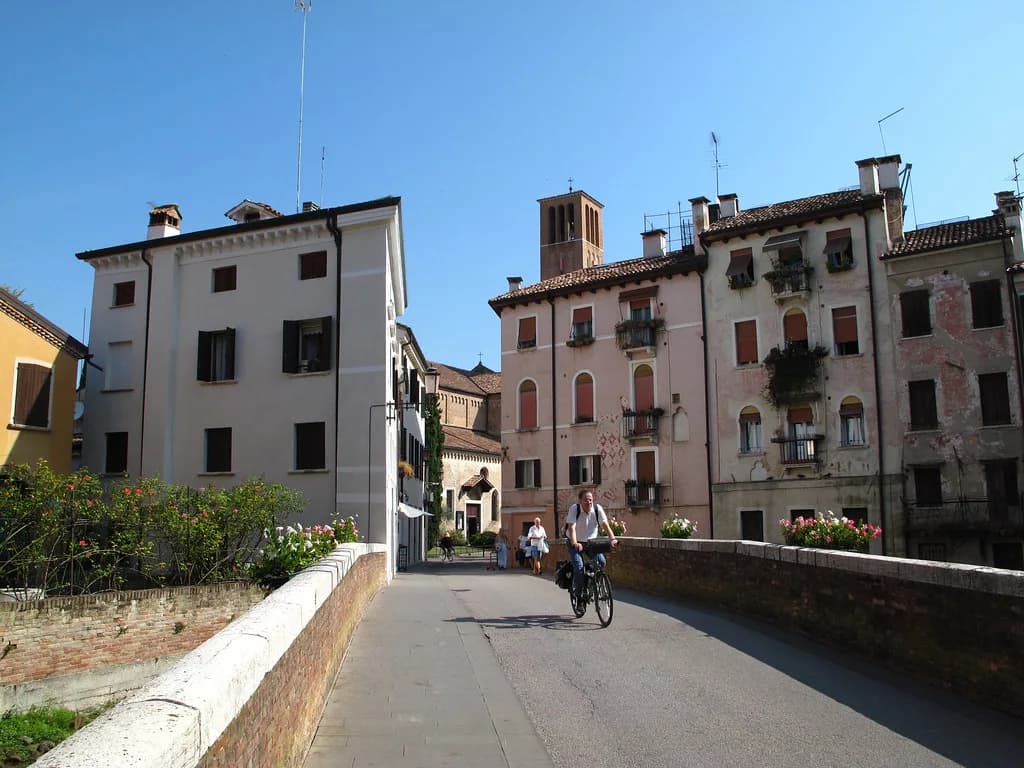
Rather than one grand belvedere, the city offers three viewing layers: green canals at water level, the 16th-century walls and gateways above the streets, and the arcaded squares that form the social heart of the old town. The Canale dei Buranelli takes its name from the Venetian fishermen of Burano who once came here to trade, and its streets are linked by wrought-iron bridges, with red-brick Renaissance palaces and an old decorative water wheel along the way.
Expect intimate, low-angle scenery rather than sweeping vistas, and comfortable shoes rather than hiking gear. The timing and light suggestions below are editorial starting points; confirm museum hours and any current conditions yourself before setting out.
What Kind of Viewpoints Treviso Actually Offers
Treviso's canals differ markedly from Venice's. One visitor's account notes that most of them run perpendicular to the streets, are much shallower, and support no gondolas or boat traffic, yet look clean and clear, with plant life, waterfowl and swans visible in the green-tinted water. That shapes what a canal viewpoint gives you: reflections, water wheels and facades, not aquatic processions.
Above the canals, the historic centre was fortified in the 16th century under Venetian rule, and the walls and bastions now offer a route around the old town punctuated by three grand gateways. That ring is less a summit experience than a continuous edge-of-town perspective over streets and rooftops.
The third layer is the square. Piazza dei Signori is framed by several palaces, including the Palazzo dei Trecento and the Palazzo del Podestà with its civic tower, and it functions as the city's historical and social heart. At dusk its appeal is architectural and human rather than panoramic, which is worth knowing if you arrive expecting a conventional viewpoint.
None of these places is secret or empty in any meaningful sense, though Treviso sees far fewer visitors than its famous neighbour. That usually means you can linger at a bridge or gate without being hurried along, but not that you will have the scene to yourself. No viewing platforms are documented in the sources consulted.
How to Plan an Evening Around the Light
The practical way to sequence an evening is by light. Water surfaces pick up low, warm light, so canal bridges and the Cagnan water wheels suit the later afternoon. Brick walls and gateways hold colour longer, and arcaded squares work at almost any hour because the porticoes provide shade as well as outward views.
Because the canals are shallow and the lanes narrow, direct sun reaches the water only in patches. A canal walk is therefore less about one wide-open sunset than about watching the light shift across facades and reflections, so allow time to move along a short stretch rather than waiting at a single fixed spot.
Conditions change through the year, so check a local forecast and the day's light before committing. The city's tourism portal publishes current events and listings. If cloud is forecast, keep the museums in reserve and shift the walk earlier.
Treviso's centre mixes pedestrian lanes with regular roads shared with cars, bikes and buses, so step clear of the carriageway before stopping to photograph a bridge or gate.
Water-Level Views: Canals and Water Wheels
Start in the Buranelli district, where the streets are connected by wrought-iron bridges and lined with the occasional Renaissance palace and old water wheel, with cafés and restaurants nearby. Try to arrive while there is still daylight to read the water's green tint and the masonry along the banks.
For the water wheels, head to the small island in the Cagnan that hosts the fish market. One guide notes that the current covered market building dates from 1856, that wheels are visible on both sides, and that weeping willows hang over the canals; surrounding streets hold wine bars serving small plates. Those practical details come from a third-party guide, so verify current conditions on arrival.
The canal loop is described as taking about forty-five minutes at a leisurely pace, with early morning or late afternoon suggested for photography. Again, that is a workable planning suggestion rather than a rule, since light quality varies with season and weather.
The most-photographed corner is where the Cagnan and Roggia canals meet near the fish market, close to the Ponte di Pria stone bridge. Pick one bridge and stay put for ten minutes rather than rushing between them, and pair the spot with a broader look at the riverside. For wider planning, see Ponte di Prato and Treviso's Riverside.
Piazza dei Signori and the Arcades at Dusk
Piazza dei Signori rewards more than a photo stop. The Palazzo dei Trecento anchors the square with a brick facade and battlemented roofline in medieval Veneto style, and the square is ringed with cafés. That combination makes it the natural hinge between a canal walk and a gate stroll.
Look for smaller details too. The Loggia dei Cavalieri, a 13th-century arcade on Via Martiri della Liberta, retains traces of 14th-century frescoes and often hosts temporary exhibitions; it sits about 100 metres from the square. A short detour costs little and gives you another shaded, low-angle view of the centre.
In the lanes nearby you can find the Fontana delle Tette, tucked into a portico close to the piazza, where a visitor noted you can drink the water. Treat the surrounding arcades as part of the experience rather than ticking off a single landmark; walking them as evening falls gives cover from sun or rain and repeated glimpses back into the square.
Via Calmaggiore links the square with Piazza del Duomo, so it makes a natural continuation if you want a second open space before the light goes. Keep the pace slow and let the arcades set the rhythm.
The Walls and Gates: Reading the Fortifications
The most impressive entrance to the old town is Porta San Tomaso, described as by far the finest of the three grand gateways. Starting there gives a clear sense of scale before you explore the neighbouring bastions, and the walls and bastions together make a picturesque walking route around the historic centre.
Two other monumental gates survive alongside it: Porta Santi Quaranta to the west and Porta Altinia to the southeast. One guide notes a tree-lined walkway along the northern and western sections, with a route heading west from Porta San Tomaso for about a kilometre. Access can change, so treat this as a route sketch to check locally rather than a guarantee.
For a water-and-wall combination, the Sile runs along the south edge of the walled city and looks as green and planted as the smaller canals, with a riverside stretch linking the walls to parks and willow-lined banks. Walking part of it after the gates gives a second take on the same light at water level.
A Suggested Evening Walking Order
Begin near the railway station or Ponte San Martino and follow Corso del Popolo towards the centre, arriving first at Piazza dei Signori with its Gothic civic buildings. From there the Via Calmaggiore axis leads to Piazza del Duomo, a natural spine for the middle of the walk.
Continue to the canals and cross the Ponte di Pria before the light drops, then loop through the Buranelli to the fish-market island while the water still holds the afternoon brightness. Finish with a gate and, if energy allows, a short stretch of wall before returning through the arcades to the square.
If you prefer a fixed line to improvising at each junction, a step-by-step route through the waterways helps you connect the bridges and frescoed facades without doubling back. Either way, leave slack for a second pass along the canal once the light warms. For wider planning, see Treviso Self-Guided Canal Walk.
Allow roughly two to three hours for an unhurried version, adjusting as daylight dictates. This is a suggested duration, not an official one.
Museo di Santa Caterina: A Light-Independent Backup
If cloud or rain spoils the walk, the Civic Museums are a solid substitute. The Santa Caterina complex occupies a former 14th-century church and convent, and its collection includes the fresco cycle of the life of St Ursula by Tomaso da Modena alongside works by Titian, Pietro Longhi and Tiepolo. The restored architecture is part of the draw.
The operator publishes its visiting hours clearly. Museo Santa Caterina and Museo Luigi Bailo are open Tuesday to Sunday from 10:00 to 18:00 and closed on Monday, while Casa Robegan opens only during temporary exhibitions. Check the operator page before planning around these, as programming changes.
Do not assume one ticket covers everything. The civic museum system comprises separate sites, and admission details and guided-tour information are published by the museums. Confirm the current arrangement on the day rather than relying on older accounts of prices, and check whether a temporary show changes what is on view.
For a longer indoor programme, a dedicated rainy-day route helps you sequence museums and covered arcades sensibly across an afternoon.
What to Expect Instead of a Panorama
The main planning mistake is arriving in Treviso expecting a scaled-down Venice. The canals are shallower, run perpendicular to many streets and carry no boat traffic, so there are no gondola-style views. Once you accept that, the waterways feel like an intimate experience rather than a compromise.
Another is treating the city as a checklist of piazzas and churches. Treviso is better suited to meandering through side alleys and lingering over a long lunch than to racing between landmarks, which is just how it differs from a day trip to its neighbour.
Resist the strongest sense of the hidden-gem label. Treviso is quieter, not undiscovered, and its squares and canal corners are well known to residents and visitors alike. For a deeper look at lesser-known corners, browse the wider set of sights. For wider planning, see Hidden Gems in Treviso.
Wider Views Nearby: The Prosecco Hills
For genuinely open landscape, look beyond the city. The Prosecco wine route starts in Treviso and runs towards Valdobbiadene, passing through the hills of Conegliano and Valdobbiadene within about 30km of the city. Those are separate places, not city districts, so treat the area as a day out rather than an evening stroll.
Expect vineyard-covered slopes rather than a single designated viewpoint, and give the trip enough time to feel unhurried. Check current timetables and service details yourself rather than relying on older accounts.
In the opposite direction, the Treviso-Ostiglia greenway follows an old railway line for around 50km through the Veneto landscape, with detours possible to Palladian villas. It is a rambling route rather than a town viewpoint, so bring a map and plan your return before setting off.
Practical Timing and Comfort Notes
Cobbled lanes and arcaded streets are part of the charm and part of the challenge, so wear shoes you can walk in for a couple of hours. Carry water in warm months, since stone and water reflect heat and open shade is limited, and take a light layer for when the sun drops.
Crowds vary with season and hour. Treviso is generally calmer than Venice, but the main square and canal bridges draw people at popular times. If you want quieter conditions, plan around early mornings or midday heat rather than the busiest afternoons, and check a separate guide to timing and crowds for seasonal patterns.
Verify before you go. Museum hours, temporary exhibitions and event programming change through the year, and the tourism portal lists current events. Check those pages the day before rather than relying on a guide written months earlier.
Plan Your Treviso Evening
Treviso's viewpoints work best as a sequence rather than a destination: canals first for reflections, the square as a hinge, and the gates and walls as the closing act. None of them is a grand belvedere, and that is precisely the appeal of an evening here.
Keep the plan flexible. Check current museum hours if you want a fallback, confirm conditions on the day, and treat the light advice as a starting point. With that in place, the city's green canals and brick gateways do the rest.
Frequently Asked Questions
Does Treviso have good viewpoints for sunset?
Treviso is not a city of panoramic terraces. Its evening views come from three layers: canal bridges and water wheels at water level, the Renaissance walls and gateways above the streets, and arcaded squares such as Piazza dei Signori. Which works best depends on the light on the day, so treat any recommendation as a suggestion and check conditions before setting out.
Where do you see the water wheels near the fish market?
The water wheels sit around the small island in the Cagnan river that hosts Treviso's fish market, with wheels visible on both sides and the Ponte di Pria stone bridge close by. The surrounding streets have wine bars and small eateries. The island and bridges are worth a look outside market hours too.
Can you walk on Treviso's city walls?
Parts of the wall circuit are walkable, and one guide notes a tree-lined walkway along the northern and western sections, with a route heading west from Porta San Tomaso for about a kilometre. Conditions and access can change, so check locally before planning a walk along the walls.
Do you need tickets to see Treviso's squares and canals?
The squares and canal-side streets are open public spaces with no entry requirement. The civic museums do charge admission, and the operator publishes current arrangements for its separate sites. Check the official museum pages rather than relying on older accounts of prices.
What can you do in Treviso on a cloudy evening?
The Civic Museums are the obvious fallback. Museo Santa Caterina and Museo Luigi Bailo are open Tuesday to Sunday from 10:00 to 18:00 and closed on Monday, while Casa Robegan opens only during temporary exhibitions. Confirm hours and current exhibitions on the operator site before you travel.
Is Treviso like a smaller Venice?
Not in the way that phrase suggests. Treviso's canals are shallow and run perpendicular to streets, and they carry no gondolas or boat traffic. The city is quieter and spread out like a typical mid-sized European town, so expect intimate canal corners and arcaded squares rather than grand waterway vistas.
What is close to Treviso if you want wider landscapes?
The Prosecco hills around Conegliano and Valdobbiadene lie within roughly 30km of Treviso and offer vineyard-covered slopes rather than urban viewpoints. The Treviso-Ostiglia greenway, following an old railway line for about 50km, is another option for longer walks. Both are day-out territory; check current transport and routes yourself.
How long do you need for the main viewpoints?
A focused evening walk linking the canal area, Piazza dei Signori and one gateway fits comfortably into two to three hours at an easy pace, as an editorial suggestion. Add time if you want to linger at the water wheels or walk a stretch of the walls; the canal loop alone is described as roughly forty-five minutes at a leisurely pace.
Sources
- Treviso Travel Guide - Reasons to Visit this City Near Venice | Tuscany Now & More
- Treviso, Italy: A Visitor's Guide For Mindful Travelers - Caffeinated Excursions
- Platz der Signori – Wander- & Radrouten | Komoot
- Things to Do in Treviso - The Weather Guide
- Musei Civici Treviso - Sito Ufficiale dei Musei civici di Treviso
- Hotel Treviso Alberghi bed and breakfast B&B ristoranti treviso agriturismi
- A slow trip to Treviso, the treasure chest of good living - Marcadoc
Continue exploring
More guides you'll find useful