Palazzo del Podestà Treviso: History and Visiting Notes
Understand Palazzo del Podestà in Treviso: its role on Piazza dei Signori, the civic tower above it, and how to pair the square with canals and museums.
On this page
Palazzo del Podestà rarely tops a Treviso itinerary, and that is precisely the point. It reads best as one side of Piazza dei Signori, the square locals treat as an open-air salon, rather than as a monument you queue for. Once you understand what the building was for, the whole piazza becomes legible.
Treviso sits roughly 26 to 30 kilometres from Venice depending on which source you follow, and its compact centre, progressively pedestrianised since 2017 according to Eupedia, makes this cluster easy to explore on foot. The payoff is a civic ensemble that rewards ten minutes of looking over a checklist of interiors.
Set the Scene: Piazza dei Signori as Treviso's Living Room
Piazza dei Signori functions as Treviso's social and political heart, framed by arcades that shelter cafés and shops in any weather. The square is paved with local stone and reads as a single composition rather than a collection of separate attractions. Eupedia notes that locals gather here for the evening passeggiata, which makes the square a good place to start rather than a stop to tick off.
One traveller's account describes the piazza as home to a large building that actually serves as city hall, with shops and restaurants on all sides. Komoot's listing adds that the square takes its name from the palaces of the old seignory that ring it, including the Palazzo del Podestà, Palazzo dei Trecento, Palazzo Pretorio and Palazzo della Prefettura. Seeing them together explains more than studying any one facade in isolation. Start in the middle of the square and turn slowly; the civic story is in the relationship between the buildings.
What the Palazzo del Podestà Was For
The Palazzo del Podestà served as the residence and administrative base of the podestà, the governor appointed to run the city. According to ATVO's city guide, the office came with a deliberate restriction: by ancient law the podestà could be neither a Treviso native nor from neighbouring territories, a safeguard intended to keep governance impartial. He moved in with his entire entourage, effectively creating a self-contained administrative centre inside the city.
That detail is the most useful thing to carry with you when you look at the building. The palazzo is not primarily a family palace or a church; it is an instrument of imported authority layered onto a proud local commune. Treviso's wider story follows the same arc, from an independent commune to four centuries under the Venetian Republic, as Eupedia's history section sets out. For wider planning, see Treviso Attractions: Visitor Guides to 11 Sights.
The Torre Civica: The Square's Orientation Landmark
Behind the Palazzo del Podestà rises the Torre Civica, described by ATVO as the tallest tower in Treviso. Its battlemented crown makes it the unmistakable landmark of the square, visible from several points in the historic centre. If you need one fixed point while wandering the arcades, this is it.
Eupedia notes that the tower's large clock face has marked the hours of Treviso life since medieval times, and it still anchors the piazza's daily rhythm. Photograph it from the far end of the square, then walk closer to see how the palazzo and tower sit together as one composition. The pairing is the reason the piazza works as an orientation point for the whole centre.
Reading the Architecture and Fresco Tradition
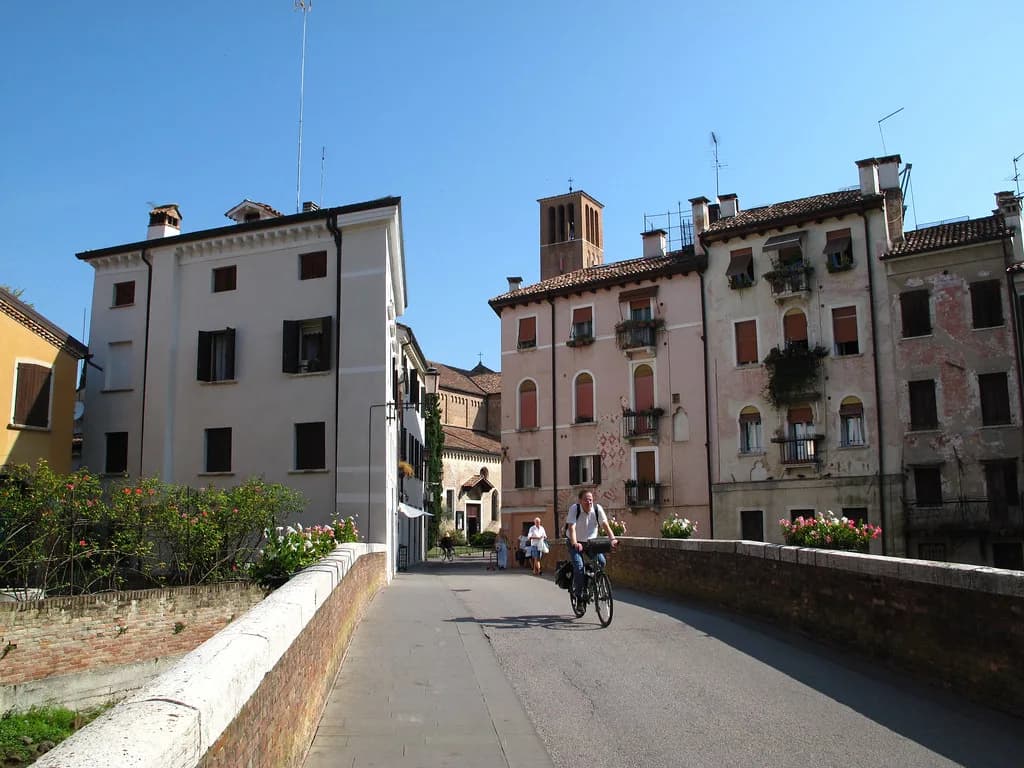
Eupedia describes the historic centre as red-brick palaces, arcaded ground floors and faded frescoes on upper facades. ATVO singles out the Palazzo del Podestà's elegant red-brick exterior within that same vocabulary, and the piazza as a whole shows how medieval and Renaissance layers accumulated over centuries. Look up above the arcades, where the painted decoration survives best in fragments.
The city's great fresco cycle by Tommaso da Modena belongs to the churches and museums, not to this palazzo, so treat the piazza as an introduction to that tradition rather than the main event. Avion Tourism notes that the Museo di Santa Caterina holds the fourteenth-century Cycle of St Ursula by Tommaso, which is the deeper dive. Seeing the exterior first makes the indoor works easier to place.
What You Can Realistically See From Outside and Inside
The sources describe the piazza ensemble in detail but do not confirm that the Palazzo del Podestà's interiors are open to visitors, so plan on admiring it from the square. That is not a loss: the facade, the arcades and the tower against the sky are the experience. If interior access matters to you, check with the city's official channels before you travel rather than assuming.
The square itself is public space, and simply being in it is the visit. Komoot's listing states that there are no entrance fees or permits required to visit Piazza dei Signori, and describes the flat, paved terrain as generally considered wheelchair accessible. Treat that as a community note rather than an operator guarantee and confirm current conditions yourself.
The Neighbours: Palazzo dei Trecento and Its Wartime Scars
On the western side of the piazza stands the Palazzo dei Trecento, built in the early fourteenth century as the meeting place of the Council of Three Hundred. Eupedia describes its crenellated facade and large arched windows as the most imposing civic statement on the square, and notes that the building survived bombing damage during the Second World War and was carefully restored.
ATVO reports that thirteenth-century frescoes inside still bear the scars of that wartime damage, which makes the building unusually direct about its own history. It is worth pairing with the palazzo next door so you see civic authority and civic resilience side by side. The Palazzo Pretorio, with its more refined Renaissance lines, completes the group.
One Walkable Sequence: Calmaggiore, the Fountain and the Duomo
From the piazza, follow Via Calmaggiore, the porticoed street that links the civic heart to Piazza del Duomo. Eupedia notes that its name derives from Callis Major, marking it as the main thoroughfare since Roman times, and that its continuous arcades shelter you whatever the weather. This is the natural continuation of a piazza visit.
Tucked into the courtyard of Palazzo Zignoli off Calmaggiore is the Fontana delle Tette, a curious female bust fountain described by ATVO. Tradition holds that during celebrations for a new mayor it once dispensed red and white wine to the public; the fountain standing there now is a reconstruction, with the original preserved in the Palazzo dei Trecento. Read it as history and civic folklore, not as a current service.
At the end of Calmaggiore, ATVO describes the Duomo as combining Romanesque, Gothic and Neoclassical elements, with Titian's Annunciation inside. The sequence from piazza to portico to cathedral gives you a compact cross-section of the city's civic and religious architecture in one unhurried walk.
Water and Walls: Extending the Walk
When you have had enough of the piazza, head for the Canale dei Buranelli, where wrought-iron bridges connect streets lined with red-brick Renaissance palaces and an old decorative water wheel. Tuscany Now & More, which calls this stretch the most beautiful waterway in Treviso, explains the name through the Venetian fishermen of Burano who once traded here. It is a quieter, more domestic face of the city than the civic square.
The Isola della Pescheria, a small island in the Cagnan river reached by two bridges, has hosted the city's fish market since at least the fifteenth century, according to Eupedia. Arrive in the morning to see it working rather than empty. Tuscany Now & More describes a seafood market running every morning except Monday, with fruit and vegetable stalls selling local produce including radicchio, so check current trading days before you build a morning around it.
Treviso's sixteenth-century walls, built under Venetian rule, now serve as a green walking route around the old town. Eupedia names three monumental gates on the circuit: Porta San Tomaso, Porta Santi Quaranta and Porta Altinia, and describes Porta San Tomaso as a triumphal arch of Istrian stone built in 1518. That makes it a natural end point for a loop back to the centre.
Nearby Ticketed Collections: Separate Visits, Not Add-Ons
The Museo di Santa Caterina and the Museo Luigi Bailo are separate civic museums, each with its own visit. The official Musei Civici site lists both Santa Caterina and Bailo as open Tuesday to Sunday from 10:00 to 18:00, closed Monday, and notes that Casa Robegan opens only for temporary exhibitions. Santa Caterina occupies a former fourteenth-century church and convent; Avion Tourism lists paintings there from the fifteenth to the nineteenth centuries, including Lorenzo Lotto, Titian, Giovanni Bellini and Jacopo Bassano.
Both museums sit inside the city walls and can be reached on foot from the piazza, but their ticket prices and any combined offers change, so check the official museum site before setting out. Do not assume one ticket covers both, and do not plan your day around a price you read in an older blog. The museum site is the place to confirm current visiting information for each venue. Further visitor details appear in Musei Civici Treviso - Sito Ufficiale dei Musei civici di Treviso.
Best Time and Pace: Linger, Don't Tick Off
The piazza rewards lingering over checklist tourism. Morning brings the market rhythm around the Pescheria and a quieter square; evening brings the passeggiata, when locals gather at the cafés under the arcades. Either way, budget more time than you think you need for the square itself and let the surrounding streets fill the rest. As a rough editorial suggestion, allow about half an hour on the square and a couple of hours for the wider walk; that is our advice, not an official timing.
For seasonal context, the local Treviso info site lists dated events such as the Fiere di San Luca, which it reports running until 25 October 2026. Dates shift year to year, so confirm current editions rather than relying on a remembered date. The calendar is a planning aid, not a guarantee of what will be running when you arrive.
Common Mistakes to Avoid
The most common error is treating Treviso as a small Venice substitute. As one visitor's comparison explains, the city's canals are shallower, the water runs clear and green, and the canals do not support gondolas or other boat traffic; the pleasure is walking beside them, not cruising. Approaching the city on its own terms is what makes a visit work.
The second mistake is rushing the piazza on the way to somewhere else. Give the ensemble half an hour of unhurried looking, then let Calmaggiore, the fountain courtyard and the Duomo follow naturally. The third is assuming every palace interior is open; sources confirm the square's public spaces but not the interiors of each building, so verify before relying on access.
Finally, do not repeat the tiramisu origin story as settled fact. Tuscany Now & More states plainly that the origins are uncertain, while noting the popular theory tracing the dessert to Le Beccherie in 1969. Enjoy a slice and treat the story as part of the local lore rather than a proven record.
Plan Your Visit
Treat Palazzo del Podestà as the key to reading Piazza dei Signori, then let the square lead you onward. A sensible plan is to arrive mid-morning, study the palazzo and tower from the piazza, walk Calmaggiore to the Duomo, then head for the Buranelli canal and the Pescheria. Finish with the walls and a gate if you have the energy.
Before you go, confirm museum hours and prices on the official sites, check whether any interior you care about is open, and verify event dates rather than trusting older listings. The hidden gems in Treviso and the city's attraction guides reward the traveller who slows down and looks around the square rather than through it.
Frequently Asked Questions
Can you go inside the Palazzo del Podestà in Treviso?
The available sources describe the building as part of the Piazza dei Signori ensemble but do not confirm that its interiors are open to visitors. Plan on admiring it from the square, and check directly with the city's official channels if interior access matters to you.
What was the Palazzo del Podestà used for?
It was the residence and administrative base of the podestà, the governor appointed to run the city. According to ATVO, the governor could not be a Treviso native or come from neighbouring territories, and he moved in with his entourage, making the building a self-contained administrative centre.
What is the tall tower on Piazza dei Signori?
The Torre Civica rises behind the Palazzo del Podestà and is, per ATVO, the tallest tower in Treviso. Its battlemented crown makes it the square's most identifiable landmark, and Eupedia notes that its large clock face has marked the city's hours since medieval times.
How long should you spend in Piazza dei Signori?
As an editorial suggestion rather than an official timing, allow at least half an hour of unhurried looking at the square itself, then add time for Calmaggiore, the fountain courtyard and the Duomo. If you continue to the Buranelli canal and the Pescheria, the whole walk can easily fill a morning or an afternoon.
Is Piazza dei Signori free to visit?
The square is public space, and Komoot's community listing states that no entrance fees or permits are required to visit it. Museums and interiors around Treviso are separate and may charge, so check each site before you go.
What else is worth seeing near the Palazzo del Podestà?
On the same square are the Palazzo dei Trecento, the Palazzo Pretorio and the Palazzo della Prefettura. A short walk away are Via Calmaggiore, the Fontana delle Tette courtyard, the Duomo with Titian's Annunciation, the Canale dei Buranelli and the Isola della Pescheria fish market.
Why is Treviso called Little Venice?
Treviso is nicknamed Little Venice because of its network of canals winding through the historic centre. The comparison is loose: as one visitor's account points out, Treviso's canals are shallower and greener and do not carry boats, so the city has its own character rather than being a smaller version of Venice.
Sources
- Treviso Travel Guide - Reasons to Visit this City Near Venice | Tuscany Now & More
- Treviso Travel Guide - Italy - Eupedia
- What to See in Treviso: 7 Unmissable Attractions | ATVO
- Treviso, places to visit?
- Treviso, Italy: A Visitor's Guide For Mindful Travelers - Caffeinated Excursions
- Platz der Signori – Wander- & Radrouten | Komoot
- myPortal | Comune di Treviso
- Musei Civici Treviso - Sito Ufficiale dei Musei civici di Treviso
- Hotel Treviso Alberghi bed and breakfast B&B ristoranti treviso agriturismi
Continue exploring
More guides you'll find useful