Ponte di Prato Treviso: Stone Bridge, Fish Market & River Walk
Plan a slow walk around Treviso's Ponte di Prato, the Pescheria fish market island and the Sile and Cagnan canals, with squares, food stops and museum tips.
On this page
The Ponte di Prato area is not a single monument you tick off and leave. It is the point where Treviso's water, its old market island and its arcaded lanes fold into each other, so the sensible approach is a slow loop rather than a targeted photo stop. Allow roughly two hours for the bridge, the fish market island, the canals and Piazza dei Signori at an easy pace; that duration is a practical suggestion, not an official figure.
Treviso sits about 26 kilometres from Venice and is often treated as its quieter neighbour, with a pedestrianised historic centre and a network of canals crossed by wrought-iron bridges. The city is the capital of a province known for Prosecco and radicchio, and its food and drink are reason enough to linger once the walking is done.
What the Ponte di Prato Area Actually Is
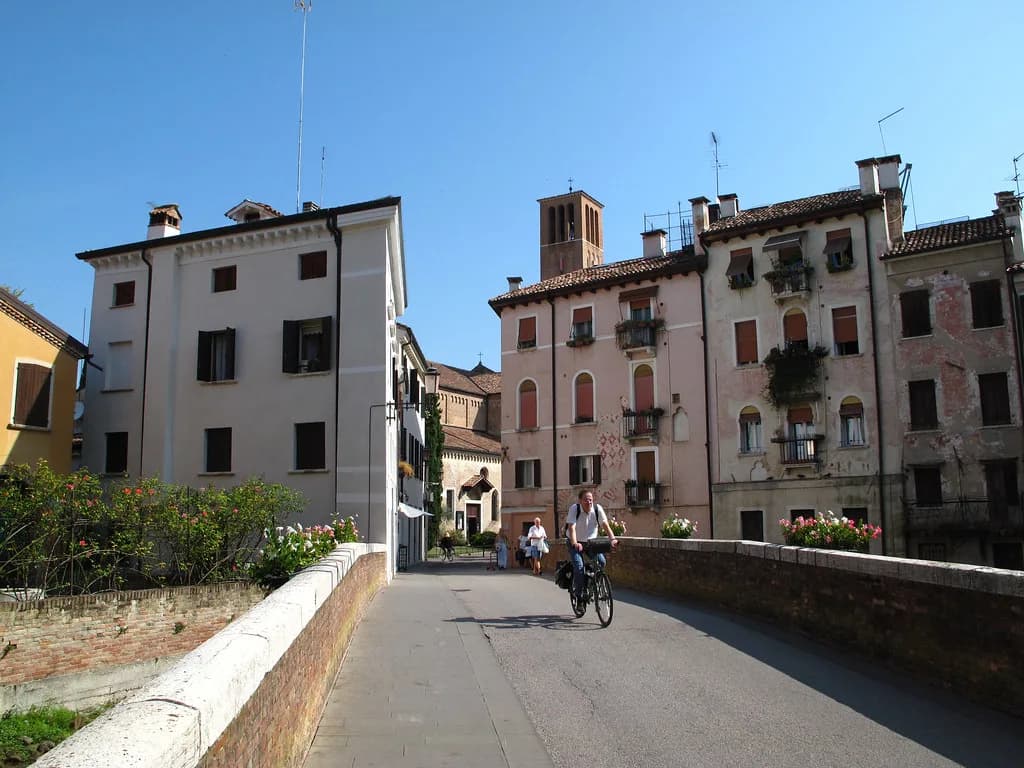
Treat the bridge, the riverbank and the Pescheria island as one continuous sight. The water you are walking beside is the Sile, which runs along the south edge of the walled centre, feeding the smaller canals that thread between the streets. Because everything sits within a compact pedestrian core, you can see the bridge, the market island and a main square without planning transport in between.
This is also why the area rewards a wander rather than a checklist. Streets around the canals are narrow and often arcaded, with occasional red-brick Renaissance facades and an old decorative water wheel still in place. Look up as much as down: faded frescoes survive on facades in the historic centre, a reminder that Treviso was once nicknamed the painted city.
Orienting Yourself: Sile, Cagnan and the Pescheria Island
Start from Piazza dei Signori, the social heart of the old town, ringed by palaces including the Romanesque Palazzo dei Trecento and the Palazzo del Podestà with its civic tower. From here the lanes lead quickly down to the water, so the square works as a natural anchor for the walk in either direction. The square is public ground and free to enter, which makes it a useful meeting point before you set off.
The fish market sits on Isola della Pescheria, a small island in the Cagnan river reached by a short bridge, with the street alongside known as Via Pescheria. It is a compact, photogenic pocket rather than a sprawling market hall, so give it time to look rather than to shop. Smaller canals such as the Canale dei Buranelli take their name from the Burano fishermen who once came here to trade.
The centre is small enough to cover on foot, but it is a working city, not a car-free island: pedestrians share the roads with cars, bikes and buses. Keep to the arcades and canal banks where you can, and treat the bridge as a crossing point rather than a viewpoint to stop dead on.
Reading the Fish Market Island
Treviso has a long tradition of a morning fish market on the island, historically held every morning except Monday, with fruit and vegetable stalls selling local produce including the city's famous radicchio. That description comes from an undated travel guide, so treat it as background rather than a schedule. Before you build a morning around it, check current days and times locally or via the city's channels, because market rhythms change with season and holidays.
If you do arrive on a market morning, behave as you would in any working food market: keep clear of stalls while photographing, ask before taking close-ups of produce or traders, and buy something small if you linger. If the stalls are not there, the island still works as a quiet place to read the architecture of the little market building and the water around it.
Canals, Mill Wheels and Green Water
The most useful correction for first-time visitors is this: Treviso is not a small Venice with gondolas. Its canals are generally shallow and run perpendicular to the streets, and they do not carry boat traffic, so no ride exists to book. What you get instead is clear, plant-filled water with an emerald cast, waterfowl, and old mill wheels that still turn beside the lanes.
That difference changes how you should plan the walk. In Venice you might plan around boats and bridges; here you plan around light and quiet. Early morning is when the centre feels emptiest and most photogenic, and one traveller's account describes giving the city at least half a day, with a full unhurried day being better.
Extending the Walk: Squares, Palaces and the Fountain
From the water it is a few minutes back to Piazza dei Signori and the Palazzo dei Trecento, the Gothic palace that has served as the city's civic hall and still anchors the square. Nearby, under the loggia of the Palazzo dei Trecento, sits the Fontana delle Tette, a small fountain with a colourful history of wine flowing instead of water during civic celebrations. That wine tradition is history, not something you will see today, so read the story rather than expect a spectacle.
Continue to Via Calmaggiore, the main street linking Piazza dei Signori with Piazza del Duomo, where the cathedral holds an Annunciation attributed to Titian. If your legs are still willing, the city walls and bastions offer a walking or running circuit around the old town, entered through grand gateways such as Porta San Tomaso.
Where to Break for Food and Drink Near the Water
Treviso's food identity is easy to build into the walk. The province is one of the recognised zones for DOCG Prosecco, and the hills of Conegliano and Valdobbiadene lie within about 30 kilometres of the city, so a glass of the local sparkling wine is a natural pause rather than a detour. Radicchio Rosso di Treviso appears on menus and market stalls from late autumn into spring.
On the tiramisu question, be careful with certainty: the dessert's origins are disputed, though a popular story traces it to Le Beccherie in Treviso around 1969, and the restaurant remains a well-known place to try it. Other reliable options near the centre include small osterie and trattorie serving bigoli, polenta and baccalà, with plenty of choice around Piazza dei Signori. For prices and current opening days, check the restaurant's own listing rather than relying on old blog posts.
Practical pacing matters here. Sit down for a proper lunch and the walk stretches into an afternoon; grab a sandwich and coffee and you can finish the loop before midday crowds build. Either way, carry water in summer, when the arcades provide the only real shade.
Timing Your Walk Without Relying on Invented Hours
Think in two distinct experiences rather than one fixed schedule. A market-morning visit puts you in the middle of the city's food routine, with stalls, voices and the smell of the water; an early or late-day visit gives you the canals, the mill wheels and the squares with far fewer people. Neither is official, and neither guarantees an empty frame, but the contrast is real.
Season changes the appeal more than the clock does. Spring and autumn are generally the most comfortable for walking, while high summer brings heat and humidity that make the shaded arcades essential. Winter is quieter and the radicchio season is in full swing, but daylight is short, so plan the canal section before dusk.
For sunset, the city walls and open water give you a longer view than the narrow canals. Pair the riverside walk with a short climb or stroll toward the walls, and check the day's light before committing to a spot. For wider planning, see Treviso Viewpoints and Sunset Spots.
Pairing the Riverside With a Museum Visit
Treviso's civic museums make a sensible rainy-day or afternoon pairing with the riverside, but they are ticketed interiors with their own rules, separate from the free streets and squares. The Museo Santa Caterina, in a restored former convent, holds the Saint Ursula fresco cycle by Tomaso da Modena alongside works by Titian and Lorenzo Lotto, plus an archaeological section. The Museo Luigi Bailo focuses on nineteenth- and twentieth-century art. For wider planning, see Treviso Attractions: Visitor Guides to 11 Sights.
The official Civic Museums site lists both Santa Caterina and Luigi Bailo as open Tuesday to Sunday from 10:00 to 18:00, closed on Mondays, with Casa Robegan opening only for temporary exhibitions. Hours change with exhibitions and holidays, and ticket prices are not stated here because they vary by show, so check the museum's own tickets page on the day you plan to go.
A convenient shape for the day is museums in the late morning, a slow lunch, then the bridge and market island as the light softens. If you have already covered the canals, swap in a church interior such as the Duomo, or step into Santa Maria Maggiore, which holds frescoes and chapels worth a quiet half hour. For wider planning, see Duomo di Treviso Visitor Guide.
Practical Notes: What to Check Before You Go
Be sceptical of confident details about the bridge itself. This guide does not give a construction date or builder for the Ponte di Prato because the available sources do not support one, and it does not describe current condition or closures. If the bridge's history is central to your visit, look for information panels on site or city heritage material rather than repeating a date you read online.
The same caution applies to logistics. Sources describe the centre as pedestrianised with canals crossed by bridges, but they do not verify step-free routes, lift access at specific bridges or parking arrangements, so anyone with mobility needs should confirm with the city's tourism office before relying on a route. The municipality's portal is the place to start for official notices and events.
Finally, keep the walk honest to what Treviso is: a compact, lived-in city with an unusually pretty waterside. It is quieter than Venice and easier to cross on foot, but it is not undiscovered, and its markets, museums and churches keep ordinary local hours. A little checking ahead protects you from the most common disappointments.
Plan Your Visit
Build the Ponte di Prato walk around two fixed points: Piazza dei Signori as your start or finish, and the water as your route. From there, choose your version of the day: an early empty-centre stroll, a market morning, or a museum-and-lunch combination that ends on the bridge as the light changes.
Reconfirm the details that actually change, meaning market days, museum hours and any temporary exhibitions, on official pages close to your date. Everything else, from the arcaded lanes to the green water under the bridge, you can simply walk and look at. For related planning, see San Francesco Treviso: A Practical Guide to the Church.
Frequently Asked Questions
Is Ponte di Prato in Treviso worth visiting?
Yes, if you treat it as the centre of a riverside walk rather than a standalone monument. The bridge, the Pescheria fish market island and the surrounding canals sit within minutes of Piazza dei Signori, so the area delivers a compact, free, pedestrian-friendly loop through the historic centre.
Can you take a gondola or boat ride on Treviso's canals?
No. Treviso's canals are generally shallow and do not carry boat traffic, unlike Venice's. They are best enjoyed on foot, from the small bridges and canal-side lanes, where you can see the plant-filled green water and old mill wheels.
When is the fish market on Isola della Pescheria busiest?
A morning market tradition exists on the island, historically held every morning except Monday according to an undated guide, but current days and hours are not confirmed here. Check locally or with the city before planning your morning around it, and expect produce stalls as well as fish.
How long does it take to walk Treviso's riverside and old town?
Allow about two hours for the bridge, the market island, the canals and Piazza dei Signori at an easy pace, as a practical suggestion rather than an official figure. Add time if you stop for lunch, a museum or a circuit of the city walls.
What should I eat near the Ponte di Prato and Piazza dei Signori?
Look for local staples such as bigoli, polenta, baccalà, radicchio in season and a glass of Prosecco from the surrounding hills. Tiramisu is widely served and its origin is disputed, though Le Beccherie is the best-known claimant; check current menus and prices directly with each place.
Are Treviso's canals similar to Venice's?
Only superficially. Both cities have water running between buildings, but Treviso's canals are narrower, shallower and crossed by small iron bridges, and they are not used by boats. The water often looks green because of the plant life, and swans and waterfowl are common.
Should I book museum tickets before the riverside walk?
Check the official Civic Museums site before you go, since hours and prices vary with exhibitions. The site lists Santa Caterina and Luigi Bailo as open Tuesday to Sunday from 10:00 to 18:00 and closed on Mondays, but confirm on your date; the riverside itself needs no ticket.
Sources
- Treviso Travel Guide - Reasons to Visit this City Near Venice | Tuscany Now & More
- Treviso, Italy: A Visitor's Guide For Mindful Travelers - Caffeinated Excursions
- Platz der Signori – Wander- & Radrouten | Komoot
- 2026 Recommended Comprehensive guides in Province of Treviso (Updated October)| Trip Moments
- Civic Museums of Treviso – The Artistic Heart of Santa Caterina | Trip.com Treviso
- Cityscape of Treviso Downtown with the River Sile - Veneto Italy Europe Stock Image - Image of famous, monument: 247291657
- myPortal | Comune di Treviso
- Musei Civici Treviso - Sito Ufficiale dei Musei civici di Treviso
- Treviso: what to see and what to do | ViaggiArt
Continue exploring
More guides you'll find useful