Duomo di Treviso Guide: Titian, Crypt and What to See
Plan a visit to Treviso Cathedral: its 6th-century origins, Neoclassical rebuild, the Titian altarpiece, chapels and Romanesque crypt, with honest gaps flagged.
On this page
Treviso Cathedral, known locally as the Duomo di Treviso and dedicated to Saint Peter, is easy to walk past because the exterior is a restrained Neoclassical composition rather than a dramatic Gothic or Romanesque front. Step inside and you find a layered building: an early Christian site, a Romanesque survivor underground, and an ambitious eighteenth- and nineteenth-century interior that holds a Titian altarpiece. As the seat of the Bishop of Treviso and a working church, it rewards a slow, attentive visit rather than a quick photo stop.
This guide covers the documented history and art, from the 6th-century origins to the Malchiostro Chapel, and it flags the practical details the available sources do not confirm. Admission arrangements, opening hours, crypt access and the adjacent baptistery are not published here, so treat them as things to verify rather than assume. The suggestion for pacing is our own, not official guidance.
Where the Cathedral Sits in Central Treviso
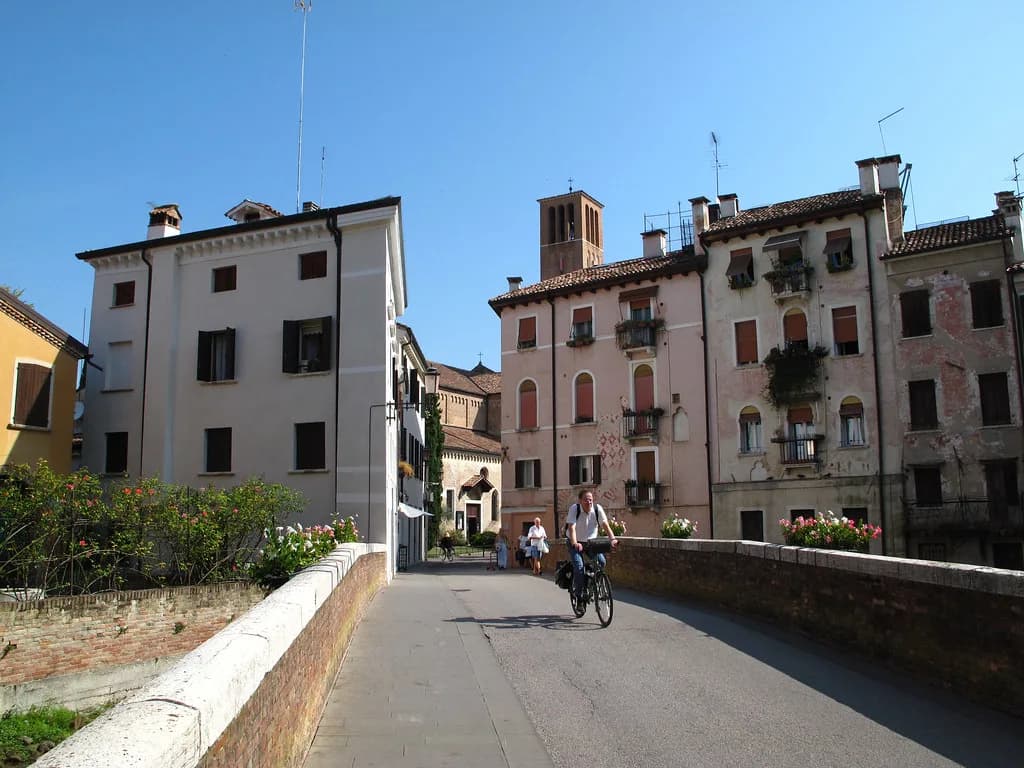
The cathedral stands in Treviso's historic centre, close enough to the canals and piazzas that it naturally belongs to a short walk through the city. Its address is just off the main pedestrian grid, so you can reach it without committing to a dedicated excursion; it is part of the compact centro storico. That makes it a sensible anchor for a half-day route that begins with the cathedral and drifts outward toward the rivers.
A way to orient yourself is to treat the Duomo as the calm, indoor episode of a city walk, then let the streets around it provide the contrast. For a lighter counterpoint after the cathedral, the hidden gems in Treviso include a more intimate, atmospheric look at the city's lesser-known corners. Building the day that way prevents the visit from feeling like a checklist and gives you room to linger in the chapels.
A Building in Layers: From the 6th Century to 1759
The cathedral's site traces its origins to the early Christian era, around the 6th century, and was built on ground that had earlier held a temple, a theatre and possibly thermal baths. That Roman and early Christian substratum explains why the building feels like an overlay rather than a single design. It was significantly transformed in the 11th and 12th centuries under Bishop Rotario, and parts of that Romanesque phase survive in the crypt.
The building you see today owes much of its shape to an 18th-century reconstruction in the Neoclassical style, credited to the scholar and architect Giordano Riccati. Financial constraints delayed completion, and the interior was finished by Giannantonio Selva by 1790. The grand facade, with its pronaos and staircase, was added later in 1836 by Francesco Bomben and Gaspare Petrovich, which is why the front reads as a separate, more austere chapter from the space behind it.
Reading the 1836 Facade
The facade is a neoclassical front of six Ionic columns supporting a pediment, set above a broad staircase that invites you to climb and look back over the street. Flanking the staircase are two marble lions, remnants of the original Romanesque structure, which quietly tie the 19th-century composition back to the medieval church.
Look at the right side of the building for a Roman bas-relief depicting a bacchant embedded in the wall, a nod to the site's ancient past. Details like this reward a slow circuit of the exterior before you go in; they also prepare you for the crypt, where the oldest fabric is preserved. If you only glance at the facade, you miss the way the cathedral keeps its earlier lives visible in odd corners.
Inside the Three-Aisled Plan
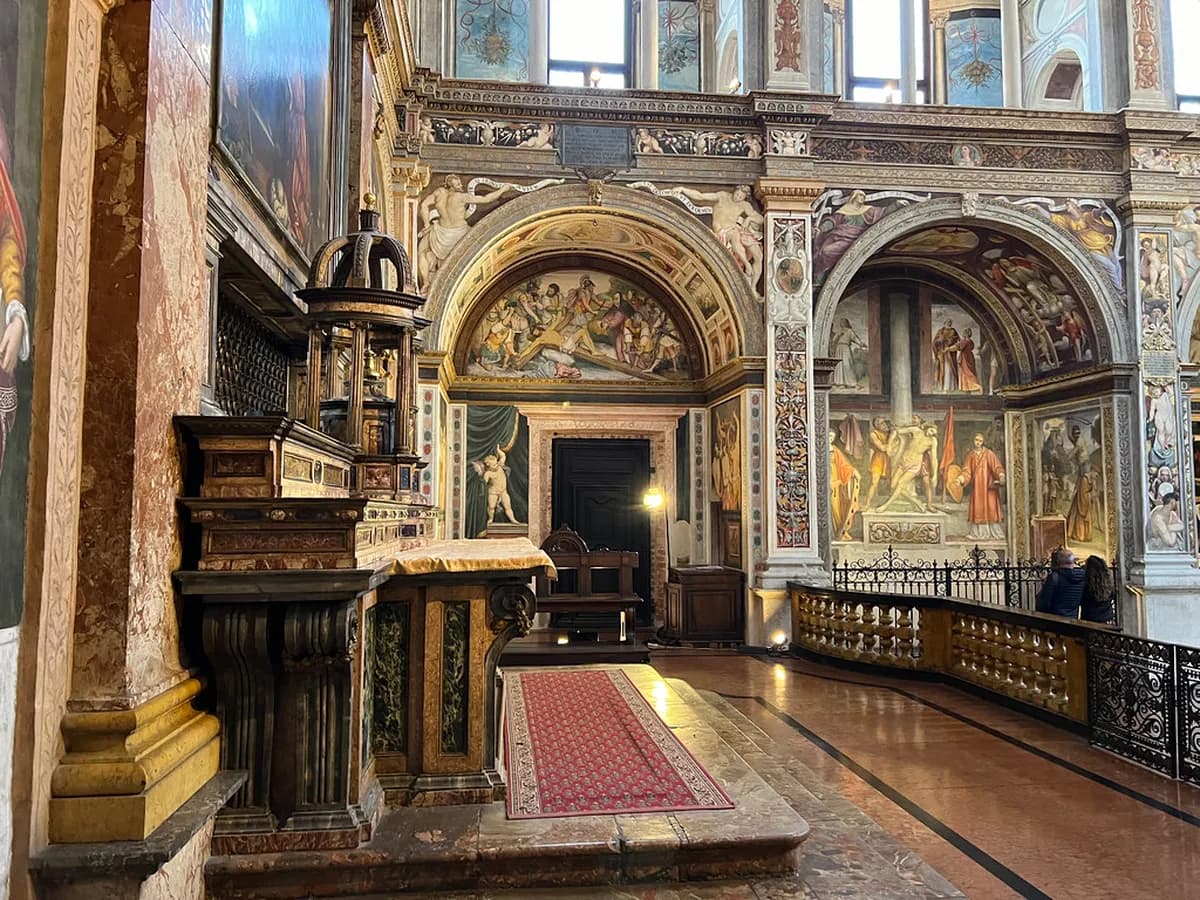
Inside, the cathedral opens into three wide naves with several chapels and three apses, and the ancient crypt lies beneath them. The church is crowned by seven domes, five over the central nave and two over the transept chapels, a feature that adds a soft, layered light to the interior. Because the plan is broad rather than deep, it is easy to drift down one aisle and miss the chapels on the other side, so a deliberate loop works better than a straight line.
The interior is a working place of worship as well as a monument, so the pace should respect anyone praying or attending a service. Move quietly through the aisles, keep voices low, and treat the chapels as places to stand still rather than pass through. That approach also lets the art register: the cathedral is dense with altars, tombs and paintings, and a rushed circuit flattens them into a blur.
The Malchiostro Chapel and Titian's Annunciation
The single most rewarding stop is the Chapel of the Annunciation, also known as the Malchiostro Chapel, a Renaissance commission by Broccardo Malchiostro. It was designed by Tullio and Antonio Lombardo and showcases frescoes by Pordenone alongside a remarkable painting by Titian. The chapel is the reason to slow down inside the cathedral, and it sits within the main body of the church rather than in a separate museum.
The Titian work is his Annunciation, and it is the piece most visitors come to see once they know it is here. Standing in the chapel, compare the painterly softness of the Titian with the more assertive frescoes around it; the contrast is part of what makes the chapel memorable. Give yourself time to look rather than photograph, and check on site whether photography is permitted in this area.
The Crypt: The Romanesque Survivor
The crypt is the oldest readable layer of the building and the part that most clearly survives from the Romanesque church. It is a sacred resting place for the city's bishops and saints, including the martyrs Theonistus, Tabra and Tabrata, as well as Saint Liberal, the patron saint of Treviso. That makes it both an architectural survivor and a devotional heart of the cathedral.
Whether the crypt is open during your visit is not something the available sources confirm, so ask at the cathedral or check with the diocese before building your route around it. If it is accessible, descend calmly and allow your eyes to adjust; the space is low and dim compared with the bright nave above. If it is closed, the rest of the cathedral still holds enough to justify the trip, but you should know before you go rather than be disappointed on the stairs.
Other Chapels and Altars Worth Planning For
The Chapel of the Madonna holds a recent wooden statue of Mary Help of Christians by Ferdinand Stuflesser, flanked by marble statues of Saint Liberal and Saint Anthony Abbot. It also contains a statue of Saint John by Alessandro Vittoria and a bas-relief of the Visitation by Lorenzo Bregno, which makes it a compact lesson in Venetian sculpture.
In the left nave, the Chapel of the Blessed Sacrament is a 16th-century addition that houses the tomb of Bishop Niccolò Franco, with a vestibule bearing the coat of arms of Bishop Bernardo de' Rossi. The main altar, consecrated in 1999, incorporates the ancient sarcophagus of Blessed Henry of Bolzano, and the presbytery holds the tomb of Bishop Giovanni Dacre and the baroque monument to Pope Alexander VIII Ottoboni by Giovanni Bonazza. These stops are easy to miss if you only look for the Titian, so add them to your loop.
Practical Planning: What to Confirm Before You Go
The available sources do not publish cathedral opening hours, admission arrangements, closure days, booking options or guided tour schedules. Rather than guess, check the Diocesi di Treviso site or ask locally before you travel, and treat any figure you find elsewhere with suspicion if it is not dated. Note that the curia office hours listed on the diocesan site refer to the diocese's offices, not to cathedral visiting hours.
The baptistery adjacent to the cathedral is often mentioned together with the Duomo, but the sources here do not describe its frescoes or confirm how it is accessed. Plan to ask on site whether it is open on the day of your visit, and keep it as an optional addition rather than the centrepiece. The same rule applies to the crypt: confirm, then decide.
Treviso has a busy events calendar, and the city's tourism pages list changing exhibitions, fairs and theatre seasons. It is worth checking what else is on during your dates so the cathedral visit fits the wider city, rather than competing with it. The Trevisoinfo site is a useful starting point for that kind of current listing.
Suggested Pacing: Cathedral Alone or Cathedral Plus City
As our own suggestion, not official guidance, allow around an hour for the cathedral itself if you want to see the Malchiostro Chapel, the main altar and the crypt without rushing. If the crypt is closed or you move quickly, forty-five minutes may be enough for a first pass; if you linger over the chapels, an hour and a half is reasonable. These are planning figures to help you decide, not a published schedule.
The trade-off is between depth and breadth. A cathedral-only visit suits a rainy morning or a tight itinerary, while pairing the Duomo with the centro storico gives you a fuller sense of Treviso. A half-day city itinerary that includes the Duomo alongside other central sights can work well, but check what is actually open on your dates rather than relying on a fixed route.
Pairing the Duomo With the Rest of Treviso
A compact walking sequence is to start at the cathedral, then drift toward the canals and smaller streets where the city's quieter corners sit. The Canale dei Buranelli is a natural way to break up the walk and gives you a view of Treviso that feels far from the museum-like calm of the cathedral. Keep the cathedral as the first stop while your attention is fresh, then let the city unwind around you.
If you want to plan more than one church or museum, the broader Treviso Attractions hub gathers guides to the city's main sights in one place. That helps you avoid overloading a single day and lets you choose the pairings that match your interests. The cathedral is a strong anchor, but it works best as part of a considered route rather than an isolated stop.
Visiting Respectfully and Noticing More
The Duomo di Treviso is a working cathedral, so the best visit is a quiet one: dress and behave as you would in any active church, and step aside when services are underway. Confirm the practical details, such as opening times and crypt access, before you go, because the sources here do not publish them. That small bit of checking is what turns a hurried look into a meaningful visit.
On a second pass, look for the details that the first visit skips: the marble lions at the foot of the stairs, the Roman relief on the exterior wall, and the way the Neoclassical interior frames the older crypt below. These are the layers that make the cathedral more than a single Titian, and they reward the time you give them. For related planning, see Santa Maria Maggiore Treviso: Visiting by the Church Circuit.
Frequently Asked Questions
Do you need tickets to visit the Duomo di Treviso?
The available sources do not confirm whether the cathedral charges admission or how entry is arranged, so this should be checked with the Diocesi di Treviso or locally before you go. Do not assume a ticket price or a free-entry policy from secondary sites.
Is Titian's Annunciation in Treviso Cathedral?
Yes. Titian's Annunciation is in the Malchiostro Chapel, also called the Chapel of the Annunciation, which was designed by Tullio and Antonio Lombardo and includes frescoes by Pordenone alongside the Titian painting.
What can you see in the crypt of Treviso Cathedral?
The crypt is the Romanesque survivor beneath the church and a sacred resting place for the city's bishops and saints, including the martyrs Theonistus, Tabra and Tabrata and Saint Liberal. Whether it is open during your visit is not confirmed by the available sources, so ask on site or check with the diocese.
How long does it take to visit the Duomo di Treviso?
Our own suggestion is around an hour for the cathedral alone, including the Malchiostro Chapel, the main altar and the crypt if it is open. This is a planning figure rather than official guidance, so adjust it to your pace and to what is accessible on the day.
Who rebuilt Treviso Cathedral in the Neoclassical style?
The 18th-century reconstruction is credited to the scholar and architect Giordano Riccati, with the interior finished by Giannantonio Selva by 1790. The 1836 facade was added later by Francesco Bomben and Gaspare Petrovich.
Can you see the baptistery frescoes on the same visit?
The available sources do not describe the baptistery's frescoes or confirm how it is accessed, so check on site or with the diocese before planning around it. Treat the baptistery as an optional addition rather than a confirmed part of the cathedral visit.
Sources
Continue exploring
More guides you'll find useful