Santa Maria Maggiore Treviso: Visiting by the Church Circuit
Plan a slow church walk through Treviso, using Santa Maria Maggiore as a central starting point and checking verified details on chapels and frescoes nearby.
On this page
Published sources used here do not set out Santa Maria Maggiore's chapels, frescoes, opening hours or entry rules in detail, so treat it as a starting point rather than a fully mapped interior. What the sources do document is how concentrated Treviso's church art is: a city guide notes that the small Chiesa di Santa Lucia, across the cobbled square from San Vito, has a vaulted ceiling and walls covered in fourteenth- and fifteenth-century frescoes by Tommaso da Modena's circle.
That density is the practical reason to organise a Treviso day around churches. Small interiors sit close to one another inside the historic centre, and one major civic collection gathers the region's medieval and Renaissance art under a single roof. Build the day around two or three interiors rather than racing between facades, and check each one's access separately. For wider planning, see Treviso Attractions: Visitor Guides to 11 Sights. For wider planning, see Duomo di Treviso Visitor Guide.
Where Santa Maria Maggiore Sits in the City
Mapping data records a chiesa di Santa Maria near the post office, the Sile river park and the Sant'Angelo suburb, with Treviso Cathedral and the main railway station both roughly a kilometre and a half away by the map. That places it inside the compact centre, where a walking loop makes more sense than single-purpose trips.
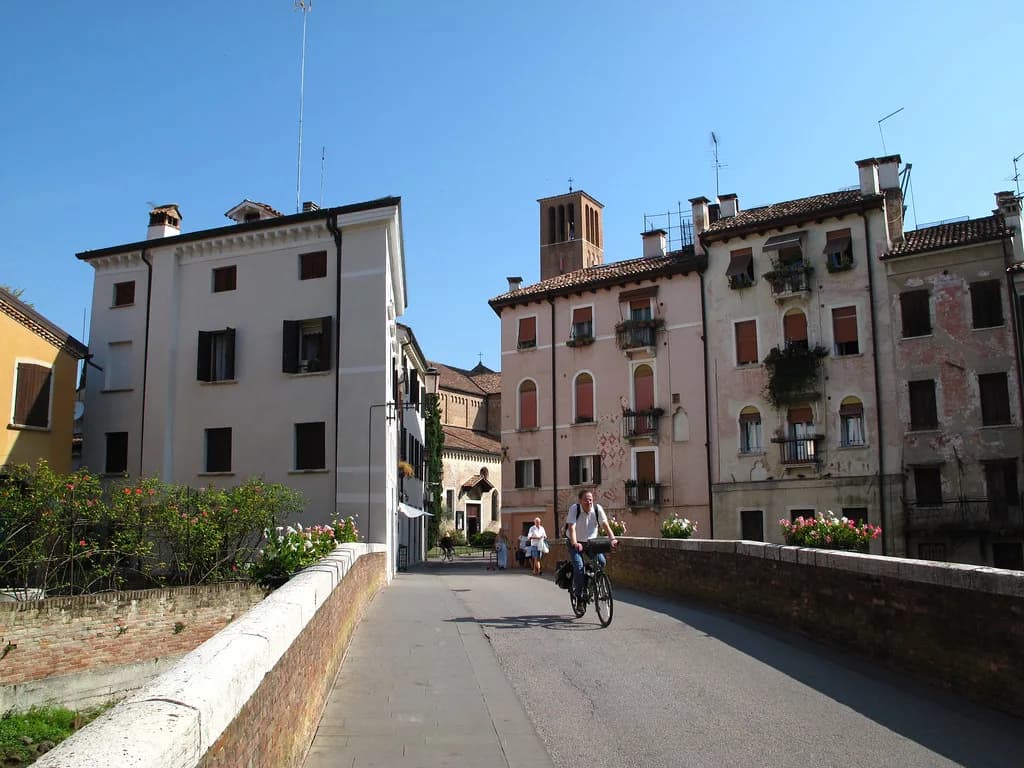
Treviso's wider shape helps you plan: a walled centre, the Sile running through it, medieval gateways, arcaded streets and shallow canals. A qualified city guide describes the historic centre as largely pedestrianised and quiet compared with Venice, with the Canale dei Buranelli and its wrought-iron bridges as the most photographed waterway. For wider planning, see Hidden Gems in Treviso.
What to Verify Before Relying on this Church
This research does not establish Santa Maria Maggiore's opening times, closing days, admission arrangements or which parts of the interior are visitable. The honest approach is to check with the parish or the Diocesi di Treviso in the days before travelling, and to treat older blog descriptions as provisional rather than current.
Keep a fallback ready. The Duomo and San Nicolò are both substantial interiors within walking distance, and the Santa Caterina museum is a separate, ticketed institution. If one door is closed, you lose minutes rather than the whole day. For wider planning, see San Nicolò in Treviso.
The Frescoed Churches Around the Centre
The San Vito and Santa Lucia group is the most concentrated fresco stop. A visitor-sourced description calls San Vito a fifteenth-century Gothic church linked to the medieval church of Santa Lucia, with origins traced back centuries, restoration in 2013 opening the site to the public, and interior works including an altarpiece by Marco Vecellio. The same source advises checking opening hours because they may vary or be inconsistent, which is a reason to confirm before a special trip.
San Leonardo, better known as Santa Rita, is a single-nave church in its own small square. Visitor-sourced notes describe a sixteenth-century triptych associated with Cima da Conegliano's workshop, paintings by Ludovico Pozzoserrato, an eighteenth-century ceiling fresco, a plaque with cannonballs embedded from 1848 bombings, and an eighteenth-century organ by Gaetano Callido. Some reviews mention volunteers offering informal tours, but staffing cannot be planned around. Further visitor details appear in Chiesa di San Leonardo (Santa Rita), Treviso, Italy - Reviews, Ratings, Tips and Why You Should Go – Wanderlog.
For scale, San Nicolò is the largest church in the city and a fourteenth-century Gothic building whose interior and frescoes reflect medieval Treviso's prosperity, according to a city guide. Seeing one large interior first recalibrates your eye for the smaller, more layered spaces. For wider planning, see San Nicolò in Treviso.
The Duomo and Titian: Setting Expectations
Treviso's cathedral stands on the foundations of an early Christian temple and holds Titian's Malchiostro Annunciation, as described by a city guide. It is among the most rewarding interiors in the centre, a short walk from Piazza dei Signori along Via Calmaggiore, the main shopping street linking the two squares. For wider planning, see Duomo di Treviso Visitor Guide.
Because the Duomo gives you one large, well-documented set piece, the smaller churches then read as intimate spaces where a single panel or a few faded frescoes carry the visit. If time is short, choose one large interior and two small ones.
Santa Caterina and the Tommaso da Modena Thread
The Santa Caterina complex now houses Treviso's civic museums in a restored fourteenth-century convent, with collections spanning local archaeology and medieval, Renaissance and modern art. One visitor account describes the Ursula fresco cycle by Tommaso da Modena, works by Cima da Conegliano, Lorenzo Lotto and Titian, and a deconsecrated Gothic church used for exhibitions.
Treat the museum as its own ticketed entity, separate from the parish churches. A visitor blog mentions a combined ticket for the Luigi Bailo and Santa Caterina museums at thirteen euro as of August 2022, which is an old figure and should never be assumed current; confirm prices and booking rules with the museum before relying on them. The museum's own listing gives Piazzetta Botter Mario, 1 as its address. Further visitor details appear in Treviso, Italy: A Visitor's Guide For Mindful Travelers - Caffeinated Excursions.
The Tommaso da Modena thread gives the walk coherence. A city guide notes that his frescoes also appear in San Francesco and San Nicolò, and that the Santa Lucia cycle reflects his circle. Following one artist is more rewarding than collecting facades. For wider planning, see Museo di Santa Caterina.
Why Side Chapels Reward Slow Looking
In Treviso's smaller churches the architecture is often modest and altered, while the art clusters at side altars. San Leonardo is the clearest case: works arrived from suppressed churches and were reassembled here, so the nave reads as a small gallery of displaced pieces rather than one unified scheme.
Look for working-parish details rather than monument labels: a venerated side altar, Gothic inscriptions, an old organ, a memorial plaque. Santa Lucia is noted for fourteenth-century Gothic inscriptions on display, a small thing that rewards a few minutes of close reading.
Free Churches, Paid Interiors and Suggested Timings
Plan the day around two categories. Parish churches are places of worship first, and access depends on Mass times and parish decisions; civic museums are ticketed institutions. Alternating a paid, published-hours visit with a free one means a locked church never derails the afternoon. Do not assume a single ticket covers several sites.
Suggested visit lengths here are editorial planning suggestions, not official figures. A parish interior usually occupies fifteen to thirty minutes; a museum collection deserves an hour or more. A visitor account suggests arriving early in the day at small churches, when interiors are quieter and volunteer guides are more likely to be present.
Itineraries can stay distinct by duration. A half day suits Santa Maria Maggiore plus one large interior such as the Duomo; a full day adds San Vito and Santa Lucia, a canal stretch along the Buranelli and a wall walk. For wider planning, see Treviso one day itinerary: a practical plan.
Piazza dei Signori and the Civic Backdrop
Piazza dei Signori is Treviso's civic heart, framed by the Palazzo del Podestà with its thirteenth-century civic tower, the Gothic Palazzo dei Trecento, still used by the municipal council, and the Palazzo Pretorio. Outdoor route descriptions describe the square as flat, paved and free to enter, which makes it an easy reset between church visits.
Allow a few minutes for the smaller landmarks near the centre. The Fontana delle Tette, a sixteenth-century fountain, and the Loggia dei Cavalieri, a thirteenth-century meeting place for nobles, are quick stops that add texture without demanding a detour.
Canals, the Fish Market Island and the Walls
Treviso's canals are shallow and green, threading between buildings rather than dividing the city into islands. The Canale dei Buranelli, named for fishermen from Burano who once traded here, is the most photographed stretch, with iron bridges and an old mill wheel; it sits beside Piazza San Vito.
The Isola della Pescheria, a small island in the Cagnan, has long been the city's fish market. One guide describes trading every morning except Monday plus a Saturday street market, but attribute this rather than trusting it as an official timetable; confirm locally before making a special trip.
The sixteenth-century walls circle the historic centre and carry a walking route. A mapped walk through the old centre, or a walk along the Sile, works well as a late-afternoon alternative to more church interiors.
Food and Drink Context
The province of Treviso is one of the prestigious DOCG Prosecco production areas, with the hills between Conegliano and Valdobbiadene within about thirty kilometres of the city, according to a city guide. Radicchio rosso di Treviso is the other local speciality, appearing on market stalls from November into spring.
Tiramisu's origins are uncertain, but one popular theory traces it to 1969 at Le Beccherie in Treviso. Present that to yourself as a local claim rather than proven history, and order a slice regardless. For wider planning, see Treviso local food guide: what to eat and where.
Day-Trip Logic from Venice
Treviso sits roughly twenty-six kilometres from Venice and is easy to reach by train on the Venice–Udine line, with the station a short walk from the centre, according to city and mapping sources. One traveller's account describes using Treviso as a quieter base while visiting Venice for a single day, and notes the lagoon can be noticeably hotter and busier in summer.
That choice keeps your church-looking unfrantic. Treviso's own canal-side streets reward an unhurried afternoon, which is the opposite of a rushed lagoon day trip.
Where to Go Next in the Church Cluster
After Santa Maria Maggiore, the natural next steps are the Duomo for Titian, San Nicolò for Gothic scale and the Santa Caterina museum for the Ursula cycle. Each has its own access rules, so check them separately rather than assuming one ticket covers the city's churches.
If you want to step away from the church circuit, Treviso's quieter corners include canal-side lanes, the wall walk, and the small fountain and loggia landmarks. These are not secret, just frequently skipped in favour of the main square.
Plan Your Visit
Santa Maria Maggiore works best as a central starting point rather than a destination in itself. Combine it with one large interior such as the Duomo or San Nicolò, one or two small frescoed churches, and a walk along the Sile or the Buranelli canal. Balanced that way, the day has range without becoming a checklist.
Before you travel, confirm the church's access with the parish or via the Diocesi di Treviso site, and check museum hours and entry rules separately. The rest, from prosecco to tiramisu, can be decided on arrival.
Frequently Asked Questions
Is Santa Maria Maggiore in Treviso the old cathedral?
Published sources used here do not confirm that Santa Maria Maggiore served as Treviso's old cathedral. The city's cathedral is the Duomo di San Pietro Apostolo, which stands in the centre and holds Titian's Malchiostro Annunciation. Ask the parish directly if you want the church's precise history.
What frescoes and chapels can you see in Treviso's historic churches?
Santa Lucia is noted for fourteenth- and fifteenth-century frescoes by Tommaso da Modena's circle, San Leonardo holds a triptych associated with Cima da Conegliano's workshop and an eighteenth-century ceiling fresco, and the Santa Caterina museum houses Tommaso da Modena's Ursula cycle. Details inside Santa Maria Maggiore itself should be checked locally.
How long should you spend visiting churches in Treviso's centre?
As a planning suggestion rather than an official figure, allow roughly half a day for the main church interiors plus the Santa Caterina museum. A parish church usually takes fifteen to thirty minutes; a museum collection deserves an hour or more.
Are Treviso's churches free to enter?
Many parish churches do not charge for entry, but the Santa Caterina museum is a separate ticketed institution. Entry rules vary by church, so confirm with the parish or the Diocesi di Treviso before assuming access.
Which Treviso churches should you prioritise on a short trip?
For a short visit, prioritise the Duomo for Titian, San Nicolò for scale, and one small frescoed church such as Santa Lucia or San Leonardo. Santa Maria Maggiore works as a central anchor nearby.
Do you need to book tickets for Treviso's civic museums?
Booking rules should be confirmed directly with the museum. Prices and combination offers mentioned in older trip reports should not be assumed current, so check the official site before relying on them.
How practical is Treviso as a day trip from Venice?
Treviso is reachable by train on the Venice–Udine line, with the station a short walk from the historic centre, so a day trip is practical. Check the current timetable, as schedules change.
Sources
- Chiesa di San Vito, Treviso, Italy - Reviews, Ratings, Tips and Why You Should Go – Wanderlog
- Treviso, Italy: A Visitor's Guide For Mindful Travelers - Caffeinated Excursions
- Platz der Signori – Wander- & Radrouten | Komoot
- Chiesa di San Leonardo (Santa Rita), Treviso, Italy - Reviews, Ratings, Tips and Why You Should Go – Wanderlog
- What to see in Treviso: what to see and where to go | The Art Post Blog
Continue exploring
More guides you'll find useful