Hidden Gems in Treviso: Quiet Canals, Walls and Lesser-Known Corners
Discover Treviso's quieter corners, from the Canale dei Buranelli to the city walls and small museums, with practical advice for unhurried wandering.
On this page
Treviso sits a short distance from Venice, yet it moves at a different pace. Its historic centre is largely pedestrianised, threaded with canals and ringed by 16th-century walls, and one travel writer notes that you will not meet overwhelming crowds or the high prices of its famous neighbour. That makes the city a good fit for travellers who would rather wander than queue, and it also sets the right expectation: the pleasures here are quiet streets and small sights, not headline monuments.
This guide uses hidden gem loosely and deliberately. It points to lesser-known corners and calmer alternatives, never to secret or locals-only spots, and it separates free outdoor wandering from paid museum interiors so you can plan a budget honestly. Where something changes often, such as museum admission or market schedules, check the organiser's own page rather than relying on any guide.
Why Treviso Rewards Slow Wandering
The city's scale is the point. A visitor who spent several days there describes Treviso as a place to try family-run restaurants, meander through side alleys and take it easy, rather than a checklist of cathedrals and piazzas. That rhythm suits a half day of strolling or a full day if you add a museum and a proper lunch.
Travellers often arrive expecting a miniature Venice and leave disappointed by the comparison. Treviso is inland and surrounded by countryside, its streets are shared with cars and bikes, and its old town is compact rather than labyrinthine. Accept those differences and the city stops being a substitute and becomes a destination in its own right.
Canale dei Buranelli and the Water Wheel
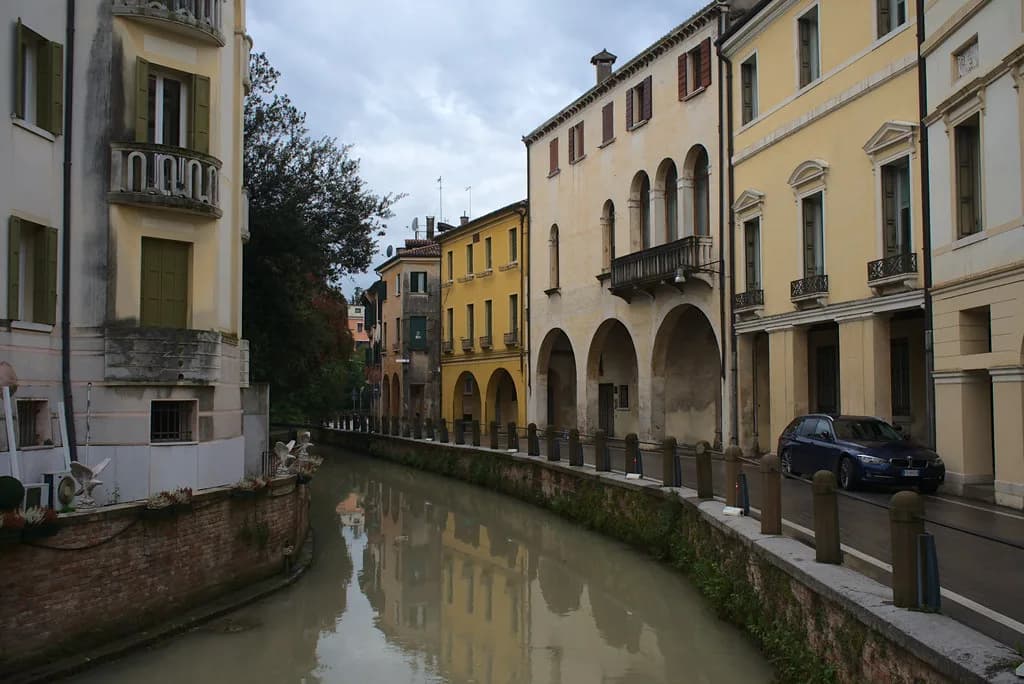
The Canale dei Buranelli is the most photographed stretch of water in the historic centre, lined with wrought-iron bridges, occasional red-brick Renaissance palaces and an old decorative water wheel. The name comes from fishermen of Burano who once came here to trade, and cafes and restaurants cluster along the banks for a light lunch or an evening drink. It is a short walk, so treat it as a pause rather than a sight in itself.
Do not expect to glide through on a boat. Treviso's canals are shallow, run perpendicular to the streets rather than carving the city into islands, and carry no gondola traffic; plant life gives many of them a green, glassy look. Understanding that before you arrive is the single best way to enjoy them on their own terms.
Arcaded Lanes Between the Two Piazzas
The natural walking spine of the centre is Via Calmaggiore, the main shopping street that links Piazza dei Signori with Piazza del Duomo, where the neoclassical cathedral holds an Annunciation by Titian. The surrounding lanes are narrow, cobbled and often arcaded, which makes them pleasant in light rain and provides shade in summer. Walk them without a route and you will find faded fresco fragments on facades above shop level.
A worthwhile detour is Piazza San Vito, which backs onto the Buranelli canal and holds the small Chiesa di Santa Lucia, its vaulted interior covered in 14th and 15th-century frescoes attributed to the circle of Tommaso da Modena. Churches in Italy frequently change their visiting arrangements, so check locally on the day rather than assuming the interior is open.
The Walls, Bastions and Gates
Treviso's historic centre was fortified in the 16th century under Venetian rule, and the walls and bastions now form a walkable or runnable loop around the old town. Three grand gateways punctuate the circuit, and Porta San Tomaso is the most impressive entrance into the centre. The walk is free and outside, which makes it the easiest way to add a green hour to your day.
A visitor's account notes that a moat survives in places and that entering or leaving the centre often means passing through a bridged gate such as Porta San Tomaso or Porta Santi Quaranta, both worth a look for their detailing. Wear shoes suited to uneven paving and treat the circuit as a loop rather than a fixed trail, since paths and access points can shift with maintenance.
Piazza dei Signori and the Fontana delle Tette
Piazza dei Signori is the city's main square, lined with cafes and palaces including the Romanesque Palazzo dei Trecento and the Palazzo del Podestà with its 13th-century civic tower. It is not a hidden corner, but it works best as a base: settle at a table, watch the square change through the day, then explore outward from it.
A few steps away, tucked into a shady alcove, the Fontana delle Tette is a small curiosity most day-trippers walk past. Its water is drinkable, according to one visitor, which makes it a handy refill stop on a warm walk between the square and the canal lanes. Treat it as a thirty-second pause, not a destination.
Along the Sile and Into the Green Belt
The Sile runs along the southern edge of the walled city and is calmer than the central canals. Beyond the centre it feeds the Parco Regionale del Fiume Sile and the Oasi Cervara, a protected area of towpaths, birdlife and ancient woodland covering roughly 3,000 hectares. Cyclists should note that Treviso is the home city of Pinarello, a manufacturer with a long racing pedigree, and bike shops in town cater to riders accordingly.
For a longer ride or walk, the Treviso-Ostiglia is a 50-kilometre public greenway following an old railway alignment, and it still connects the provinces of Treviso and Vicenza. Short detours reach Palladian villas such as Villa Cornaro and Villa Contarini. Choose your segment in advance and turn back when it suits you, since the full route is far more than a city stroll.
Museo di Santa Caterina or Museo Luigi Bailo: How to Choose
Treviso's two main civic museums suit different moods. The Museo di Santa Caterina occupies a former 14th-century church and convent and holds the fresco cycle of the life of St Ursula by Tommaso da Modena alongside paintings by Titian, Pietro Longhi and Tiepolo, plus 19th and 20th-century works. Pick it if you want older art in a building that is itself part of the visit.
The Museo Luigi Bailo, also known as the Galleria del Novecento, focuses on 19th and 20th-century Italian art in a bright contemporary interior. One visitor reported buying a combined ticket covering both museums for thirteen euro in August 2022, but that is an older report rather than a current price, so confirm the present ticket structure on the civic museums' own website before you go.
A third, more niche option is the Galleria delle Prigioni, installed in an old Habsburg prison near the Duomo and used for temporary contemporary exhibitions. Because programming rotates, check what is on before making a special trip, and do not assume one ticket covers the others. Museum hours and closing days vary and change, so verify them with the museum rather than a blog.
Calm Alternatives to Crowded Venice Museums
Venice's museums and its very streets can feel congested, and travellers sensitive to that often look for a quieter base nearby. Treviso offers exactly that: one visitor found the two main civic museums nearly empty and was able to view the collections at their own pace. If you want art without jostling, this is the argument for spending a night here rather than commuting.
That does not mean skipping Venice. If you want a broader menu of lesser-known stops on both sides of the comparison, our guide to hidden gems in Venice pairs well with a Treviso base, and the same slow-travel logic transfers to other Italian cities such as the hidden gems in Florence. Think of Treviso as the calm half of a two-city trip.
Eating and Drinking as Local Culture
Treviso's food scene rewards curiosity more than booking. Family-run osterie and trattorie serve local flavours at reasonable prices, from bigoli in sardine sauce to gnocchi with duck ragu, and a proseccheria on Piazza dei Signori pours the regional sparkling wine that gives the area its reputation. Reservations help at small dining rooms, and many close one day a week.
The tiramisu story is worth knowing but not repeating as fact. A popular claim traces the dessert to Le Beccherie in Treviso around 1969, yet the origins are genuinely disputed, and the restaurant remains one place to try a version of it. Treat it as a local legend with a good table attached rather than a certified birthplace.
Markets add another layer when they are running: a seafood and produce market on the Isola della Pescheria, an organic farmers' market on Piazza Giustinian and a Saturday street market have all been described. Schedules change with season and administration, so check the city's own notices before planning a morning around one.
Suggested Pacing: Half Day or Full Day
For a half day, start at Porta San Tomaso, follow the walls for a stretch, drop into Piazza dei Signori for coffee, then wander the Buranelli canal and Via Calmaggiore to Piazza del Duomo. That route is entirely outdoors and free, and it works in either direction. Add the Fontana delle Tette and Santa Lucia as quick stops rather than separate outings.
For a full day, keep the morning walk and give the afternoon to one museum, choosing Santa Caterina for older art and Bailo for the 20th century. Finish along the Sile or with a proper meal in an osteria. If you have a third day, use it for the greenway or the regional park rather than adding more squares, since those are what make Treviso feel different from other Veneto cities.
What to Skip, and How to Visit Mindfully
Skip the mini-Venice framing and any itinerary built around ticking off canals. Treviso's appeal is spread out and low-key, and travellers who race between sights tend to find it thin. Slow down, sit in a square, and let the city set the pace; that is the honest version of a hidden-gems visit here.
Mindful travel also means spreading pressure. Overtourism in Venice is well documented, and staying in Treviso rather than day-tripping in and out supports a smaller city that absorbs visitors comfortably. Check the wider Treviso Attractions hub before finalising plans, since opening arrangements for individual sights change more often than the city's geography does.
Plan Your Visit
Treviso works best as a place to slow down: a canal lane with a water wheel, a ring of 16th-century walls, a main square with a small fountain nearby, and two civic museums that rarely feel busy. None of it is secret, and that is precisely why it is worth your time.
Before you travel, confirm the details that change: museum hours and ticket options, market days, and any event programming at the Galleria delle Prigioni. Use official city and museum pages for those, and let this guide handle the decisions that do not change, such as where to walk and how long to allow. For related planning, see Treviso Neighbourhoods Guide: Where to Stay by Area.
Frequently Asked Questions
Is Treviso worth visiting?
Yes, if you value unhurried wandering over headline sights. Its compact historic centre is largely pedestrianised, its canals are lined with cafes and old palaces, and its civic museums are calm enough to browse at your own pace. Travellers expecting a smaller Venice may be disappointed, but those looking for a quieter Veneto base usually are not.
Are Treviso's canals like Venice's?
No. Treviso's canals are shallow, often green with plant life, run perpendicular to the streets and carry no gondolas or boat traffic. Venice's waterways are wide, deep and navigable, carving the city into islands. Treviso is inland and surrounded by countryside, so treat its canals as a pleasant walk rather than a transport network.
What are the quietest places to see in Treviso?
The city walls and bastions form a free outdoor loop with gateways such as Porta San Tomaso, and the Canale dei Buranelli and its side lanes are calmer than the main squares. The two civic museums, Museo di Santa Caterina and Museo Luigi Bailo, have been described as sparsely visited. None of these are secret; they are simply less crowded.
How long do you need in Treviso?
A half day covers the walls, Piazza dei Signori, the Buranelli canal and the walk to the Duomo. A full day adds one museum and a proper meal, and a second or third day suits the Sile riverfront, the regional park or a stretch of the Treviso-Ostiglia greenway. Treat these as suggestions and adjust to your own pace.
Can you visit Treviso as a day trip from Venice?
Yes, and one traveller suggests the reverse is also worthwhile: base in Treviso and visit Venice for a shorter stretch to limit your footprint in the busier city. Check current rail options and timetables with the operator before you go, since schedules change by season and are not something to plan from memory.
Where should you eat in Treviso?
Small osterie and trattorie are the heart of it, serving pasta such as bigoli and local specialities at reasonable prices, with a proseccheria on Piazza dei Signori for the regional sparkling wine. Le Beccherie is associated with a disputed tiramisu origin story. Reserve at small dining rooms and check current opening days directly, as restaurants change their schedules often.
What is the best quiet corner in Treviso?
The stretch along the Canale dei Buranelli, with its wrought-iron bridges and old water wheel, is the most rewarding small corner, especially early in the day. Pair it with Piazza San Vito and the small Chiesa di Santa Lucia nearby. Check locally whether the church interior is open, since visiting arrangements vary.
Sources
Continue exploring
More guides you'll find useful